
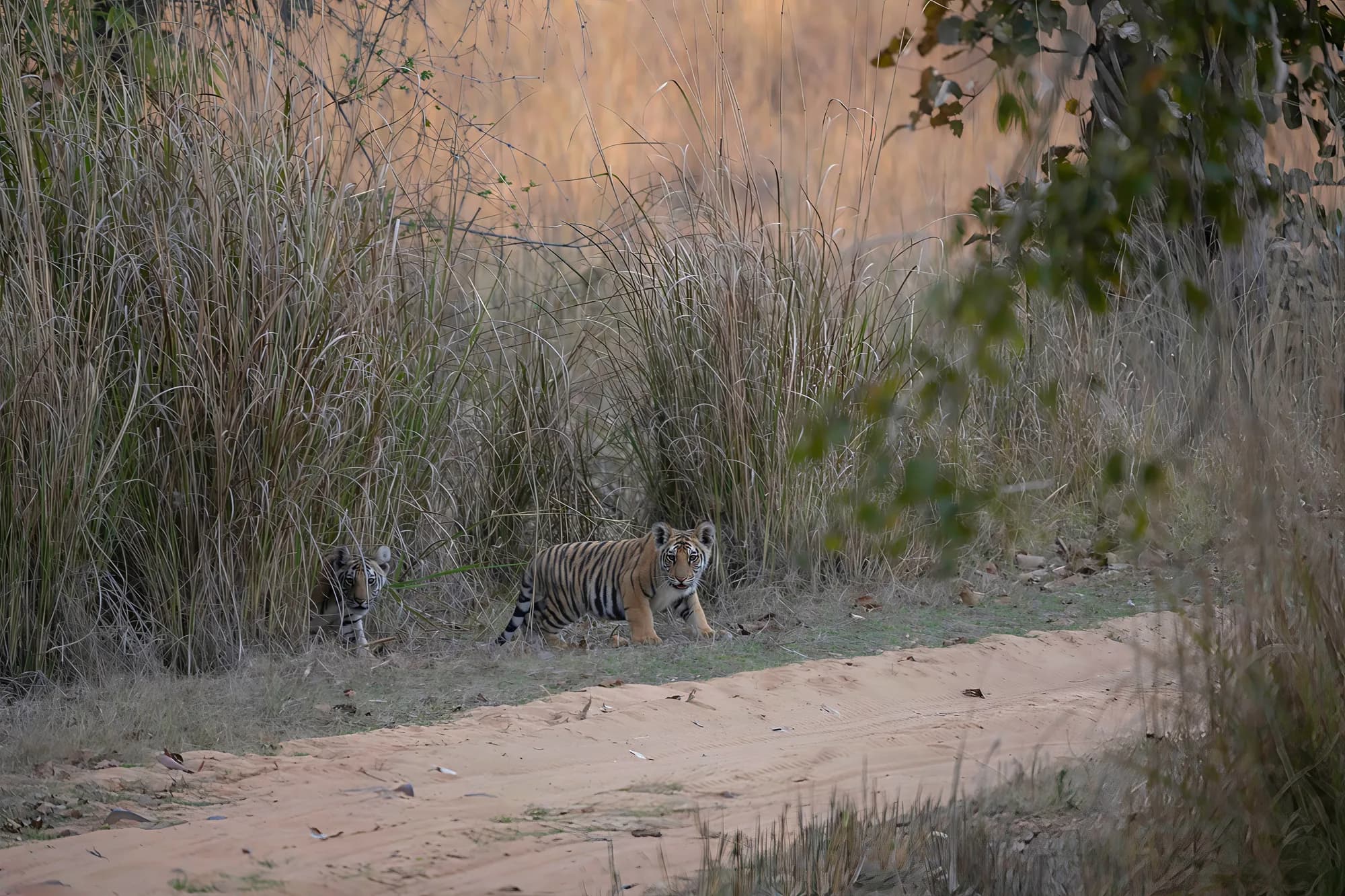
Landscape
Eleven tigers used the Pench underpasses 89 times
A highway was widened through a tiger corridor on condition that animals could still cross it. Camera traps spent ten months finding out whether they do.
A reserve is not a closed system. Tigers disperse, and where they can disperse to decides whether a population is genuinely viable or merely large this decade. The Kanha–Pench corridor is the best-studied piece of that question in India, because a national highway was driven through it and somebody was made to check.
Why corridors decide outcomes
Central India holds the country's largest tiger population — Madhya Pradesh alone accounted for 785 of the 3,682 counted in 2022. Those animals are not in one forest. They are in Kanha, Pench, Satpura, Bandhavgarh, Navegaon-Nagzira and the fragments between, and the corridors are what make them one population rather than several small ones.
A reserve that cannot exchange animals with its neighbours accumulates the problems of isolation regardless of how well the core is protected. That is why the 2022 report flagged roughly 35% of India's reserves as needing intervention despite a rising national total.
What was actually measured
National Highway 44 — formerly NH7 — cuts the Kanha–Pench and Pench–Navegaon-Nagzira corridors. Permission to upgrade it was granted on condition that animal crossing structures were built at identified crossing zones. Nine were constructed in the Maharashtra section, through Pench Tiger Reserve.
Between March and December 2019 the Wildlife Institute of India, funded by the NTCA, put camera traps under all nine and counted what used them.
What crossed, and how often
- Structures monitored
- 9
- Wild species recorded
- 18
- Tiger crossings
- 89
- Individual tigers
- 11
Eighteen species of wild animal used the structures. Indian hare and jungle cat were the most frequent. Among the large carnivores — tiger, leopard, wild dog, sloth bear and jackal, all of them regular visitors — wild dogs used them most, then tigers.
The tiger figure is the one worth holding on to: 89 crossings by 11 individual animals, recorded at six of the nine structures. Not a token appearance. A repeated, identifiable pattern of use by named individuals, at two-thirds of the structures built for them.
Three of the nine recorded no tiger at all — which is as useful a finding as the 89.
One highway is not the whole problem
Connectivity work across this landscape has mapped 567 barriers within 30 linkages. Of those, 265 intersect infrastructure — roughly 694 km of roads, 150 km of railway, 48 reservoirs and 10 mines. The remaining 302 are land-use change and gaps in forest cover.
So nine underpasses address a fraction of one barrier type on one road. India has identified something in the order of 50,000 km of road development. The Pench structures matter because they demonstrate the method works, not because they solve the landscape.
How to read this as a visitor
- Reserve boundaries are administrative, not biological. The tiger you photograph in Pench may have been born in Kanha.
- Mitigation is testable, and was tested. When someone claims a road through a forest is fine because underpasses were built, the honest follow-up is whether anyone put cameras under them.
- Corridor land is mostly not protected land. It is farmland, village forest and revenue land, and its future is decided by land-use policy rather than by park management.
Questions people ask
Do tigers actually use highway underpasses?
What is the Kanha–Pench corridor?
Why do tiger corridors matter?
How many barriers are there in the Kanha–Pench landscape?
Checked against
- Monitoring of animal underpasses on National Highway 44 (earlier 7) passing through Pench Tiger Reserve, Maharashtra — TR No. 2020/09 — Habib, B., Saxena, A., Jhala, Y. V. & Rajvanshi, A. — Wildlife Institute of India / NTCA, 2020
- All India Tiger Estimation 2022 — release of the detailed report — Press Information Bureau, Ministry of Environment, Forest and Climate Change, 2023
Read next
Madhya Pradesh
Kanha
Sal forest and wide meadows, larger and calmer than Bandhavgarh. Repays four or five drives far more than two.
Madhya Pradesh
Pench
Teak and open water, smaller and calmer than its neighbours, and the easiest of the Madhya Pradesh parks to combine with another.
58 reserves, six worth the trip
Tiger
Where the odds actually are, how they move by month and by zone, and the three things that change them.