
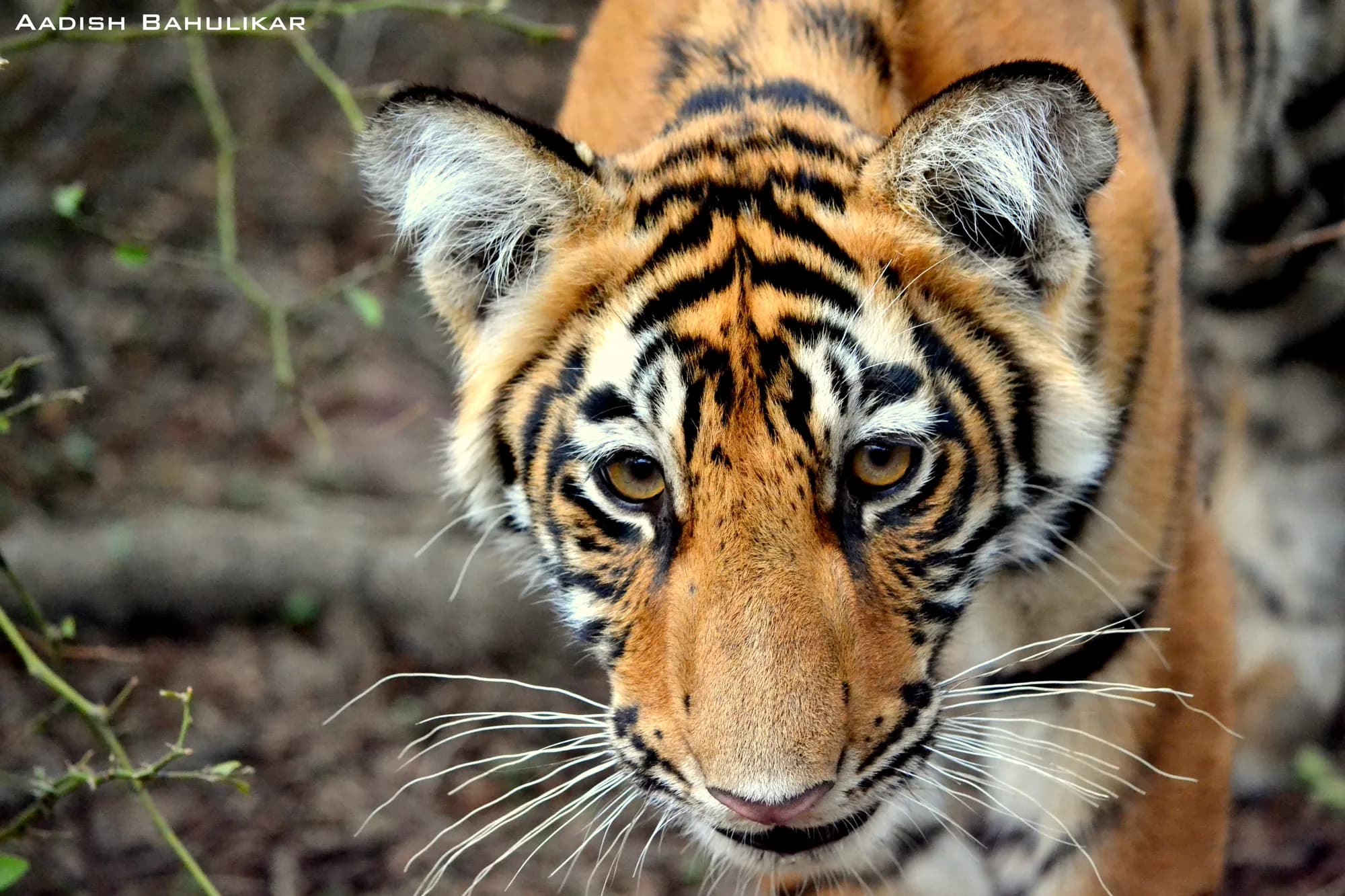
Species · Panthera tigris tigris
Tiger
The animal most people come for, and the one most often missed. Where the odds actually are, and how they move by month and by zone.
Also called
- Bagh (बाघ) · Hindi
- Sher (शेर) · Hindi, colloquial
- Wagh · Marathi
- Bagh · Bengali
- Puli · Tamil
Checked 14 Aug 2026
- Where
- Central & northern India
- Best months
- March–June
- Reserves
- 58 declared
- Population
- 3,682Range 3,167–3,925All India Tiger Estimation, NTCA & Wildlife Institute of India, 2022 cycle, published 2023
Six states hold the reserves worth planning a trip around.
Where it is
Where to actually go
Ranked, with the reason each — these are not interchangeable.
- 01BandhavgarhMadhya PradeshHigh density in a compact area, so less ground between you and an animal. The reserve most often recommended for a first visit.Book Tala the minute the window opens, or take Magadhi
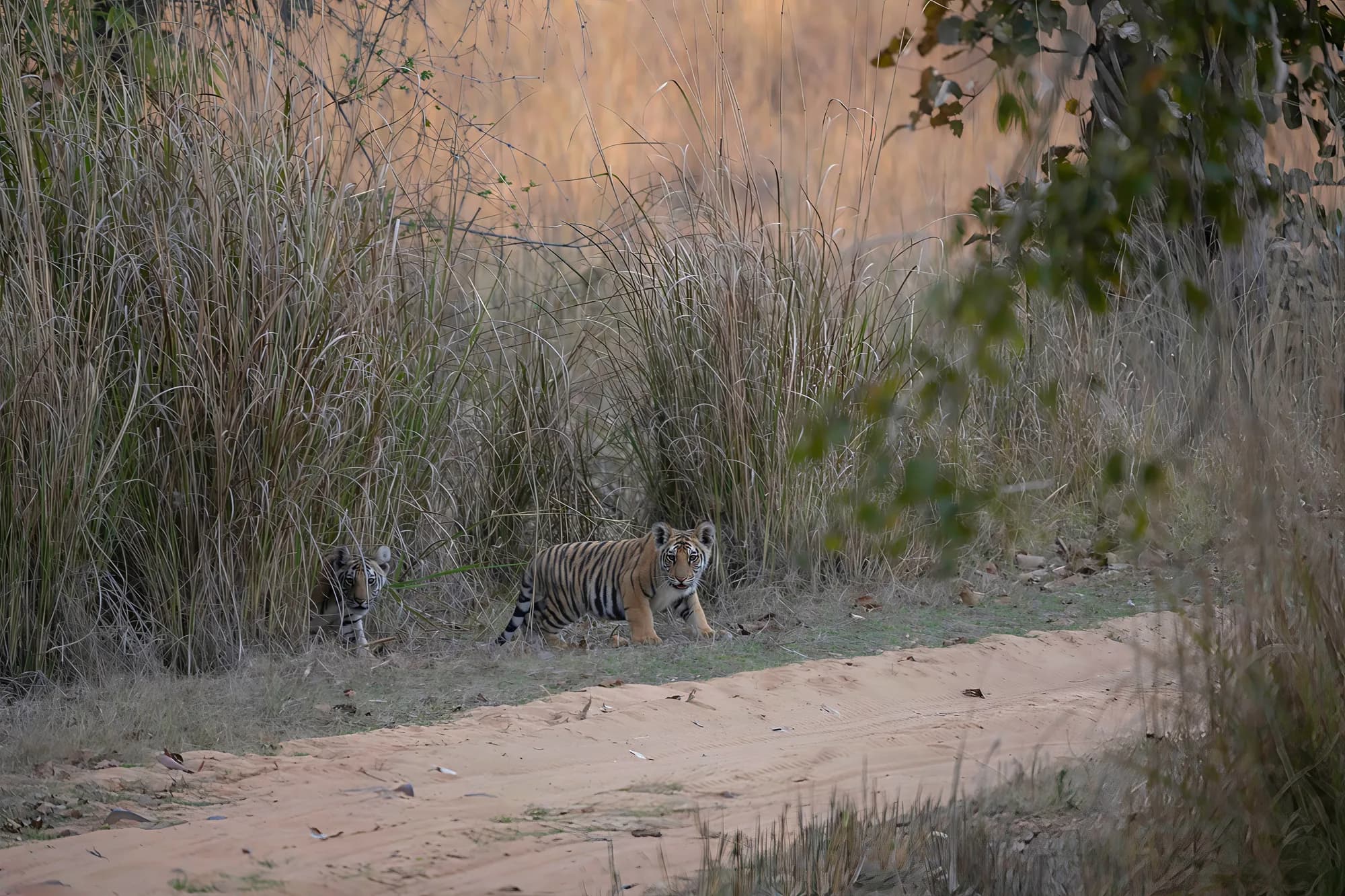
- 02TadobaMaharashtraOpen teak and bamboo, and animals habituated enough to keep walking rather than melt away. Daylight sightings here are earned, not marketed.Quieter than the Madhya Pradesh parks for the same odds
- 03KanhaMadhya PradeshSal forest and wide meadows, larger and calmer. Rewards four or five drives far more than it rewards two.The better forest, if you have the days
- 04RanthamboreRajasthanDry forest around a fort, and the easiest reserve to reach from Delhi — which is exactly why it carries the heaviest vehicle pressure in India.Three nights or none — a single night here is poor value
Where you will not see one
- GirThe one reserve in India with lions and no tigers. It is the most common single mix-up we are asked about, and no amount of time at Gir will fix it.
- The SundarbansThere are tigers here, at real density, and you will almost certainly not see one. The forest is mangrove, the viewing is from a boat on a channel, and the animals are famously wary. Go for the Sundarbans; do not go for a tiger.
- Anywhere above about 2,500 mTigers have been camera-trapped surprisingly high, but no Himalayan reserve is a tiger trip. If you are in Ladakh or Spiti you are in snow leopard country, which is a different animal and a different kind of holiday.
When to go
When to go
- J
- F
- M
- A
- M
- J
- J
- A
- S
- O
- N
- D
January: good. February: good. March: best. April: best. May: best. June: marginal. July: closed or unproductive. August: closed or unproductive. September: closed or unproductive. October: marginal. November: good. December: good.
Through the day
- Dawn
- Morning
- Midday
- Afternoon
- Dusk
- Night
Dawn: most active. Morning: active. Midday: usually resting. Afternoon: active. Dusk: most active. Night: not normally seen.
Realistic odds on a three-day trip
- Near-certain
- Likely
- Lucky
- Expedition
Telling it apart
Told apart from
Every central Indian reserve, usually at distance or in poor light
Size settles it before pattern does — a tiger is roughly twice the bulk and stands much taller at the shoulder. If you are close enough to argue about markings, look at them anyway: a tiger is striped and a leopard is rosetted, and no lighting makes those the same.
Only in the planning, never in the field
Not actually a field problem, because their ranges do not touch anywhere on earth. If you are looking at a big cat in Gir it is a lion; if you are looking at one anywhere else in India it is not.
Marks chosen to be usable from a moving vehicle — a tiger is rarely still and never close enough for anything subtler.
What it looks like in the field
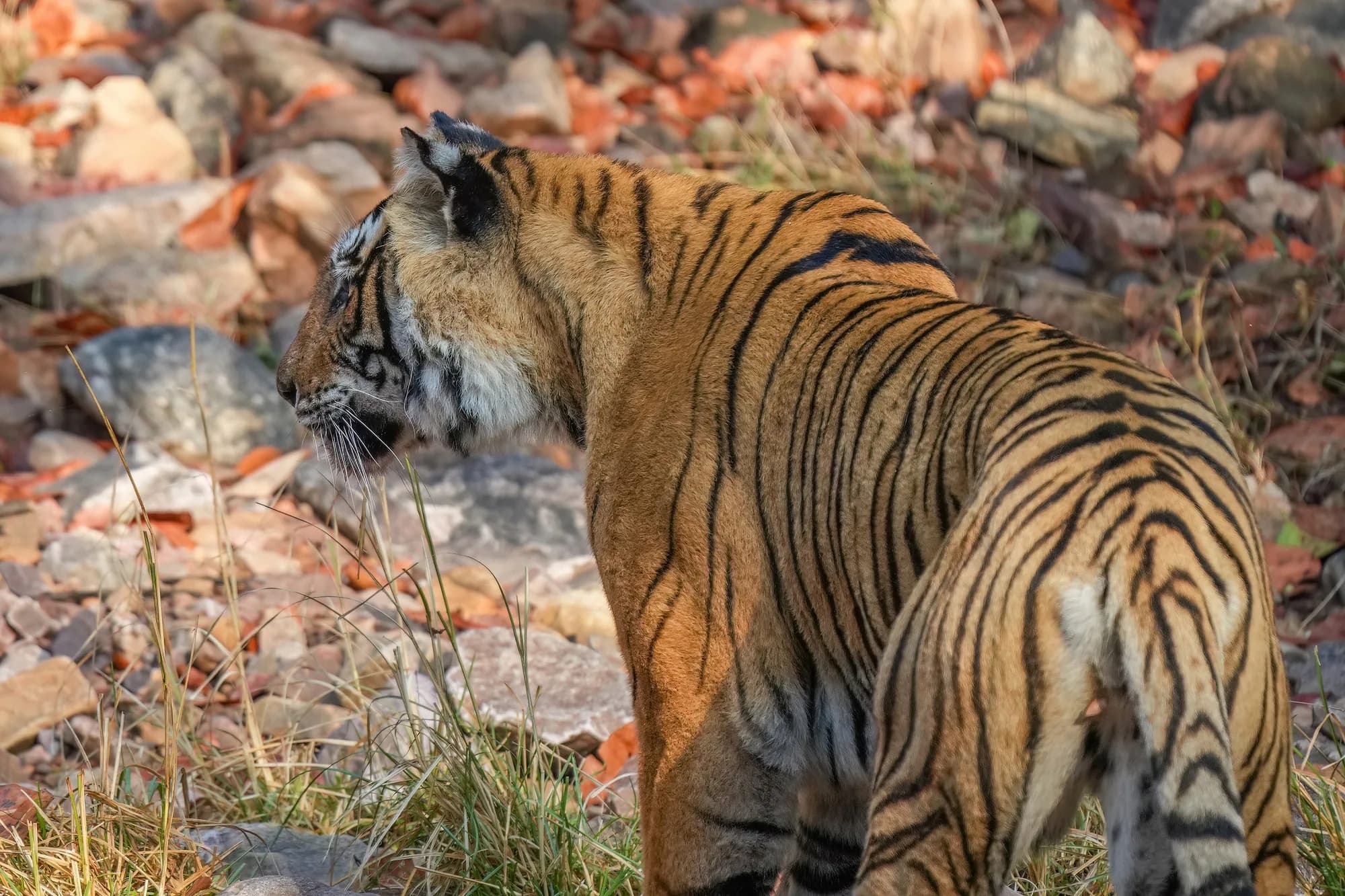
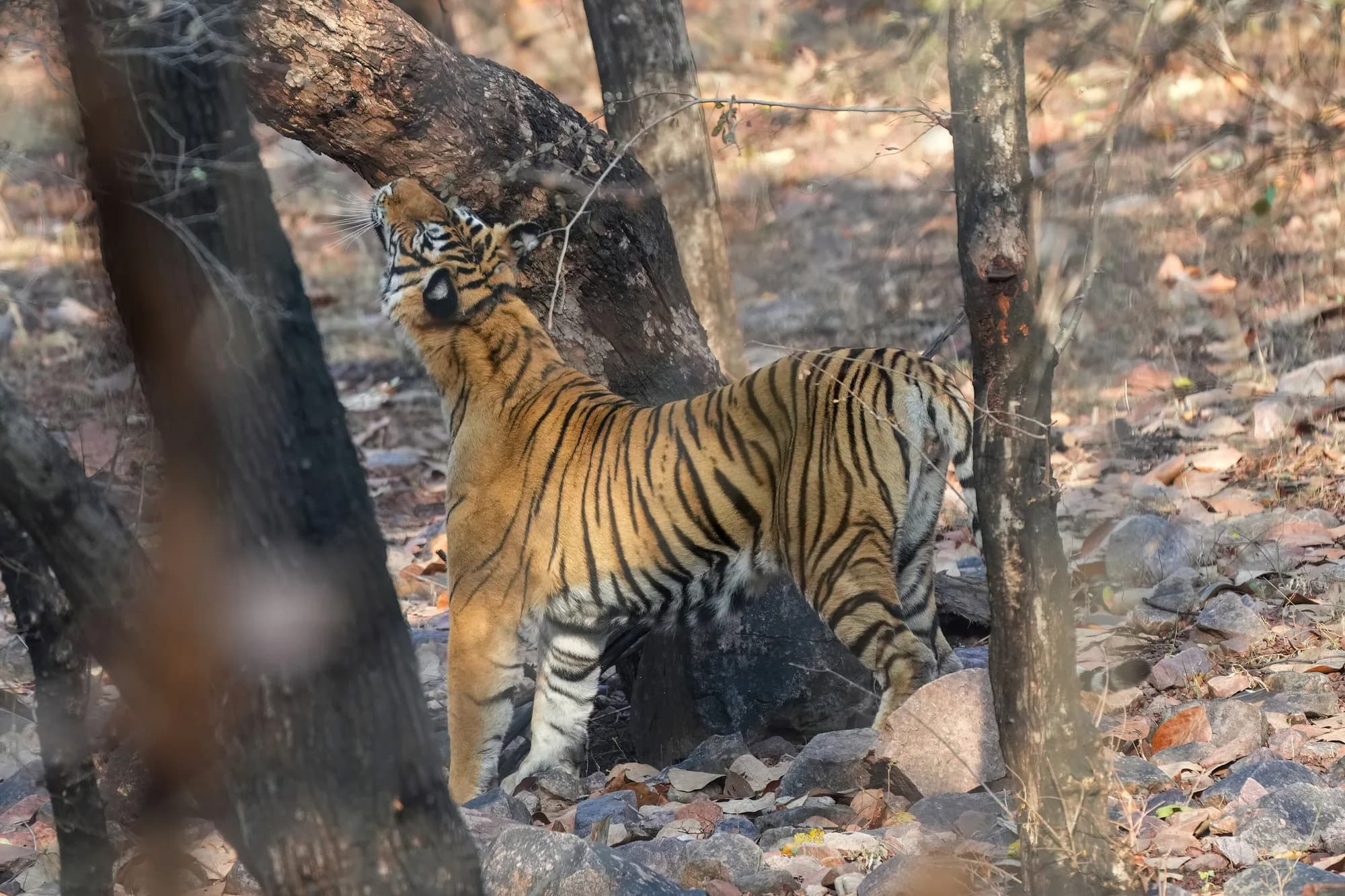
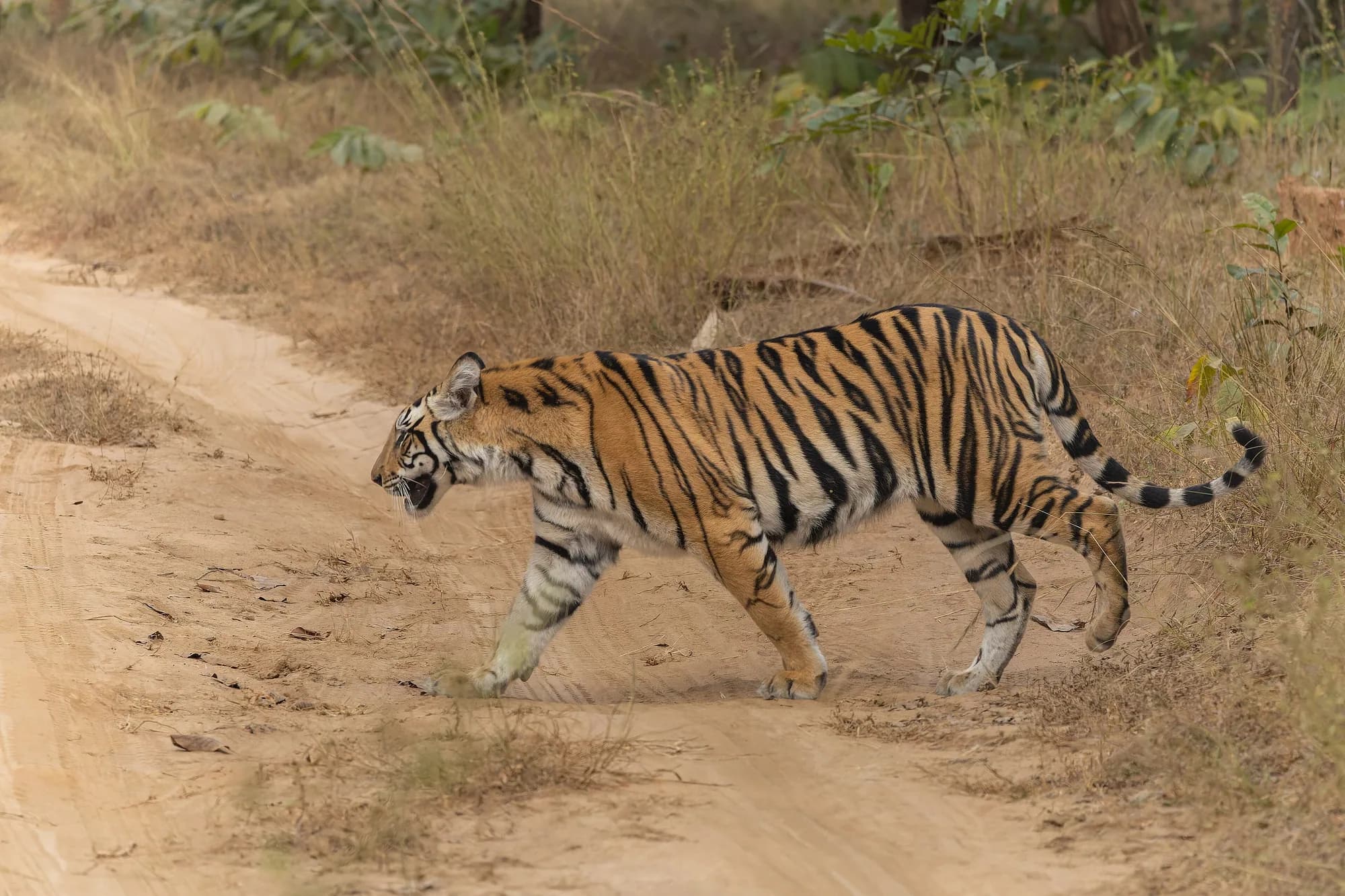
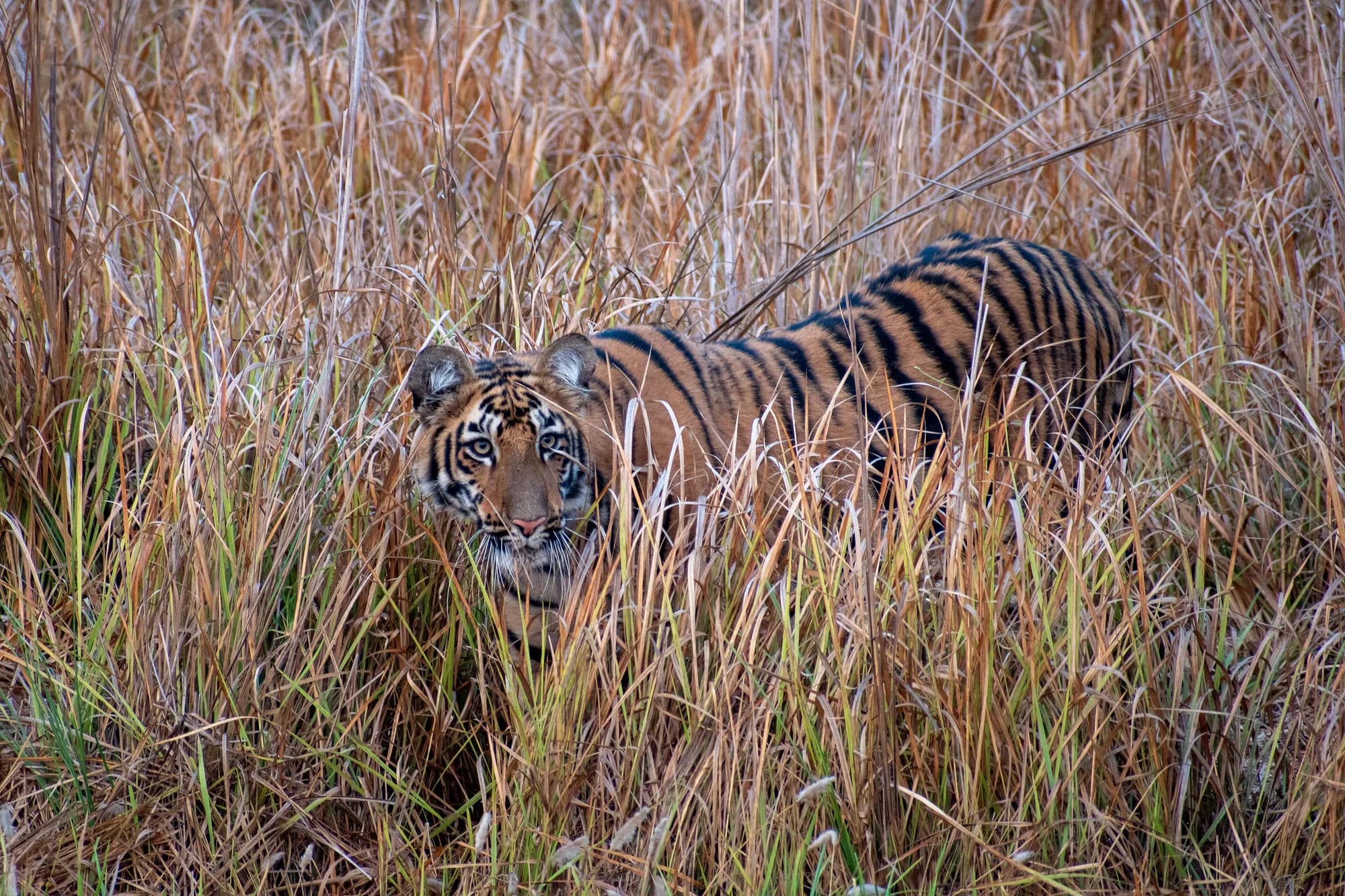
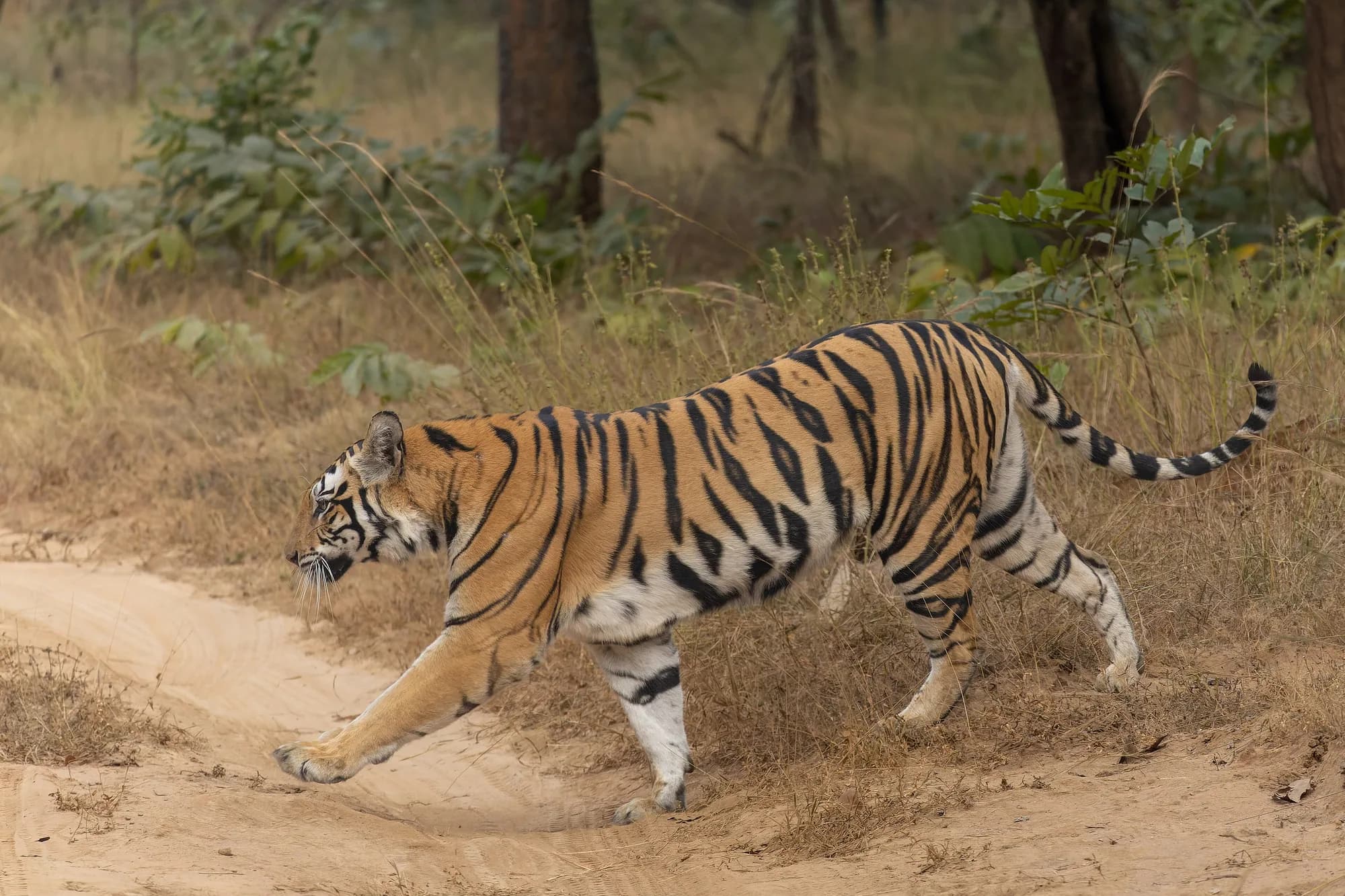
Photographs of Tiger in the wild, in Indian reserves. We publish no captive, baited or digitally composited images, and no photograph whose licence we cannot show.
Photographing it
- Lens
- 400mm minimum on full frame, and 500–600mm is not excessive. A second body with a 70–200 for the habitat shot, because the wide frame of a tiger in its forest is the picture most people come home without.
- Typical distance
- Twenty to eighty metres in most reserves. Closer happens and cannot be planned for.
- Light
- Brutal by nine in the morning. The first forty minutes of the morning shift and the last thirty of the evening are the only reliably good light, which is another argument for booking more drives.
Where to stopThe vehicle stays on the track and the engine decision is the guide's, not yours. Never ask a driver to cut off a walking animal for a better angle — it is the most common pressure guides get and the reason some reserves have tightened their rules. If an animal changes what it is doing because of you, you are too close.
Signs and calls
- Pugmark
- A rounded pad with four toes and no claw marks — cats retract; dogs do not, so a canid track shows claws. Hind pugmarks are noticeably narrower than front. Fresh track in dust with sharp edges means minutes, not hours.
- Rake marks
- Vertical claw scores on a tree trunk, usually a metre and a half up and often on the same tree for years. A territorial signpost, and a good reason for your driver to slow down.
- Scat
- Segmented, hair-packed, often chalk-white with age from the bone. Frequently left in the middle of a track rather than off it, which is the point of it.
- Scrape and spray
- A backward-kicked scrape in the dust at a track junction, sometimes with a strong scent on the vegetation beside it. Guides check junctions for exactly this.
Who gives it away
Chital
A single sharp, rising bark, repeated at intervals. The most common alarm in central India and the one your guide is listening hardest for.
Reliable when repeated and when the herd is facing one direction
Sambar
A deep, resonant honk — much lower and slower than a chital. A sambar rarely calls without cause.
The one worth stopping for
Langur
A hacking, coughing whoop from the canopy. Langurs can see a long way down and often call first.
High value, because they are usually watching the animal
Peafowl
A loud, repeated single note. Peafowl call at almost anything, including your vehicle.
Low on its own; useful alongside a deer
Alarm calls announce a predator, not specifically a tiger, and a great many of them announce nothing at all. They are a reason to stop the vehicle, which is most of what finding one takes.
What a sighting is actually like
Most of a tiger sighting is not the tiger. It is twenty minutes of stationary silence while langur and chital work out where something is, a driver reversing fifty metres for a better angle on nothing, and then a shape resolving out of grass you had been staring straight at for a quarter of an hour.
People expect drama and get something slower, and considerably better.
This is worth knowing in advance, because the most common way to be disappointed by an Indian safari is to arrive expecting a documentary and treat the waiting as dead time. The waiting is the drive.
Three things that move the odds
None of them is the lodge, and none of them costs as much as the lodge does.
Choose the zone deliberately. A reserve is not one place — different gates, different quotas, different resident animals. Two people can visit the same park in the same week and describe different forests. And stay put when your guide wants to wait. Most sightings follow an alarm call heard by somebody who had stopped driving.
Per-zone sighting rates are not yet verified. They are the numbers people most want and most often see invented, so we publish them only from a logged source.
Status and protection
Status and protection
- IUCN Red List
- Endangered
- Population trend
- ↓ Decreasing
- Wildlife Protection Act 1972
- Schedule I (post-2022 amendment numbering)
- CITES
- Appendix I
Species-level assessment for Panthera tigris (Goodrich, J., Wibisono, H., Miquelle, D., Lynam, A.J., Sanderson, E., Chapman, S., Gray, T.N.E., Chanchani, P. & Harihar, A. 2022;
Assessed 2022 · IUCN Red List assessment
What to book to see one
What you would be booking
- How it is seen
- Jeep safari — a six-seat Gypsy with a driver and a forest guide, two shifts a day.
- Drives to book
- Six across three days. One drive is a lottery ticket; six in a good reserve turns the question from whether you will see one into how well.
- Zone or shift
- Book the zone, not the park. Tala at Bandhavgarh and Moharli at Tadoba are different products from their neighbouring gates, with their own quotas and their own resident animals.
Permits are per vehicle, per zone, per shift, and the online window for the popular zones opens 120 days ahead and empties in minutes. This is the single thing worth being early about — earlier than the flights, and much earlier than the lodge.
The reserves, ranked honestlyOn the same trip you would also get
- Indian leopard — present in every tiger reserve, and often better seen in the buffer than the core
- Sloth bear — the animal most guides would rather show you, and the one that most often obliges in Tadoba
- Dhole — packs hunt in the open at Tadoba and Kanha, and a hunt is a better sighting than most tiger sightings
- Barasingha — Kanha only — the hard-ground swamp deer exists nowhere else on earth
Questions people ask
What is the best park to see a tiger in India?
What time of year is best for tigers?
How many drives do I need to be reasonably confident?
Read next
With our criteria stated
The reserves, ranked honestly
Sighting odds, permit difficulty and what each reserve costs you in travel days — ranked for a traveller with a week, not a photographer with a month.
Twelve months, cross-park
When to go, month by month
The single decision that moves the odds most. Heat, crowds, closures and what is actually open, one page per month.
Kanha or Bandhavgarh
Start here
Your first safari
How a permit works, what a shift is, why the vehicle matters more than the lodge, and the four decisions that determine whether you see anything.