
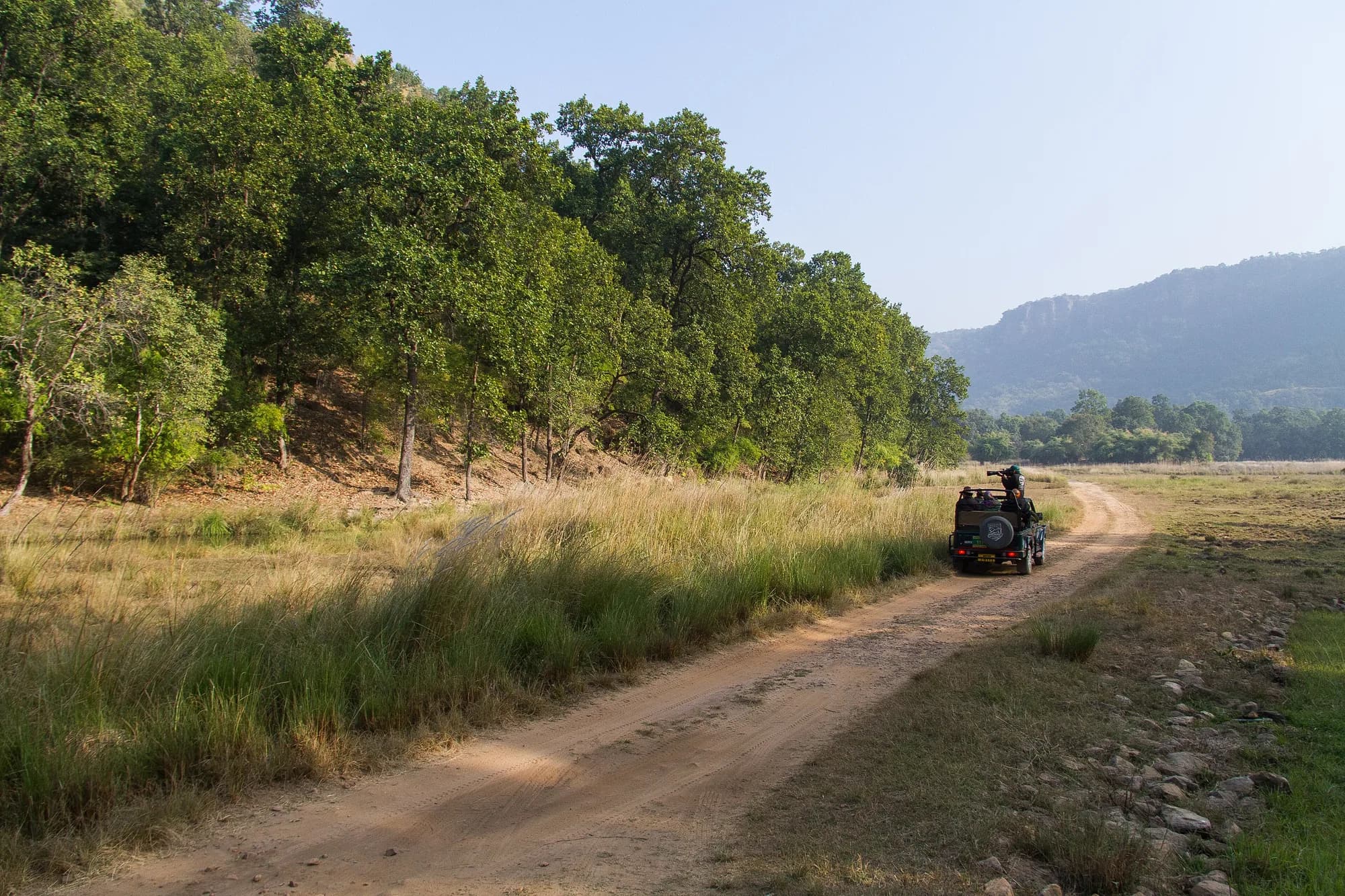
India / Bandhavgarh / Wildlife of Bandhavgarh
Wildlife of Bandhavgarh
1,536.93 sq km of Deccan Peninsula dry forest, five forest types, and the twelve mammals the NTCA documents here.
The habitat, before the animals
Bandhavgarh sits in biogeographic zone 6A — the Deccan Peninsula of the Central Highland — across the Umaria, Katni and Shahdol districts of Madhya Pradesh.
Five forest types in one reserve
- Moist peninsular low-level sal forest — closed, tall-canopy country.
- Northern dry mixed deciduous forest
- Dry deciduous scrub
- Dry grassland — the open meadows.
- West Gangetic moist mixed deciduous forest
The hill the reserve is named after
Bandhavgarh takes its name from the Bandhavgarh hill (807 m), standing in the centre of the reserve and surrounded by 32 smaller hills.
Tiger
Panthera tigris. The NTCA puts Bandhavgarh's tiger population at 104 (All India Tiger Estimation 2018).
This figure is from 2018
The NTCA reserve profile still carries the 2018 number. We print 104 with its year attached.
Bengal tiger in Bandhavgarh — daytime sighting, Tala zone
Ratio 3:2 · Alt: A Bengal tiger walking through dry sal forest in the Tala zone of Bandhavgarh Tiger Reserve · Why: The primary subject of the reserve. Every reader expects to see one before booking.
Indian leopard
Panthera pardus. Co-exists alongside tigers, often sighted in hilly, rocky terrain.
Sloth bear
Melursus ursinus. Favours broken, boulder-strewn ground with termite mounds around the escarpment.
Indian rock python
Python molurus. Most visible basking on cold December mornings.
The twelve mammals the NTCA names
| Species | Binomial |
|---|---|
| Tiger | Panthera tigris |
| Indian leopard | Panthera pardus |
| Jungle cat | Felis chaus |
| Indian wolf | Canis lupus |
| Golden jackal | Canis aureus |
| Indian fox | Vulpes bengalensis |
| Dhole | Cuon alpinus |
| Sloth bear | Melursus ursinus |
| Honey badger | Mellivora capensis |
| Striped hyena | Hyaena hyaena |
| Chinkara | Gazella bennettii |
| Four-horned antelope | Tetracerus quadricornis |
What the rules mean for watching
- Vehicle only. Walking on foot in the core is prohibited.
- Defined routes only. No off-roading.
- One zone per permit.
Photography, properly
Full-day photography permits allow access across all three core zones for 5 vehicles total reserve-wide.
When the forest is closed to you
Core shuts 1 July to 30 September during the monsoon. Buffer zones remain open.