
India / Ranthambore / Wildlife of Ranthambore
Wildlife of Ranthambore
Species catalogue and ecological breakdown of Ranthambore Tiger Reserve, where dry Dhok forests meet ancient fort ruins and historic lake systems.
Habitat & ecosystem profile
Ranthambore lies at the geological junction of the flat Vindhya plateau and the rugged Aravalli hill range. Over 75% of the forest canopy comprises Anogeissus pendula (Dhok tree), complemented by grasslands, dry gorges, and man-made reservoir lakes.
Biodiversity count statistics
Bengal Tiger — the lake hunting dynasty
Ranthambore is globally famous for daytime tiger activity. Generations of tigers — descended from iconic matriarch Machli (T-16) — have adapted to hunt Sambar deer in the lily-covered waters of Padam Talao and Rajbagh Lake.
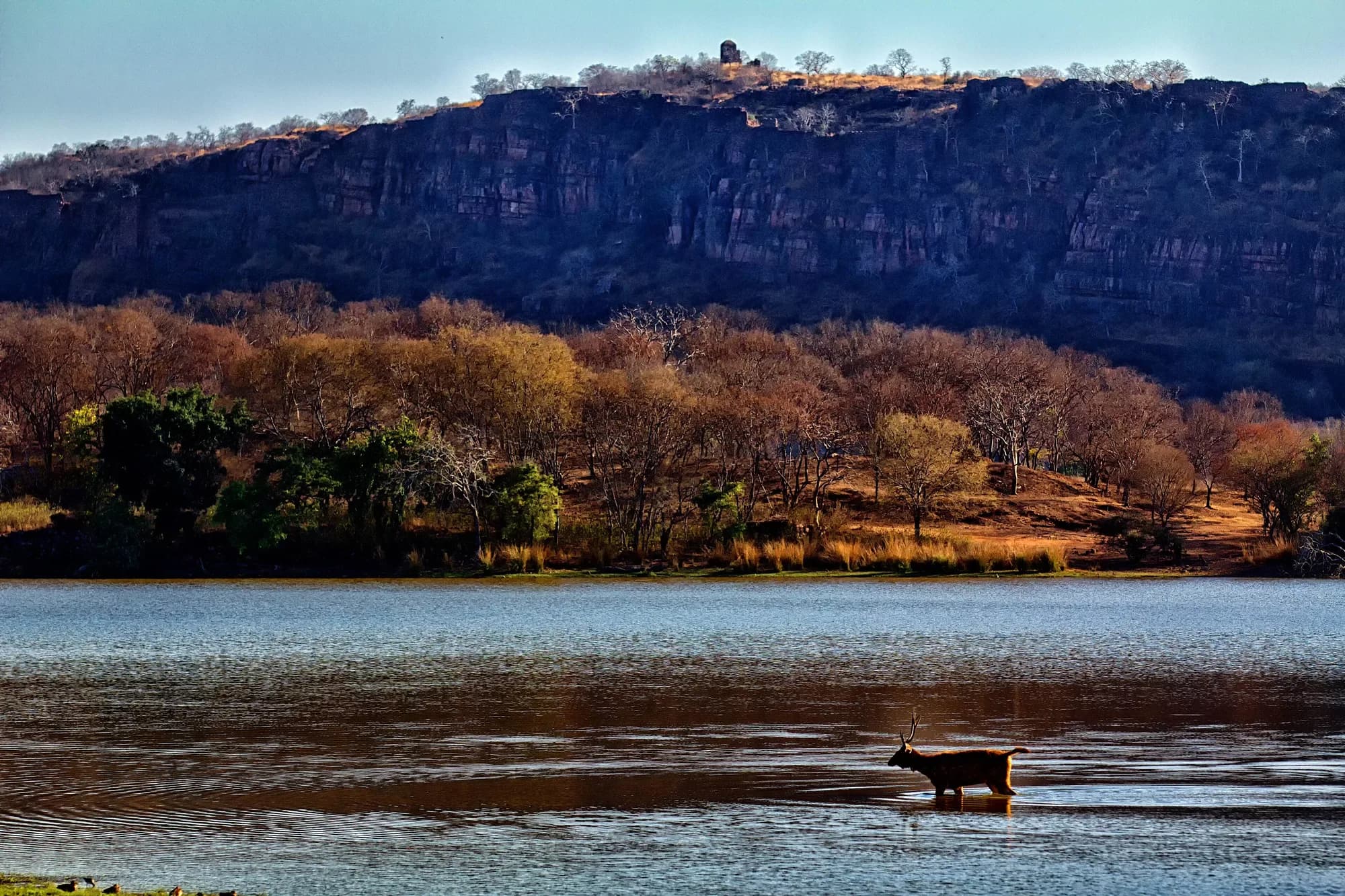
Bengal tiger crossing waterhole near Rajbagh lake in Ranthambore
Ratio 16:9 · Alt: Male Bengal tiger walking along lake shore in Ranthambore core
Indian Leopard & Caracal
Leopards thrive along the rocky cliffs of Kachida valley and outer Zones 6–10. Ranthambore is also one of India's few reserves with recorded sightings of the elusive Caracal in dry ravine sectors like Qual Ji.
Sloth Bear & Striped Hyena
Sloth bears forage for termite mounds in Lakarda and Semli valleys. Nocturnal Striped Hyenas nest in rocky caves around the fort foothills and outer zones.
Herbivores — Sambar, Chital & Chinkara
Sambar deer form the primary prey base for tigers near waterbodies. Chital (Spotted Deer) graze open grasslands, while Chinkara (Indian Gazelle) inhabit the dry scrubland of Zone 7.
Aquatic life — Marsh Crocodiles
Padam Talao and Rajbagh Lake support a massive population of Marsh Crocodiles (Mugger) frequently seen basking on muddy banks alongside water birds.
Birdlife of Ranthambore
Over 320 avian species inhabit the park, including Crested Serpent Eagle, Changeable Hawk-Eagle, Painted Stork, Sirkeer Malkoha, Indian Courser, and wintering migratory waterfowl.
Species conservation status table
| Species | Scientific Name | IUCN Status | Primary Habitat in Park |
|---|---|---|---|
| Bengal Tiger | Panthera tigris tigris | Endangered | Zones 1–5 Lake Complexes |
| Indian Leopard | Panthera pardus fusca | Vulnerable | Kachida Valley & Zones 6–10 |
| Sloth Bear | Melursus ursinus | Vulnerable | Lakarda & Semli Valleys |
| Caracal | Caracal caracal schmitzi | Least Concern (Rare in India) | Qual Ji & Zone 9 Scrubland |
| Mugger Crocodile | Crocodylus palustris | Vulnerable | Padam & Rajbagh Lakes |
How we checked this
All wildlife data, species counts, and IUCN threat classifications are compiled from NTCA All India Tiger Estimation reports and Rajasthan Forest Department publications.