
India / Khangchendzonga / When to go to Khangchendzonga
When to go to Khangchendzonga
India's highest national park, running from subtropical forest to the third-highest mountain on earth. Two windows: April–May for rhododendron and red panda, October–November for snow leopard and clear skies on the high plateau.
The season, in one line
Two windows: April–May for rhododendron bloom and red panda at mid-altitude, October–November for clear Kanchenjunga views and snow leopard sightings in the upper valleys. June to September monsoon closes all high-altitude routes.
Closed / Snow
Snow Leopard Season
Limited Access
Open · Rhododendron
Open · Red Panda
Wet & Cloudy
Closed
Closed
Closed
Open · Clear Skies
Open · Snow Leopard
Closing / Snow
Snow leopard on rocky ridge above tree line in Khangchendzonga National Park, Sikkim
Ratio 16:9 · Alt: Snow leopard resting on granite boulder above tree line in Khangchendzonga National Park with Kanchenjunga peak in background
Why India's highest park is different
Khangchendzonga spans a vertical range of over 7,000 metres — from subtropical rainforest at 1,220 m to the Kanchenjunga summit at 8,586 m. Wildlife and season windows differ completely by altitude zone. Red panda and satyr tragopan live at 2,000–3,500 m; snow leopard and bharal at 4,000–5,500 m. A visit requires deciding which zone you are targeting before choosing a route.
Month by month, in full
| Month | Mean min °C | Mean max °C | Record min | Record max | Rainfall mm | Status |
|---|---|---|---|---|---|---|
| January | -5.0 | 3.5 | -10.0 | 8.0 | 15.0 | Snow / Closed |
| February | -3.5 | 5.0 | -8.5 | 10.0 | 20.0 | Snow Leopard |
| March | 0.0 | 8.5 | -5.0 | 14.0 | 45.0 | Limited |
| April | 4.5 | 13.0 | 0.0 | 18.0 | 80.0 | Peak Open |
| May | 8.0 | 16.5 | 3.5 | 22.0 | 200.0 | Peak Open |
| June | 12.5 | 19.5 | 8.5 | 24.0 | 590.0 | Trails Closed |
| July | 14.0 | 20.0 | 10.5 | 24.5 | 680.0 | Closed |
| August | 14.0 | 20.0 | 10.0 | 24.0 | 620.0 | Closed |
| September | 12.0 | 18.5 | 8.0 | 23.0 | 350.0 | Closed |
| October | 6.0 | 14.0 | 1.0 | 18.5 | 60.0 | Peak Open |
| November | 0.5 | 8.0 | -4.5 | 12.5 | 18.0 | Open · Best Views |
| December | -3.0 | 4.5 | -8.0 | 9.0 | 12.0 | Snow / Closing |
April to May — rhododendron and red panda season
April is the best month for red panda and satyr tragopan at 2,500–3,200 m altitude. The rhododendron bloom peaks in April — Rhododendron niveum, R. grande and R. hodgsonii flower at different altitudes, creating a spectacular gradient from the Yuksom entry point up to Dzongri. Blood pheasant and Himalayan monal are reliably sighted near tree line.
October to November — snow leopard season
October and November offer the clearest conditions of the year for the Goecha La circuit — the high-altitude trek to 4,940 m with direct views of the Kanchenjunga massif. Snow leopard sightings are possible in the upper Samiti Lake area (4,200 m+) where bharal graze on the last autumn grass before snowfall. Bring a full -15°C sleeping bag.
Closure and inner line permit rules
Monsoon closure
June – September (typical)
All high-altitude routes above 3,000 m close due to monsoon landslide risk. The Yuksom range office announces exact dates. Lower zone day treks may remain possible — check current status.
Inner line permit
Required for all visitors
An inner line permit is required at Yuksom entry. Foreign nationals need an additional Protected Area Permit (PAP) from the Sikkim Tourism office in Gangtok. Group minimum of 2 persons and a licensed guide is mandatory for the high-altitude circuit.
Trek timings and routes
The main entry is at Yuksom (1,780 m), accessible from Jorethang by road. The standard circuit is Yuksom–Dzongri–Goecha La, 7–10 days return. A shorter 4–5 day version reaches Dzongri (4,020 m) for panoramic views without the high-altitude push to Goecha La. All camping gear and porters are arranged through licensed agencies in Yuksom.
The monsoon
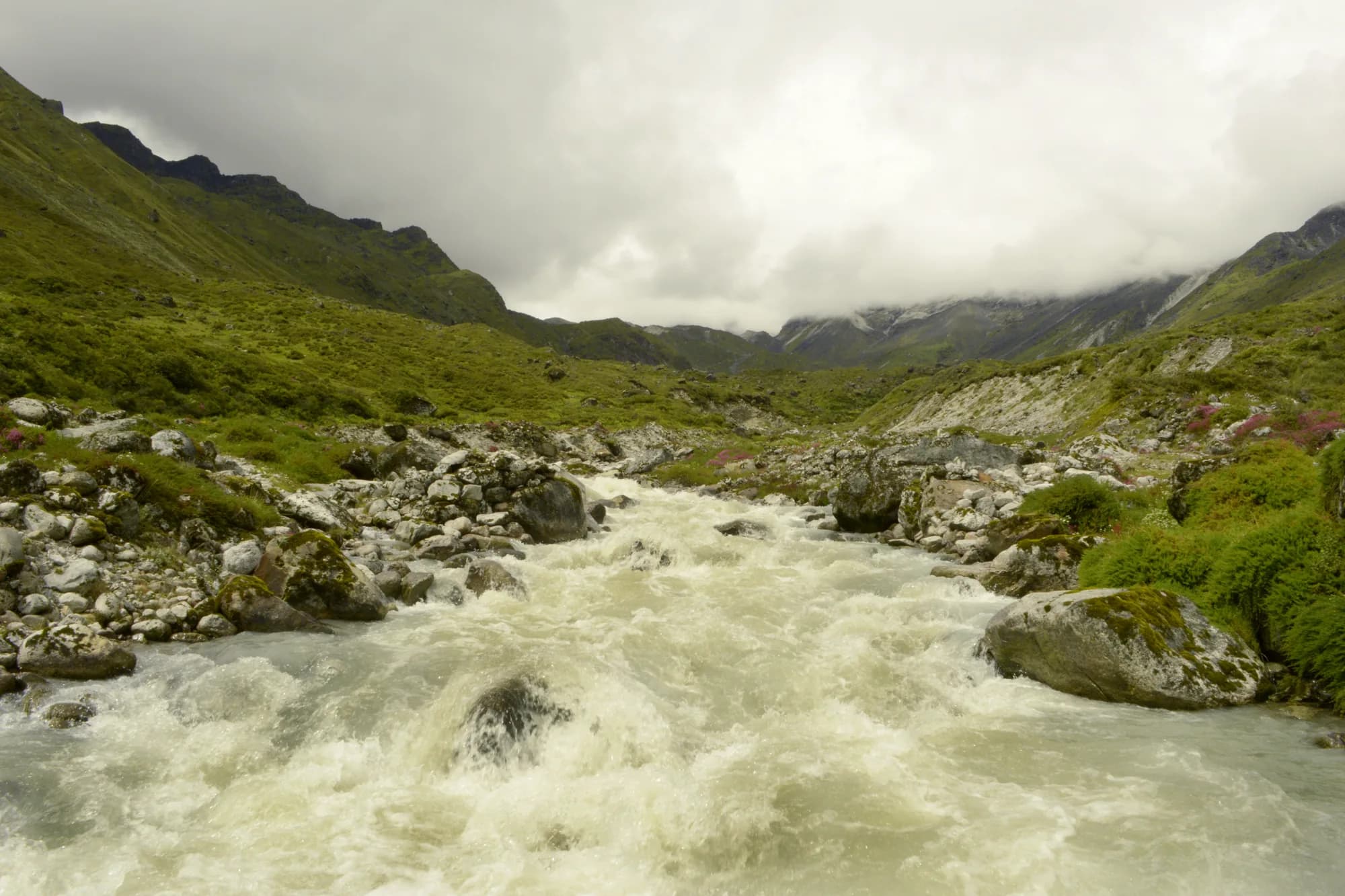
July brings around 680 mm at lower elevations; above 3,000 m this falls as frequent snow and freezing rain. Landslides routinely cut the Yuksom approach road. The cloud is so dense at altitude that the mountains are invisible for weeks on end. Do not plan a high-altitude visit between June and September.
When to book
- April and May — peak season. Yuksom guesthouses and camping porters are fully booked. Reserve at least 6–8 weeks ahead.
- October — best weather and views. High demand from domestic and international trekkers — book well in advance.
- November — late season. Colder nights but very clear days. Some agencies begin closing in late November.
Data source
IMD Gangtok station used for climate data
Khangchendzonga spans West Sikkim. Climate data is from the IMD Gangtok station (~1,650 m); high-altitude zone temperatures at Dzongri (4,020 m) and Goecha La (4,940 m) run 10–18°C colder. Data checked 8 Sep 2026.