
Namibia / Namib-Naukluft / Wildlife — Namib-Naukluft
Wildlife — Namib-Naukluft
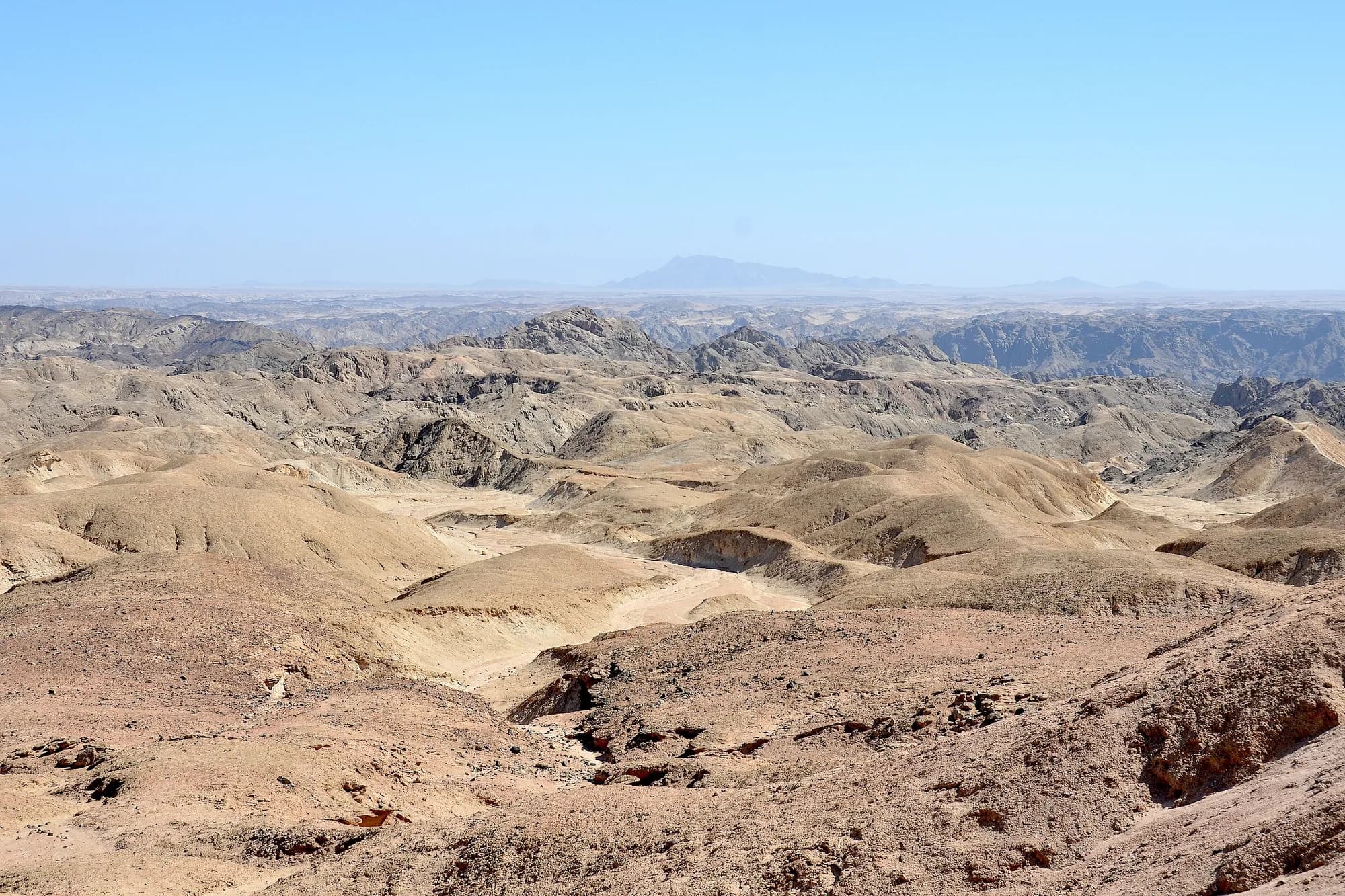
Pretending this is a game park would be dishonest. It is a desert with a short mammal list, a long bird list, a thousand-year-old plant and a set of small specialists you will only see if somebody shows you.
Say the quiet part first
MEFT's wildlife line for Namib-Naukluft, in full, is this: oryx, Hartmann zebra, giraffe, springbok, brown hyaena, leopard, baboon. Seven mammals. There is no elephant, no lion, no rhino, no buffalo, no wildebeest herd and no predator you have any realistic chance of seeing. Compare Etosha's 114 mammal species on the same ministry's website and the difference is not one of degree.
That is not a criticism of the park. It is the correct description of a hyper-arid desert, and it is why the pages that sell this place talk about dunes and light rather than about animals. But it is a real mismatch with what a reader who booked a "Namibia safari" is often expecting, and the mismatch is usually discovered on the second morning.
If you want animals, this is not the park
Etosha is 750 km north of Sesriem on NWR's own figure and is the game park in this country. The standard Namibian pair is Sossusvlei and Etosha for exactly this reason: one is a landscape, the other is a game park, and each is bad at the other's job. Doing Sossusvlei and expecting Etosha's wildlife is the commonest disappointment in Namibian travel and it is entirely avoidable by reading the ministry's own seven-name list before you go.
MEFT — Namib-Naukluft Park park profile
Read 28 September 2026. The Ministry of Environment, Forestry and Tourism's own page for the park. It carries the proclamation history, the park area, the vegetation types and biomes, a short wildlife and bird list, a one-line summary of each accommodation area including the Central Namib, and the note that permits are required for camping there. It gives no gate names, no gate times, no fee figures and no map.
https://www.meft.gov.na/national-parks/namib-naukluft-park/224/What the park is, in the ministry's own figures
MEFT's own figures for Namib-Naukluft
| Figure | |
|---|---|
| Park size | 49,768 square kilometres |
| Namib Desert Park proclaimed | 1907, as Game Reserve number 3 |
| Naukluft Mountain Zebra Park proclaimed | 1968 |
| Amalgamated and proclaimed as Namib-Naukluft | 1979 |
| Mammals named by MEFT | Seven |
| Bird species recorded | 348 |
| Biomes | Namib Desert, Succulent Karoo and Nama Karoo |
| Vegetation types | Six, from Southern Desert to Dwarf Shrub Savannah |
MEFT lists the six vegetation types as Southern Desert, Central Desert, Desert/Dwarf Shrub Transition, Central-Western Escarpment and Inselbergs, Succulent Steppe, and Dwarf Shrub Savannah. Three biomes in one park is the interesting number here: the reason the Naukluft looks nothing like the dunes is that it is in a different biome.
MEFT names the park's characteristic plants as welwitschia, camel-thorn, shepherd's tree, lichens and Commiphora. NWR adds that the Naukluft's five vegetation communities support a wealth of tree and shrub species and a variety of aloes. Between them that is a better description of what you will actually be looking at than any mammal list.
MEFT — Namib-Naukluft Park park profile
Read 28 September 2026. The Ministry of Environment, Forestry and Tourism's own page for the park. It carries the proclamation history, the park area, the vegetation types and biomes, a short wildlife and bird list, a one-line summary of each accommodation area including the Central Namib, and the note that permits are required for camping there. It gives no gate names, no gate times, no fee figures and no map.
https://www.meft.gov.na/national-parks/namib-naukluft-park/224/NWR — Namib-Naukluft Park
Read 28 September 2026. Namibia Wildlife Resorts' own landing page for the park. It names the key features, gives the park area, describes the dunes and Dead Pan, and lists the Naukluft wildlife. It lists exactly three NWR properties in the park: Naukluft Camp, Sesriem Campsite and Sossus Dune Lodge.
https://www.nwr.com.na/namib-naukluft-park/Hartmann's mountain zebra, and the Naukluft list
The Naukluft section exists because of this animal. MEFT records that the Naukluft section was created to serve as a sanctuary for Hartmann zebra, endemic to Namibia, and NWR says the same on both the park page and the camp page. It is the one large mammal in Namib-Naukluft with a genuine conservation story attached, and the Naukluft is where you look for it.
- NWR's Naukluft list, in addition to Hartmann's mountain zebra: kudu, gemsbok, klipspringer, duiker, steenbok, leopard, baboon, black-backed jackal, bat-eared fox, African wild cat, caracal and aardwolf.
- That is twelve species against MEFT's seven for the whole park, which tells you the Naukluft is the richest section rather than that the two sources disagree.
- Klipspringer on a dolomite slope is the most likely of these to be seen from a trail, because it is the one that lives on the rock rather than crossing it.
- Leopard, caracal, African wild cat and aardwolf are all present and all essentially nocturnal. Nobody publishes a density and we would not put odds on any of them.
- Gemsbok and springbok are the two you will see on the gravel at the dune end as well, and they are the species most people photograph in this park by a wide margin.
Black eagles on the cliffs
Both NWR's park page and its Naukluft Camp page single out the section's steep cliffs as nesting grounds for cliff-breeding birds including black eagles. On a 10 km Olive Trail morning that is a more realistic target than any of the cats, and it is the reason to carry binoculars rather than a long lens.
NWR — Namib-Naukluft Park
Read 28 September 2026. Namibia Wildlife Resorts' own landing page for the park. It names the key features, gives the park area, describes the dunes and Dead Pan, and lists the Naukluft wildlife. It lists exactly three NWR properties in the park: Naukluft Camp, Sesriem Campsite and Sossus Dune Lodge.
https://www.nwr.com.na/namib-naukluft-park/NWR — Naukluft Camp
Read 28 September 2026. Each resort page carries its own rate table in Namibian dollars, split into two seasons — July 2026 to October 2026, and November 2026 to June 2027 — together with unit counts, an activity price list, facilities, contact numbers and distances from key areas. Accommodation rates are per person sharing unless the row says single.
https://www.nwr.com.na/resorts/naukluft-camp/MEFT — Namib-Naukluft Park park profile
Read 28 September 2026. The Ministry of Environment, Forestry and Tourism's own page for the park. It carries the proclamation history, the park area, the vegetation types and biomes, a short wildlife and bird list, a one-line summary of each accommodation area including the Central Namib, and the note that permits are required for camping there. It gives no gate names, no gate times, no fee figures and no map.
https://www.meft.gov.na/national-parks/namib-naukluft-park/224/The small specialists, which are the real natural history
The interesting biology of the Namib is not mammalian and not visible from a car. It is a set of small animals that have solved the problem of living where there is fog but no rain: a gecko with webbed feet for running on loose sand and a tongue for wiping condensed fog off its own eyes, an adder that moves sideways across a slip face and buries itself with a shimmy, a spider that escapes by cartwheeling down a dune, a chameleon that changes colour to manage heat rather than to hide.
You find them on a walk, not on a drive
None of these animals is visible at driving speed and most are under the sand by mid-morning. They are the product of a guided walk with somebody who reads tracks, which in Namibia is sold as a living-desert or little-five walk and is typically run out of Swakopmund and Walvis Bay rather than from Sesriem. We name no operator and quote no price because we have no published tariff to cite. NWR sells no such walk at any of its three properties in this park.
The institutional reason to take the small stuff seriously is in MEFT's own text: much of the research on the desert environment has been conducted here because of the Gobabeb Training and Research Centre on the banks of the Kuiseb. This is one of the most intensively studied deserts on earth, and none of that research is about the seven mammals.
MEFT — Namib-Naukluft Park park profile
Read 28 September 2026. The Ministry of Environment, Forestry and Tourism's own page for the park. It carries the proclamation history, the park area, the vegetation types and biomes, a short wildlife and bird list, a one-line summary of each accommodation area including the Central Namib, and the note that permits are required for camping there. It gives no gate names, no gate times, no fee figures and no map.
https://www.meft.gov.na/national-parks/namib-naukluft-park/224/The welwitschia
The plant that gives the Welwitschia Trail its name is the first thing MEFT lists under the park's vegetation: Welwitschia mirabilis. It is two leaves, which it grows for its entire life and which fray into what look like many, above a woody stem and a very long taproot, on gravel plains that get almost no rain and live on coastal fog. It is not rare in Namibia and it is not impressive at a glance, and it is one of the strangest organisms on the continent.
We are not printing an age
Individual welwitschias are routinely described as over a thousand years old, and some of the plants on the Welwitschia route are named and signposted as such. Neither MEFT nor NWR publishes an age for any individual plant in this park, or a location, or a route. So this page tells you the species is here on the ministry's own authority and does not put a number on any specimen. If a guide shows you one and names an age, that is a claim worth asking the source of.
The one age this park does publish is for something dead. NWR dates the camelthorn skeletons in Dead Pan, by carbon dating, at between 500 and 600 years old. It is the only carbon-dated figure either authority gives for anything in Namib-Naukluft, and it is worth holding next to the welwitschia claims as a calibration of what the official sources are actually willing to state.
MEFT — Namib-Naukluft Park park profile
Read 28 September 2026. The Ministry of Environment, Forestry and Tourism's own page for the park. It carries the proclamation history, the park area, the vegetation types and biomes, a short wildlife and bird list, a one-line summary of each accommodation area including the Central Namib, and the note that permits are required for camping there. It gives no gate names, no gate times, no fee figures and no map.
https://www.meft.gov.na/national-parks/namib-naukluft-park/224/NWR — Namib-Naukluft Park
Read 28 September 2026. Namibia Wildlife Resorts' own landing page for the park. It names the key features, gives the park area, describes the dunes and Dead Pan, and lists the Naukluft wildlife. It lists exactly three NWR properties in the park: Naukluft Camp, Sesriem Campsite and Sossus Dune Lodge.
https://www.nwr.com.na/namib-naukluft-park/Birds
Three hundred and forty-eight species recorded, against Etosha's 407, which for a desert is a great many and is the strongest wildlife argument this park has. MEFT singles out six.
The six MEFT names, and where they belong
| Species | Where it fits |
|---|---|
| Dune Lark | The sand sea itself; the one on MEFT's list that lives in the dunes |
| Ruppell's Korhaan | Gravel plains and the desert margin |
| Ludwig's Bustard | Open arid country, walking rather than flying |
| Herero Chat | Rocky escarpment country; a genuine near-endemic and hard to find |
| Lappet-faced Vulture | The largest vulture in the region, over the plains |
| African Black Oystercatcher | The coast, which most visitors to this park never reach |
MEFT's six between them cover four of the park's four sections, which is a neat accident: the dune lark belongs to the sand, the korhaan and bustard to the Namib gravel, the Herero chat to the Naukluft escarpment and the oystercatcher to Sandwich Harbour. The characterisation of where each belongs is ours; the six names are MEFT's.
The other birding event here is conditional. NWR writes that when it has rained sufficiently in the interior for the Tsauchab River to come down and fill the main pan, flamingoes and other aquatic birds are drawn to the area. Flamingoes at the foot of a 300-metre dune is the photograph nobody plans and a handful of people a decade get.
MEFT — Namib-Naukluft Park park profile
Read 28 September 2026. The Ministry of Environment, Forestry and Tourism's own page for the park. It carries the proclamation history, the park area, the vegetation types and biomes, a short wildlife and bird list, a one-line summary of each accommodation area including the Central Namib, and the note that permits are required for camping there. It gives no gate names, no gate times, no fee figures and no map.
https://www.meft.gov.na/national-parks/namib-naukluft-park/224/NWR — Namib-Naukluft Park
Read 28 September 2026. Namibia Wildlife Resorts' own landing page for the park. It names the key features, gives the park area, describes the dunes and Dead Pan, and lists the Naukluft wildlife. It lists exactly three NWR properties in the park: Naukluft Camp, Sesriem Campsite and Sossus Dune Lodge.
https://www.nwr.com.na/namib-naukluft-park/What we could not verify
Population figures of any kind, and the entire small fauna
MEFT publishes no population estimate for any animal in Namib-Naukluft — not the Hartmann's mountain zebra the Naukluft section was created for, not leopard, not brown hyaena. It publishes no reptile, amphibian, invertebrate or plant species count for this park, although its Etosha permit document carries all of those for Etosha. We found no seasonal movement study, no survey, no density and no checklist beyond the thirteen names on the profile page.