
Nepal / Chitwan / Wildlife — Chitwan
Wildlife — Chitwan
Chitwan is the best place outside Assam to see a greater one-horned rhino without effort. Everything else here is a bonus, and the tigers are a genuinely good bonus.
Greater one-horned rhino
The National Rhino Count of 2021 put 694 greater one-horned rhino in Chitwan National Park and its surroundings, out of 752 in Nepal as a whole. Chitwan is where almost all of Nepal's rhino are, and they are not hidden: they graze the floodplain grassland, wallow in the oxbows, and walk into the buffer zone forests behind the lodges. They are also, at close range, considerably larger than the photographs suggest.
National Rhino Count 2021
| Park | Rhino |
|---|---|
| Chitwan and surroundings | 694 |
| Bardia and surroundings | 38 |
| Shuklaphanta | 17 |
| Parsa | 3 |
| Nepal total | 752 |
Counted 22 March to 10 April 2021 by direct block count, with 57 elephants and around 350 personnel. The previous national count, in 2015, found 645 — an increase of 107, or about 16.6 per cent, over six years.
Why we are quoting a five-year-old number
Because it is the most recent one that exists. The national count runs roughly every four to five years and it has now been deferred twice on budget grounds, most recently to 2027, with a planned switch to a genetic method using dung samples in Chitwan because the park is too large for direct observation to stay affordable. Anyone quoting you a current rhino figure for Chitwan is estimating. The honest statement is 694 in 2021, and no completed count since.
NTNC — National Rhino Count 2021
Counted 22 March to 10 April 2021 and announced on 11 April 2021 at Sauraha. Led by DNPWC with NTNC, WWF Nepal, ZSL Nepal and the Nepal Army, using the direct block count method, with 57 elephants and around 350 personnel. Read 28 September 2026. This is the most recent completed national count.
https://ntnc.org.np/news/752-one-horned-rhinos-nepal-determined-national-rhino-count-2021The Himalayan Times — Rhino census deferred to next year amid budget constraints, 11 May 2026
Reports the national rhino count deferred for a second consecutive year on budget grounds, now planned for 2027, and a shift to a genetic method using dung samples in Chitwan. Puts the cost of the 2021 count at about Rs 30 million. Read 28 September 2026.
https://thehimalayantimes.com/nepal/rhino-census-deferred-to-next-year-amid-budget-constraintsHow Chitwan compares — the Kaziranga question
Anyone choosing where to see this animal is choosing between Chitwan and Kaziranga in Assam, and the honest answer is that Kaziranga has far more rhino. Its 2022 census counted 2,613 against Chitwan's 694 the year before. If the single question is density of rhino, Kaziranga wins and it is not close.
The two great rhino parks, on their most recent counts
| Chitwan | Kaziranga | |
|---|---|---|
| Rhino, latest count | 694 in 2021 | 2,613 in 2022 |
| Previous count | 605 in the park in 2015 | 2,413 in 2018 |
| Country | Nepal | India |
| Core area | 932 sq km | About 900 sq km |
| Walking permitted | Yes, with two guides | No |
Two countries, two counting exercises, two different years. Treat this as scale rather than a league table. The Chitwan 2015 park figure of 605 comes from the PARKS paper; the 2021 figure from the national count.
Why you might still choose Chitwan
You can walk here. That is the real difference and it is not a small one — Chitwan lets you stand on the ground in rhino habitat with two guides, which almost nowhere comparable does. Add the canoe, the gharial centre, easier access from Kathmandu than Kaziranga has from anywhere, and a tiger population that has grown for fifteen years. Kaziranga is where you see the most rhino. Chitwan is where you spend three days in rhino country.
The Shillong Times — Rhino population in Kaziranga NP increases by 200 to 2613, 29 March 2022
Assam Forest Department census of 26 to 27 March 2022: 2,613 greater one-horned rhino in Kaziranga against 2,413 in the 2018 count. Read 28 September 2026. Used here only for the comparison with Chitwan; it is a different country, a different counting exercise and a different year, so treat the two totals as indicative of scale rather than as a like-for-like ranking.
https://theshillongtimes.com/2022/03/29/rhino-population-in-kaziranga-np-increases-by-200-to-2613/Dhakal & Thapa — Buffer zone management issues in Chitwan National Park, PARKS Vol 21.2, IUCN, November 2015
Peer-reviewed. Gives the park as established in 1973, inscribed by UNESCO in 1984, and covering 932 square kilometres; the buffer zone as declared in 1996 over 34 Village Development Committees and two municipalities totalling 750 square kilometres; and the revenue share to the buffer zone as 30 to 50 per cent of park revenues, allocated 30 per cent conservation, 30 per cent community development, 20 per cent income generation and skills, 10 per cent conservation education and 10 per cent administration. Read 28 September 2026. Note the age: the administrative units it names were reorganised after Nepal's 2017 local government restructuring.
http://parksjournal.com/wp-content/uploads/2015/10/Dhakal-and-Thapa-PARKS-21.2-10.2305IUCN.CH_.2014.PARKS-21-2BD.en_.pdfTiger
Nepal's fifth national tiger survey, released on 29 July 2026, counted 145 tigers in Chitwan — the largest population in the country, out of a national total of 429. That is a substantial density in a park of 932 square kilometres, and it is why Chitwan is a real tiger destination rather than a rhino park where tigers happen to live.
National tiger survey, 2022 and 2026
| Park | 2022 | 2026 |
|---|---|---|
| Chitwan | 128 | 145 |
| Bardia | 125 | 112 |
| Parsa | 41 | 71 |
| Banke | 25 | 51 |
| Shuklaphanta | 36 | 50 |
| Nepal total | 355 | 429 |
Bardia was the only park to fall between the two surveys. The national series runs 121 in 2009, 198 in 2013, 235 in 2018, 355 in 2022 and 429 in 2026 — a more than threefold rise in fifteen years.
A good tiger population is not a good sighting rate
145 tigers in tall grass and dense sal forest is not 145 tigers on a track. Chitwan is not Ranthambhore and it is not Bandhavgarh: there is no habituated, heavily photographed cohort, the vegetation is against you for most of the year, and most visitors leave without a sighting. Come for rhino, treat tiger as the thing that might happen on the full-day drive, and a very good park will not disappoint you.
IUCN — Nepal's tiger number increases to 429, July 2026
Results of Nepal's fifth national tiger survey, released by DNPWC on 29 July 2026 to mark Global Tiger Day. Read 28 September 2026. The national series runs 121 in 2009, 198 in 2013, 235 in 2018, 355 in 2022 and 429 in 2026.
https://iucn.org/story/202607/tiger-census-nepals-tiger-number-increases-429Gharial, and the breeding centre at Kasara
The gharial is the long, narrow-snouted, fish-eating crocodilian of the Himalayan rivers, and it came very close to disappearing — by the mid-1970s only about 70 were reported across the Koshi, Narayani, Rapti, Babai and Karnali. Nepal established a breeding centre at Kasara, inside the park, in 1978. Eggs are collected from the riverbanks, hatched and reared in captivity, and the young released once they are large enough to stand a chance. Between 1981 and 2017, 1,246 gharial were released into those rivers and the Kaligandaki.
The centre is open to visitors and is the standard turning point of a full-day drive to Kasara, which is also where the park headquarters sits. It is worth knowing what you are looking at before you go: enclosures of juveniles at various ages, not a zoo exhibit, and the reason the animals you might see from a canoe exist at all.
The canoe is the better gharial experience
Seeing a wild gharial hauled out on a sandbank from a dugout at water level is a different thing from seeing juveniles in a pen. Mugger crocodile, the broad-snouted and much commoner species, are near certain on any river trip; gharial are likely rather than guaranteed. Do both, in that order — the centre explains what the river shows you.
NTNC — Gharial breeding centre, Kasara
States the centre was established by the Government of Nepal in 1978 at Kasara, that gharial numbered about 70 in the Koshi, Narayani, Rapti, Babai and Karnali in the mid-1970s, and that 1,246 gharial were released into those rivers and the Kaligandaki between 1981 and 2017. Read 28 September 2026.
https://ntnc.org.np/thematic-area/gharial-breeding-centerThe large mammals you have not come for
- Sloth bear — present, occasionally seen, and one of the two animals that makes a walking safari a serious activity. Poor eyesight, bad temper, and a habit of being surprised at close range in thick cover.
- Gaur — the largest wild cattle in the world, in and around the sal forest. Massive, dark, and consistently underestimated by people who have only seen domestic cattle.
- Wild elephant, as distinct from the working elephants of Sauraha. Herds move through the park and across the Indian border, and encounters are unpredictable rather than routine.
- Mugger crocodile throughout the rivers and oxbows, far more commonly seen than gharial.
- Chital, sambar, hog deer, barking deer and wild boar — the prey base, and the reason the tiger numbers hold up. Hog deer in particular are a grassland speciality here.
- Leopard, mostly on the periphery and in the buffer zone, where they do better away from tigers.
- Rhesus macaque and grey langur, common and conspicuous; langur alarm calls are worth learning to recognise.
- Smooth-coated otter and Gangetic dolphin have both been recorded in the river system, and neither should be planned for.
The two that determine how a walk is run
Rhino and sloth bear. Between them they account for the majority of injuries recorded in the buffer zone, and they are the reason the briefing exists and the group stays tight. The safari booking page sets out what that study actually measured and why it does not translate directly into a visitor's odds.
Birds, and why Bishazari Tal is the overlooked half of the park
Chitwan is a serious birding destination and hardly anybody books it as one. The combination of habitats is unusual — big rivers, oxbow wetland, tall grassland, sal forest and riverine woodland within a few kilometres of each other — and it produces a list that rewards somebody who is actually looking rather than being driven past.
- Bishazari Tal, the Ramsar-listed oxbow system in the buffer zone, is the single best birding site within reach of Sauraha and a completely different landscape from the forest around it.
- The Rapti and Narayani banks from a canoe at first light, for kingfishers, storks, darters, lapwings and waders.
- The grassland specialists, which are the hardest and the most interesting, and which are far easier to find after the January cut than before it.
- Winter migrants arrive from October and the list is at its longest through the cool months.
- A birding-focused guide is a different person from a general safari guide. Ask specifically, and ask early.
Why the habitat is the story
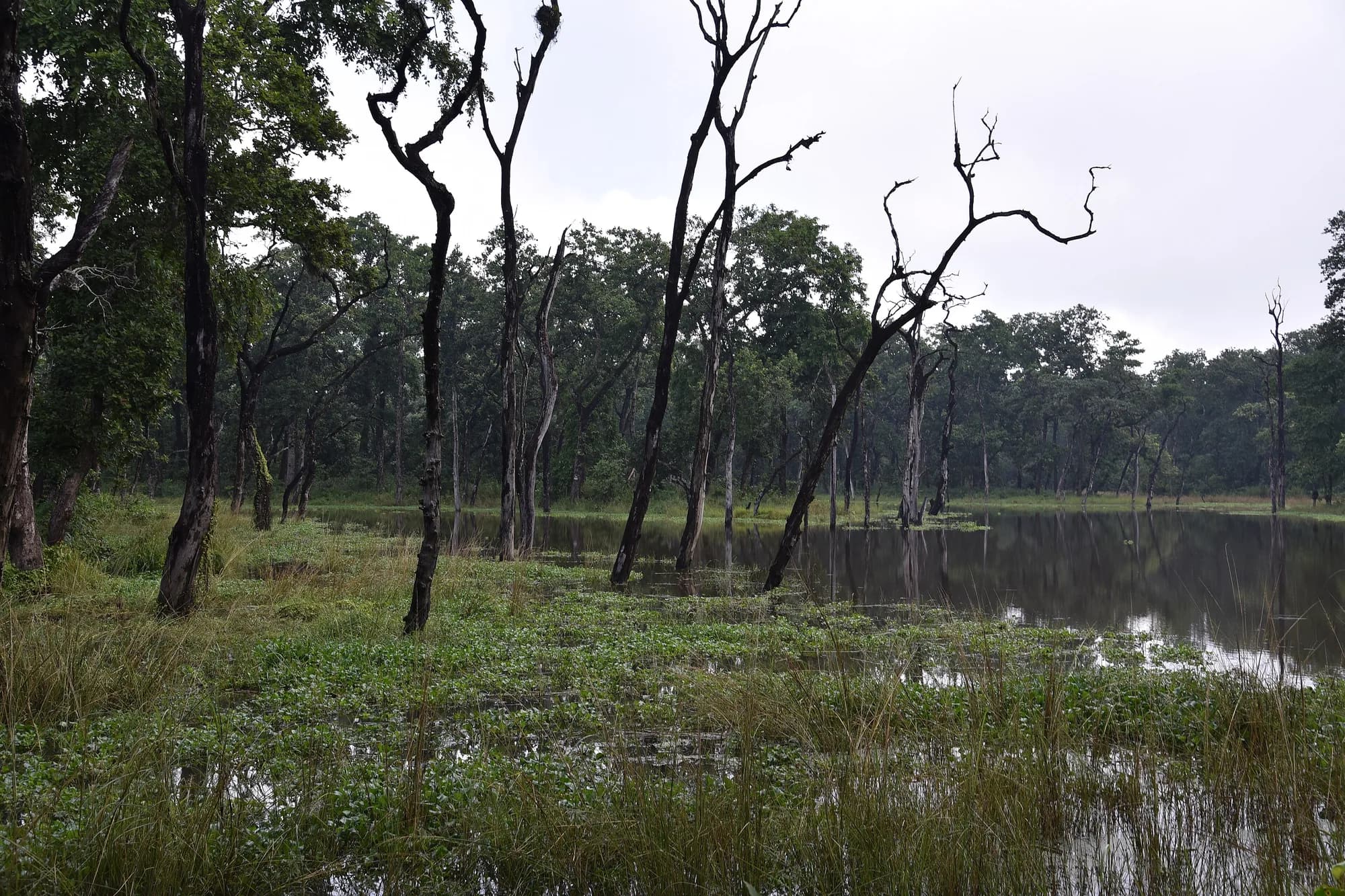
Chitwan works as a wildlife park because of what it is made of: alluvial floodplain between two rivers, with a mosaic of tall grassland and riverine forest that is among the most productive habitat in South Asia. That is what supports a rhino population of this size in 932 square kilometres, and what supports the deer that support 145 tigers. It is also, historically, exactly the land people most wanted to farm, which is the whole tension of the place.
The park's own record makes the case better than any argument. Rhino in Chitwan rose from 147 to 544 by 2000 and 605 by 2015, under a regime that combined hard protection with revenue sharing into the buffer zone. Tigers nationally went from 121 in 2009 to 429 in 2026. Neither of those numbers happened by leaving the place alone.
Dhakal & Thapa — Buffer zone management issues in Chitwan National Park, PARKS Vol 21.2, IUCN, November 2015
Peer-reviewed. Gives the park as established in 1973, inscribed by UNESCO in 1984, and covering 932 square kilometres; the buffer zone as declared in 1996 over 34 Village Development Committees and two municipalities totalling 750 square kilometres; and the revenue share to the buffer zone as 30 to 50 per cent of park revenues, allocated 30 per cent conservation, 30 per cent community development, 20 per cent income generation and skills, 10 per cent conservation education and 10 per cent administration. Read 28 September 2026. Note the age: the administrative units it names were reorganised after Nepal's 2017 local government restructuring.
http://parksjournal.com/wp-content/uploads/2015/10/Dhakal-and-Thapa-PARKS-21.2-10.2305IUCN.CH_.2014.PARKS-21-2BD.en_.pdfIUCN — Nepal's tiger number increases to 429, July 2026
Results of Nepal's fifth national tiger survey, released by DNPWC on 29 July 2026 to mark Global Tiger Day. Read 28 September 2026. The national series runs 121 in 2009, 198 in 2013, 235 in 2018, 355 in 2022 and 429 in 2026.
https://iucn.org/story/202607/tiger-census-nepals-tiger-number-increases-429