
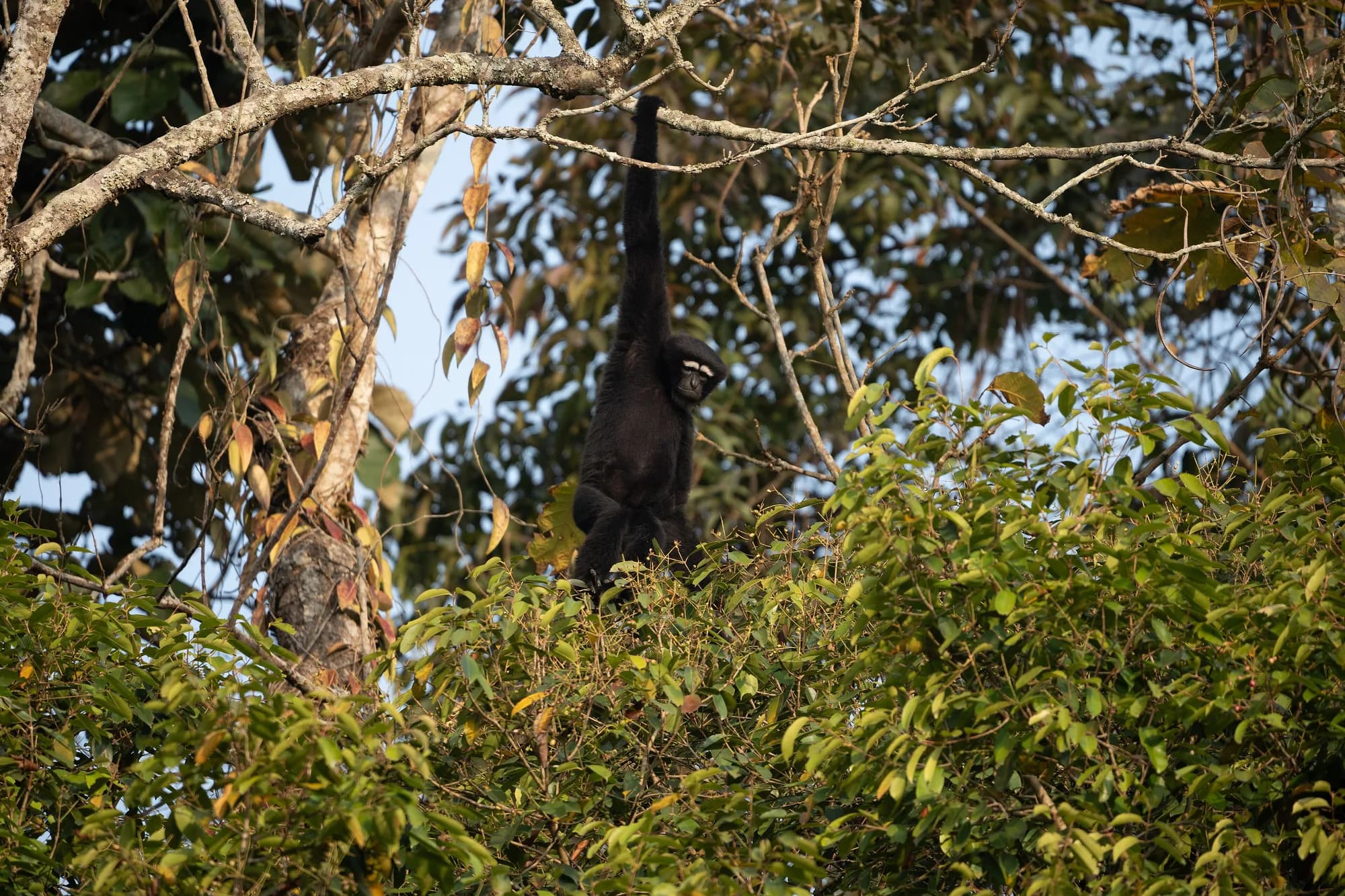
Species · Hoolock hoolock
Western hoolock gibbon
The only ape in India, in a forest island surrounded by tea. You will hear the pair duet across a kilometre of canopy before you have any idea where to look.
Also called
- Holou bandar · Assamese
- Hoolock · Hindi
Checked 30 Aug 2026
- Where
- Assam & the Northeast
- Best months
- November–March
- Found by
- The dawn duet
- Note
- India's only ape
Everything south of the Brahmaputra and east of the Dibang, in fragments. The river is a hard boundary for the species.
Where it is
Where to actually go
Ranked, with the reason each — these are not interchangeable.
- 01Hollongapar Gibbon SanctuaryAssamTwenty-odd square kilometres of forest surrounded by tea, holding a well-studied population that is used to being walked past. The only place in India where a gibbon sighting is a reasonable plan rather than a hope.Be at the gate before first light, or do not bother
- 02Kaziranga (Panbari block)AssamA small population in the forest block, and easy to add to a rhino trip — but it needs a separate arrangement and most itineraries omit it.Ask for Panbari by name when booking Kaziranga
- 03NamdaphaArunachal PradeshGenuinely wild, enormous, and one of the least accessible reserves in India. Better gibbon habitat and far worse gibbon odds.An expedition, not an add-on
Where you will not see one
- Kaziranga's grasslandRight state, wrong habitat entirely. The rhino grassland has no gibbons — they are in the Panbari forest block, which most Kaziranga itineraries never visit.
- North of the BrahmaputraThe river is the range limit. No amount of time in the northern Assam reserves will produce one.
- Anywhere expecting a monkeyIt is an ape — no tail, long arms, and it moves by swinging rather than running along branches. People scanning for a langur-shaped animal look straight past it.
When to go
When to go
- J
- F
- M
- A
- M
- J
- J
- A
- S
- O
- N
- D
January: best. February: best. March: best. April: good. May: marginal. June: marginal. July: marginal. August: marginal. September: marginal. October: good. November: best. December: best.
Through the day
- Dawn
- Morning
- Midday
- Afternoon
- Dusk
- Night
Dawn: most active. Morning: most active. Midday: usually resting. Afternoon: active. Dusk: usually resting. Night: not normally seen.
Realistic odds on a three-day trip
- Near-certain
- Likely
- Lucky
- Expedition
Telling it apart
Told apart from
Capped langur
The same Assam forests, constantly
Look for a tail. Langurs have a long one and gibbons have none at all. The capped langur also has an orange-buff belly and moves by running and leaping rather than swinging hand over hand.
Stump-tailed macaque
Northeast forests
Heavy, ground-using, with a red face and a short thick tail. If it came down to the forest floor it was not a gibbon.
Male versus female of the same species
Every sighting of a pair
Not two species, though it looks like it. Males are black with a white brow band; females are buff-golden with a pale ring around the face. Pairs are reported as two different animals more often than any other confusion here.
Marks chosen to be usable from a moving vehicle — a western hoolock gibbon is rarely still and never close enough for anything subtler.
What it looks like in the field
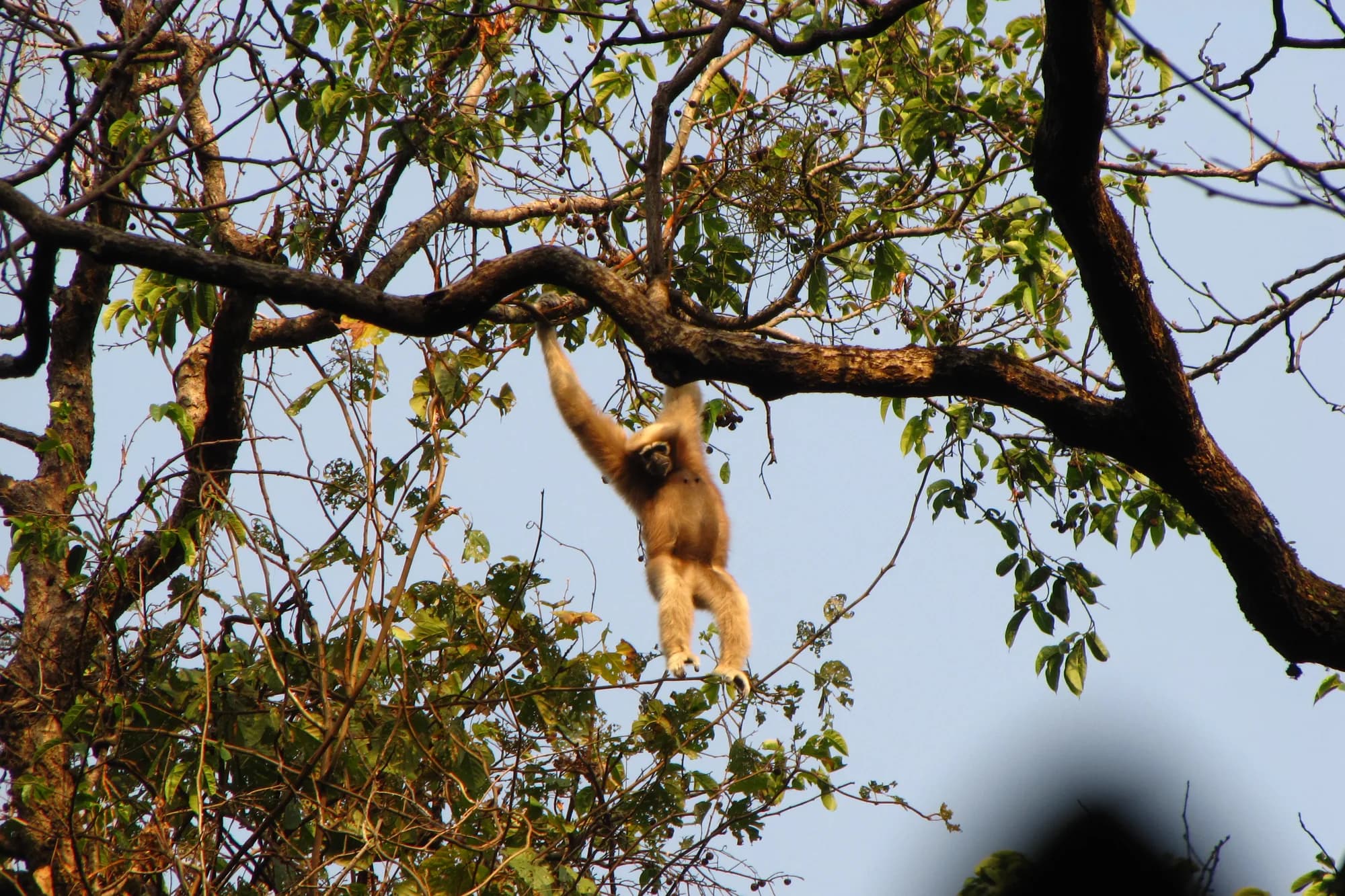
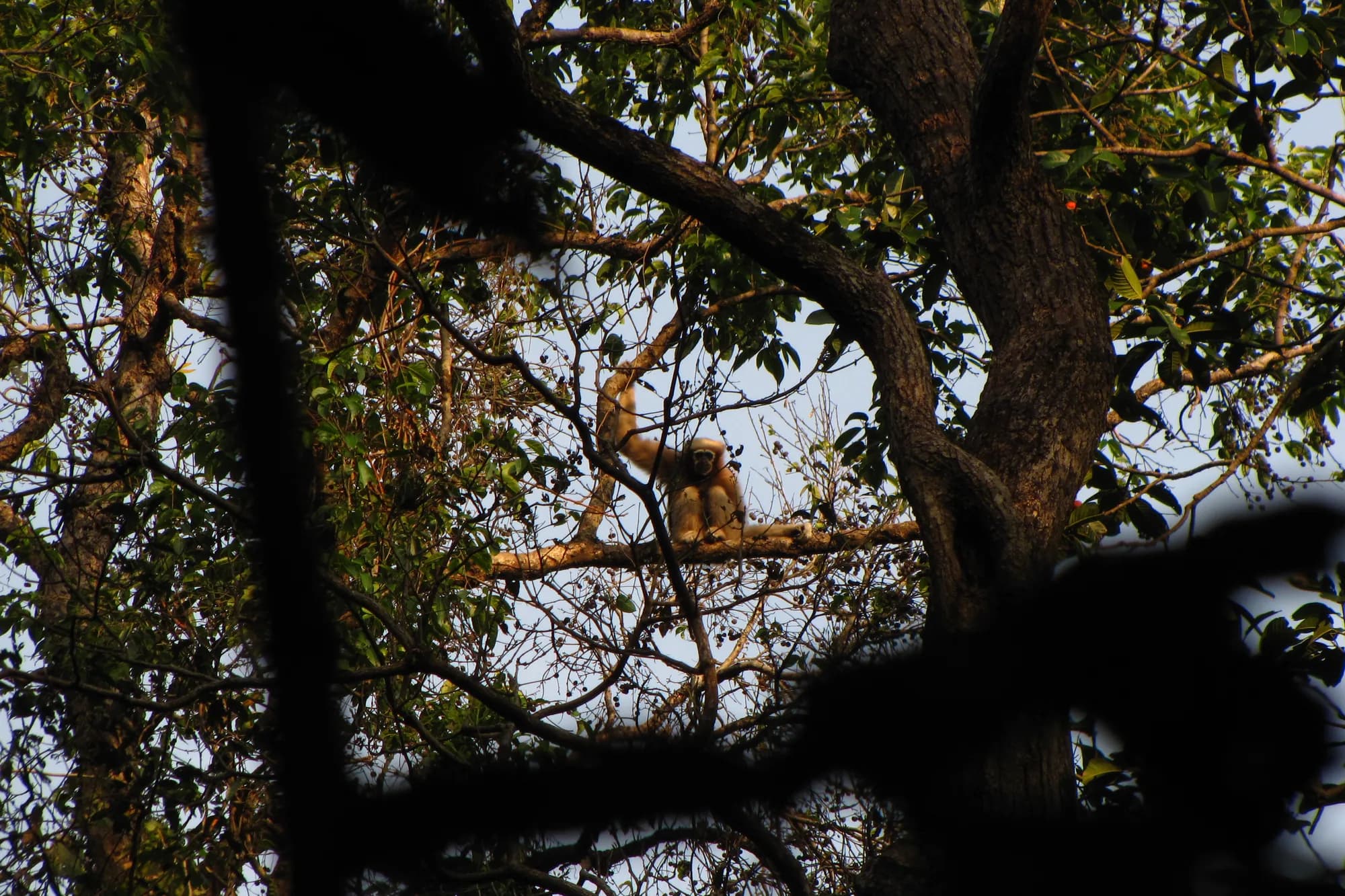
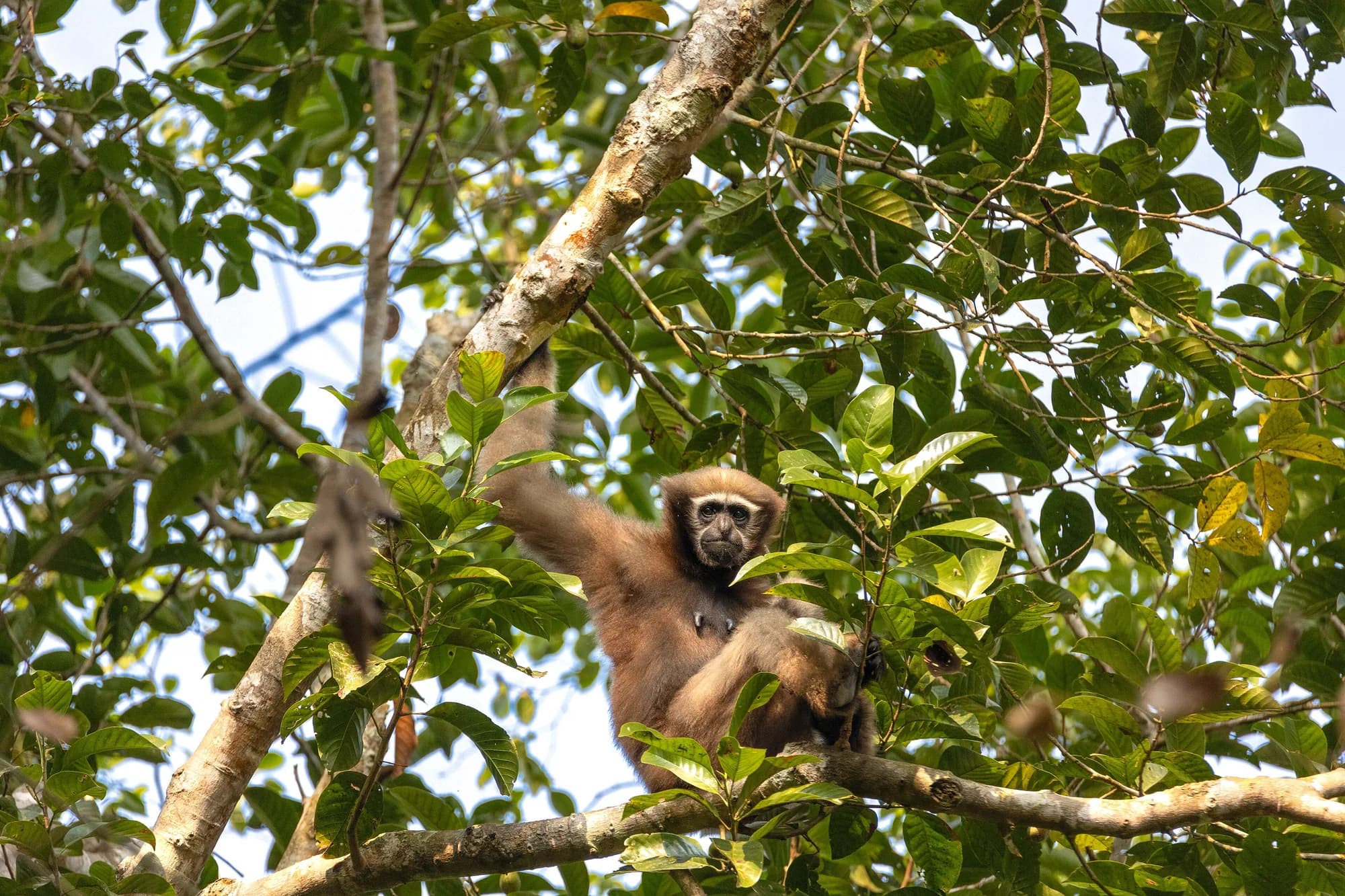
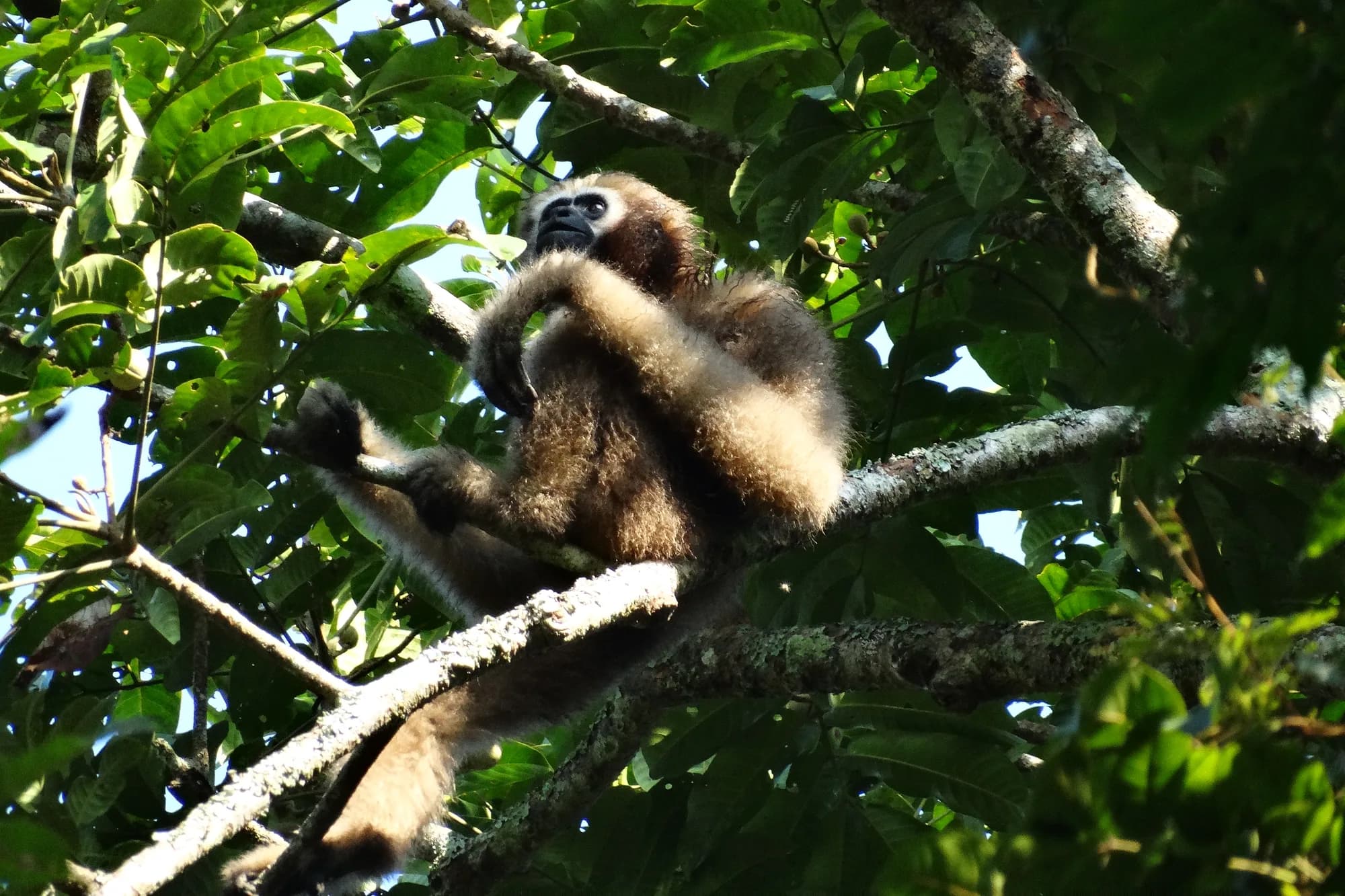
Photographs of Western hoolock gibbon in the wild, in Indian reserves. We publish no captive, baited or digitally composited images, and no photograph whose licence we cannot show.
Photographing it
- Lens
- 400mm and a body that tolerates high ISO. You are shooting up into closed evergreen canopy before the sun has cleared the trees.
- Typical distance
- Twenty to forty metres, almost entirely vertical, and usually through leaves.
- Light
- Very poor. This is the hardest photographic subject on the flagship list — dark animal, dark canopy, first light, and constant motion.
Where to stopDo not play recorded calls to draw them in. Playback provokes a territorial response in a species already squeezed into fragments, and it costs the animals energy for your convenience. Wait for the natural duet.
Signs and calls
- Duet
- The pair sing together shortly after dawn — a rising, whooping series that accelerates and carries over a kilometre. It is territorial, it is unmistakable, and it is the only practical way to locate them.
- Canopy movement
- Whole branches springing back in sequence along a line through the canopy. Gibbons travel fast and leave a wake you can follow with your eyes.
- Feeding remains
- Dropped and part-eaten figs beneath a fruiting tree. Shared with squirrels and hornbills, so useful only alongside sound.
What a sighting is actually like
It begins as sound in the dark. A rising, whooping duet somewhere off the trail, answered by another pair further away, and then twenty minutes of walking towards it while it moves.
You do not find a gibbon. You follow one until it decides to be visible.
When it happens, the thing that lands is the movement: an arm-over-arm swing across a gap that no monkey could make, at a speed that looks like falling sideways. They are not showing off. That is simply how the animal gets to breakfast.
A forest island
Hollongapar is about twenty square kilometres of evergreen forest with tea gardens on every side and a railway line through the middle. The line severed the canopy decades ago and split the population, and some groups on the wrong side of it have not bred well since.
It also sets the expectation correctly. This is not a wilderness experience. You are walking a small, well-worn, heavily-studied fragment, and the value of it is the animal rather than the setting.
Status and protection
Status and protection
- IUCN Red List
- Endangered
- Population trend
- ↓ Decreasing
- Wildlife Protection Act 1972
- Schedule I (post-2022 amendment numbering)
- CITES
- Appendix I
Species-level assessment for Hoolock hoolock, the western hoolock gibbon (e.T39876A17968083; published 2019, last assessed 12 September 2017).
Assessed 2019 · IUCN Red List assessment
What to book to see one
What you would be booking
- How it is seen
- A guided walk on forest trails, not a jeep safari. Hollongapar is walked, and you are following sound rather than driving a circuit.
- Drives to book
- Two mornings. Start before first light both times — one morning is a coin toss because the duet is weather-dependent.
- Zone or shift
- Hollongapar Gibbon Sanctuary near Jorhat. Small enough to cover on foot and dense enough that the sound does the finding.
This is a day trip from Jorhat, not a safari circuit, and it pairs naturally with Kaziranga a few hours west. Most operators will not offer it unless you ask by name.
Kaziranga — the natural pairingOn the same trip you would also get
- Greater one-horned rhino — Kaziranga is three hours away and the obvious pairing
- Capped langur — the same canopy, and a good identification exercise
- Great hornbill — the Panbari and Hollongapar forest holds both
Questions people ask
Where can I see a hoolock gibbon in India?
Why do the male and female look like different species?
Is the hoolock a monkey?
Read next
Assam
Kaziranga — the natural pairing
Floodplain grassland, one-horned rhino in daylight, and the one Indian park where the headline animal is close to certain.
Assam floodplain, near-certain
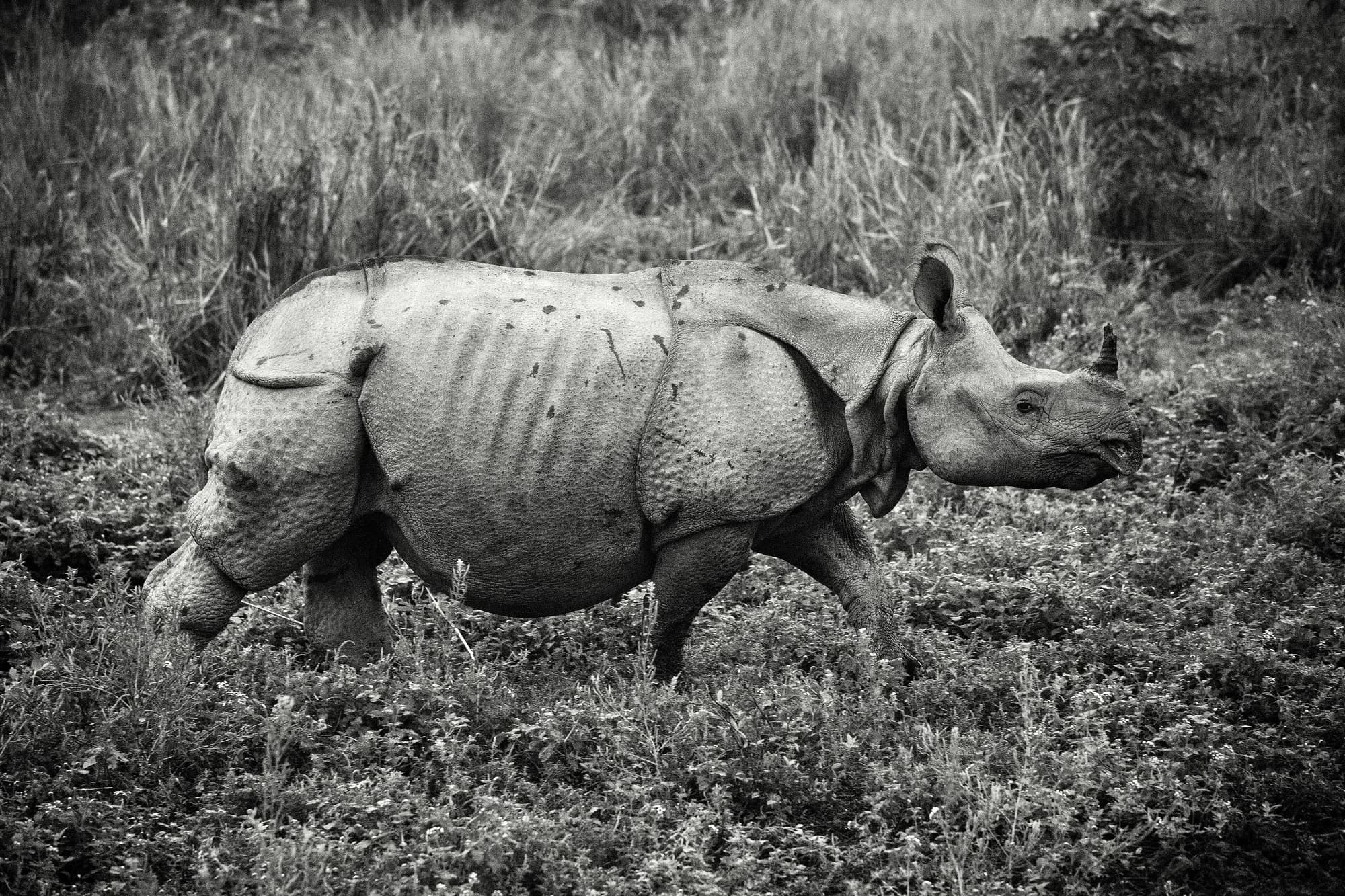
One-horned rhino — where and when
The easiest large mammal in India to see well. Two-thirds of the world's population stands in open grass, in daylight, in one Assam floodplain.
Three reserves, and you hear it first
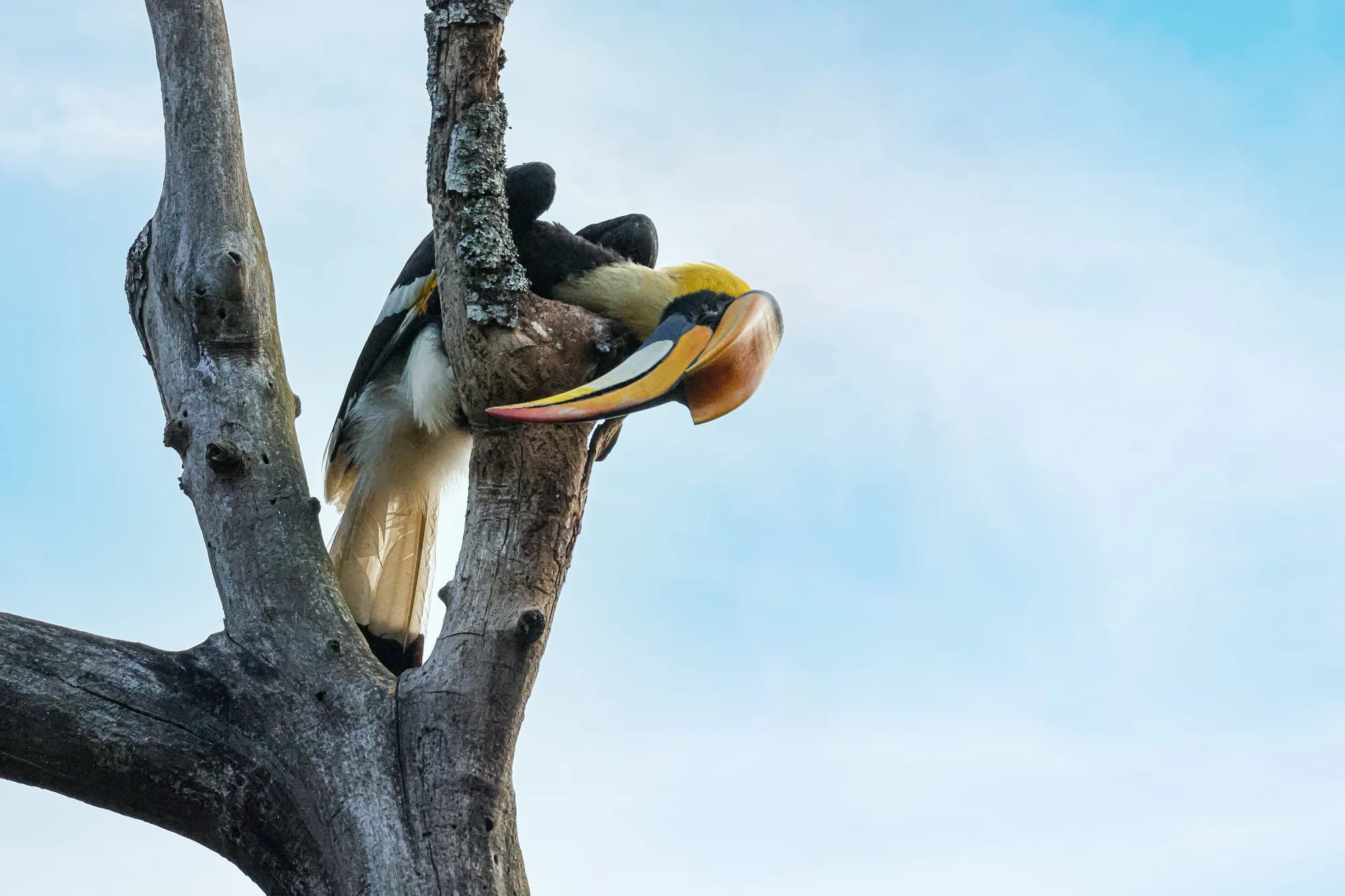
Great hornbill — where and when
The bird non-birders stop the vehicle for. You hear the wingbeats several hundred metres before you see it, and the nesting behaviour is stranger than anything a mammal in the same forest does.
Twelve months, cross-park
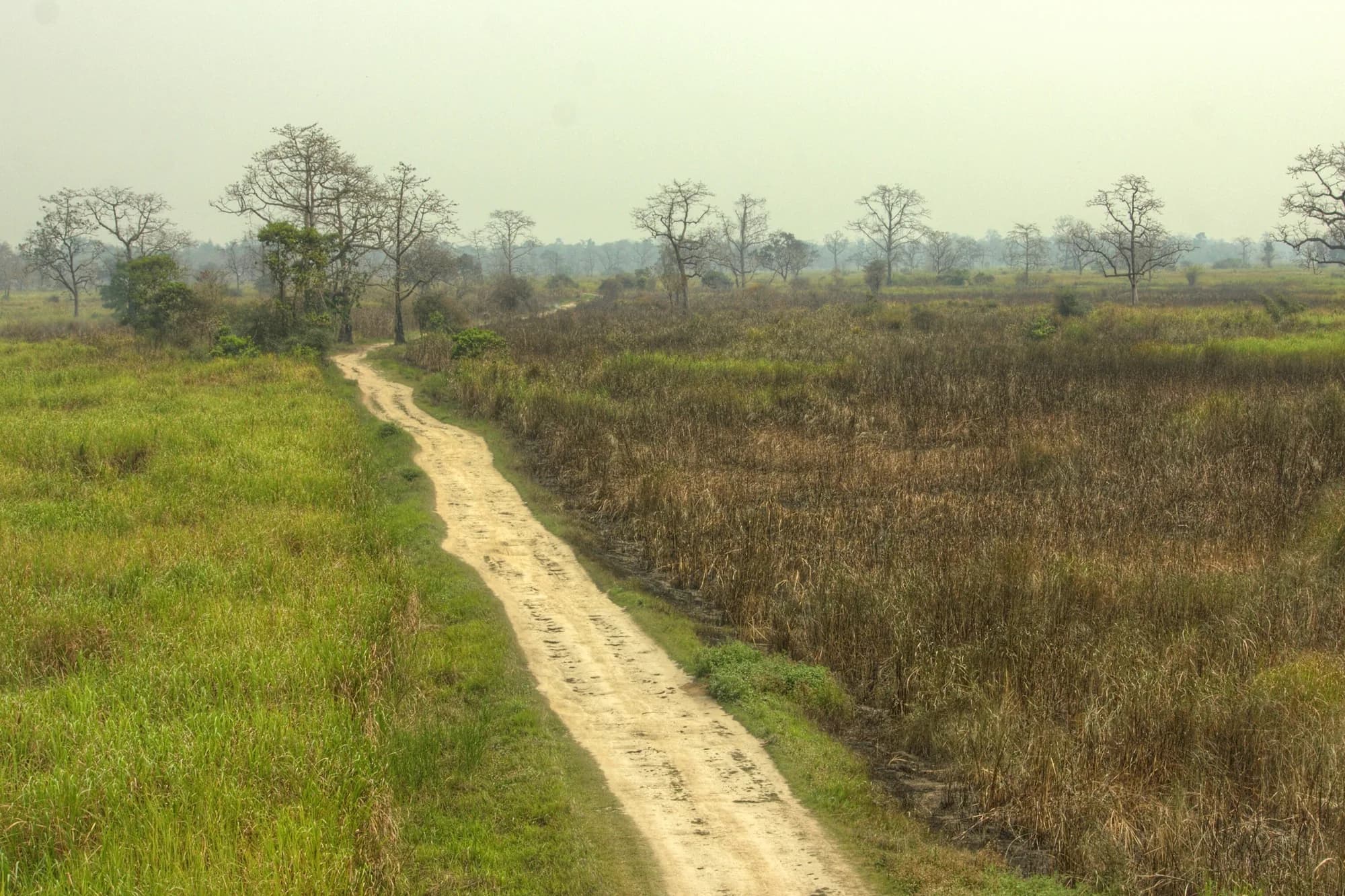
When to go, month by month
The single decision that moves the odds most. Heat, crowds, closures and what is actually open, one page per month.