
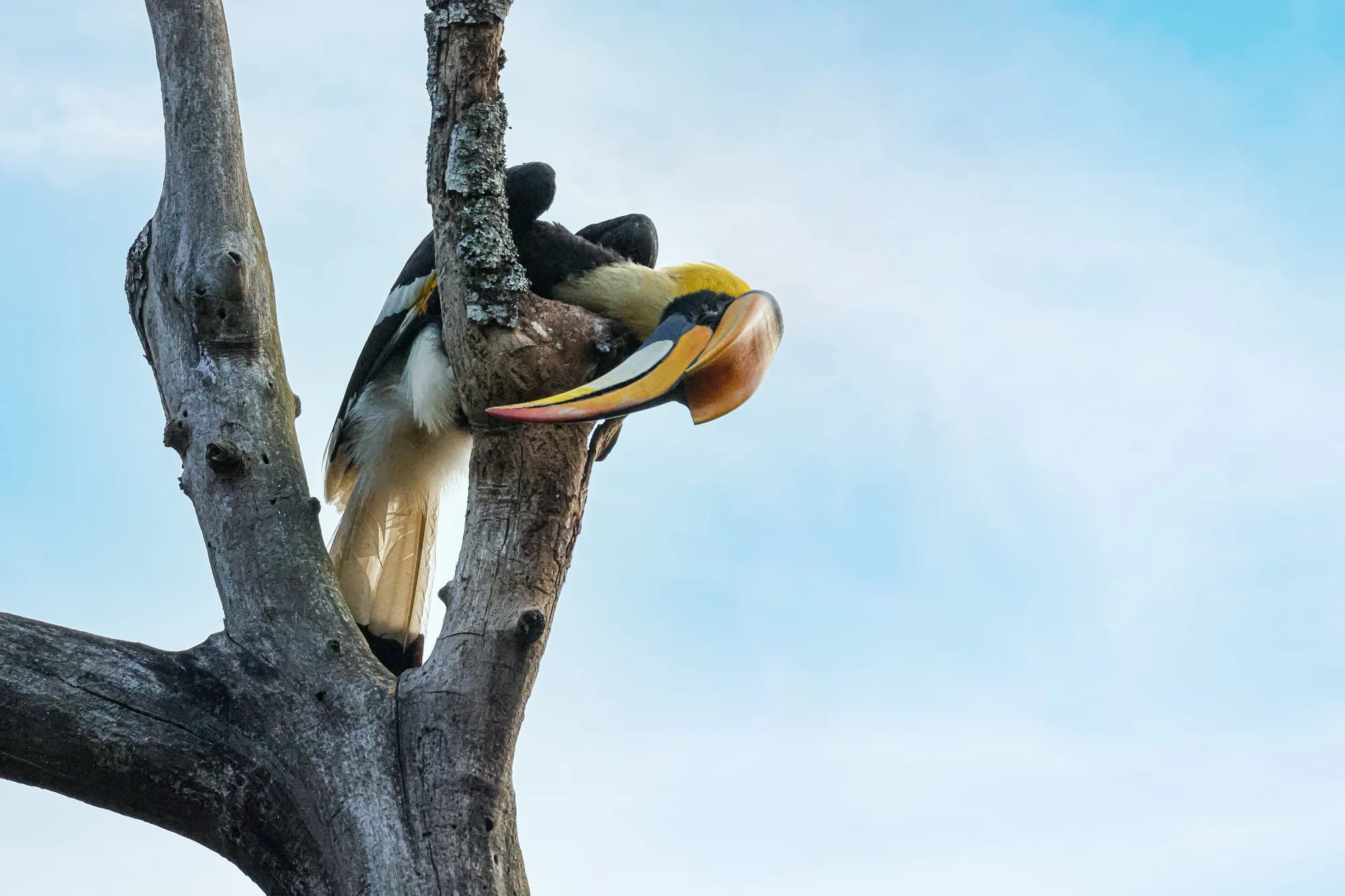
Species · Buceros bicornis
Great hornbill
The bird non-birders stop the vehicle for. You hear the wingbeats several hundred metres before you see it, and the nesting behaviour is stranger than anything a mammal in the same forest does.
Also called
- Dhanesh (धनेश) · Hindi
- Malamuzhakki vezhambal · Malayalam
- Raj dhanesh · Assamese
- Doddha kokku · Kannada
Checked 30 Aug 2026
- Where
- Western Ghats & Northeast
- Best months
- February–May
- Wingspan
- About 1.5 m
- Found by
- Sound, almost always
Two separate strongholds — the Western Ghats and the Northeast — with very little in between, which is why a central Indian trip will not produce one.
Where it is
Where to actually go
Ranked, with the reason each — these are not interchangeable.
- 01PeriyarKeralaThe most reliable great hornbills in India, in forest tall enough to hold them properly, and with lodge staff who track which fig is fruiting.Walk the trails rather than only taking the boat
- 02KazirangaAssamStrong numbers, but only in the forested blocks. A rhino-focused itinerary can spend three days here and never enter the right habitat.Ask specifically for a forest range, not a grassland one
- 03KabiniKarnatakaPresent in the taller stands of Nagarhole, and a good bonus on a trip booked for elephant and leopard.Less reliable than Periyar; better for everything else
Where you will not see one
- The central Indian tiger reservesBandhavgarh, Kanha, Tadoba, Pench, Ranthambore — no great hornbills. The hornbill you see in those forests is the Indian grey or the Malabar pied, both much smaller and neither with the yellow casque.
- Kaziranga's grasslandRight park, wrong habitat. The rhino grassland everyone photographs holds no hornbills; you need the tall forest blocks, which most one-day itineraries never enter.
- Anywhere expecting a toucanDifferent continent, different family, and a much heavier bird. The casque is hollow and light, but the animal is not — a great hornbill in flight sounds like something mechanical.
When to go
When to go
- J
- F
- M
- A
- M
- J
- J
- A
- S
- O
- N
- D
January: good. February: best. March: best. April: best. May: best. June: marginal. July: marginal. August: marginal. September: marginal. October: good. November: good. December: good.
Through the day
- Dawn
- Morning
- Midday
- Afternoon
- Dusk
- Night
Dawn: active. Morning: most active. Midday: usually resting. Afternoon: active. Dusk: active. Night: not normally seen.
Realistic odds on a three-day trip
- Near-certain
- Likely
- Lucky
- Expedition
Telling it apart
Told apart from
Malabar pied hornbill
Western Ghats and central India, often in the same tree
Much smaller, black and white with no yellow anywhere, and a casque that is a flat black-and-cream block rather than the great hornbill's broad yellow shelf. The commonest mix-up in the Ghats.
Wreathed hornbill
Assam and Arunachal
A Northeast problem only. Wreathed hornbills have a plain, ridged casque and a bare throat pouch — blue in the female, yellow in the male — and lack the great hornbill's bold white wing bar in flight.
Oriental pied hornbill
Northeast and the terai
Half the size, mostly black with a white belly, and common around villages and edges where a great hornbill would not be. If it is comfortable near people, it is not this bird.
Marks chosen to be usable from a moving vehicle — a great hornbill is rarely still and never close enough for anything subtler.
What it looks like in the field
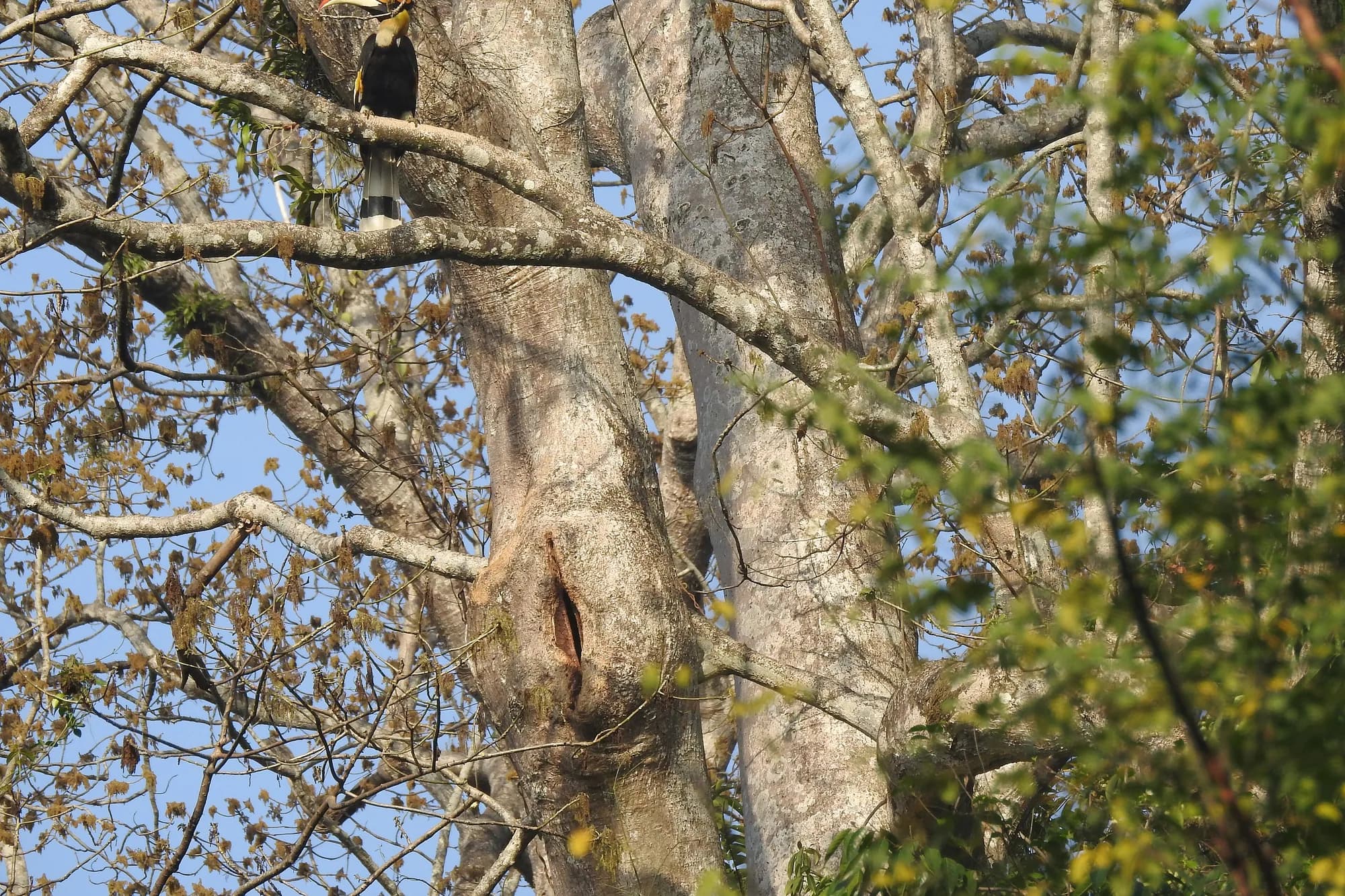
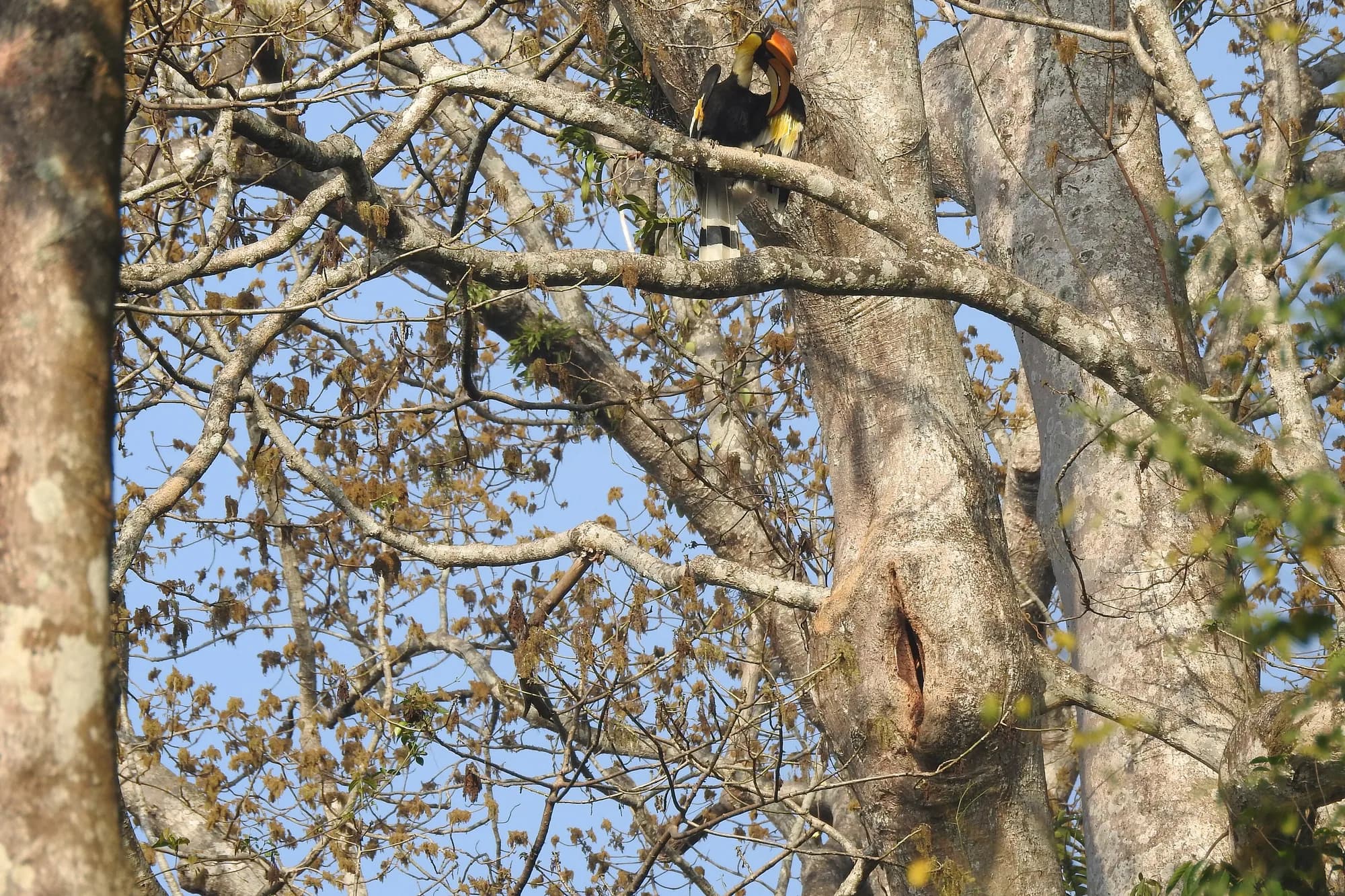
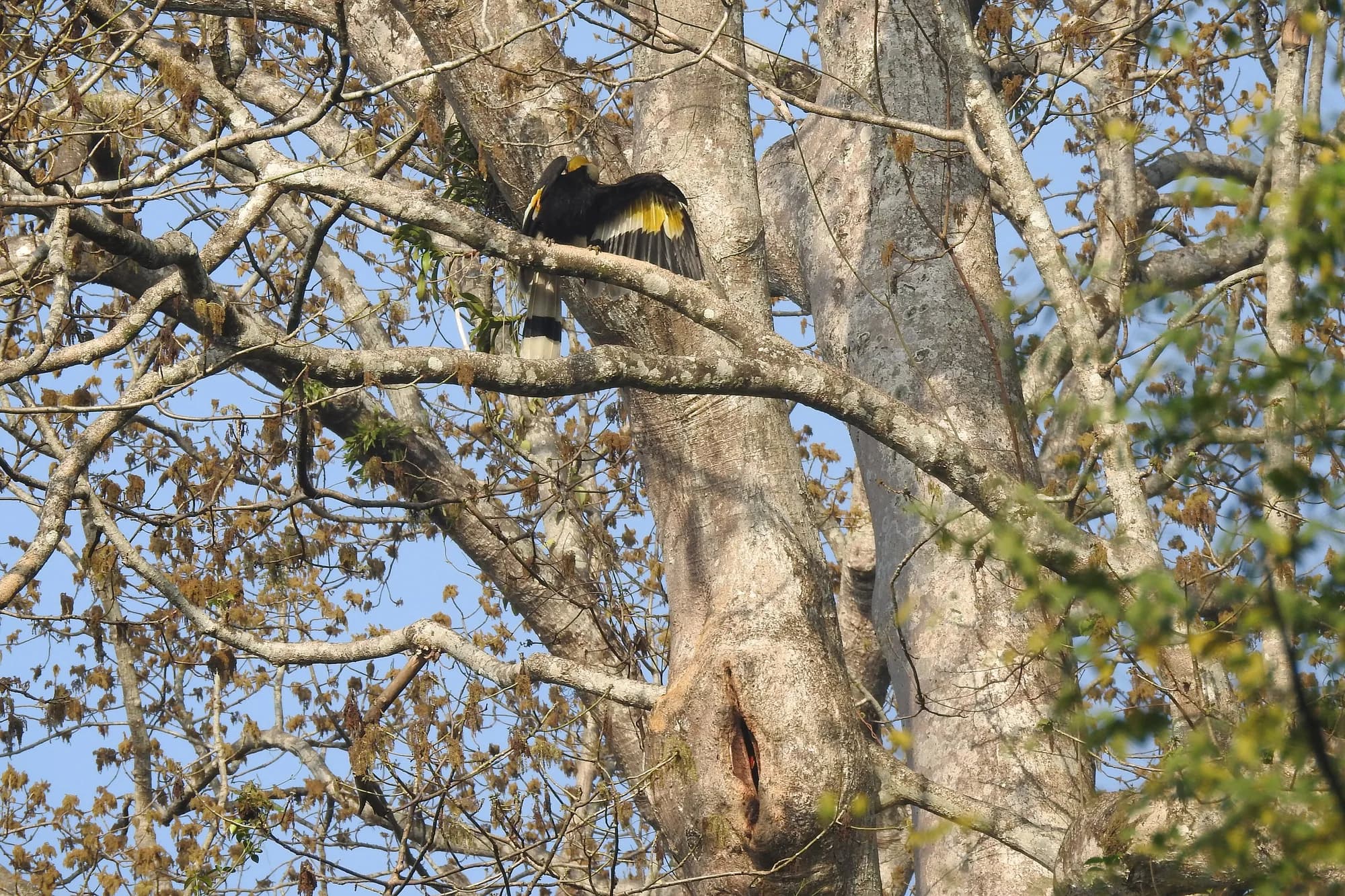
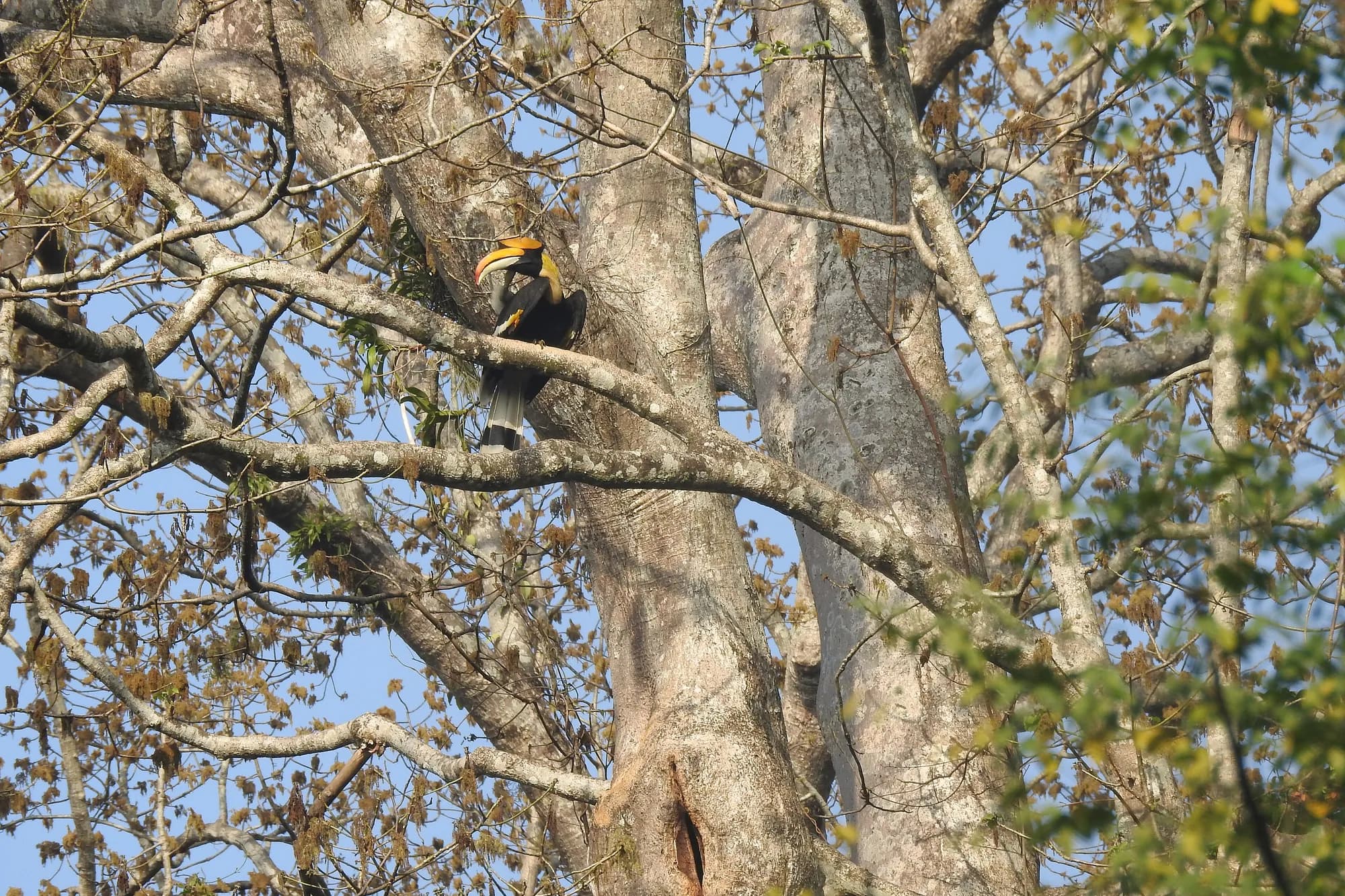
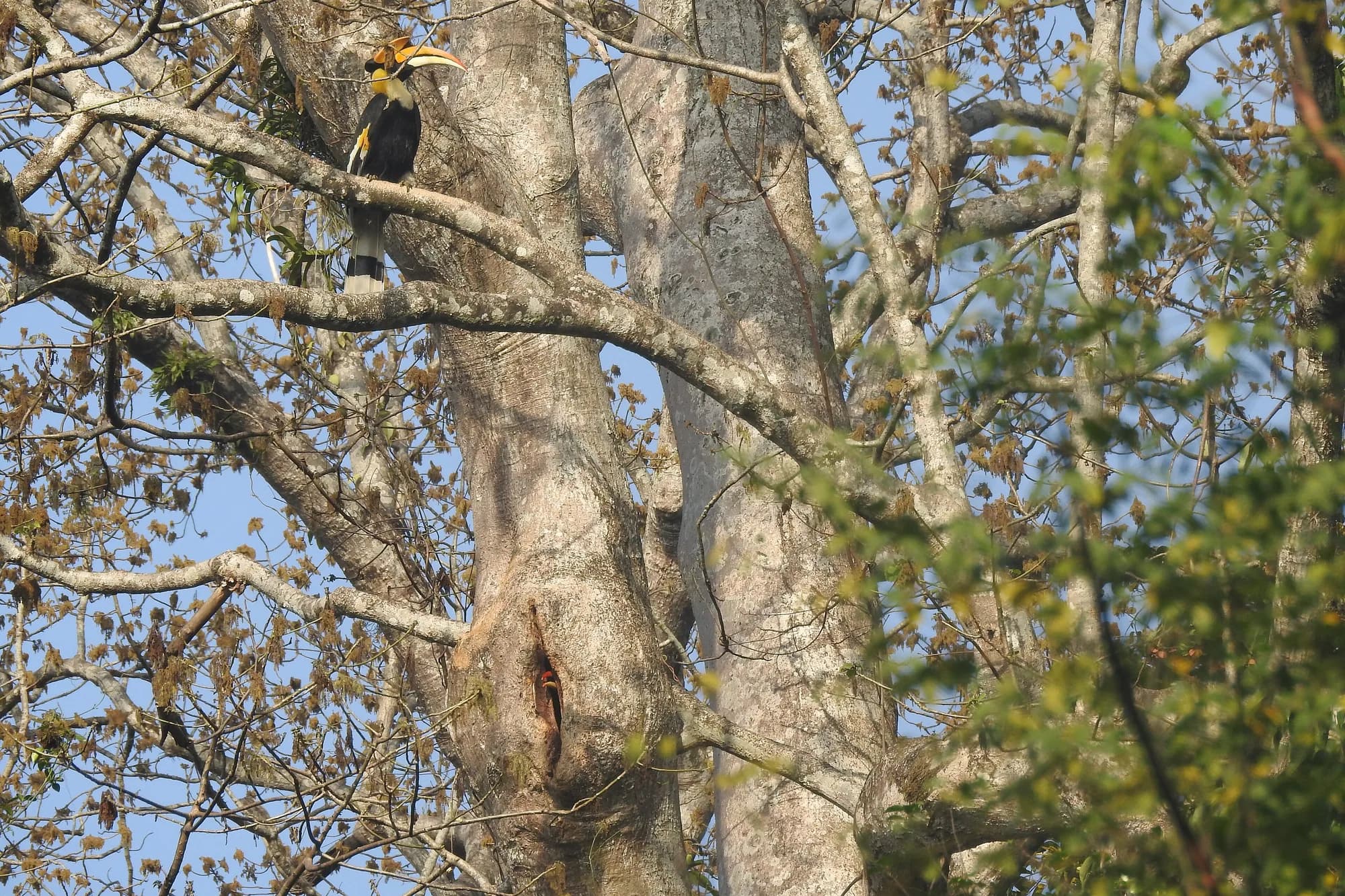
Photographs of Great hornbill in the wild, in Indian reserves. We publish no captive, baited or digitally composited images, and no photograph whose licence we cannot show.
Photographing it
- Lens
- 400–600mm. Flight shots are the ones worth having and they need shutter speed more than reach.
- Typical distance
- Twenty to sixty metres, nearly all of it above you.
- Light
- Canopy dapple and bright sky, so the same problem as every arboreal species here. A bird crossing a valley with forest behind it rather than sky is the frame to wait for.
Where to stopNever approach or linger at a nest tree. The female is sealed inside for months and entirely dependent on the male's visits; a photographer at the base of the tree that stops him delivering is a direct risk to the brood. Watch nest trees from a distance or not at all.
Signs and calls
- Wingbeat
- The single most useful sign in this entry. A great hornbill's wings make a loud, rhythmic whooshing that carries several hundred metres through forest — you will hear it long before anyone sees the bird, and it is unmistakable once learned.
- Nest tree
- A cavity high in a large tree, its entrance sealed with mud and droppings to a vertical slit a few centimetres wide, with staining down the trunk beneath it. Used for years, and worth knowing the location of.
- Call
- A loud, harsh, barking kok repeated and accelerating, often as a duet. Carries as far as the wingbeats and is easier to place in dense canopy.
- Fig litter
- Whole and part-eaten figs dropped in quantity beneath a fruiting tree, with hornbill droppings among them. The tree is the sighting; find the tree.
What a sighting is actually like
Auditory first. The wingbeats arrive as a slow mechanical whooshing from somewhere behind the canopy, everyone in the vehicle looks up, and then a very large black-and-white bird crosses a gap in about two seconds.
People who have shown no interest in birds all week put the phone down for this one.
The better sighting is a fruiting fig, where four or five birds will feed for half an hour and you can watch a male toss a fruit up and catch it at the back of the bill — the trick the huge beak requires, because the tongue is too short to move food any other way.
The sealed nest
The female enters a tree cavity and is walled in by the pair, working from both sides with mud and droppings until only a vertical slit remains. She then moults her flight feathers and stays there for the better part of four months, entirely fed by the male through the gap.
It also explains the range map. Great hornbills need very large, old, hollow trees, which is why they persist in the Ghats and the Northeast and vanish from forest that has been worked — and why their presence is a reasonable shorthand for a canopy that has been left alone.
Status and protection
Status and protection
- IUCN Red List
- Vulnerable
- Population trend
- ↓ Decreasing
- Wildlife Protection Act 1972
- Schedule I (post-2022-amendment numbering)
- CITES
- Appendix I
Species-level assessment of Buceros bicornis; binomial matches, no subspecies issue.
Assessed 2020 · IUCN Red List assessment
What to book to see one
What you would be booking
- How it is seen
- Jeep safari, a walk, or simply standing still near a fruiting tree. This is one of the few species on this list you can genuinely find on foot without a permit at the right lodge.
- Drives to book
- Two or three in the right forest, but weight them to mid-morning rather than first light, and build in time to sit at a fruiting tree.
- Zone or shift
- Tall, unlogged canopy with figs. At Periyar the trails above the lake; at Kaziranga the forested blocks rather than the grassland ranges.
Ask the lodge which fig is fruiting. Hornbill sightings in the Ghats are organised around individual trees, and the staff nearly always know which one is working this week.
Periyar — the park in fullOn the same trip you would also get
- Indian giant squirrel — the same fruiting figs, often in the same twenty minutes
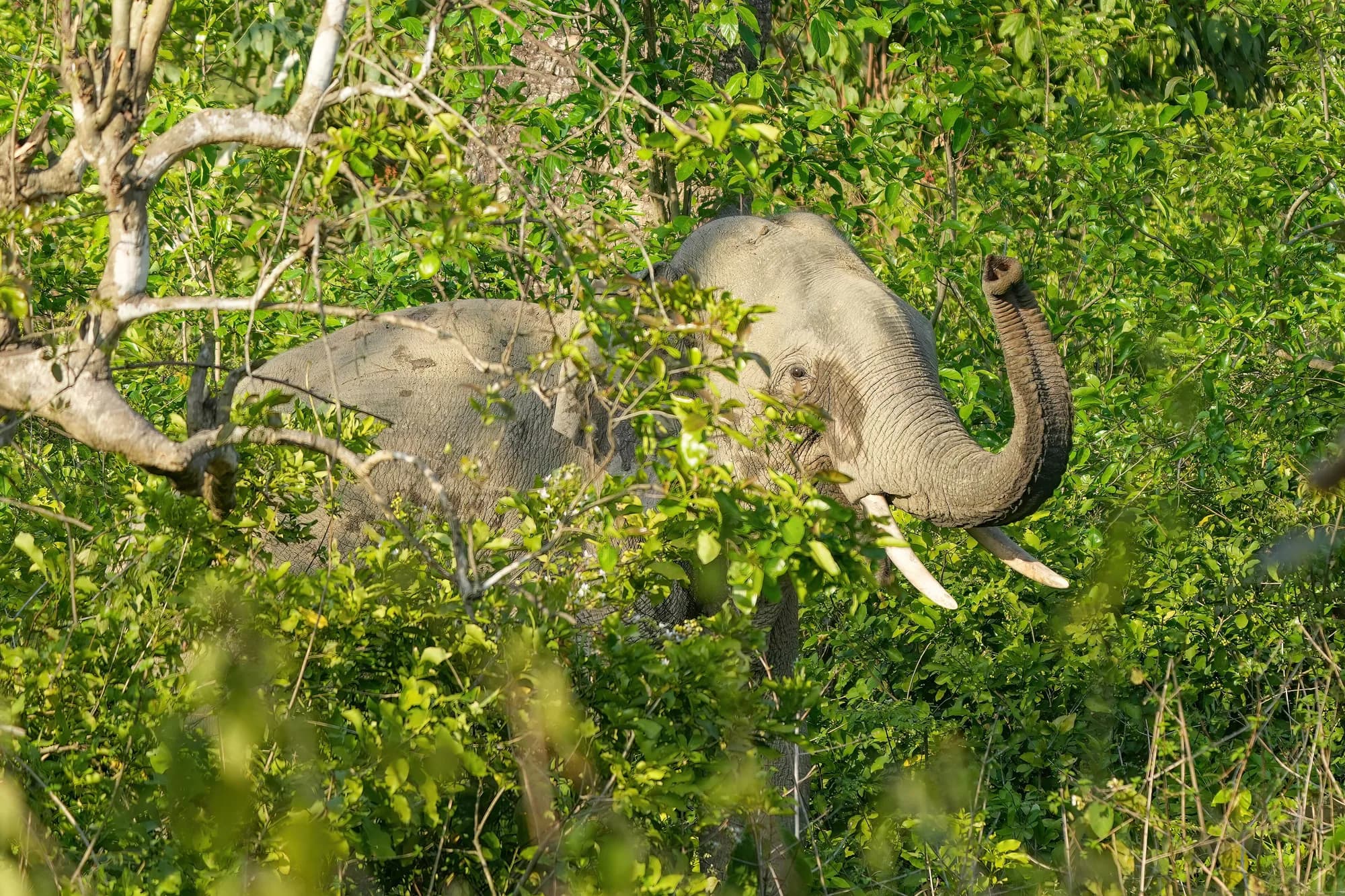
- Indian elephant — Periyar and Kabini both, from the boat or the track
- Malabar grey hornbill — the smaller Ghats endemic, usually in the same forest
Questions people ask
Where can I see a great hornbill in India?
What is the best time of year?
Why is the female sealed into the nest?
Read next
Kerala
Periyar — the park in full
A lake in the Western Ghats, walked and boated rather than driven. Elephants, hornbills and rain — not a tiger destination in any practical sense.
November to February
Birding on an Indian safari
Every reserve here is a birding destination whether or not it is sold as one. Say so when you book.
Assam
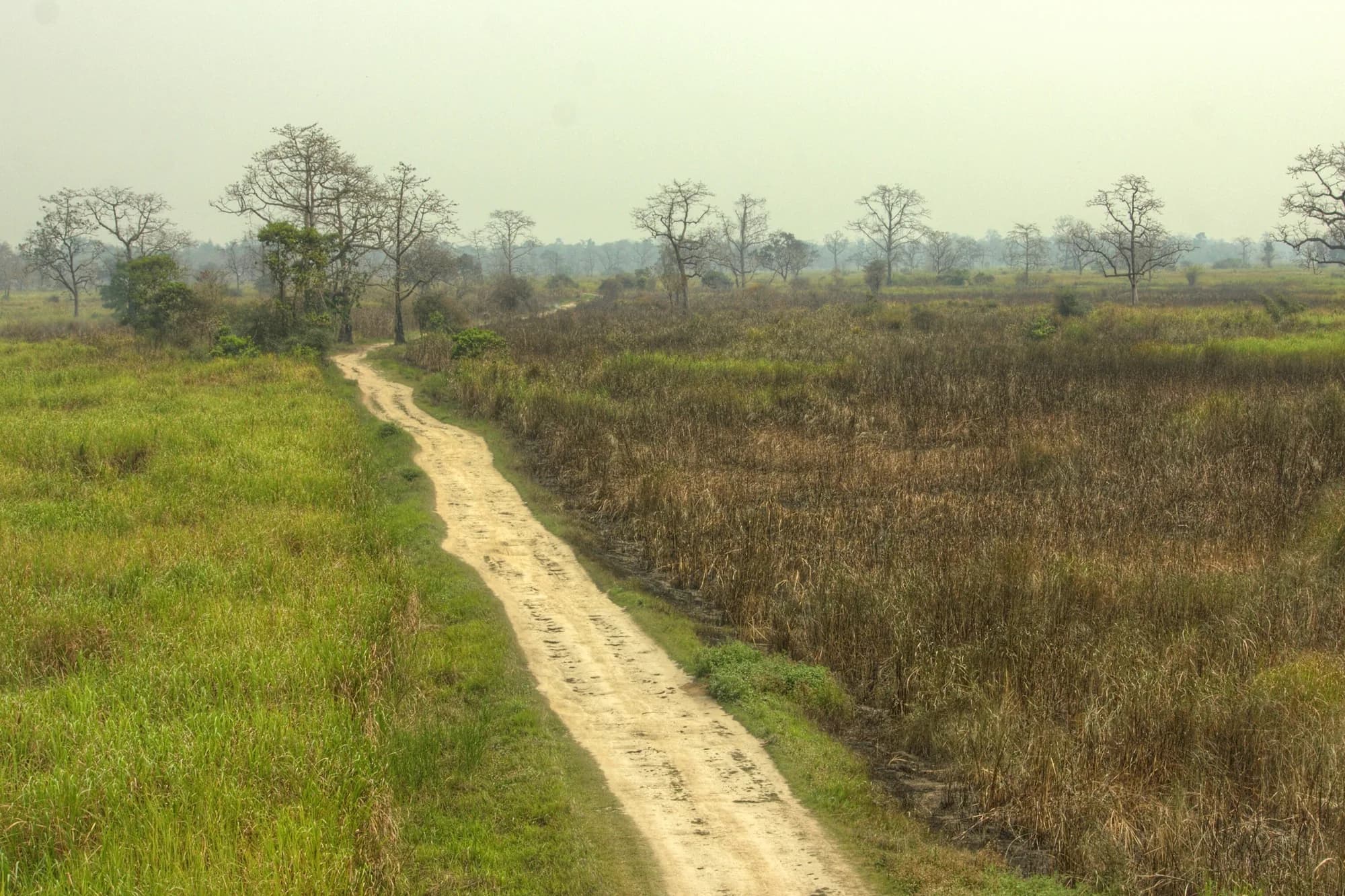
Kaziranga — the park in full
Floodplain grassland, one-horned rhino in daylight, and the one Indian park where the headline animal is close to certain.
Twelve months, cross-park
When to go, month by month
The single decision that moves the odds most. Heat, crowds, closures and what is actually open, one page per month.