
Sri Lanka / Minneriya / Best time to visit — Minneriya
Best time to visit — Minneriya
Late dry season — roughly August to October — is the answer, and it is the only answer. But the Gathering is not a weather event. It depends on a reservoir being drawn down on time, and between 2019 and 2022 it very largely was not.
The year
Minneriya through the year
| Months | Conditions | What it means |
|---|---|---|
| January – March | The tail of the north-east monsoon, then drying | Tank high, bed submerged, elephants dispersed in forest. A thin park |
| April – May | Heating up, water beginning to fall | The turn. Some grass, some elephants, and very few other visitors |
| June – July | Dry, bed emerging | The build. Numbers rising through July in a normal year |
| August – September | Deep dry season, bed widest | The peak of the Gathering, and the busiest weeks of the park's year |
| October | Dry until the rains break | Still strong early, then dispersing. The month the herds most often shift to Kaudulla |
| November – December | North-east monsoon, tank filling | The bed goes under. Water everywhere, nothing concentrated, birds arriving |
The wet season is October to January on the north-east monsoon and the dry season May to September, per the park's Wikipedia article. The month-by-month reading of what that means for a visitor is editorial.
This site's own summary for Minneriya is August to October, and nothing here argues with it. What the rest of this page adds is the part the summary cannot carry: that the window has in recent years been contingent on a decision taken upstream, and that a reader booking a 2026 trip should know the history before they commit a week of a holiday to three hours at a reservoir.
Minneriya National Park, English Wikipedia
Read 28 September 2026. Used for the park's designation dates, its area, its species counts and its climate figures, none of which we could obtain from the Department of Wildlife Conservation itself. Its own elephant figures are contradictory — it gives around 150 to 200 in one place and reports of as high as 700, attributed to Amaranayake 2007, in another — and both are printed in the wildlife page's table of counts rather than reconciled.
https://en.wikipedia.org/wiki/Minneriya_National_ParkWhy the Gathering happens at all
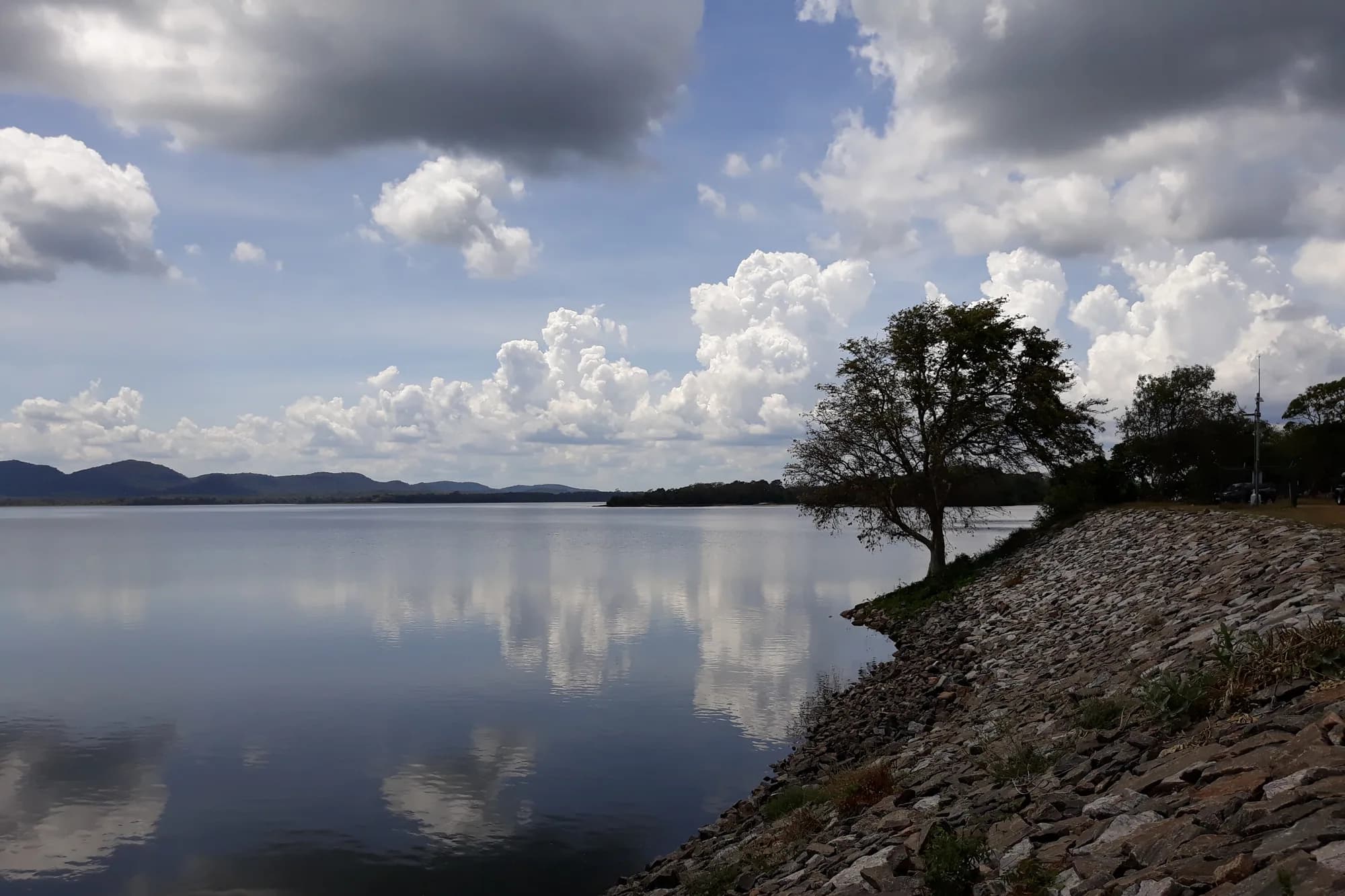
The mechanism is simple and worth understanding rather than memorising. Minneriya sits in the dry zone, which takes its rain from the north-east monsoon late in the year and then goes without. Through the dry months the tank is drawn down for irrigation, and the reservoir floor emerges. Silt that has been under water grows grass fast, and it grows it at the exact moment when the surrounding forest has nothing green in it. Elephants that spend the rest of the year spread across a wide landscape converge on the one place with food and water together.
So the Gathering is not migration and it is not mating. It is a feeding aggregation on a man-made resource, which is why it can be broken by a man-made decision. Everything else about it — the social behaviour, the size of the groups, the spectacle — follows from a large number of animals being in one place with enough to eat.
What the condition actually is
The tank must fall far enough, early enough, and stay down. The Sunday Times, reporting in October 2022, described the gathering as coinciding with the water receding from end June to mid-October. If the water does not recede on that schedule the grass either never appears or is submerged after it does, and there is no aggregation for anyone to photograph. That is the whole dependency, and it is not about rainfall.
Moragahakanda water imperils Minneriya jumbo gathering — The Sunday Times (Sri Lanka), 9 October 2022
Read 28 September 2026. A reported news piece quoting, by name, the Minneriya park warden D.K.P.M. Pradeep Kumara, the then Director-General of the Department of Wildlife Conservation Chandana Sooriyabandara, an Irrigation Department director D. Abeysiriwardena, the environmental campaigner Sajeewa Chamikara and a working safari driver, Asanka Dharmasinghe. Figures attributed to it on these pages are that newspaper's reporting of what those people said in 2022, and are labelled as such.
https://www.sundaytimes.lk/221009/news/moragahakanda-water-imperils-minneriya-jumbo-gathering-498385.htmlThe years the Gathering did not happen
The Moragahakanda reservoir came into operation upstream, and from 2019 water was released into Minneriya during the dry season — Minneriya being used as a holding tank on the way to irrigation in the east. The consequence was that the tank stayed high when it should have been falling, the tank-bed grasslands stayed under water, and the elephants had nothing to gather for. This is reported, on the record, in the Sri Lankan press, and it is the most important thing on this page.
What each source says, and what kind of claim it is
| Figure | Attributed to | What kind of claim |
|---|---|---|
| A peak of around 400 elephants in August and September, historically | Dr Sumith Pilapitiya, former Director-General of the Department of Wildlife Conservation, reported by the Sri Lanka Tourism Alliance, 12 August 2021 | A researcher's account of a former norm |
| Scattered groups of barely 200 at the most, by 2021 | The same source, same date | A researcher's account of the decline |
| Merely 20 elephants at the peak of the Gathering in September 2021, with the tank 88 per cent full | Rohan Wijesinha, Daily FT, 5 September 2022 | A single dated observation, the sharpest figure we found |
| Only around 50 to 70 elephants near the tank in 2022 | Safari driver Asanka Dharmasinghe, quoted in The Sunday Times, 9 October 2022 | A working operator's estimate, not a survey |
| A 90 per cent reduction by 2021; human-elephant conflict up six-fold | The Sunday Times, 16 November 2025 | A newspaper's retrospective summary |
| In full force again in 2024 and 2025 | The Sunday Times, 16 November 2025 | A newspaper's assessment of the recovery |
None of these is a census. We deliberately state no elephant count for the Gathering as a fact of our own, because no survey we could reach publishes one for a given year. Hundreds is defensible in a good year; a specific number attributed to nobody is not.
Two published figures for one study, and they disagree
Srilal Miththapala valued the Gathering economically in 2018. The Sri Lanka Tourism Alliance reports that study as well over Rs 4 billion or USD 22 million a year; the Daily FT reports the same study as USD 20 million, Rs 3 billion. We have not seen the study itself, so we print both and say they disagree rather than quietly picking one. The Daily FT also reports the Gathering supporting more than a thousand safari jeep operators, which is the figure that explains why the collapse was a livelihoods story in Sri Lanka and not only a wildlife one.
Working together to try and save The Gathering — Rohan Wijesinha, Daily FT, 5 September 2022
Read 28 September 2026. Written for the Wildlife and Nature Protection Society, and the source of the single most alarming figure on these pages: twenty elephants at the peak of the Gathering in September 2021, with the Minneriya tank at 88 per cent full. It also reports the Department of Wildlife Conservation holding a seat on the weekly Water Management Committee and declining to attend a conservation meeting on 12 August 2022. Advocacy journalism by a named conservationist, not a departmental statement, and treated here as such.
https://www.ft.lk/Sustainability-Environment/Working-together-to-try-and-save-The-Gathering/10519-739465Sri Lanka — home to the largest Asian elephant gathering: but for how long? — Sri Lanka Tourism Alliance, 12 August 2021
Read 28 September 2026. A tourism industry body writing about a tourism asset, so read it with that in mind. It is cited here for two things it attributes to named people: Dr Sumith Pilapitiya, a former Director-General of the Department of Wildlife Conservation, on the fall from a peak of four hundred elephants to barely two hundred, and Srilal Miththapala's 2018 valuation of the Gathering. Its figure for that valuation does not match the Daily FT's figure for the same study, and both are printed on these pages.
https://www.srilankatourismalliance.com/news-and-updates/sri-lanka-home-to-the-largest-asian-elephant-gathering-but-for-how-long/Bring about a National Policy beneficial to humans and wild elephants before the next Dry Season — Kumudini Hettiarachchi, The Sunday Times (Sri Lanka), 16 November 2025
Read 28 September 2026. This is the most recent account of the Gathering we could find from a Sri Lankan newspaper of record, and it is the source for the recovery: it reports that the Gathering, having been reduced by ninety per cent, was out in full force in 2024 and 2025. It also reports that no national policy yet binds the water releases that caused the collapse, which is why these pages treat the recovery as a good run rather than a settled fact.
https://www.sundaytimes.lk/251116/news/bring-about-a-national-policy-beneficial-to-humans-wild-elephants-before-the-next-dry-season-621261.htmlThe recovery, and how firmly to trust it
The good news is real. The Sunday Times, writing in November 2025, reports that the Gathering — once reduced by ninety per cent — was out in full force in 2024 and 2025, and that this was achieved without depriving any farmer of water. The mechanism was coordination rather than sacrifice: the Water Management Committee, which decides releases into and out of the reservoirs, adjusting the timing so that the tank bed is exposed when it needs to be.
The qualification is equally real, and it comes from the same article. There is no national policy binding any of it. The same piece reports Dr Sumith Pilapitiya urging the President to bring one in before the next dry season, which is a thing you only have to urge when it does not exist. Two good years produced by goodwill on a weekly committee are two good years, not a guarantee. The Daily FT reported in 2022 that the Department of Wildlife Conservation holds a seat on that weekly committee and had declined to attend a conservation meeting on 12 August 2022, which is a useful measure of how contingent the coordination has been.
What this means for a 2026 booking, said plainly
Go in the Gathering months and expect a good one, because the last two reported seasons were good. Do not build a two-week Sri Lanka trip whose emotional centre is one afternoon at Minneriya, because the mechanism that produces it is administrative and was broken as recently as 2022. Build the trip so that a poor Minneriya afternoon is a disappointment rather than a ruin — which in practice means Udawalawe or a second park somewhere in the itinerary.
Bring about a National Policy beneficial to humans and wild elephants before the next Dry Season — Kumudini Hettiarachchi, The Sunday Times (Sri Lanka), 16 November 2025
Read 28 September 2026. This is the most recent account of the Gathering we could find from a Sri Lankan newspaper of record, and it is the source for the recovery: it reports that the Gathering, having been reduced by ninety per cent, was out in full force in 2024 and 2025. It also reports that no national policy yet binds the water releases that caused the collapse, which is why these pages treat the recovery as a good run rather than a settled fact.
https://www.sundaytimes.lk/251116/news/bring-about-a-national-policy-beneficial-to-humans-wild-elephants-before-the-next-dry-season-621261.htmlOutside the Gathering months, Minneriya is a modest park
We are going to be blunt, because this is the sentence that would have saved a great many readers an afternoon. From roughly November to May, Minneriya is a pleasant, unremarkable dry-zone park with elephants in it. The tank is high, the grass bed is under water, the herds are dispersed through the forest, and a three-hour drive may produce a handful of elephants at distance, chital, peafowl, buffalo and a lot of bush. That is a perfectly reasonable afternoon. It is not what the brochures are describing and it is not worth reorganising an itinerary for.
What Minneriya gives you, by season
| When | What you will probably see | Is it worth the fee |
|---|---|---|
| August to October, in a good year | Large aggregations on the tank bed in the late afternoon; the thing itself | Yes, unreservedly. This is one of Asia's great wildlife events |
| June to July | Building numbers, growing bed, far fewer vehicles | Often the best value of the year, and underrated |
| April to May | Modest numbers, the bed beginning to appear | A reasonable afternoon if you are in the Cultural Triangle anyway |
| November to March | Scattered elephants in forest, waterbirds, chital, a high tank | Only if you are here for something else. Go to Udawalawe for elephants |
Editorial judgements. We hold no sightings data for Minneriya and quote none; this is an honest account of what the park delivers when, and the seasonality of the tank behind it is the mechanism described above.
Go to Udawalawe instead
If elephants are the point and your dates fall outside August to October, the right park is Udawalawe, in the south. It has resident elephants in open grassland all year round and does not depend on a reservoir being drawn down on schedule. It is a long way from the Cultural Triangle, which is the real cost of the advice. But a reference site that lets you book a March afternoon at Minneriya in the expectation of the Gathering is not being useful to you.
Travelling for something other than elephants
- Waterbirds: the wet months, roughly November to March, when the tank is full and migrants are in. The season that ruins the Gathering makes the birding.
- Chital and buffalo: any month. They are the constant of the park and they are everywhere.
- Toque macaque and purple-faced langur: any month, in the forest stretch of the drive rather than on the bed.
- Leopard and sloth bear: both are recorded here, and both are genuinely unlikely on a three-hour afternoon among a hundred vehicles. Do not come for them.
- Photography of the Gathering: late September and early October, when numbers are still high, the light is at its best late and the crowd has thinned slightly from the August peak.
The two peaks pull against each other
Minneriya's elephant season and its bird season are opposites, because they depend on opposite states of the same reservoir. Nobody can have both on one visit and any itinerary that claims otherwise is selling you the average of two good things. Pick the one you came for.
Crowds, and whether there is a closure
Weather is only half of when to come. The other half is how many jeeps are on the tank bed with you at five in the afternoon, and in August and September that number is large. Minneriya and Kaudulla together are among the most visited wildlife destinations in Sri Lanka, and the Gathering is on a very high proportion of foreign itineraries in those months. The crowd calendar follows European holidays, Sri Lankan school holidays and poya days.
- Weekdays are lighter than weekends, consistently, and it is the cheapest improvement available.
- Late in the season, from about the second half of September, numbers are still good and the peak crowd has thinned.
- A morning drive is very much quieter and very much less productive. That is a real trade and some people should take it.
- The Cultural Triangle as a whole is busiest when Sigiriya is busiest, which loads the roads as well as the park.