
Sri Lanka / Wilpattu / Wildlife — Wilpattu
Wildlife — Wilpattu
Wilpattu holds leopards at a density that stands comparison with anywhere in the species' range, and hides most of them in dry evergreen forest. The gap between what is there and what you see is the subject of this park.
The leopards, and the numbers behind the claim
The leopard here is Panthera pardus kotiya, the Sri Lankan subspecies, found on this island and nowhere else, and the apex predator on it — no tiger, no lion, nothing to push it off a kill. What is unusual about Wilpattu is that its leopard population has actually been surveyed since the park reopened, which is more than can be said for most of the density claims made about Sri Lanka.
Published survey figures for Wilpattu leopards
| Figure | Survey | What kind of claim it is |
|---|---|---|
| 49 individual leopards photographed | Remote camera survey, July to October 2015 | A count of individuals identified in the surveyed area — not a population estimate for the park |
| 133 individual leopards, estimated density 18 per 100 sq km | Survey of May to September 2018 | An identified count plus a modelled density estimate |
| 750 to 900 adult leopards remaining | Population estimate for the Sri Lankan subspecies across the whole island, reported 2016 | A national estimate, not a Wilpattu figure — included because it is the number the Wilpattu figures should be read against |
The 2015 and 2018 survey figures are as reported in the English Wikipedia article on the park, read 28 September 2026, which attributes them to those surveys; we could not read the primary journal paper, which returned HTTP 403 on the same day. The national estimate is from Mongabay's 2016 report on post-war carnivore research in Sri Lanka, read the same day. These are three different kinds of claim and they are labelled accordingly rather than blended into one number.
What a density figure does and does not tell you
Eighteen leopards per hundred square kilometres is a high figure by the standards of published estimates for the species. It is not a sightings probability. Density measures how many cats are on the ground; whether you see one depends on how much of the ground you can see into, and around seventy per cent of Wilpattu is dry evergreen forest and thorn scrub. Yala's Block 1 is famous because it combines high density with open country. Wilpattu has the first half of that and not the second, and everything on this page follows from that single sentence.
Wilpattu National Park, English Wikipedia
Read 28 September 2026. Cited here only for figures it attributes to a named survey or study, and always labelled as such, because we could not reach the primary source: the journal paper behind the leopard density figure returned HTTP 403 on the same day. Where Wikipedia and the department's own 2018 guide disagree — and on the number of villus and the closure dates they do — both are printed and the disagreement is stated.
https://en.wikipedia.org/wiki/Wilpattu_National_ParkLeopards and landmines: post-war carnivore research in Sri Lanka — Mongabay, September 2016
Read 28 September 2026. Reports the Wilderness and Wildlife Conservation Trust's work in Wilpattu after the park reopened, including 49 individual leopards identified across 836 camera days in an area of 500 sq km, and a national estimate of 750 to 900 adult Sri Lankan leopards remaining. Journalism reporting researchers' figures, not a primary paper.
https://news.mongabay.com/2016/09/leopards-and-landmines/Why a Wilpattu leopard is harder — and the trade, stated plainly
This site sends readers here from the Yala pages, so it owes them an honest account of the cost of taking that advice. Here it is. Leopard sightings at Wilpattu are genuinely harder and less frequent than in Yala's Block 1. Not marginally — materially. Three things cause it and none of them is going to change.
- Size. Wilpattu is over 1,300 square kilometres against a Block 1 that a driver can work in a morning. The same number of leopards spread over that area is a different search problem.
- Cover. Around seventy per cent of the park is dry evergreen forest and deciduous thorn scrub. You cannot see into most of it, and neither can your tracker.
- Speed and distance. A 25 km/h limit across a very large park means fewer kilometres of track covered per hour of daylight than in a small open one.
The trade, as honestly as we can put it
| Yala Block 1 | Wilpattu | |
|---|---|---|
| Chance of a leopard in a day | Good, and strong over three sessions | Materially lower, and it stays lower over three days |
| Vehicles at a sighting | Often many, converging on a radio call | Few |
| How a cat is usually found | The radio network, then everyone drives to it | Your own tracker, your own alarm call, your own villu |
| Habitat | Open thorn scrub, rock outcrops, coast | Closed dry evergreen forest, opening at the villus |
| What you take home | Almost certainly a leopard photograph | Possibly nothing, possibly the best hour of the trip |
Editorial comparison. We hold no per-park sightings-rate data for either park and quote none; the density figures above are population measures, not sighting probabilities.
Whether the trade is worth taking
It depends entirely on what you came for, and the honest split is this. If you have one shot at seeing a wild leopard in your life, go to Yala's Block 1 and be first through the gate; Wilpattu will very possibly not deliver. If you have seen a leopard, or if what you actually want is a wilderness with a leopard somewhere in it rather than an animal in a queue, come here. Most people who make the swap and are disappointed made it for the wrong reason — they wanted the same sighting with fewer jeeps, and that is not on offer. What is on offer is a different and better drive with a worse hit rate.
Sloth bear, and the palu
Wilpattu is widely held to be the better of the two big leopard parks for sloth bear, and there is a reasonable structural case for it rather than only an assertion. The department's own guide lists the sloth bear as one of the park's three headline mammals and describes the large palu tree, Manilkara hexandra, as conspicuous in a forest that covers around seventy per cent of the park. Palu fruit is what brings sloth bears into the open in daylight. A very large park in which the relevant tree is conspicuous throughout is, on the face of it, a better bet than one in which it is present.
The fruiting window is roughly June and July. Outside it a sloth bear is a piece of luck anywhere in Sri Lanka: nocturnal, shy, and in thick cover. Inside it, bears feed in fruiting trees during the day and the odds move from negligible to worth hoping for. It is one of the more specific seasonal windows in Asian wildlife viewing and it is the single best reason to put Wilpattu in June or July rather than in February.
How firmly we are prepared to say Wilpattu beats Yala for bears
Qualitatively, and no further. We could not find a survey, a sightings record or a departmental statement that compares sloth bear encounter rates between the two parks, and the sources that assert it most confidently are operators with a Wilpattu product to sell. What we can stand behind is the department's own description of the habitat — palu conspicuous through seventy per cent forest cover, sloth bear named as one of the park's three principal large mammals — and the observation that the palu window is the same June-to-July window in both parks. If you are planning a trip around a bear, plan it around the month first and the park second.
They are not gentle and not slow
A sloth bear surprised at close range is dangerous in a way a leopard generally is not, and the rule about staying in the vehicle exists for this animal as much as for any other. The department's guide restricts you to designated stopping points precisely because the alternative is people wandering about in bear country.
Wilpattu National Park Information Guide — published by the Wilpattu National Park & Influence Zone Management Project, Department of Wildlife Conservation and GIZ Sri Lanka, author GOPA / Dr Nishanthi Perera, copyright 2018
Read in full on 28 September 2026. This is the closest thing to an official Wilpattu visitor document we could obtain: the Department of Wildlife Conservation co-published it and its Battaramulla address and telephone number are on the imprint alongside GIZ's. It carries no fee schedule. It is dated 2018, so facilities, counts and seasonal statements in it are eight years old and are labelled as 2018 figures wherever they appear on these pages.
https://snrd-asia.org/wp-content/uploads/2021/08/Visitor-information-guide-ENG.pdfElephant, and the wider cast
The department's guide describes the Wilpattu area — the park together with the Mavillu Conservation Forest, Wilpattu West Sanctuary and Thabbowa Sanctuary around it — as one of the most important elephant habitats in the country. Elephants here are forest elephants rather than the open-grassland animals of Udawalawe: seen less often, at shorter range, and usually at or near a villu.
Recorded species, from the department's 2018 guide
| Group | Species recorded |
|---|---|
| Mammals | 45 |
| Birds | 253 |
| Reptiles | 57 |
| Amphibians | 17 |
| Freshwater fish | 23 |
| Plants | 621 |
As stated in the Department of Wildlife Conservation and GIZ visitor guide, 2018. These are recorded-species counts for the park and its surroundings, not abundance estimates, and they are eight years old.
- Spotted deer, described in the guide as scattered herds found throughout the park — the backbone of the prey base and the animal whose alarm call finds you a leopard.
- Sambar, larger and scarcer, in heavier cover.
- Wild boar, common and often in the open at a villu margin.
- Water buffalo, in and around the villus.
- Mugger crocodile, described in the guide as the most noteworthy reptile in the park.
- Grey langur and toque macaque, the latter endemic, and frequently the noise that gives a predator away.
- Golden jackal, seen more often than most visitors expect.
Deer numbers and the war
Mongabay's 2016 report on post-war research in Sri Lanka records researchers saying that deer herds in Wilpattu are smaller than they used to be, following bushmeat hunting during the years the park was closed, while noting that conclusive data is unavailable. That is worth knowing because the prey base is the whole explanation for a predator density, and it suggests the park's carrying capacity may still be recovering. It is a researcher's impression reported in journalism, not a measurement, and we present it as such. The species counts above are from the department's own 2018 guide, which is carried as a source elsewhere on this page.
Leopards and landmines: post-war carnivore research in Sri Lanka — Mongabay, September 2016
Read 28 September 2026. Reports that during the war development did not occur and people moved out of the area, allowing forested areas to remain intact, but that bushmeat hunting occurred and deer herds are smaller than they used to be, with conclusive data unavailable.
https://news.mongabay.com/2016/09/leopards-and-landmines/Birds
253 bird species are recorded for Wilpattu and its surroundings in the department's guide, and the villus are why. A sand-rimmed shallow lake with a grassy margin is close to a purpose-built waterbird habitat, and the park has dozens of them in a range of water chemistries. Wilpattu is a better birding park than its leopard reputation suggests, and the birding is the part of a quiet drive that stops it being a quiet drive.
- Sri Lanka junglefowl, the endemic national bird, on and beside the tracks.
- Painted stork, Asian openbill, little cormorant and the rest of the villu waterbird cast.
- Sri Lanka green pigeon, grey hornbill, black-capped bulbul, brown-capped babbler, Ceylon hanging-parrot, Ceylon small barbet, crimson-backed flameback, Ceylon swallow and Ceylon woodshrike — the endemics the department's guide lists for the park and its surroundings.
- Raptors through the forest and over the open villu margins.
- Waders and waterfowl when the villus are full, which is to say at the wrong end of the year for mammals.
If birds are the actual point
Wilpattu rewards a birder who is already there and is not the first place you would go if birds were the only reason for the trip. Bundala in the deep south is a coastal lagoon system built for exactly this, and Kumana on the east coast is better again. What Wilpattu offers that neither does is a long list in dry-zone forest and villu habitat, with a chance of a leopard walking through it.
Wilpattu National Park Information Guide — published by the Wilpattu National Park & Influence Zone Management Project, Department of Wildlife Conservation and GIZ Sri Lanka, author GOPA / Dr Nishanthi Perera, copyright 2018
Read in full on 28 September 2026. This is the closest thing to an official Wilpattu visitor document we could obtain: the Department of Wildlife Conservation co-published it and its Battaramulla address and telephone number are on the imprint alongside GIZ's. It carries no fee schedule. It is dated 2018, so facilities, counts and seasonal statements in it are eight years old and are labelled as 2018 figures wherever they appear on these pages.
https://snrd-asia.org/wp-content/uploads/2021/08/Visitor-information-guide-ENG.pdfThe water, and the marine edge
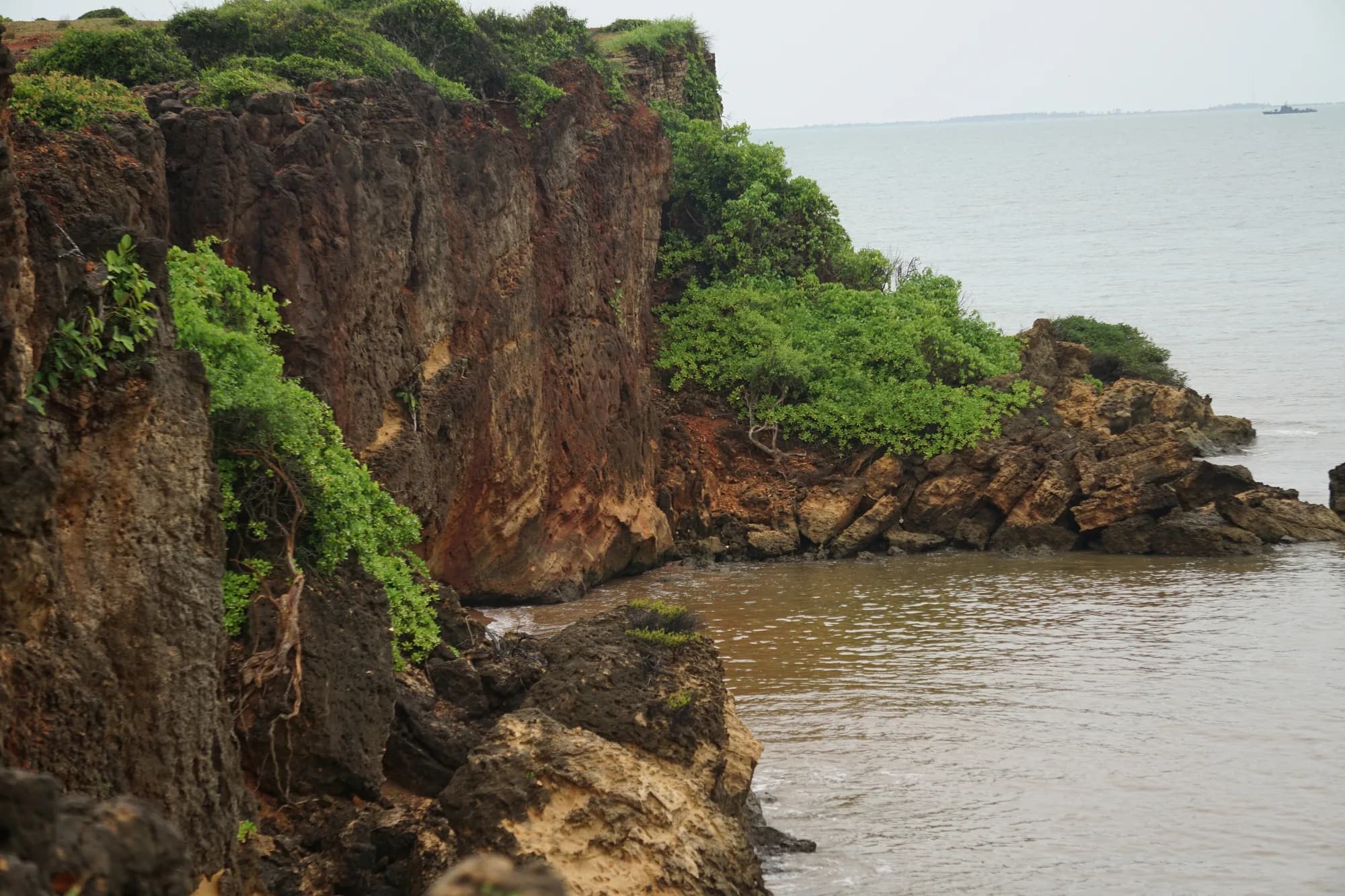
Wilpattu is a Ramsar site. The department's guide records that in 2013 the whole park, together with its bordering sea and islands within 10 km offshore and the Mahavilachchiya tank, was declared a wetland of international importance under the Ramsar Convention. That designation is about the villus, the Kala Oya estuary — which holds one of the largest mangrove forests in Sri Lanka — and the shallow, productive sea off the western edge.
- Mugger crocodile in the villus, easiest to see when the water is low and they are out on the sand rims.
- Land and water monitor, both common and both larger than first-time visitors expect.
- Dugong in the sea grass beds off the coast, listed as globally endangered in the guide.
- Indo-Pacific humpbacked dolphin in the shallow water.
- Olive ridley and green turtle, both recorded in the same waters.
The marine species are a designation, not a product
The dugong, the dolphins and the turtles are in the guide because they are part of what the Ramsar listing protects. They are not something a Wilpattu game drive shows you. We found no boat trip operating from inside the park that we could verify, and Kudiramale Point on the coast is a designated stopping place on a long drive rather than a marine-viewing platform. Do not book Wilpattu expecting to see a dugong.
Wilpattu National Park Information Guide — published by the Wilpattu National Park & Influence Zone Management Project, Department of Wildlife Conservation and GIZ Sri Lanka, author GOPA / Dr Nishanthi Perera, copyright 2018
Read in full on 28 September 2026. This is the closest thing to an official Wilpattu visitor document we could obtain: the Department of Wildlife Conservation co-published it and its Battaramulla address and telephone number are on the imprint alongside GIZ's. It carries no fee schedule. It is dated 2018, so facilities, counts and seasonal statements in it are eight years old and are labelled as 2018 figures wherever they appear on these pages.
https://snrd-asia.org/wp-content/uploads/2021/08/Visitor-information-guide-ENG.pdfWhat Wilpattu does not have
- No tiger, no lion, no other large cat. The leopard is alone at the top, and it behaves accordingly.
- No rhino and no great ape. Sri Lanka has neither.
- No night drives. The stated hours are 6 am to 6 pm.
- No walking. The guide names two designated places where you may leave the vehicle and rules out everywhere else.
- No open plains full of animals. This is a forest park with lakes in it, and the open ground is measured in hectares rather than square kilometres.
- No guarantee of a leopard, and a materially lower chance of one than Yala offers.
- No Gathering. If hundreds of elephants in one place is what you want, that is Minneriya and Kaudulla in the late dry season, not here.