
Uganda / Murchison Falls / Sightings log — Murchison Falls
Sightings log — Murchison Falls
The river does most of the work here. Hippo, crocodile and giraffe are close to certain; lion is a real search; the shoebill is a bird you go to a specific place in a specific season for.
The reliable half, and why it is reliable
Murchison has an unusually high floor for a savanna park, and the reason is geometric rather than lucky. A large river runs through the middle of a hot, low, dry park. Everything that drinks has to come to it, and the boat runs along it. You are not searching a landscape; you are sitting on the one edge the landscape converges on.
What the river and the north bank actually deliver
| Animal | Where | How likely |
|---|---|---|
| Hippopotamus | The reach below the falls; UWA calls them permanent residents | Near-certain on any launch. Paraa means home of the hippo. |
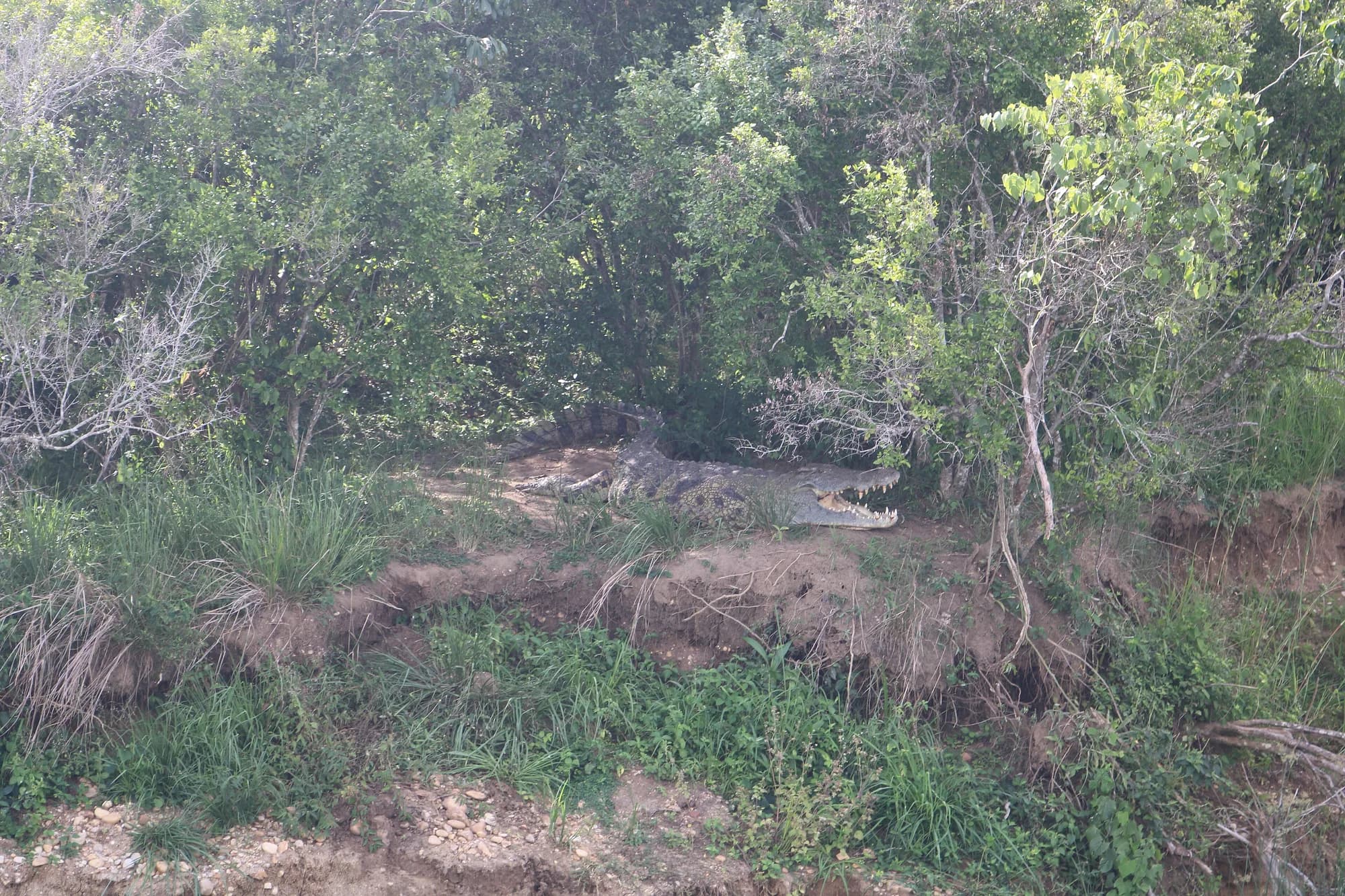
| Nile crocodile | The same reach; also a permanent resident per UWA | Near-certain on any launch |
| Nubian giraffe | The Buligi tracks on the north bank | Very likely on a north-bank game drive; around 2,250 animals in the park per GCF |
| African elephant | Regular visitors to the riverbank, per UWA; over 900 in the park | Likely on the river, less predictable on the tracks |
| Buffalo | Riverbank and grassland; over 10,000 in the park | Very likely |
| Uganda kob | The Buligi grassland and the Heart of Murchison; 35,000 in the park | Certain on the north bank |
The species figures are UWA's, except the giraffe estimate, which is the Giraffe Conservation Foundation's. The likelihood column is our reading of those figures against the habitat UWA describes; UWA publishes no sighting probabilities for any animal at any park.
The single highest-yield two hours in Uganda
A launch to the foot of the falls at USD 30 a head puts you alongside hippo, crocodile, elephant, buffalo and waterbirds in one sitting, with a 45-metre waterfall at the end of it. On UWA's own tariff that is cheaper than a night game drive and the same price as an hour at a mongoose colony in Queen Elizabeth. Whatever else you cut, do not cut the boat — and if you are fewer than four, read the cost page before you agree the price.
Uganda Wildlife Authority — Murchison Falls National Park
UWA's own park page, read 28 September 2026. The source here for the park area, the altitude, the district, the gazettement dates, the species counts, the gorge width and drop as UWA currently states them, the elephant, buffalo and kob figures, and the road distances and drive times from Kampala and Fort Portal.
https://ugandawildlife.org/national-parks/murchison-falls-national-park/Uganda Wildlife Authority — Murchison Falls National Park brochure
UWA's own park brochure, linked from the park page and hosted on ugandawildlife.org. The PDF's internal creation date is 19 June 2018 and the file name carries the year 2018; it is the most detailed thing UWA publishes about this park and it is eight years old. Read 28 September 2026. The source here for the gate names, the route distances from Masindi, the airfield distances, the Buligi and Heart of Murchison descriptions, Kaniyo Pabidi, the ferry, the climate figures and the concessionaire names.
https://ugandawildlife.org/wp-content/uploads/2024/05/MFNP-2018-4.pdfGiraffe Conservation Foundation — Nubian giraffe conservation in Uganda
The Giraffe Conservation Foundation's standing Uganda programme page, read 28 September 2026. The source here for the Uganda and Murchison Falls giraffe estimates, for the taxonomy as GCF states it, and for the Operation Twiga translocation across the Nile. GCF is a conservation NGO and a partner of UWA on this work, not a government department; the page carries no revision date.
https://giraffeconservation.org/programs/nubian-giraffe-conservation-in-uganda/Giraffe — the one sighting this park owns
If there is one animal to come to Murchison Falls for, it is this one, and the case is numerical rather than sentimental. The Giraffe Conservation Foundation puts around 2,250 Nubian giraffe in this park against over 2,400 in the whole of Uganda. Roughly nineteen out of every twenty giraffe in the country are here.
- They are on the north bank. UWA's park page says giraffe have historically been exclusive to the northern sector, which is the Buligi grassland with its borassus palms and acacia.
- Thirty-seven were translocated across the Nile to the southern bank in 2016 and 2017 under Operation Twiga I and II, so the south is not giraffe-free — but the herds are not there.
- A south-bank itinerary that never crosses the river is an itinerary that may miss the thing the park is best at. This is the clearest case anywhere at Murchison for taking the ferry.
- Borassus palms are the giveaway in photographs: a giraffe under a fan palm, on flat grass, with the Albertine escarpment behind, is a Buligi picture and it is not available anywhere else in Uganda.
- The name will change depending on who is guiding you. Nubian giraffe and Rothschild's giraffe are the same animal — the wildlife page has the taxonomy and the argument behind it.
Numbers this large change what a sighting means
At two thousand-odd animals in one sector, giraffe at Murchison are not a sighting you hope for, they are a background condition of the morning. That has an odd effect on visitors: people who have driven six hours to see them stop photographing them by the second day. The thing worth watching for instead is behaviour — necking, a creche of calves, a herd crossing a track in single file — because you will have enough encounters to see some, which you will not at any other park in the country.
Giraffe Conservation Foundation — Nubian giraffe conservation in Uganda
The Giraffe Conservation Foundation's standing Uganda programme page, read 28 September 2026. The source here for the Uganda and Murchison Falls giraffe estimates, for the taxonomy as GCF states it, and for the Operation Twiga translocation across the Nile. GCF is a conservation NGO and a partner of UWA on this work, not a government department; the page carries no revision date.
https://giraffeconservation.org/programs/nubian-giraffe-conservation-in-uganda/Uganda Wildlife Authority — Murchison Falls National Park
UWA's own park page, read 28 September 2026. The source here for the park area, the altitude, the district, the gazettement dates, the species counts, the gorge width and drop as UWA currently states them, the elephant, buffalo and kob figures, and the road distances and drive times from Kampala and Fort Portal.
https://ugandawildlife.org/national-parks/murchison-falls-national-park/Uganda Wildlife Authority — Murchison Falls National Park brochure
UWA's own park brochure, linked from the park page and hosted on ugandawildlife.org. The PDF's internal creation date is 19 June 2018 and the file name carries the year 2018; it is the most detailed thing UWA publishes about this park and it is eight years old. Read 28 September 2026. The source here for the gate names, the route distances from Masindi, the airfield distances, the Buligi and Heart of Murchison descriptions, Kaniyo Pabidi, the ferry, the climate figures and the concessionaire names.
https://ugandawildlife.org/wp-content/uploads/2024/05/MFNP-2018-4.pdfLions — the best odds in Uganda, and still a search
Murchison came out of Uganda's largest ever carnivore count as the country's lion stronghold, and it is worth being precise about what that means, because the marketing and the survey are some distance apart.
What the 2022–23 survey found, and what it works out at
| Figure | |
|---|---|
| Lions at Murchison Falls | Approximately 240 |
| Area surveyed | Some 3,200 sq km |
| Which works out at | Roughly one lion per 13 sq km |
| Queen Elizabeth, same survey | A marked decline of over 40 per cent |
| Kidepo Valley, same survey | Just 12 individuals |
| Leopard | Continues to occur at high densities in select areas |
The lion count and the survey area are the authors'; the density is our division of the two. The survey area is 640 sq km smaller than the park, so the count is not a whole-park figure. UWA itself publishes no lion number for Murchison Falls and its brochure's own wording for the Buligi tracks is to keep your fingers crossed for lion and leopard.
How to actually find one
Follow the kob. UWA's own brochure makes the connection when it describes the Heart of Murchison as becoming known as a prime location for lions thanks to substantial herds of Uganda kob, and 35,000 kob is what holds 240 lions up. In practice that means the Buligi grassland at first light and the Rabongo road country if you have a third day. Take the UWA ranger guide at USD 25 for the vehicle — it is the cheapest line on the tariff and the guides know where the pride was yesterday, which is information no map contains.
Two or three morning sessions on the north bank give a reasonable chance. One midday drive on the way to the ferry does not, and midday at 25 to 32 degrees Celsius is the worst possible time to look. If a guaranteed lion is what the trip is for, no Ugandan park can offer one, and Murchison is the closest any of them comes.
Braczkowski, Gopalaswamy and Biggs — Uganda's lions in decline, hyenas thriving, The Conversation, 25 March 2025
The authors' own account of the national carnivore survey run with the Uganda Wildlife Authority between January 2022 and January 2023 — more than 100 collaborators, 26,000 km driven and 7,516 camera-trap nights at 232 locations across six protected areas. Read 28 September 2026.
https://theconversation.com/ugandas-lions-in-decline-hyenas-thriving-new-findings-from-countrys-biggest-ever-carnivore-count-249724Uganda Wildlife Authority — Murchison Falls National Park brochure
UWA's own park brochure, linked from the park page and hosted on ugandawildlife.org. The PDF's internal creation date is 19 June 2018 and the file name carries the year 2018; it is the most detailed thing UWA publishes about this park and it is eight years old. Read 28 September 2026. The source here for the gate names, the route distances from Masindi, the airfield distances, the Buligi and Heart of Murchison descriptions, Kaniyo Pabidi, the ferry, the climate figures and the concessionaire names.
https://ugandawildlife.org/wp-content/uploads/2024/05/MFNP-2018-4.pdfUganda Wildlife Authority — Murchison Falls National Park
UWA's own park page, read 28 September 2026. The source here for the park area, the altitude, the district, the gazettement dates, the species counts, the gorge width and drop as UWA currently states them, the elephant, buffalo and kob figures, and the road distances and drive times from Kampala and Fort Portal.
https://ugandawildlife.org/national-parks/murchison-falls-national-park/The shoebill, and the two windows
The shoebill is the bird a large share of visiting birders come to Uganda for, and Murchison is one of the few places a government agency will describe it as commonly spotted. UWA's park page says so of the Albert Delta. UWA's brochure calls it an iconic rarity and names when to go.
What UWA says about finding one
| Question | UWA's answer |
|---|---|
| Where | The Nile Delta, where the river's exit into Lake Albert is choked by a maze of channels between wetland islands |
| How | A boat downriver from Paraa — a different trip from the launch to the falls, on the same tariff line |
| When | Best sighted in the delta during the December–February and June–September dry seasons |
| What else is there | Rich in waterbirds; Delta Point on the north bank is where the game tracks converge on the same water |
| Odds | Not published. UWA states no success rate for the shoebill or for anything else. |
Everything above except the last row is a direct restatement of UWA's own text. The last row is what we found after looking: UWA publishes success rates for no activity at any park.
The mistake is booking the wrong boat
Upriver from Paraa is the waterfall. Downriver from Paraa is the delta and the shoebill. UWA prices both on one line — launch cruise, USD 30 — and a package that says boat trip will almost always mean the falls, because that is what most people want. If the shoebill is the reason for the trip, say delta when you book, check it is on the ticket, and budget a second boat if you want the falls as well. And if you are two people, remember that a second boat is a second USD 120 floor and not a second USD 60.
Uganda Wildlife Authority — Murchison Falls National Park
UWA's own park page, read 28 September 2026. The source here for the park area, the altitude, the district, the gazettement dates, the species counts, the gorge width and drop as UWA currently states them, the elephant, buffalo and kob figures, and the road distances and drive times from Kampala and Fort Portal.
https://ugandawildlife.org/national-parks/murchison-falls-national-park/Uganda Wildlife Authority — Murchison Falls National Park brochure
UWA's own park brochure, linked from the park page and hosted on ugandawildlife.org. The PDF's internal creation date is 19 June 2018 and the file name carries the year 2018; it is the most detailed thing UWA publishes about this park and it is eight years old. Read 28 September 2026. The source here for the gate names, the route distances from Masindi, the airfield distances, the Buligi and Heart of Murchison descriptions, Kaniyo Pabidi, the ferry, the climate figures and the concessionaire names.
https://ugandawildlife.org/wp-content/uploads/2024/05/MFNP-2018-4.pdfUganda Wildlife Authority — Conservation Tariff 2024–2026
Downloaded and read page by page on 28 September 2026. A fifteen-page PDF laid out as twenty-four numbered tariff pages, covering entrance, annual passes, vehicles, boats and aircraft, game drives, walks, primate permits, experiential tourism, mountain activities, fishing, accommodation, camping, filming, fines, research fees and a per-park fees summary. The tariff is printed "subject to change without prior notice" and its cover period, July 2024 to June 2026, has now expired with no successor on UWA's site.
https://ugandawildlife.org/wp-content/uploads/2024/03/UWA-Conservation-Tariff-July-2024-June-2026.pdfA day at Murchison, hour by hour
One full day on the north bank, built on what UWA publishes: gates 7am to 7pm, a 40 km/h limit, daytime temperatures of 25 to 32 degrees Celsius, a launch of two hours by the tariff or three by the brochure. The hours below are the shape of the day, not a timetable, because the ferry has no published timetable to build one against.
The shape of a Buligi day
| Time | What is happening | What you are likely to see |
|---|---|---|
| First light | On the Buligi tracks before the heat. UWA gates open at 7am, so if your bed is outside the boundary you start after this | Giraffe, kob, buffalo. Best lion window of the day |
| Mid-morning | Working the track network out towards Delta Point | Elephant, oribi and hartebeest country, waterbirds offshore at the Delta |
| Late morning | Back before the heat builds | Movement drops off sharply as the temperature climbs |
| Midday to mid-afternoon | Out of the sun. This is not a driving window at 127 m altitude and 32 degrees Celsius | Very little, and you will not enjoy looking for it |
| Mid-afternoon | Launch from Paraa upriver. Allow three hours | Hippo and crocodile continuously, elephant and buffalo on the banks, fish eagle and Goliath heron |
| At the head of Fajao Gorge | The falls, the Devil's Cauldron, and the option to get off and climb with a ranger escort | The gap itself — 6 m by UWA's brochure, 8 m by UWA's park page |
| Dusk | Off the water. Ferry if your bed is on the far bank; gates shut at 7pm | The crossing is the part of the day with no published timing |
| After dark | Night game drive, if you are sleeping inside the park. UWA guide mandatory | The only window for genets, civets, white-tailed mongoose and hunting lion |
Species named in the right-hand column are either UWA's for this park or the general fauna of the habitats UWA describes; the timings are our planning judgement built on UWA's gate hours, speed limit, temperature range and boat duration.
The single change that improves this day most
Swap the order. Launch in the morning and game drive in the late afternoon, and you trade the best lion light for the best light on the water and the coolest three hours on an open boat. Whether that is the right trade depends on what you came for, and it is a decision most itineraries make for you without mentioning that it was a decision.
Uganda Wildlife Authority — Conservation Tariff 2024–2026
Downloaded and read page by page on 28 September 2026. A fifteen-page PDF laid out as twenty-four numbered tariff pages, covering entrance, annual passes, vehicles, boats and aircraft, game drives, walks, primate permits, experiential tourism, mountain activities, fishing, accommodation, camping, filming, fines, research fees and a per-park fees summary. The tariff is printed "subject to change without prior notice" and its cover period, July 2024 to June 2026, has now expired with no successor on UWA's site.
https://ugandawildlife.org/wp-content/uploads/2024/03/UWA-Conservation-Tariff-July-2024-June-2026.pdfUganda Wildlife Authority — Murchison Falls National Park brochure
UWA's own park brochure, linked from the park page and hosted on ugandawildlife.org. The PDF's internal creation date is 19 June 2018 and the file name carries the year 2018; it is the most detailed thing UWA publishes about this park and it is eight years old. Read 28 September 2026. The source here for the gate names, the route distances from Masindi, the airfield distances, the Buligi and Heart of Murchison descriptions, Kaniyo Pabidi, the ferry, the climate figures and the concessionaire names.
https://ugandawildlife.org/wp-content/uploads/2024/05/MFNP-2018-4.pdfUganda Wildlife Authority — Murchison Falls National Park
UWA's own park page, read 28 September 2026. The source here for the park area, the altitude, the district, the gazettement dates, the species counts, the gorge width and drop as UWA currently states them, the elephant, buffalo and kob figures, and the road distances and drive times from Kampala and Fort Portal.
https://ugandawildlife.org/national-parks/murchison-falls-national-park/What surprises people
Six things visitors report being unprepared for at Murchison Falls, of which two are wonderful, two are logistics and two are questions nobody answered before they arrived.
- The heat. At 127 metres this is one of the hottest regions in Uganda, 25 to 32 degrees Celsius in the day, and nothing in the highland-gorilla imagery of Uganda prepares anyone for it.
- The sheer number of giraffe. Around 2,250 in one park is not a sighting, it is a landscape feature, and it is the thing people talk about afterwards rather than the waterfall.
- How narrow the gap is. The entire Victoria Nile goes through something between six and eight metres wide, depending which UWA document you read, and standing above it is a physical rather than a visual experience.
- That the ferry is the whole day. One crossing, no timetable, and an itinerary that lives or dies by it.
- That the top of the falls is a separate ticket from the boat, and that the good version of it involves climbing Fajao Gorge with a ranger rather than parking at a viewpoint.
- That there is an oil development inside the park. It is documented, it is contested, UWA's own visitor material does not mention it, and the zones page sets out what each party publishes.
And what we still cannot tell you
No success rates, for anything. UWA publishes a price, a capacity and a set of rules for every activity at this park and it publishes no probability for any of them — not for lion, not for the shoebill, not for the chimpanzees at Kaniyo Pabidi, which are not on its tariff at all. Anyone quoting you a percentage is quoting an operator's estimate or their own, and the honest version is the one on this page: the river is close to certain, the giraffe are close to certain on the right bank, and everything else is a search with about 240 lions spread across 3,200 square kilometres.
Uganda Wildlife Authority — Murchison Falls National Park
UWA's own park page, read 28 September 2026. The source here for the park area, the altitude, the district, the gazettement dates, the species counts, the gorge width and drop as UWA currently states them, the elephant, buffalo and kob figures, and the road distances and drive times from Kampala and Fort Portal.
https://ugandawildlife.org/national-parks/murchison-falls-national-park/Uganda Wildlife Authority — Conservation Tariff 2024–2026
Downloaded and read page by page on 28 September 2026. A fifteen-page PDF laid out as twenty-four numbered tariff pages, covering entrance, annual passes, vehicles, boats and aircraft, game drives, walks, primate permits, experiential tourism, mountain activities, fishing, accommodation, camping, filming, fines, research fees and a per-park fees summary. The tariff is printed "subject to change without prior notice" and its cover period, July 2024 to June 2026, has now expired with no successor on UWA's site.
https://ugandawildlife.org/wp-content/uploads/2024/03/UWA-Conservation-Tariff-July-2024-June-2026.pdfBraczkowski, Gopalaswamy and Biggs — Uganda's lions in decline, hyenas thriving, The Conversation, 25 March 2025
The authors' own account of the national carnivore survey run with the Uganda Wildlife Authority between January 2022 and January 2023 — more than 100 collaborators, 26,000 km driven and 7,516 camera-trap nights at 232 locations across six protected areas. Read 28 September 2026.
https://theconversation.com/ugandas-lions-in-decline-hyenas-thriving-new-findings-from-countrys-biggest-ever-carnivore-count-249724