
Uganda / Murchison Falls / Wildlife — Murchison Falls
Wildlife — Murchison Falls
This is the giraffe park. It holds what conservationists believe is the largest population of its kind anywhere, on one bank of one river, and the animal's name has changed twice in a decade.
What UWA publishes, and the two counts that do not agree
Before any individual species, a caution about the headline numbers. UWA publishes two species counts for this park in two of its own documents, and they are not close to each other. We print both because we cannot choose between them on the evidence, and because the gap is itself informative about how old some of the material on this park is.
Two UWA documents, one park
| UWA park page, read 2026 | UWA park brochure, file dated 2018 | |
|---|---|---|
| Mammals | 144 species | 76 species |
| Birds | 556 species | over 451 species |
| Reptiles | 51 species | Not stated |
| Amphibians | 51 species | Not stated |
The mammal counts differ by a factor of nearly two and the bird counts by over a hundred species. These are not a revision and a re-survey; they are two live documents on the same website. The likeliest reading is that the brochure counts a narrower area or an older list, but UWA does not say so, and a visitor comparing parks on species richness should know the number depends on which UWA page they landed on.
The single most useful line on UWA's park page
Past the counts, UWA gives four species-level figures for this park and they are the ones worth carrying: over 900 elephants from an aerial survey, with numbers steadily increasing; buffalo soared to over 10,000; Uganda kob grown to 35,000; and giraffe historically exclusive to the northern sector. No date is attached to the aerial survey and none to the buffalo or kob figures, which is a real limitation and one we flag rather than hide.
Uganda Wildlife Authority — Murchison Falls National Park
UWA's own park page, read 28 September 2026. The source here for the park area, the altitude, the district, the gazettement dates, the species counts, the gorge width and drop as UWA currently states them, the elephant, buffalo and kob figures, and the road distances and drive times from Kampala and Fort Portal.
https://ugandawildlife.org/national-parks/murchison-falls-national-park/Uganda Wildlife Authority — Murchison Falls National Park brochure
UWA's own park brochure, linked from the park page and hosted on ugandawildlife.org. The PDF's internal creation date is 19 June 2018 and the file name carries the year 2018; it is the most detailed thing UWA publishes about this park and it is eight years old. Read 28 September 2026. The source here for the gate names, the route distances from Masindi, the airfield distances, the Buligi and Heart of Murchison descriptions, Kaniyo Pabidi, the ferry, the climate figures and the concessionaire names.
https://ugandawildlife.org/wp-content/uploads/2024/05/MFNP-2018-4.pdfThe giraffe, and its three names
This site's own park record names the species here rothschilds-giraffe, and that is what most visitors will have been told they are coming to see. The Giraffe Conservation Foundation, which runs the Uganda giraffe programme with UWA, calls the same animal the Nubian giraffe and says plainly that it was formerly called Rothschild's giraffe. The animal has not changed. The label has, twice.
The names, and what each of them is doing
| Name | Status | Where it comes from |
|---|---|---|
| Rothschild's giraffe | The name in long-standing popular and park usage, including on this site | Named for Walter Rothschild; the historic subspecies name rothschildi |
| Nubian giraffe | GCF's current name for the animal at Murchison Falls | Giraffa camelopardalis camelopardalis; Rothschild's was subsumed into it |
| Northern giraffe | The species GCF places it in | GCF writes: "a subspecies of the northern giraffe (Giraffa camelopardalis)" |
GCF's wording is the key to the disagreement. Under the long-standing arrangement Giraffa camelopardalis is the whole giraffe, with the Nubian as one of several subspecies. Under the arrangement GCF uses, Giraffa camelopardalis names the northern giraffe alone, one of several giraffe species, with the Nubian as one of its subspecies. The trinomial is identical in both; what it sits inside is not.
What is and is not in dispute
Not in dispute: the animal at Murchison Falls is Giraffa camelopardalis camelopardalis, it is a subspecies, and it is the same animal people have called Rothschild's giraffe for a century. In dispute: how many giraffe species there are, and therefore what the binomial Giraffa camelopardalis covers. This is a live taxonomic argument between research groups, not a settled fact that one side has failed to keep up with. If a guide tells you these are Rothschild's giraffe they are not wrong, and if the next one says Nubian they are not wrong either.
Giraffe Conservation Foundation — Nubian giraffe conservation in Uganda
The Giraffe Conservation Foundation's standing Uganda programme page, read 28 September 2026. The source here for the Uganda and Murchison Falls giraffe estimates, for the taxonomy as GCF states it, and for the Operation Twiga translocation across the Nile. GCF is a conservation NGO and a partner of UWA on this work, not a government department; the page carries no revision date.
https://giraffeconservation.org/programs/nubian-giraffe-conservation-in-uganda/How many giraffe, and the thirty-seven that crossed the Nile
The numbers are the reason this park matters to anyone who cares about giraffe. The Giraffe Conservation Foundation puts Uganda's population at over 2,400 individuals and Murchison Falls National Park's at around 2,250. That is something close to ninety-four per cent of Uganda's giraffe in one park, and the great majority of them on one bank of one river.
Nubian giraffe, as GCF states them
| Estimate | |
|---|---|
| Uganda, all sites | Over 2,400 individuals |
| Murchison Falls National Park | Around 2,250 individuals |
| Moved across the Nile to the southern bank, 2016–17 | 37, in Operation Twiga I and II |
GCF's page carries no revision date, so we cannot tell you what year these estimates are of. It is an NGO figure rather than a government census. Against it, UWA's own park page says only that giraffe have historically been exclusive to the northern sector and that the population continues to thrive — no number at all. We have found no UWA giraffe count for this park.
Why anyone would move a giraffe across a river
Operation Twiga moved 37 Nubian giraffe over the Nile to the southern bank of Murchison Falls in 2016 and 2017. A population of over two thousand animals concentrated in one sector of one park is a population that a single disease outbreak, a single fire or a single development can take a large bite out of. Putting founders on the other side of a river that giraffe do not cross is the cheapest insurance available. The same programme name appears against translocations to Kidepo Valley, Pian Upe and Lake Mburo, which is why Uganda now has giraffe in places that had none.
For a visitor the practical consequence is simple and it is the sharpest north-south asymmetry in the park. The giraffe are on the Buligi tracks. A south-bank itinerary that never crosses the Nile is an itinerary that may see a handful of translocated animals and will not see the herds. If giraffe are the reason for the trip, the ferry is not optional.
Giraffe Conservation Foundation — Nubian giraffe conservation in Uganda
The Giraffe Conservation Foundation's standing Uganda programme page, read 28 September 2026. The source here for the Uganda and Murchison Falls giraffe estimates, for the taxonomy as GCF states it, and for the Operation Twiga translocation across the Nile. GCF is a conservation NGO and a partner of UWA on this work, not a government department; the page carries no revision date.
https://giraffeconservation.org/programs/nubian-giraffe-conservation-in-uganda/Uganda Wildlife Authority — Murchison Falls National Park
UWA's own park page, read 28 September 2026. The source here for the park area, the altitude, the district, the gazettement dates, the species counts, the gorge width and drop as UWA currently states them, the elephant, buffalo and kob figures, and the road distances and drive times from Kampala and Fort Portal.
https://ugandawildlife.org/national-parks/murchison-falls-national-park/Lions — about 240, across 3,200 square kilometres
Uganda ran its largest ever carnivore count between January 2022 and January 2023 — more than a hundred collaborators, 26,000 kilometres driven, 7,516 camera-trap nights at 232 locations across six protected areas, individual animals identified from whisker spots and flank patterns. Murchison Falls came out of it as the country's lion stronghold.
The 2022–23 national carnivore survey, as its authors report it
| Finding | Figure |
|---|---|
| Lions, Murchison Falls National Park | Approximately 240, across some 3,200 sq km |
| Lions, Queen Elizabeth | A marked decline of over 40 per cent |
| Lions, Kidepo Valley | Just 12 individuals |
| Leopards | Continue to occur at high densities in select areas; strong at Murchison |
| Spotted hyena, national range | Densities from 6.15 to 45.31 individuals per 100 sq km |
Reported by the survey's own authors in The Conversation on 25 March 2025. Note the survey area: 3,200 sq km against the park's 3,840 sq km, so the count does not cover the whole park. That is a caveat the headline number usually loses.
What 240 lions across 3,200 square kilometres actually feels like
It is roughly one lion for every thirteen square kilometres, and they are not evenly spread — they follow the kob, which means the Buligi grassland and the Heart of Murchison. It is the best lion density published for any Ugandan park and it is still a genuine search. Two or three sessions on the north bank with a UWA ranger guide give you a real chance. One midday pass through on the way to the ferry does not. If someone has told you lions are guaranteed here, they have told you something the survey does not support.
Braczkowski, Gopalaswamy and Biggs — Uganda's lions in decline, hyenas thriving, The Conversation, 25 March 2025
The authors' own account of the national carnivore survey run with the Uganda Wildlife Authority between January 2022 and January 2023 — more than 100 collaborators, 26,000 km driven and 7,516 camera-trap nights at 232 locations across six protected areas. Read 28 September 2026.
https://theconversation.com/ugandas-lions-in-decline-hyenas-thriving-new-findings-from-countrys-biggest-ever-carnivore-count-249724Uganda Wildlife Authority — Murchison Falls National Park
UWA's own park page, read 28 September 2026. The source here for the park area, the altitude, the district, the gazettement dates, the species counts, the gorge width and drop as UWA currently states them, the elephant, buffalo and kob figures, and the road distances and drive times from Kampala and Fort Portal.
https://ugandawildlife.org/national-parks/murchison-falls-national-park/Elephant, buffalo and the kob that hold the whole thing up
Three herbivore figures from UWA's park page, and one of them explains the other two and the lions as well. Take them in the order UWA gives them and then look at what the last one does.
UWA's own herbivore figures for Murchison Falls
| Species | UWA's figure | UWA's wording |
|---|---|---|
| African elephant | Over 900 | An aerial survey counted over 900 individuals, with numbers steadily increasing |
| Buffalo | Over 10,000 | Their numbers have soared to over 10,000, making them one of the most commonly seen animals in the park |
| Uganda kob | 35,000 | The population has grown to an impressive 35,000 individuals |
| Nubian giraffe | No figure published by UWA | Historically exclusive to the northern sector; the population continues to thrive |
UWA attaches no date to any of these. The elephant figure is described as coming from an aerial survey but the survey is not named or dated on the page. We publish them as UWA's current published figures and not as census results, because we cannot tell from the source which they are.
Thirty-five thousand kob is the load-bearing number
Kob are the prey base. UWA's own brochure connects the two explicitly when it describes the Heart of Murchison: vehicle tracks opened in an area that, thanks to substantial herds of Uganda kob, is becoming known as a prime location for lions. Where the kob are, the lions are; where the kob are not, a game drive is a landscape drive. That is why the Buligi grassland and the Heart of Murchison are the two named game areas in a 3,840-square-kilometre park, and why nobody sends you into the southern forest to look for a cat.
The elephant figure is worth doing the division on. Over 900 animals in 3,840 square kilometres is roughly one elephant to every four square kilometres, and elephants are not spread evenly — UWA names the riverbank as where they come. That is the honest way to read it. You will very probably see elephant at Murchison, and the place you will see them is the water's edge, from a boat, rather than anywhere on a grid of tracks.
Uganda Wildlife Authority — Murchison Falls National Park
UWA's own park page, read 28 September 2026. The source here for the park area, the altitude, the district, the gazettement dates, the species counts, the gorge width and drop as UWA currently states them, the elephant, buffalo and kob figures, and the road distances and drive times from Kampala and Fort Portal.
https://ugandawildlife.org/national-parks/murchison-falls-national-park/Uganda Wildlife Authority — Murchison Falls National Park brochure
UWA's own park brochure, linked from the park page and hosted on ugandawildlife.org. The PDF's internal creation date is 19 June 2018 and the file name carries the year 2018; it is the most detailed thing UWA publishes about this park and it is eight years old. Read 28 September 2026. The source here for the gate names, the route distances from Masindi, the airfield distances, the Buligi and Heart of Murchison descriptions, Kaniyo Pabidi, the ferry, the climate figures and the concessionaire names.
https://ugandawildlife.org/wp-content/uploads/2024/05/MFNP-2018-4.pdfThe river — hippo, crocodile, and a 108-kilogram fish
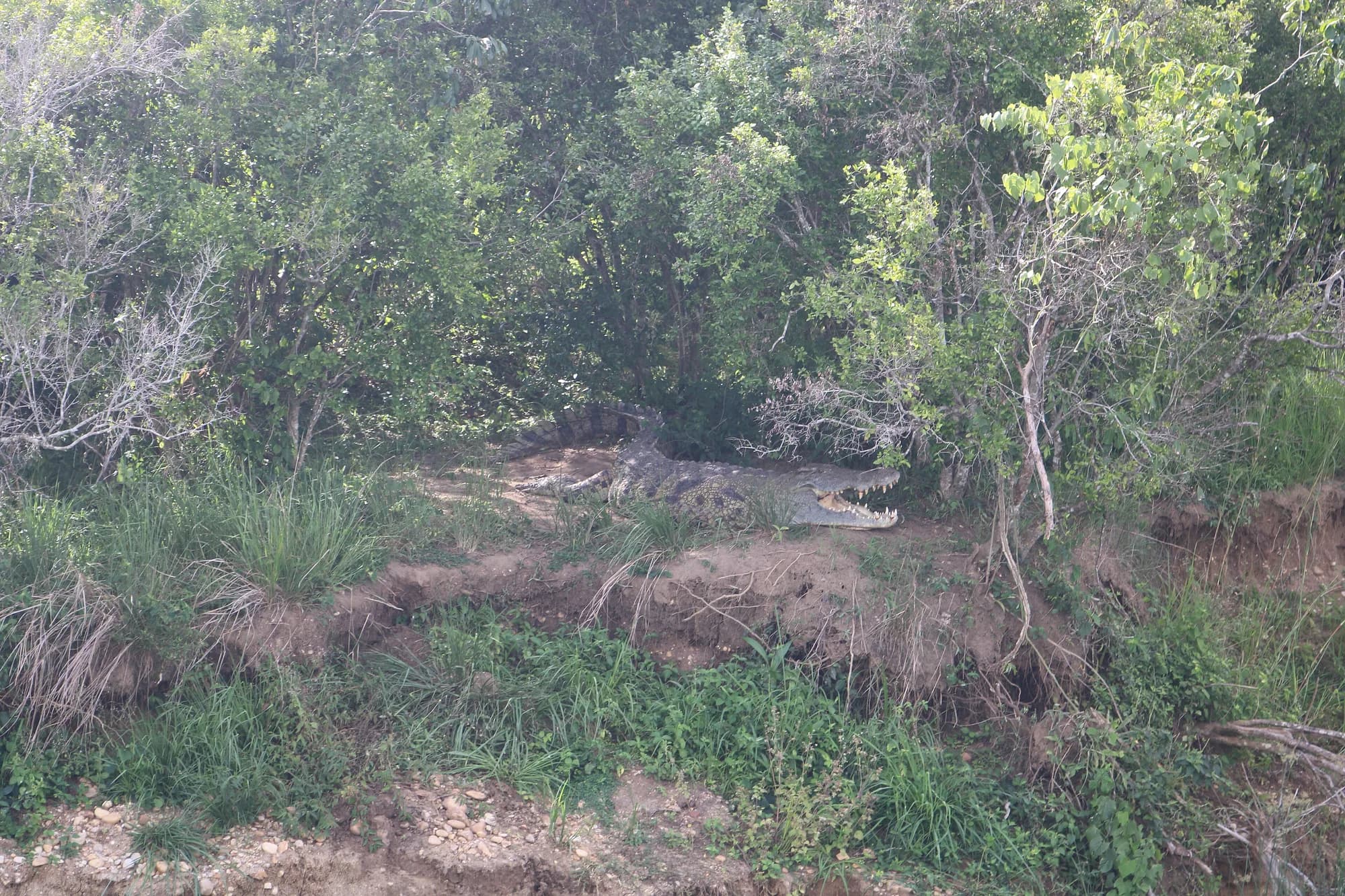
Paraa means home of the hippo in Luo, which is the shortest possible summary of what the river does at this park. UWA names hippos, Nile crocodiles and aquatic birds as permanent residents of the stretch below the falls, and elephants, giraffes and buffaloes as regular visitors to the bank. That combination is what the launch is actually for: it is not a boat ride to a waterfall, it is a game drive along an edge that every large animal in the park has to come to.
- The Nile runs 80 km west through the park, descending a series of rapids before the falls, then flattening across the rift valley floor to Lake Albert.
- Hippo and Nile crocodile are permanent along the reach below the falls, per UWA; the launch runs through the middle of them.
- Delta Point, where the game tracks converge on the north bank, is described by UWA as a place to view waterbirds offshore and distant hippos.
- The park's sport fishing record, as UWA prints it, is a Nile perch of 108 kg landed with rod and line.
- UWA charges a boat parking fee of UGX 10,000 a day and prices a privately owned boat's entry at USD 100 up to fifteen seats — separate lines from the launch ticket, and routinely confused with it.
The crocodile is the one that photographs badly and matters most
The Nile crocodile below Murchison Falls is one of the reasons this reach is on the site's park record as a species highlight, and it is a genuinely large population on a genuinely productive stretch of river — fish come over the falls stunned, which is an unusually reliable food supply. From a launch at two or three metres above the water a four-metre crocodile does not look like much. Get the guide to hold position and look at where the animals are lying relative to each other, not at any one of them.
Uganda Wildlife Authority — Murchison Falls National Park
UWA's own park page, read 28 September 2026. The source here for the park area, the altitude, the district, the gazettement dates, the species counts, the gorge width and drop as UWA currently states them, the elephant, buffalo and kob figures, and the road distances and drive times from Kampala and Fort Portal.
https://ugandawildlife.org/national-parks/murchison-falls-national-park/Uganda Wildlife Authority — Murchison Falls National Park brochure
UWA's own park brochure, linked from the park page and hosted on ugandawildlife.org. The PDF's internal creation date is 19 June 2018 and the file name carries the year 2018; it is the most detailed thing UWA publishes about this park and it is eight years old. Read 28 September 2026. The source here for the gate names, the route distances from Masindi, the airfield distances, the Buligi and Heart of Murchison descriptions, Kaniyo Pabidi, the ferry, the climate figures and the concessionaire names.
https://ugandawildlife.org/wp-content/uploads/2024/05/MFNP-2018-4.pdfUganda Wildlife Authority — Conservation Tariff 2024–2026
Downloaded and read page by page on 28 September 2026. A fifteen-page PDF laid out as twenty-four numbered tariff pages, covering entrance, annual passes, vehicles, boats and aircraft, game drives, walks, primate permits, experiential tourism, mountain activities, fishing, accommodation, camping, filming, fines, research fees and a per-park fees summary. The tariff is printed "subject to change without prior notice" and its cover period, July 2024 to June 2026, has now expired with no successor on UWA's site.
https://ugandawildlife.org/wp-content/uploads/2024/03/UWA-Conservation-Tariff-July-2024-June-2026.pdfBirds — the shoebill in the delta, and the forest list nobody plans for
Murchison is two birding destinations that happen to share a gate. One is the Nile Delta, a maze of channels threading between wetland islands where the river chokes its way into Lake Albert, and it holds the bird half the world's birders come to Uganda for. The other is Kaniyo Pabidi, a tract of Budongo Forest on the road in, and it holds a completely different list.
The two lists, and where to be for each
| Where | What UWA names | When |
|---|---|---|
| The Nile Delta, by boat downriver from Paraa | Shoebill — UWA calls it commonly spotted along the Albert Delta and an iconic rarity — plus waterbirds through the channels | Best in the delta during the December–February and June–September dry seasons |
| Kaniyo Pabidi, Budongo Forest | Albertine Rift endemics and restricted-range species: chocolate-backed kingfisher, white-thighed hornbill, Puvel's illadopsis | UWA names January–March as the prime birding period park-wide |
| The launch to the falls and the game tracks | African fish eagle, Goliath heron, saddle-billed stork; white-crested turaco in the woodland; red-winged grey warbler in the southern sector | Year round |
Species names are UWA's, from the current park page and from the brochure. The count is either 556 species or over 451, depending which UWA document you read — see the first section on this page.
The delta trip is a different boat from the falls trip
Both leave from Paraa and UWA prices them on the same launch cruise line, but they go in opposite directions. Upriver is the falls. Downriver is the delta and the shoebill. A two-night trip that books one boat has to choose, and most people choose the falls without being told there was a choice. If the shoebill is the bird you came for, say the word delta when you book and check it is on the ticket.
Uganda Wildlife Authority — Murchison Falls National Park
UWA's own park page, read 28 September 2026. The source here for the park area, the altitude, the district, the gazettement dates, the species counts, the gorge width and drop as UWA currently states them, the elephant, buffalo and kob figures, and the road distances and drive times from Kampala and Fort Portal.
https://ugandawildlife.org/national-parks/murchison-falls-national-park/Uganda Wildlife Authority — Murchison Falls National Park brochure
UWA's own park brochure, linked from the park page and hosted on ugandawildlife.org. The PDF's internal creation date is 19 June 2018 and the file name carries the year 2018; it is the most detailed thing UWA publishes about this park and it is eight years old. Read 28 September 2026. The source here for the gate names, the route distances from Masindi, the airfield distances, the Buligi and Heart of Murchison descriptions, Kaniyo Pabidi, the ferry, the climate figures and the concessionaire names.
https://ugandawildlife.org/wp-content/uploads/2024/05/MFNP-2018-4.pdf