
Namibia / Etosha / Wildlife — Etosha
Wildlife — Etosha
Four of the Big Five on an open plain with almost no cover to hide in. The buffalo is the one that is missing, and it is the thing that catches out anybody arriving with a checklist.
What the park holds
MEFT's own figures for Etosha
| Figure | |
|---|---|
| Park area | 22,935 square kilometres |
| Proclaimed | 1907 |
| Mammal species | 114, large and small |
| Bird species recorded | 407 |
| Fish species | One |
| Big Five | Four — lion, elephant, leopard and rhino |
MEFT notes that the park has been reduced considerably in size since 1907 and still remains larger than several European countries. It also records a single fish species, which is the kind of detail that tells you something about a salt pan.
- Elephant, lion, leopard, black rhino and white rhino, giraffe.
- Burchell's zebra, blue wildebeest, springbok, oryx and eland — the plains herds the park is photographed for.
- Black-faced impala and Damara dik-dik, the two antelope you will not readily see elsewhere.
- Cheetah on the open ground, which suits them, and both brown and spotted hyaena.
MEFT — Etosha National Park park profile
Read 28 September 2026. The Ministry of Environment, Forestry and Tourism's own page for the park. It carries the park area, the proclamation year, species counts, named bird and plant species and a camp-by-camp summary. It gives no gate names, no gate times and no rhino population figure.
https://www.meft.gov.na/national-parks/etosha-national-park/217/The missing buffalo
MEFT's own summary puts it flatly: four of the Big Five — lion, rhino, elephant and giraffe in its phrasing, though giraffe is not conventionally one of the five. Either way the buffalo is absent from Etosha, and that is the one fact most likely to cause a complaint at the end of a trip.
If the Big Five is the point, this is the wrong park
Etosha cannot deliver the set and no amount of luck will change that. Kruger can, and so can several parks in Botswana and Tanzania. What Etosha delivers that they mostly cannot is rhino at a floodlit waterhole at midnight, and a landscape so open that what is there is visible. Choose the park for what it has rather than for what a list says it should have.
MEFT — Etosha National Park park profile
Read 28 September 2026. The Ministry of Environment, Forestry and Tourism's own page for the park. It carries the park area, the proclamation year, species counts, named bird and plant species and a camp-by-camp summary. It gives no gate names, no gate times and no rhino population figure.
https://www.meft.gov.na/national-parks/etosha-national-park/217/Rhino, and why there is no number on this page
Etosha matters internationally for black rhino. MEFT's own park page describes a proud record of black-rhino conservation and says white rhino were recently re-introduced. It gives no population figure, and we could not find a current per-park count published by MEFT anywhere else on its site.
The absence of a number is the finding
Namibia does not routinely publish rhino populations broken down by park, and the reason is poaching intelligence: a per-park count tells a poacher where the animals are and whether last season worked. The figures circulating on travel sites are estimates of varying age, mostly copied from one another, and several are more than a decade old. We would rather tell you that the count is not public than print a guess formatted to look like a fact.
What can usefully be said is where to look. Black rhino come to water after dark, which makes the floodlit waterholes at Okaukuejo and Halali the realistic places to see one — MEFT states that at the Okaukuejo waterhole at night it is possible to see black rhino, lion and elephant. In the west, NWR says black and white rhino are often spotted at the Klippan waterhole near Dolomite.
MEFT — Etosha National Park park profile
Read 28 September 2026. The Ministry of Environment, Forestry and Tourism's own page for the park. It carries the park area, the proclamation year, species counts, named bird and plant species and a camp-by-camp summary. It gives no gate names, no gate times and no rhino population figure.
https://www.meft.gov.na/national-parks/etosha-national-park/217/NWR — Dolomite Resort
Read 28 September 2026. Each resort page carries its own rate table in Namibian dollars, split into two seasons — July 2026 to October 2026, and November 2026 to June 2027 — together with unit counts, facilities, contact numbers and distances from Windhoek, Swakopmund, Sossusvlei or Tsumeb. Rates are per person sharing unless the row says single.
https://www.nwr.com.na/resorts/dolomite-resort/Lion, elephant and the waterhole hierarchy
The thing that makes Etosha's game viewing different is that you watch a queue rather than an encounter. Species arrive at a waterhole in an order, and the order is about who can displace whom. Elephant clear the water; rhino will not be argued with; lion lying up nearby empty it of everything for an hour. Zebra and springbok come in waves, hang back, and go in together.
- Elephant are the most disruptive visitors at a waterhole and the most reliable entertainment, because everything else has to work around them.
- Lion at Etosha are frequently seen lying near water rather than hunting, which is the least dramatic and most photographable way to see them.
- Giraffe at a waterhole is the set piece worth waiting for — the splayed front legs, and the extreme wariness before they commit.
- Leopard are present and are a genuine long shot; NWR points to the thicker mopane cover around Halali as the likeliest ground.
- Cheetah favour the open plains, and the open plains are most of the park.
The endemics
MEFT records that Etosha has played a major role in the recovery of the black-faced impala, which is endemic to north-western Namibia and south-western Angola and is not a species you will tick anywhere else on an ordinary African itinerary. The Damara dik-dik is the other one: tiny, paired, and easy to drive past.
The park also hosts the Etosha Ecological Research Institute, which MEFT says attracts scientists from around the world. That research presence is part of why the park's conservation record is what it is, and it is a reason the management here is noticeably more evidence-driven than in some neighbouring reserves.
Learn to tell a black-faced impala from a common one
It is the dark blaze down the face, and it is the difference between having seen something genuinely uncommon and having photographed an impala. Ask at the camp — the staff know exactly where the local herds are.
MEFT — Etosha National Park park profile
Read 28 September 2026. The Ministry of Environment, Forestry and Tourism's own page for the park. It carries the park area, the proclamation year, species counts, named bird and plant species and a camp-by-camp summary. It gives no gate names, no gate times and no rhino population figure.
https://www.meft.gov.na/national-parks/etosha-national-park/217/Birds, and the pan
- 407 species recorded. MEFT singles out woolly-necked stork, lappet-faced vulture, Hartlaub's spurfowl, Carp's tit, white-tailed shrike, Ruppell's parrot and Meyer's parrot.
- Fisher's Pan, by Namutoni in the east, is the birding hotspot NWR names. The east is where you base yourself if birds are the point.
- In the rainy season the pan itself can hold water and NWR describes flamingos on it — the reason a minority of visitors deliberately come in February rather than September.
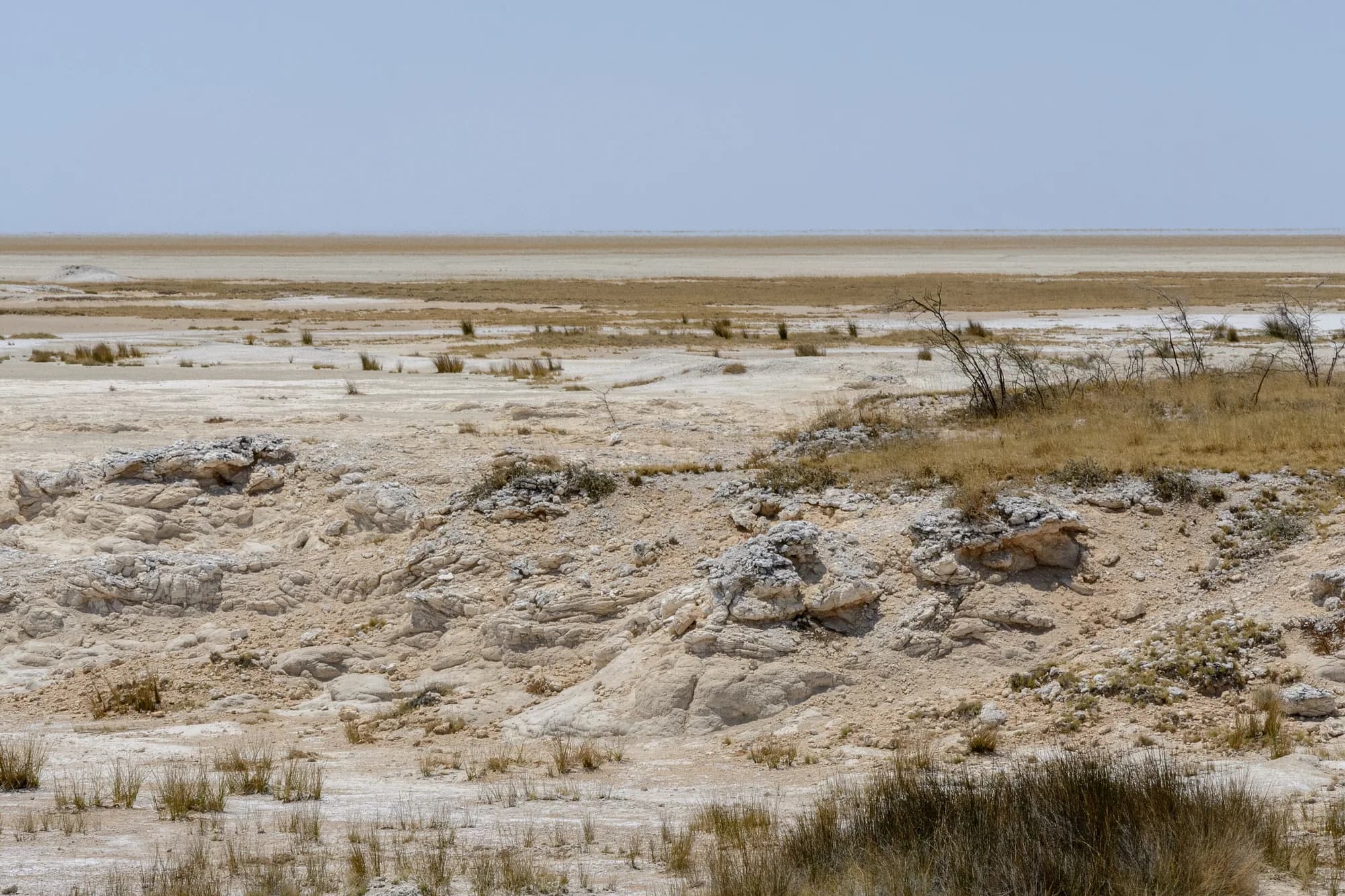
- Newly excavated fossils of marsh-dwelling antelope such as sitatunga, lechwe and tsessebe, and a 90 cm catfish, are MEFT's evidence for much wetter periods. The pan was once part of a lake fed by the Kunene.
- The Oshindonga name for the pan was Etotha, the place where no plants grow. Early European traders could not pronounce it, and Etosha is what stuck.
MEFT — Etosha National Park park profile
Read 28 September 2026. The Ministry of Environment, Forestry and Tourism's own page for the park. It carries the park area, the proclamation year, species counts, named bird and plant species and a camp-by-camp summary. It gives no gate names, no gate times and no rhino population figure.
https://www.meft.gov.na/national-parks/etosha-national-park/217/NWR — Namutoni Resort
Read 28 September 2026. Each resort page carries its own rate table in Namibian dollars, split into two seasons — July 2026 to October 2026, and November 2026 to June 2027 — together with unit counts, facilities, contact numbers and distances from Windhoek, Swakopmund, Sossusvlei or Tsumeb. Rates are per person sharing unless the row says single.
https://www.nwr.com.na/resorts/namutoni-resort/NWR — Onkoshi Resort
Read 28 September 2026. Each resort page carries its own rate table in Namibian dollars, split into two seasons — July 2026 to October 2026, and November 2026 to June 2027 — together with unit counts, facilities, contact numbers and distances from Windhoek, Swakopmund, Sossusvlei or Tsumeb. Rates are per person sharing unless the row says single.
https://www.nwr.com.na/resorts/onkoshi-resort/What we could not verify
Population figures of any kind
Beyond the species counts above, MEFT publishes no population estimate for any animal in Etosha that we could find — not elephant, not lion, not either rhino. Nor could we find a published seasonal movement study, a predator density, or a waterhole-by-waterhole species list. Everything on this page that is a number comes from MEFT's park profile and nowhere else.