

Species · Tragelaphus scriptus
Bushbuck
The most widely distributed antelope in Africa, and the one nobody books. You will meet it on a camp lawn at Victoria Falls, on a forest path at Gombe and in the coastal thicket of the Garden Route, and in almost every case it will be standing still, alone, watching you from the edge of cover.
Also called
- Bosbok · Afrikaans
- iMbabala · isiZulu
- Pongo · Swahili
Checked 28 Sept 2026
- Where
- More of Africa than any other antelope
- Best months
- Year-round, everywhere it occurs
- Social
- Solitary — it does not form herds
- Odds
- Near-certain in the right habitat
From Senegal to Ethiopia and south to the Eastern Cape, wherever there is cover and water. It is absent from true desert, from the driest Kalahari and from open grassland with no thicket in it, and present almost everywhere else in sub-Saharan Africa.
Where it is
HabitatThicket, riverine bush and forest edge, almost always within a short bound of solid cover and usually near water. It is an edge animal: the boundary between thick and open is where it feeds, and the thick side is where it goes.
Worth travelling for
Coastal forest and fynbos thicket along the Garden Route, where they walk the camp margins at Storms River and Nature's Valley.
Gombe's forest paths and stream valleys, met on foot rather than from a vehicle — which is a different and better way to see one.
The Zambezi riverine strip and the rainforest below the falls, where they are habituated enough to feed within a few metres of a footpath.
Also occurs
KenyaUgandaZambiaBotswanaNamibiaEthiopiaAngolaMozambiqueCameroonSenegal
Present, but not where you would go to see one.
Where to actually go
Ranked, with the reason each — these are not interchangeable.
- 01Garden RouteSouth AfricaCoastal forest and thicket with bushbuck along the camp margins and the walking trails, seen on foot at a few metres in soft light. The best place on this site to simply watch one.On foot, at close range
- 02Victoria FallsZimbabweThe rainforest and the Zambezi riverine strip hold habituated animals that feed within metres of the paths, which is as easy as this species ever gets.The easiest sighting
- 03GombeTanzaniaForest paths and stream valleys, met while walking to the chimpanzees. Shyer here than in the southern parks, and the more satisfying sighting for it.The wild version
Where you will not see one
- Open plain with no cover in itThe Serengeti short-grass plains, the Etosha pan, the Kalahari dunes. A bushbuck needs a thicket to step into and will not be found more than a short run from one.
- On a list where it means kuduPeople read bushbuck and picture something larger. It is a shoulder-high, solitary, thicket-bound animal, not a plains antelope, and a ram's horns make a single open twist rather than a kudu's spiral.
- Scanning at distance from a vehicleNot a place so much as a method. You find bushbuck on foot, from a camp verandah, or by looking into the thicket edge at three metres — not by glassing the middle distance.
When to go
When to go
- J
- F
- M
- A
- M
- J
- J
- A
- S
- O
- N
- D
January: good. February: good. March: good. April: good. May: best. June: best. July: best. August: best. September: best. October: good. November: good. December: marginal.
Through the day
- Dawn
- Morning
- Midday
- Afternoon
- Dusk
- Night
Dawn: most active. Morning: active. Midday: usually resting. Afternoon: active. Dusk: most active. Night: active.
Realistic odds on a three-day trip
- Near-certain
- Likely
- Lucky
- Expedition
Telling it apart
Told apart from
Nyala
KwaZulu-Natal and the Lowveld, where both occur
A female nyala is brighter orange, taller and far more striped, and travels in small groups; a bushbuck ewe is stockier, shorter-legged, more sparsely marked and almost always alone.
Kenya and Tanzania
The lesser kudu's flank stripes are numerous, narrow and cleanly vertical; a bushbuck's white marks are broken into spots, smears and part-stripes. Habitat settles it too — dry thornbush against riverine thicket.
Common duiker
A duiker is much smaller, runs hunched with its head low and dives into cover; a bushbuck stands its ground, stares, and walks away.
Marks chosen to be usable from a moving vehicle — a bushbuck is rarely still and never close enough for anything subtler.
What it looks like in the field


Photographs of Bushbuck in the wild, in Indian reserves. We publish no captive, baited or digitally composited images, and no photograph whose licence we cannot show.
Photographing it
- Lens
- 70-200mm is usually enough, and sometimes too much. This is a close-range animal in low light rather than a distant one.
- Typical distance
- Five to thirty metres, often from a path or a camp. Autofocus will hunt in dappled forest shade — focus on the eye and accept a slower shutter.
- Light
- Overcast or deep shade suits the coat far better than direct sun, which blows out the white throat patch and loses the markings entirely.
Where to stopA bushbuck on a camp lawn is habituated, not tame. Do not feed it, do not corner it against a building, and do not crowd a ram — the same horns that look modest at ten metres are the reason this animal has the reputation it does.
Signs and calls
- Bark
- A single harsh, hoarse dog-like bark, often repeated at long intervals from inside cover. At night it is the sound most often mistaken for something more dramatic.
- Tracks
- Neat, pointed cloven prints on damp paths and along thicket edges, usually a single animal's rather than a group's.
- Browse
- Low leaves and fallen fruit taken within a metre or so of the ground, concentrated along the same few metres of edge night after night — bushbuck are sedentary and reuse their routes.
One species, and a contested split
A bushbuck from the Garden Route and a bushbuck from West Africa do not look much alike. The northern animals are brightly marked with a white harness of stripes across the body; the southern ones are plainer, darker in the ram, and carry spots and smears where the northern harness would be. That difference is real, and several authors have proposed splitting the bushbuck in two — a northern Tragelaphus scriptus and a southern Tragelaphus sylvaticus.
The proposal is contested and it has not been adopted by the Red List, which assesses the bushbuck as one species. There is no separate assessment of sylvaticus and therefore no separate conservation figure for the southern animals — the category on this page covers the whole range, the Garden Route and Gombe and Victoria Falls animals included. If you read a status claim attached specifically to the southern bushbuck, it is not coming from an assessment, because none exists.
The antelope that does not form herds
Almost every antelope a visitor meets lives in a group, and the bushbuck does not. It is solitary, non-territorial and sedentary: an adult spends its life in a small home range, overlapping freely with its neighbours’ and defending none of it, and meets other bushbuck without much ceremony. A ewe with a well-grown lamb is the largest group you are likely to see.
The sexes look so different that people regularly count them as two species. Rams are darker — in southern Africa often close to chocolate or near-black in an old animal — with short horns making a single open twist and a ridge of raisable hair along the spine. Ewes are bright chestnut, hornless, and rather smaller. Both carry a white patch at the base of the throat, and both have the same flat response to being seen: stand, stare, and then walk unhurriedly into the thicket.
Status and protection
Status and protection
- IUCN Red List
- Least Concern
- Population trend
- → Stable
Species-level assessment for Tragelaphus scriptus. The proposed split into a northern scriptus and a southern sylvaticus is contested and the Red List does not assess sylvaticus…
Assessed 2016 · IUCN Red List assessment
What to book to see one
What you would be booking
- How it is seen
- No booking required and that is the honest answer. Walking trails, forest paths and the margins of any rest camp in the right habitat.
- Drives to book
- None specifically. If you are in bushbuck country for two days you will see one, and if you are in the Garden Route or at Victoria Falls you will see several without leaving camp.
- Zone or shift
- Storms River and Nature's Valley on the Garden Route; the stream valleys and the main path at Gombe; the rainforest and Zambezi riverine strip at Victoria Falls.
Two things worth knowing. First, a bushbuck barking in thick cover at night sounds enough like a warning to send people looking for a leopard, and most of the time it is just a bushbuck. Second, it has a long-standing reputation among hunters as the antelope most likely to turn on something that has cornered it — a reason to give a ram in a camp the same distance you would give anything else with horns.
Garden RouteOn the same trip you would also get
- Chimpanzee — the actual reason anyone goes to Gombe
- Nile crocodile — the same Zambezi riverine strip
Questions people ask
Is the bushbuck one species or two?
Where is the easiest place to see a bushbuck?
Do bushbuck live in herds?
Are bushbuck dangerous?
Read next

Dry thornbush in East Africa and the Horn
Lesser kudu — the harder striped antelope
The shyest antelope most people will ever try to see, and the one genuinely hard animal in the dry-country bush. It lives in thick acacia and commiphora scrub, it freezes rather than runs, and it is gone before most vehicles have stopped. Tsavo West and Ruaha are the two places worth planning around.
Uganda, Rwanda and western Tanzania
Chimpanzee — Gombe
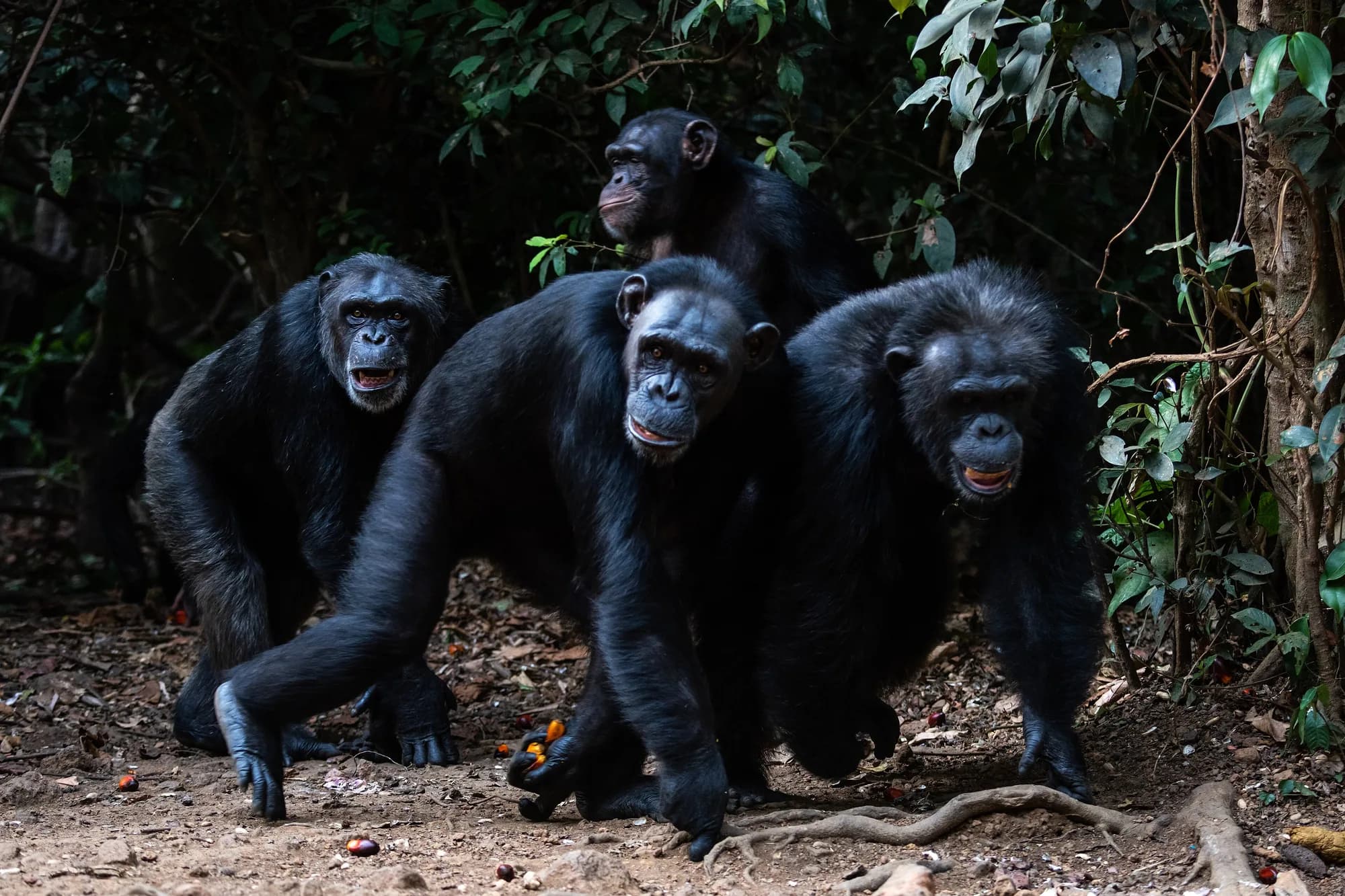
Louder, faster and far harder to keep up with than a gorilla, and the trek is nothing like the same experience. Kibale is the reliable one; Mahale, on the shore of Lake Tanganyika, is the one people remember.
Garden Route
Victoria Falls