

Species · Piliocolobus tephrosceles
Ugandan red colobus
This page is about one animal: Piliocolobus tephrosceles, the Ugandan red colobus, which despite the name is also the red colobus of Mahale and Gombe. Red colobus as a whole is a genus of seventeen or eighteen species with wildly different fortunes, and quoting one of them for another is the commonest mistake made about African monkeys.
Also called
- Mbega mwekundu · Swahili
Checked 28 Sept 2026
- Which species
- Piliocolobus tephrosceles
- Where
- Kibale, Mahale, Gombe
- Best months
- Jun–Sep; May–Oct at the lake
- Odds
- Very high at Kibale
Western Uganda and western Tanzania, and nothing in between. The Ugandan red colobus is named for the country that holds its stronghold at Kibale, but the same species lives in the lakeshore forests of Mahale and Gombe on Lake Tanganyika, which is why this one page serves all three parks. Every other red colobus — Zanzibar, Udzungwa, the Niger Delta, the whole West African set — is a different species with its own assessment.
Where it is
HabitatMid-altitude and lowland rainforest with a continuous canopy and plenty of young foliage. A leaf-eater, so it needs the flush of new growth rather than fruiting trees, and it will use regenerating forest and old logged compartments readily.
Worth travelling for
Kibale is the stronghold and the easiest place on earth to watch this species — it is one of thirteen primates there and among the most visible of them.
The Lake Tanganyika forests. Mahale and Gombe both hold it, both reached by boat, and in both it shares the forest with the chimpanzees that hunt it.
Gone from
Many of the small forest fragments around Kibale, cleared within living memory — the groups in them went with the trees
Range this species has been lost from. It is the fact a map of where it currently lives cannot show you.
Where to actually go
Ranked, with the reason each — these are not interchangeable.
- 01KibaleUgandaThe stronghold, and the easiest viewing anywhere. Thirteen primate species in one forest, a trail grid you can walk in a morning, and red colobus groups large enough to find by ear.Worth its own morning
- 02Mahale MountainsTanzaniaForested mountains dropping into Lake Tanganyika, reached only by boat, with red colobus in the forest you walk through to reach the chimpanzees.A bonus on a chimpanzee trip
- 03GombeTanzaniaWhere chimpanzee hunting of red colobus was first described, and where the longest continuous study of a wild animal population is still running. Small, steep, and historically the most important forest on this list.Where the hunting was first recorded
Where you will not see one
- Bwindi and the VirungasNo red colobus of any kind. Bwindi's primate list runs to gorillas, chimpanzees, L'Hoest's, blue monkeys, red-tailed monkeys, baboons and black-and-white colobus, and a red monkey there is a red-tailed monkey, which is a guenon.
- ZanzibarThere are red colobus at Jozani and they are excellent, but they are Piliocolobus kirkii, a different species endemic to Unguja island with its own assessment. Nothing on this page applies to them.
- The savanna parksSerengeti, Mara, Ruaha, Queen Elizabeth's plains. Closed canopy or nothing.
- Any zooRed colobus have almost never been kept successfully in captivity — the gut that lets them live on leaves does not tolerate substitute diets. If you want to see one you go to the forest.
When to go
When to go
- J
- F
- M
- A
- M
- J
- J
- A
- S
- O
- N
- D
January: good. February: good. March: marginal. April: marginal. May: good. June: best. July: best. August: best. September: best. October: marginal. November: marginal. December: good.
Through the day
- Dawn
- Morning
- Midday
- Afternoon
- Dusk
- Night
Dawn: active. Morning: most active. Midday: usually resting. Afternoon: active. Dusk: active. Night: not normally seen.
Realistic odds on a three-day trip
- Near-certain
- Likely
- Lucky
- Expedition
Telling it apart
Told apart from
Zanzibar red colobus
Zanzibar, where most visitors meet a red colobus for the first time
A different species, Piliocolobus kirkii, found only on Unguja and easily seen at Jozani. Paler, with a distinct pale face ring and a long pale crest. If you are on the coast you are not looking at the animal on this page.
Black-and-white colobus
Kibale and Gombe, in the same trees
The white mantle and plumed white tail settle it from any distance. The two share canopy routinely and a mixed group is read as one species more often than not.
Red-tailed monkey
Kibale, where the word red does most of the damage
A guenon, not a colobus: white heart-shaped nose spot, coppery tail, and a thumb. Smaller, quicker, and it eats fruit and insects rather than leaves.
Olive baboon, at a distance in poor light
Gombe's valleys
On the ground and in the open, with a long muzzle. Red colobus almost never come down.
Marks chosen to be usable from a moving vehicle — a ugandan red colobus is rarely still and never close enough for anything subtler.
What it looks like in the field


Photographs of Ugandan red colobus in the wild, in Indian reserves. We publish no captive, baited or digitally composited images, and no photograph whose licence we cannot show.
Photographing it
- Lens
- 400mm and a body that copes with high ISO. Every frame is shot upward into closed canopy, usually through leaves.
- Typical distance
- Twenty-five to forty-five metres, almost vertical.
- Light
- Hard. Bright sky behind a dark animal, and the red only reads when the light is lateral — the forest edge early, or a canopy gap.
Where to stopIf chimpanzees start hunting, put the camera down and do what the guide says. A hunt is a fast, chaotic event in which people on the ground are an obstacle, and getting closer for the frame changes what happens.
Signs and calls
- Falling debris
- Stripped leaf stalks, bitten-off shoots and a steady patter of fragments onto the leaf litter. A large group feeding makes a mess and the mess arrives before the sighting does.
- The chorus
- A ragged outbreak of squeals, chists and barks from several animals at once, then silence. Groups are large and multi-male, and the noise carries much further through closed forest than any view of them.
- Canopy shaking with no wind
- Whole crowns moving in sequence forty metres up on a still morning. Follow the line rather than the individual animal.
- Chimpanzees looking up
- A party of chimpanzees standing still and staring into the canopy, quietly, is the best red colobus indicator in the forest. It is also the beginning of a hunt, and guides at Kibale and Gombe read it that way.
Who gives it away
Red colobus, to chimpanzees
A sudden ragged chorus of squeals and barks from a whole group, with males dropping toward the disturbance rather than fleeing upward. This is the response to chimpanzees below, and it is unmistakable once you have heard it.
The highest-value sound in these forests — it means apes as well as monkeys
Red colobus, to a crowned eagle
Sharp, short alarm barks followed by the group dropping out of the exposed upper canopy into cover, which is the opposite of what they do for a ground predator.
Look up rather than down
Black-and-white colobus
A rolling, snorting roar at dawn that sets off neighbouring troops in sequence. Not this species, but it reliably puts you under shared canopy.
A locator for the forest, not for the animal
Alarm calls announce a predator, not specifically a ugandan red colobus, and a great many of them announce nothing at all. They are a reason to stop the vehicle, which is most of what finding one takes.
Which red colobus this is
Red colobus is not a species. Piliocolobus is a genus of seventeen or eighteen species depending on the authority, spread from Senegal to Zanzibar, and their Red List categories are not remotely the same: some are Endangered, several are Critically Endangered, and Miss Waldron’s red colobus of Ghana and Ivory Coast may already be gone. A category quoted for one of them says nothing whatever about another.
This page is about Piliocolobus tephrosceles, the Ugandan red colobus, and the status block above is that species’ assessment and no other. Its range is western Uganda and western Tanzania — Kibale, and the Lake Tanganyika forests of Mahale and Gombe — so the name is a little misleading and the animal you watch above a Tanzanian beach camp is the same one. If you have seen a red colobus at Jozani on Zanzibar, that was P. kirkii, an island endemic and a separate assessment.
Hunted by chimpanzees
Red colobus are the principal mammalian prey of chimpanzees across much of East Africa, and the relationship is the reason this monkey turns up in more research papers than any other on this site. Jane Goodall first described the hunts at Gombe in the 1960s. At Ngogo in Kibale, where the chimpanzee community is unusually large, hunting has been recorded at a rate heavy enough that researchers have attributed a decline in the local red colobus population to it.
For a visitor this changes what you are watching. Red colobus do not simply flee: males move down toward the chimpanzees and mob them, which is why a hunt is audible from a distance and why a group that suddenly erupts into squealing while dropping rather than climbing is worth standing still for. If your guide stops and starts listening, this is usually why.
Status and protection
Status and protection
- IUCN Red List
- Endangered
- Population trend
- ↓ Decreasing
Assessment for Piliocolobus tephrosceles, the Ugandan red colobus -- the animal at Kibale, Gombe and Mahale.
Assessed 2020 · IUCN Red List assessment
What to book to see one
What you would be booking
- How it is seen
- A guided forest walk. At Kibale a general primate walk will do it and a chimpanzee permit will usually do it as well; at Mahale and Gombe you see them while chimpanzee tracking.
- Drives to book
- One morning walk at Kibale is normally enough. At Mahale and Gombe, budget the same three or four days you would budget for the chimpanzees, because the boat schedule sets the trip length, not the monkeys.
- Zone or shift
- Kibale's main trail grid out of Kanyanchu. At Gombe, the Kakombe and Mkenke valleys. At Mahale, the forest behind the beach camps, walking up from the lake.
Kibale is the one to book if the colobus is the point: it is a road-accessible park with a long primate list and this is one of its most visible species. Mahale and Gombe are boat-access parks where you are spending real money on chimpanzees, and the red colobus is both a bonus and, sometimes, part of what you watch the chimpanzees do.
KibaleOn the same trip you would also get
- Chimpanzee — the same three parks — and the main predator
- Black-and-white colobus — the same canopy, the opposite colour
Questions people ask
Which red colobus is this page about?
Is the red colobus at Zanzibar the same animal?
Where is the best place to see red colobus?
Do chimpanzees really hunt red colobus?
Read next
Uganda, Rwanda and western Tanzania
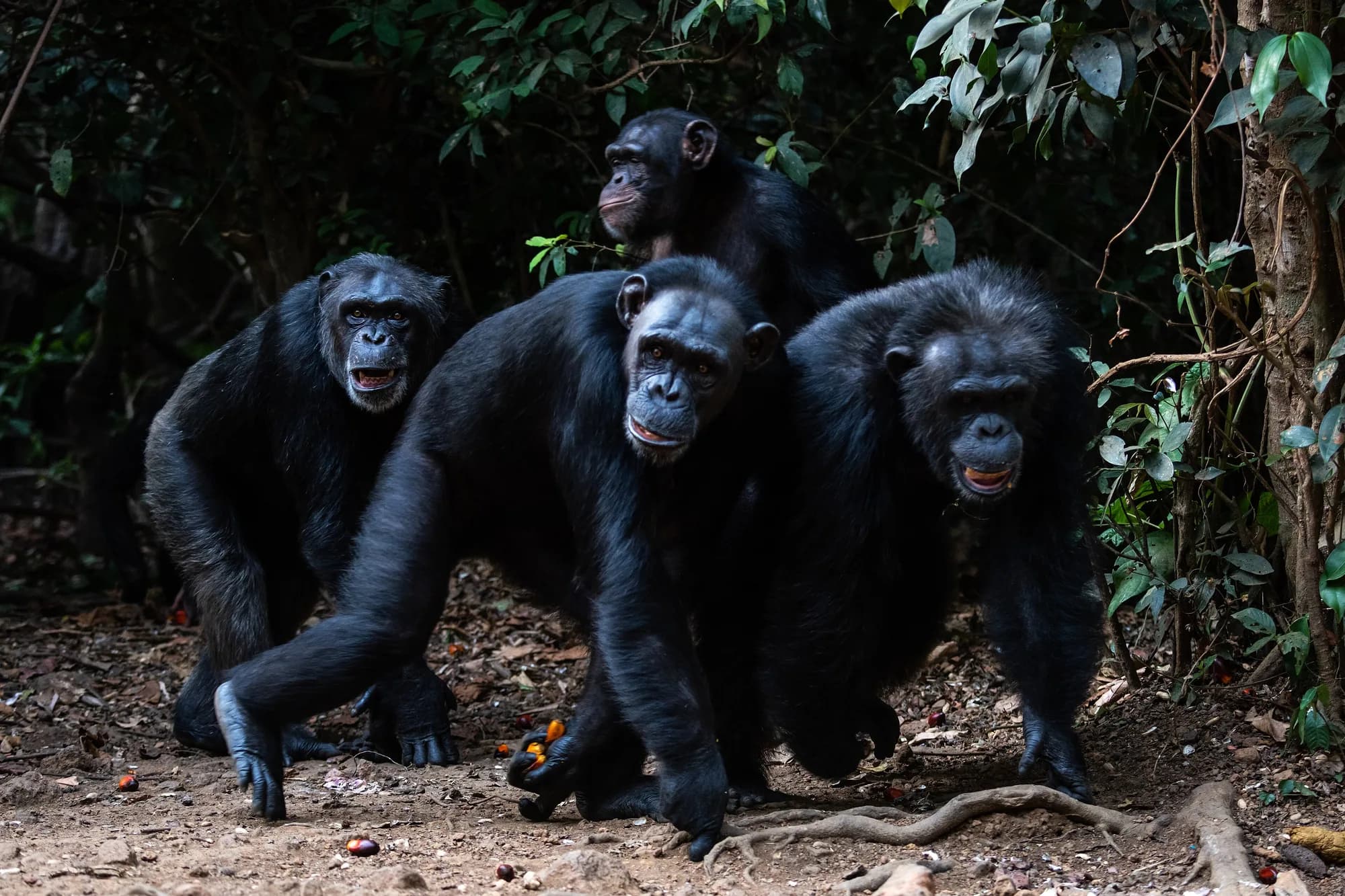
Chimpanzee — the predator
Louder, faster and far harder to keep up with than a gorilla, and the trek is nothing like the same experience. Kibale is the reliable one; Mahale, on the shore of Lake Tanganyika, is the one people remember.
Forest canopy in four countries here
Black-and-white colobus
The monkey with no thumbs and a white cape, and the one people photograph most on a forest trek without ever learning its name. A troop leaping between crowns with the mantle streaming is the best thing that happens on a gorilla trek that is not the gorillas.
Kibale