
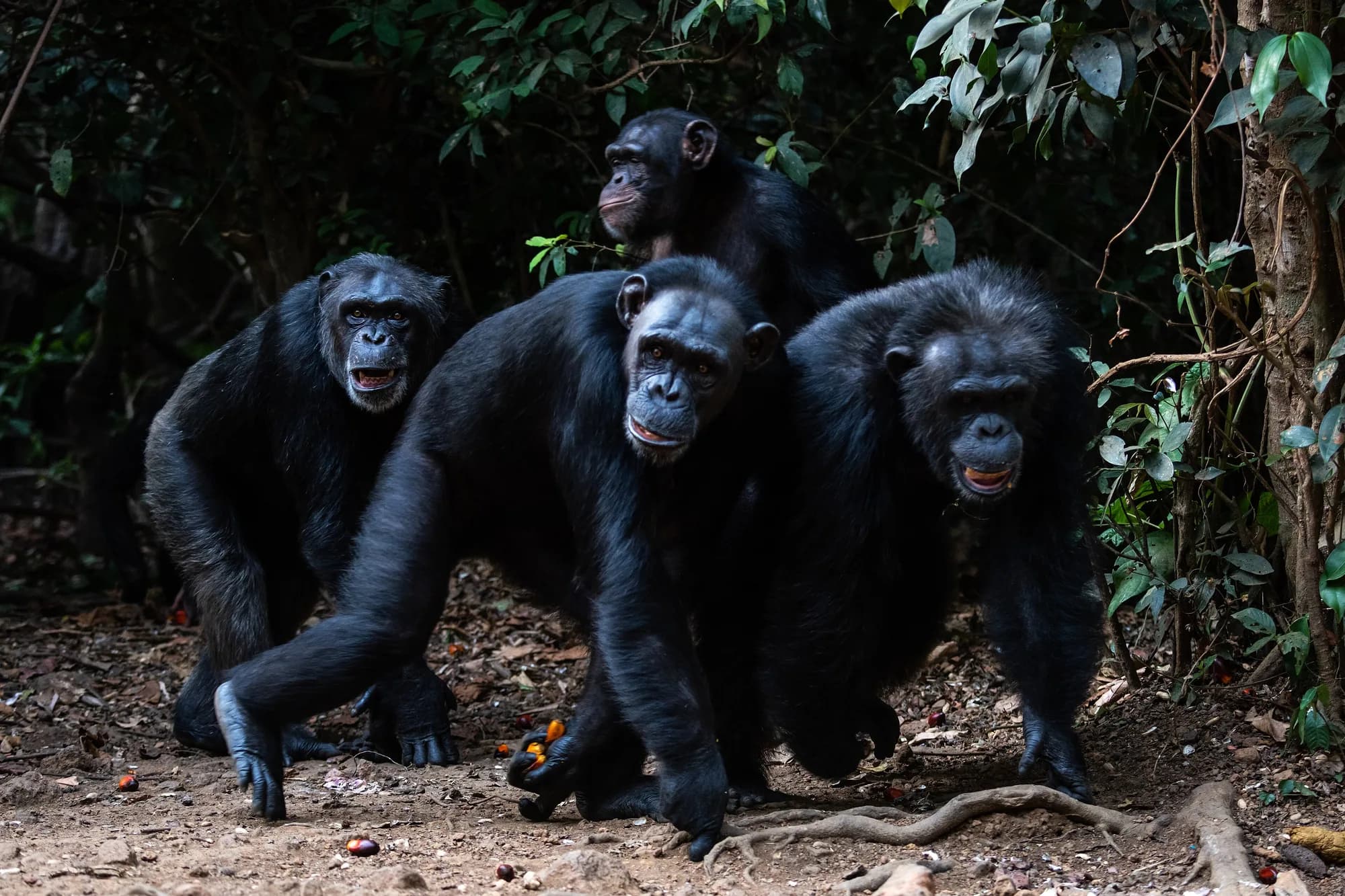
Species · Pan troglodytes
Chimpanzee
Louder, faster and far harder to keep up with than a gorilla, and the trek is nothing like the same experience. Kibale is the reliable one; Mahale, on the shore of Lake Tanganyika, is the one people remember.
Also called
- Sokwe · Swahili
- Empundu · Rutooro
Checked 27 Sept 2026
- Where
- Uganda, Rwanda, Tanzania
- Best months
- June–Sept, Dec–Feb
- Your time
- One hour, or a full day habituating
- Odds
- High at Kibale and Mahale
Tropical forest and forest mosaic across equatorial Africa. On this site that means the Ugandan forests — Kibale above all — Nyungwe in Rwanda, and the two Lake Tanganyika parks in western Tanzania, Mahale and Gombe.
Where it is
HabitatTropical forest and forest mosaic across equatorial Africa.
Worth travelling for
The most reliable trekking anywhere, with thirteen primate species in the same forest.
Forested mountains falling into Lake Tanganyika, reached by boat, studied since the 1960s.
A large montane forest with a canopy walkway, pairing naturally with Volcanoes.
Also occurs
CameroonGabonCongoDR CongoGuineaCôte d'IvoireSierra Leone
Present, but not where you would go to see one.
Gone from
GambiaBurkina FasoBeninTogo
Range this species has been lost from. It is the fact a map of where it currently lives cannot show you.
Where to actually go
Ranked, with the reason each — these are not interchangeable.
- 01KibaleUgandaThe most reliable chimpanzee trekking anywhere, with well-habituated communities, thirteen primate species in the same forest, and easy road access.Highest odds, easiest logistics
- 02Mahale MountainsTanzaniaForested mountains falling into Lake Tanganyika, reached by boat, with communities studied since the 1960s. The most remarkable place on this list and the hardest to reach.The setting, and the research history
- 03NyungweRwandaA large montane forest with chimpanzees, a canopy walkway and thirteen other primates, and it pairs naturally with Volcanoes.Pairs with the gorillas
- 04GombeTanzaniaSmall, and the site of the longest-running study of wild chimpanzees anywhere. Historically the most important forest on this list.For the history
- 05Queen ElizabethUgandaThe Kyambura gorge community is small and the odds are lower, but it slots into a savanna itinerary without a detour.Convenient, less certain
Where you will not see one
- Any savanna parkChimpanzees are a forest animal. Not in the Serengeti, the Mara, Kruger or Akagera.
- Bwindi and VolcanoesThose are the gorilla parks. Uganda's chimpanzees are at Kibale, Kyambura and Budongo; Rwanda's are in Nyungwe. A single trip can do both, but not in one forest.
- QuietlyIf you want a calm, contemplative hour, book gorillas. A chimp community is loud, mobile and often thirty metres up a tree.
When to go
When to go
- J
- F
- M
- A
- M
- J
- J
- A
- S
- O
- N
- D
January: good. February: good. March: marginal. April: marginal. May: marginal. June: best. July: best. August: best. September: best. October: marginal. November: marginal. December: good.
Through the day
- Dawn
- Morning
- Midday
- Afternoon
- Dusk
- Night
Dawn: most active. Morning: most active. Midday: usually resting. Afternoon: active. Dusk: active. Night: not normally seen.
What it looks like in the field
Photographs of Chimpanzee in the wild, in Indian reserves. We publish no captive, baited or digitally composited images, and no photograph whose licence we cannot show.
Kibale, Nyungwe or Mahale
Kibale is the answer for most people: the highest odds, the shortest walk, and thirteen primate species in the same forest so the trek is worth doing even on a bad chimp day. It sits comfortably in a standard Uganda itinerary between Queen Elizabeth and Bwindi.
Mahale is the answer for people who will travel for it. You fly to an airstrip and arrive by boat; the forest climbs straight out of Lake Tanganyika; the communities have been studied since the 1960s. Nothing else on this site combines primates and a setting like that, and it costs accordingly.
What you actually see
Usually a community spread through the canopy, feeding on figs, with a lot of noise and not much visibility — then a sudden descent to the ground and a group moving past you at walking pace. The pant-hoot carries a long way and is how the guides locate them; when it is answered from another direction, the group usually moves.
Chimpanzee society is fission-fusion: a community of dozens splits into small parties that change composition through the day, which is why what you meet is a handful of animals rather than the whole group. Grooming bouts are the most legible thing to watch, because who grooms whom, and for how long, is the politics.
Status and protection
Status and protection
- IUCN Red List
- Endangered
- Population trend
- ↓ Decreasing
- CITES
- Appendix I
Species-level assessment for Pan troglodytes, matching the binomial on the page.
Assessed 2016 · IUCN Red List assessment
What to book to see one
What you would be booking
- How it is seen
- A permit and a guided trek, usually in the morning. Several parks also sell a full-day habituation experience.
- Drives to book
- One trek is enough at Kibale. At Mahale, where you have flown a long way to get there, budget three days.
- Zone or shift
- Kibale for reliability; Nyungwe for the canopy walkway and a very large community; Mahale for the setting, which is the best of any primate site on this site.
At Kibale the habituation experience is USD 300 against USD 250 for standard tracking — four hours with the chimpanzees rather than one, for fifty dollars. Per hour it is the best value on UWA's tariff, and the obvious buy for anyone who cares about behaviour rather than a photograph. Kyambura Gorge in Queen Elizabeth is USD 100 and, unlike Kibale, does not include park entrance.
KibaleOn the same trip you would also get
- Mountain gorilla — the other trek, entirely different
- Red colobus — the same canopy, and chimp prey
Questions people ask
Where is the best place to trek chimpanzees?
How is chimp trekking different from gorilla trekking?
What is the chimpanzee habituation experience?
Read next
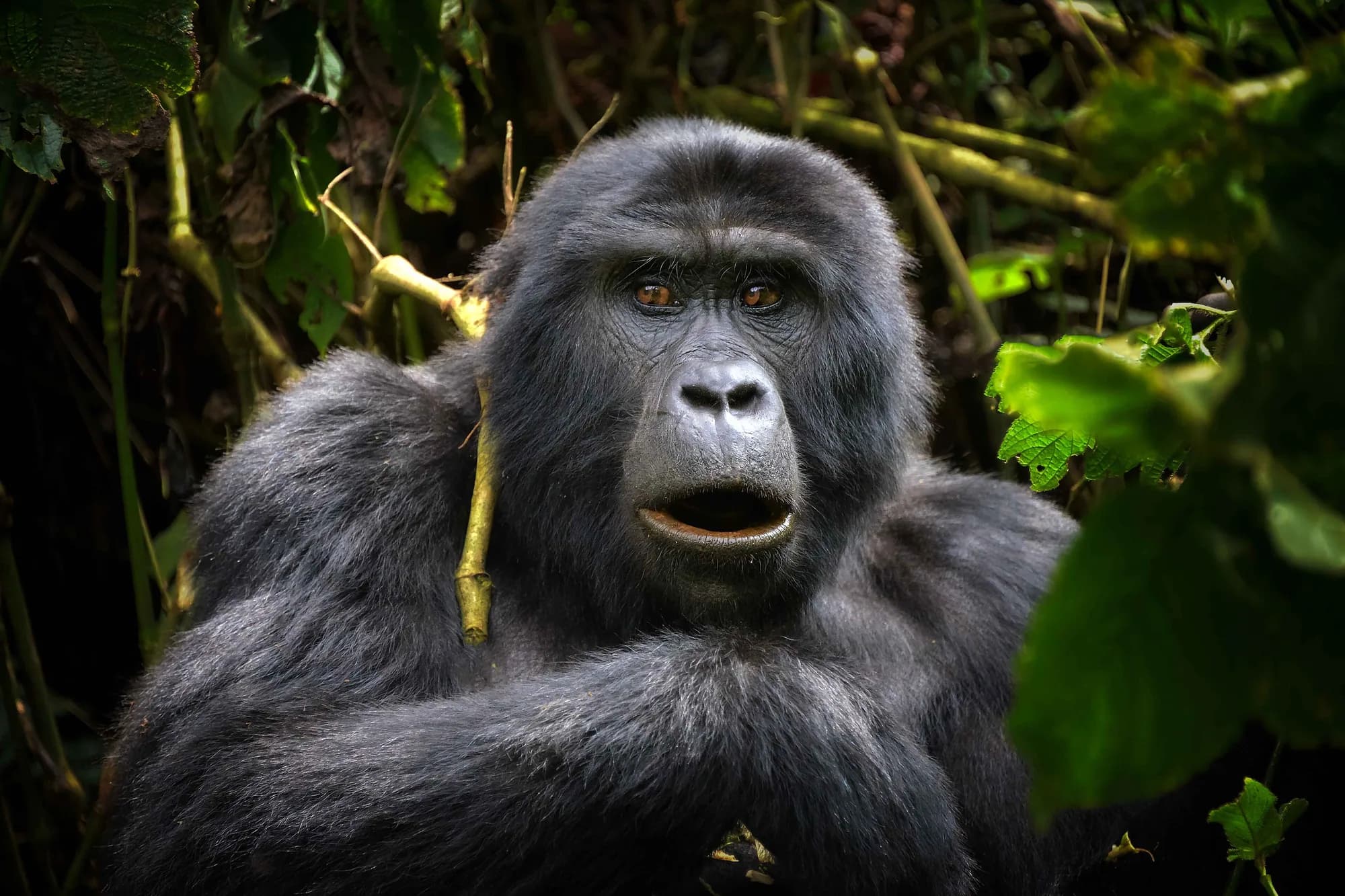
Bwindi, Mgahinga, Volcanoes — and nowhere else on earth
Mountain gorilla
Three national parks on this site hold the entire world population, and one hour with a habituated group is the most expensive and most reliably delivered wildlife encounter in Africa. It is also the rare conservation story that has gone the right way.
Kibale
Mahale Mountains