

Species · Tragelaphus imberbis
Lesser kudu
The shyest antelope most people will ever try to see, and the one genuinely hard animal in the dry-country bush. It lives in thick acacia and commiphora scrub, it freezes rather than runs, and it is gone before most vehicles have stopped. Tsavo West and Ruaha are the two places worth planning around.
Also called
- Tandala ndogo · Swahili
- Godir · Somali
Checked 28 Sept 2026
- Where
- East Africa and the Horn, dry country only
- Best months
- The dry season, roughly Jun–Oct
- Flank stripes
- Usually eleven to fifteen, against a greater kudu's few
- Odds
- Genuinely hard, even where it is common
A Horn of Africa and East African animal, reaching its southern limit in central Tanzania. The largest share of the range is in Ethiopia, Somalia and Kenya, and much of it is in country where nobody has been able to count anything for years.
Where it is
HabitatDense dry thornbush — acacia and commiphora scrub in arid and semi-arid lowland. It browses rather than grazes and takes most of its water from what it eats, so it can live well away from any river or waterhole. Thicket is the predictor, not water.
Worth travelling for
Tsavo's red thornbush is the classic ground for it, and the most accessible place in the world to try.
Ruaha sits near the southern limit of the range and is one of very few parks where both kudus occur; Tarangire holds them in the drier scrub away from the river.
Also occurs
EthiopiaSomaliaDjiboutiSouth SudanUganda
Present, but not where you would go to see one.
Where to actually go
Ranked, with the reason each — these are not interchangeable.
- 01Tsavo WestKenyaRed thornbush across an enormous area, a resident population, and easy access from Nairobi or the coast. The most practical place in the world to look for one.The classic ground
- 02RuahaTanzaniaNear the southern limit of the range, and one of very few parks where greater and lesser kudu can be seen on the same drive. The best antelope park in East Africa by some distance.Both kudus in one park
- 03TarangireTanzaniaPresent in the drier scrub away from the river, though overshadowed by the elephants and the baobabs. A bonus rather than a reason to go.Easiest to combine
Where you will not see one
- Kruger, Etosha, the Kalahari — anywhere in southern AfricaThere is no lesser kudu south of Tanzania. If a southern African park list says kudu, it means the greater kudu, which is a much larger and much commoner animal.
- The Mara, the Serengeti plains, NgorongoroToo wet and too open. The lesser kudu wants arid thornbush, and the famous northern grasslands have none of it.
- Anywhere, in the middle of the dayIt stands motionless in cover from mid-morning to mid-afternoon. Right park, wrong three hours, and you will not see one.
When to go
When to go
- J
- F
- M
- A
- M
- J
- J
- A
- S
- O
- N
- D
January: good. February: good. March: marginal. April: marginal. May: marginal. June: good. July: best. August: best. September: best. October: best. November: marginal. December: marginal.
Through the day
- Dawn
- Morning
- Midday
- Afternoon
- Dusk
- Night
Dawn: most active. Morning: active. Midday: usually resting. Afternoon: active. Dusk: most active. Night: active.
Realistic odds on a three-day trip
- Near-certain
- Likely
- Lucky
- Expedition
Telling it apart
Told apart from
Ruaha and Tsavo, two of the few parks where both live
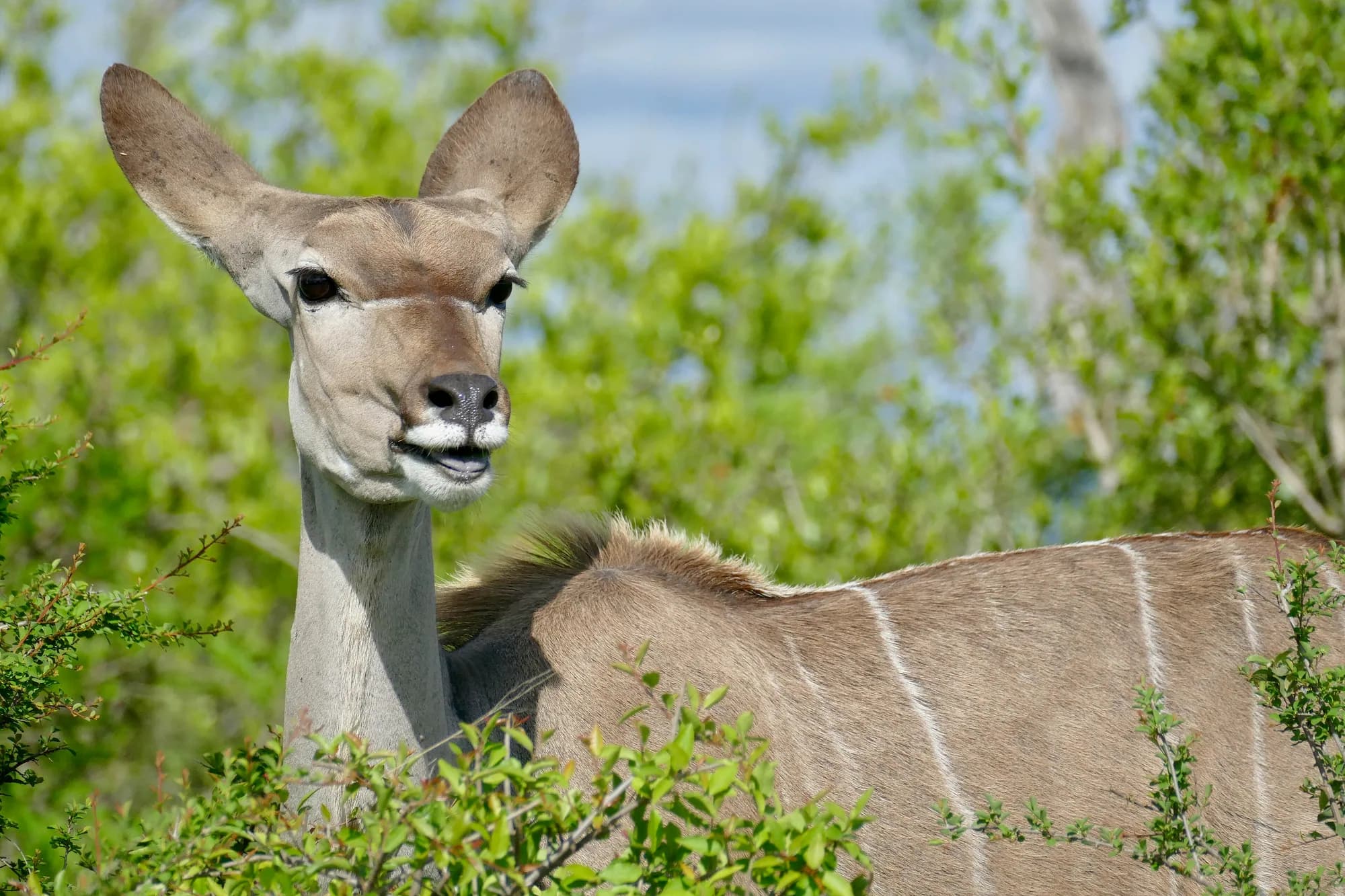
Count the stripes and look at the throat. Lesser kudu carries eleven to fifteen narrow white flank stripes and two white patches on the throat; the greater kudu has far fewer stripes, a tawny coat, and the bull has a throat fringe the lesser kudu entirely lacks.
A female lesser kudu and a bushbuck are both chestnut with white marks, but the bushbuck's markings are broken into spots and smears rather than clean vertical stripes, and it sticks to riverine thicket and forest edge rather than dry open scrub.
Marks chosen to be usable from a moving vehicle — a lesser kudu is rarely still and never close enough for anything subtler.
What it looks like in the field


Photographs of Lesser kudu in the wild, in Indian reserves. We publish no captive, baited or digitally composited images, and no photograph whose licence we cannot show.
Photographing it
- Lens
- 400mm and upwards. You will almost never get close, and the animal is nearly always partly screened.
- Typical distance
- Thirty to a hundred metres through vegetation. Expect to shoot between branches rather than around them.
- Light
- First and last hour. Dry-country dust gives warm low light that suits the coat, and the middle of the day is both harsh and empty of animals.
Where to stopDo not push a frozen animal. A lesser kudu holding still is an animal deciding whether it has been seen, and driving closer converts a two-minute sighting into a two-second one. Stop, cut the engine, and let it settle.
Signs and calls
- Tracks
- A narrow, pointed cloven print, noticeably smaller and neater than a greater kudu's and far less blunt than an impala's on the same road.
- Browse
- Freshly stripped commiphora and acacia shoots at about chest height on a standing animal, often on the shaded side of a thicket.
- Call
- A single sharp bark when it has seen you, usually delivered once as the animal turns away. It is often the only evidence you get that one was there.
Two white throat patches
The name is doing you no favours. A lesser kudu is not a small greater kudu — it is a separate species, greyer, far more heavily striped, and about half the weight. The marks that settle it in the field are two: the flank stripes, of which there are usually eleven to fifteen and which are narrow and clean, and a pair of white patches on the throat, one high and one low, that no greater kudu has.
The third tell is in the binomial. Imberbis means beardless, and the point of it is that a greater kudu bull carries a long fringe of hair down the throat and this animal carries none. Bulls of both species have spiralled horns; the lesser kudu’s make about two and a half tight turns on a much shorter frame. Cows of both are hornless, and a cow lesser kudu is the one most often called something else.
Why it is hard, and what to do about it
Almost everything else in this set is an animal people drive past. This one is the opposite. It lives in thornbush thick enough that a vehicle sees perhaps twenty metres into it, it is grey against grey, and its first response to a vehicle is to stand absolutely still with its head up rather than to run. A great many lesser kudu are looked straight at and not seen.
So the tactics are unusual. Drive slowly, at either end of the day, and scan for movement at the height of an ear rather than for the shape of a whole animal. Stop the engine the moment you suspect one, because the noise is what makes it break. Go in the dry season, when the scrub has thinned enough to see through. And expect to fail on most drives — this is an animal where three days of honest effort might produce two sightings, both brief, and that is a good trip rather than a bad one.
Status and protection
Status and protection
- IUCN Red List
- Near Threatened
- Population trend
- ↓ Decreasing
Species-level assessment for Tragelaphus imberbis, matching the binomial on the page.
Assessed 2016 · IUCN Red List assessment
What to book to see one
What you would be booking
- How it is seen
- Game drives in thornbush country, slowly, at either end of the day. A guide who knows the species is worth more here than in almost any other sighting on this site.
- Drives to book
- Four or five over three days, and plan as though it will not happen. People spend a week in perfect habitat and see nothing.
- Zone or shift
- The Ngulia and Kilaguni areas of Tsavo West; the drier eastern scrub of Tarangire, away from the river; the miombo and thornbush mosaic on the Ruaha side of the Great Ruaha river.
Drive at walking pace and watch for the ears rather than the body — the animal is screened and grey and the ears move before anything else. Stop the engine when you think you have one. Most lesser kudu are lost in the five seconds after the vehicle keeps rolling.
Tsavo WestOn the same trip you would also get
- Greater kudu — Ruaha holds both, which very few parks do
- African wild dog — Ruaha is one of the strongest populations left
Questions people ask
Where is the best place to see a lesser kudu?
What is the difference between a greater and a lesser kudu?
Can I see a lesser kudu in Kruger or Etosha?
Why are lesser kudu so hard to see?
Read next
Seven parks here, in thick bush
Greater kudu — the larger, commoner one
A very large antelope with spiral horns over a metre long, and the animal people most often fail to see because it is standing still ten metres away. Kudu are a bush species, and their whole defence is not moving.

Thicket and forest edge, across most of sub-Saharan Africa
Bushbuck — the other striped thicket antelope
The most widely distributed antelope in Africa, and the one nobody books. You will meet it on a camp lawn at Victoria Falls, on a forest path at Gombe and in the coastal thicket of the Garden Route, and in almost every case it will be standing still, alone, watching you from the edge of cover.
Tsavo West
Ruaha