
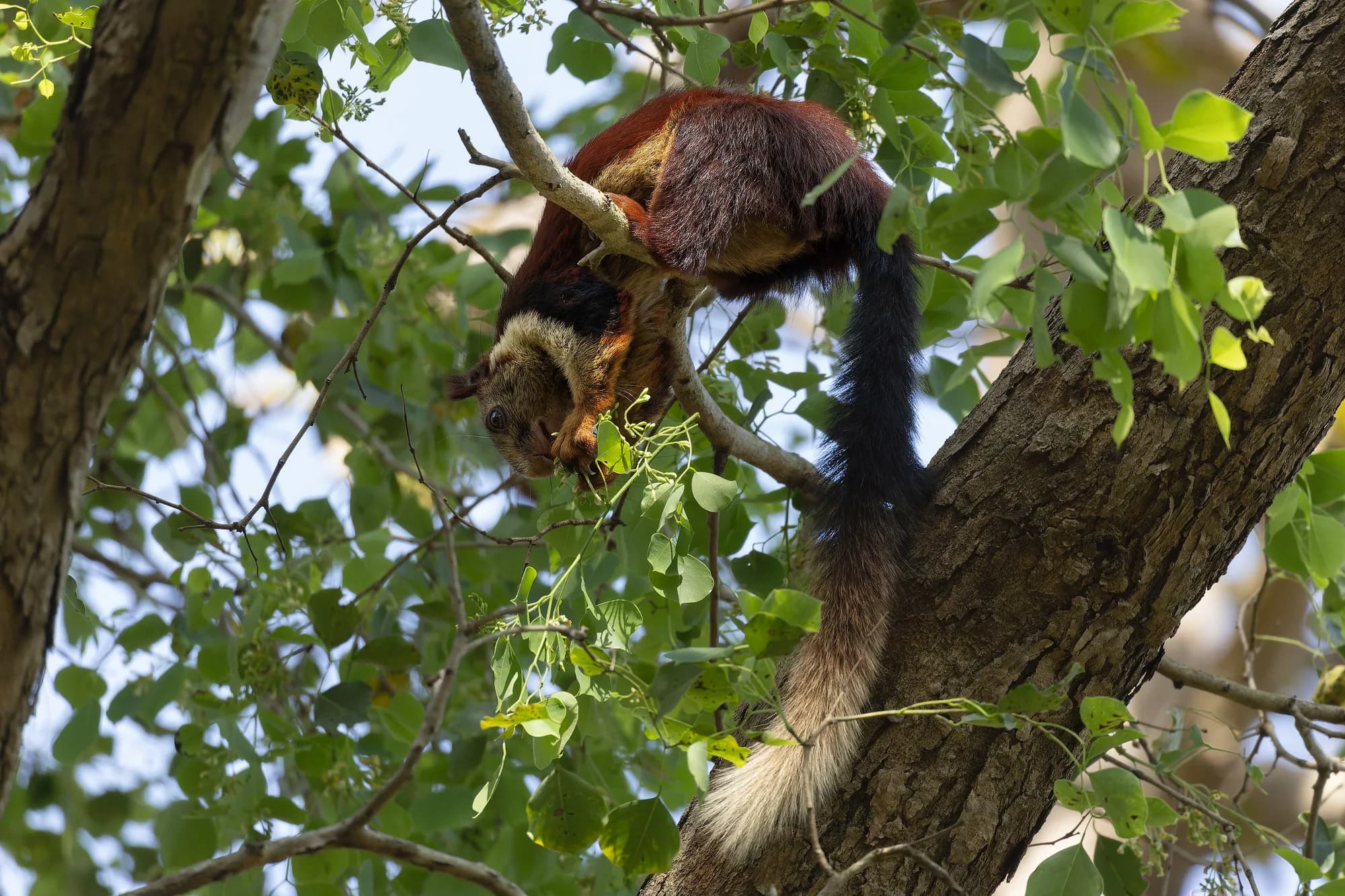
Species · Ratufa indica
Indian giant squirrel
A squirrel the length of your arm, in maroon and cream, that leaps six metres between trees. The animal that most reliably delights people who came for a tiger and did not get one.
Also called
- Shekru (शेकरू) · Marathi
- Rasu (रासू) · Hindi
- Malayannan · Malayalam
- Kesalu · Kannada
Checked 30 Aug 2026
- Where
- Western Ghats & central India
- Best months
- November–April
- Length
- Close to a metre with tail
- Look
- Up, not out
An Indian endemic, tied to tall unbroken canopy — which makes it a decent proxy for whether a forest has actually been left alone.
Where it is
Where to actually go
Ranked, with the reason each — these are not interchangeable.
- 01SatpuraMadhya PradeshTall riverine canopy and the option to walk, which is the difference between glimpsing one and watching one feed for ten minutes.The walking safari, again
- 02KabiniKarnatakaCommon, confiding, and richly coloured here. Most trips produce several without trying.The easiest of the six
- 03PeriyarKeralaThe Western Ghats forest is the species at its best — deeper maroon, taller trees, and hornbills in the same canopy.Pairs with great hornbill on one walk
- 04TadobaMaharashtraThe state animal of Maharashtra, and treated as such — guides here will actually stop for one.Ask for it by the local name, Shekru
Where you will not see one
- Ranthambore, Gir and the dry northwestNo tall closed canopy, so no giant squirrels. This is a species you can predict from the forest type alone.
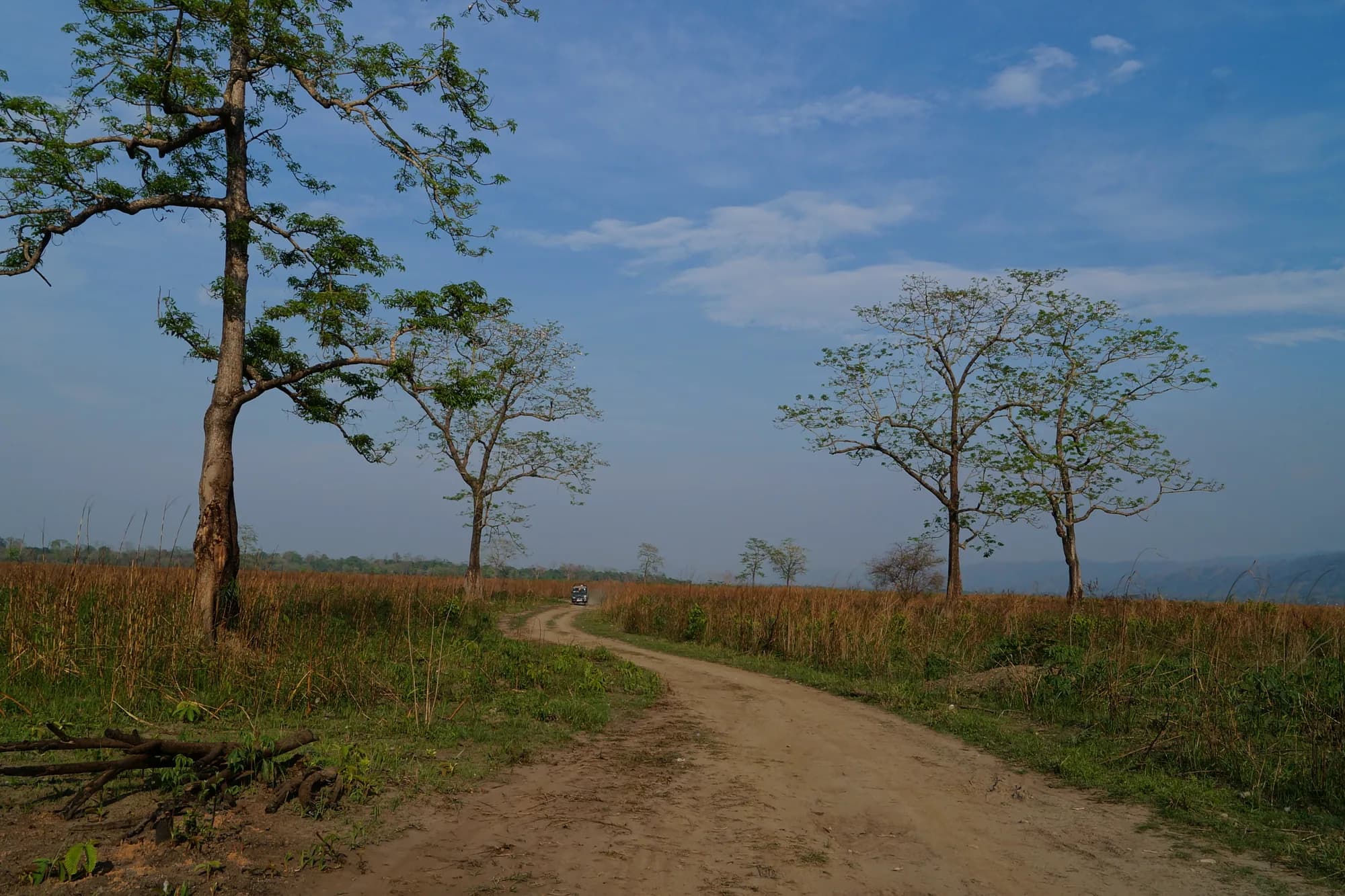
- The Himalaya and the NortheastRatufa indica is an Indian peninsular endemic. The giant squirrel you might see in Assam or Arunachal is a different species, the black giant squirrel, which is darker and much bigger.
- At eye levelNot a range mistake but the reason most people miss it. This animal lives high and comes down almost never. If you are scanning the undergrowth you will not find one all week.
When to go
When to go
- J
- F
- M
- A
- M
- J
- J
- A
- S
- O
- N
- D
January: best. February: best. March: best. April: good. May: good. June: marginal. July: closed or unproductive. August: closed or unproductive. September: closed or unproductive. October: marginal. November: best. December: best.
Through the day
- Dawn
- Morning
- Midday
- Afternoon
- Dusk
- Night
Dawn: active. Morning: most active. Midday: usually resting. Afternoon: active. Dusk: active. Night: not normally seen.
Realistic odds on a three-day trip
- Near-certain
- Likely
- Lucky
- Expedition
Telling it apart
Told apart from
Grizzled giant squirrel
Southern Tamil Nadu river valleys only
Grey-speckled rather than maroon, and confined to a few riverine pockets in Tamil Nadu and Kerala. If it is richly two-toned it is the Indian giant squirrel; if it looks salt-and-pepper, look at where you are.
Malabar giant squirrel
In conversation, not in the canopy
A naming problem, not a field one — it is the same species under another name. Guides in the Ghats use Malabar; guides in central India use Indian. Nobody is wrong.
Northern palm squirrel
Everywhere, including reserve rest houses
The common striped squirrel of every Indian garden, a fifth of the size with three pale back stripes. Only confusable at distance when scale is lost, which happens more than you would think in a high canopy.
Marks chosen to be usable from a moving vehicle — a indian giant squirrel is rarely still and never close enough for anything subtler.
What it looks like in the field
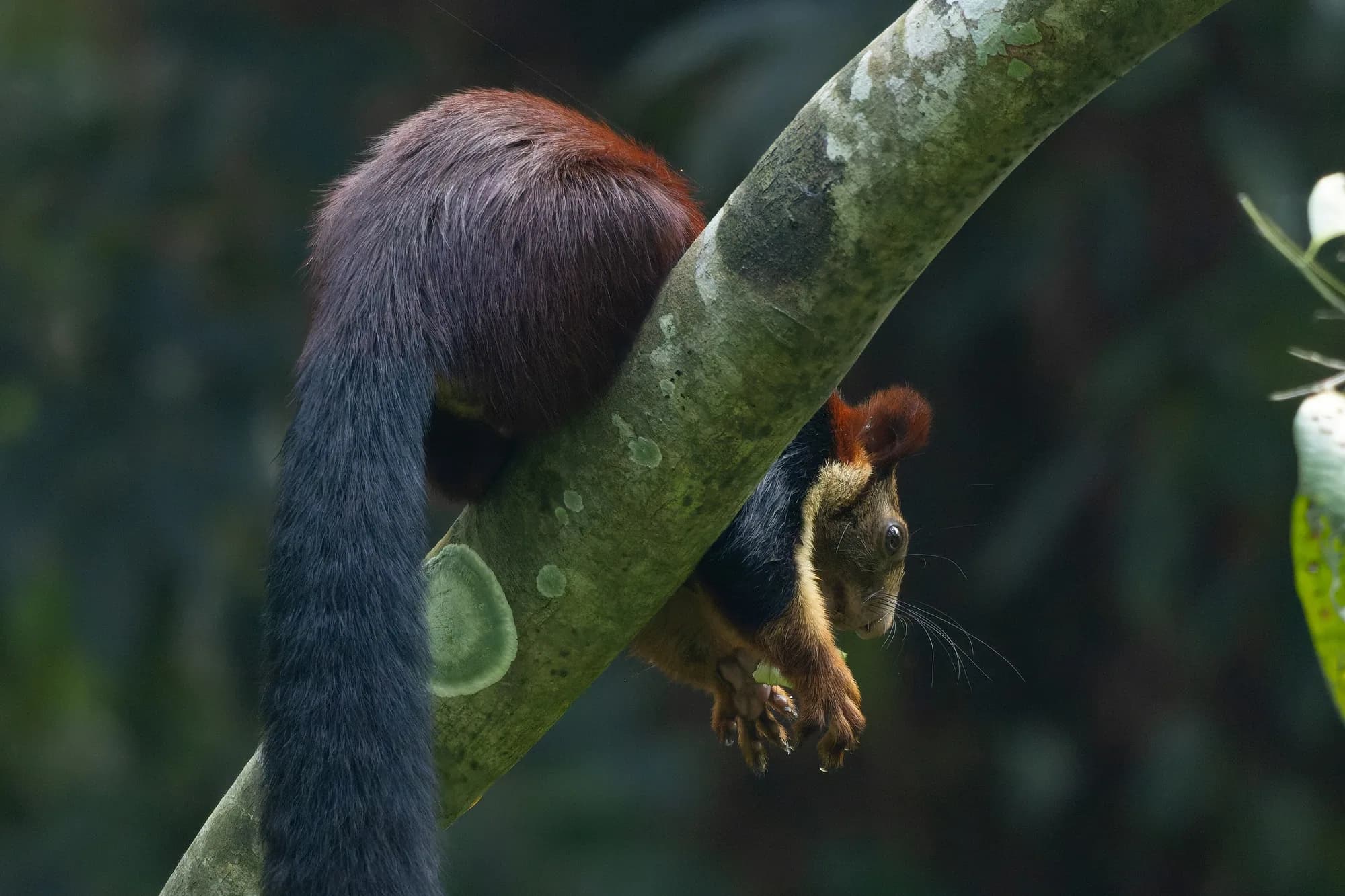
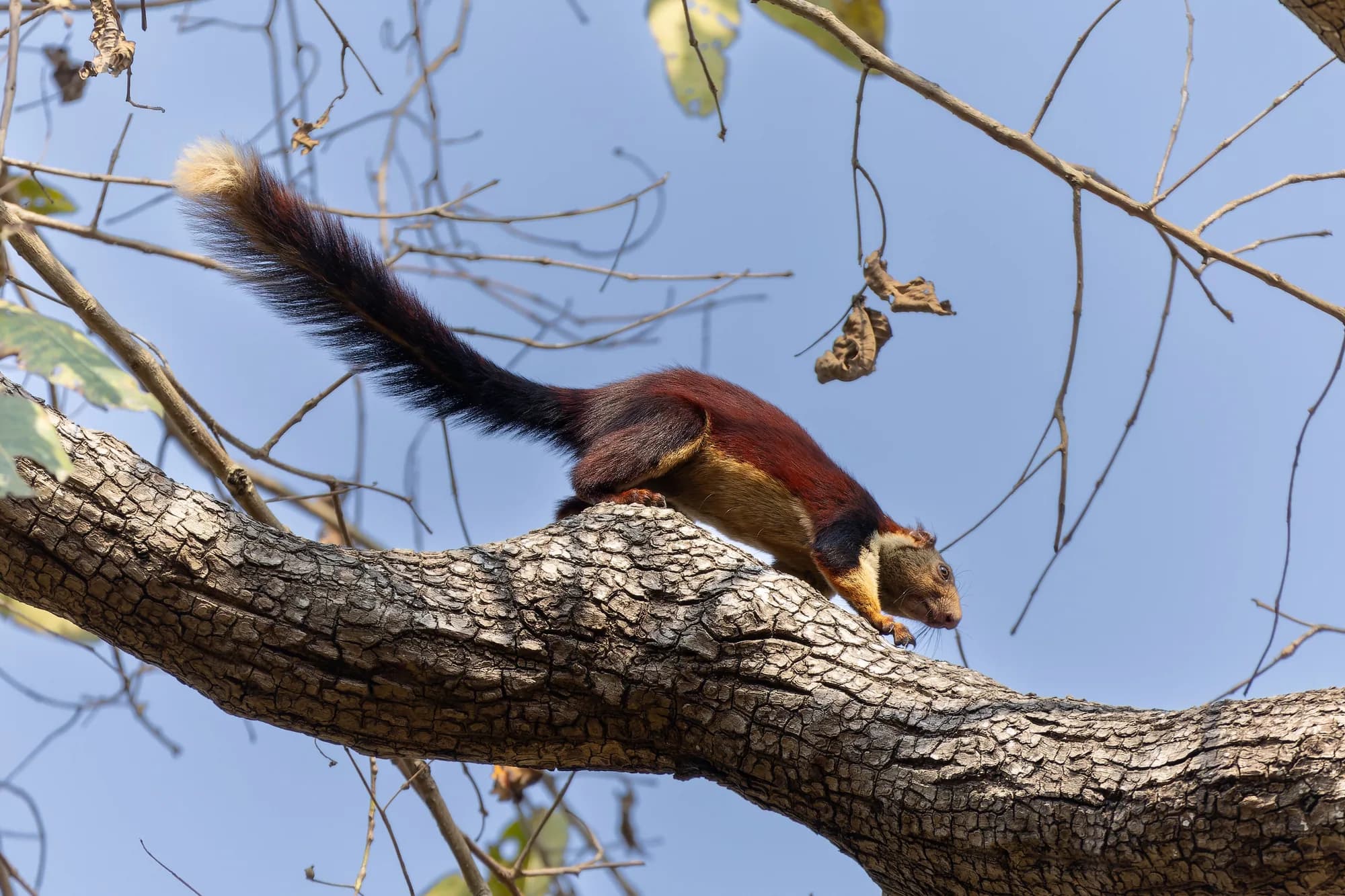
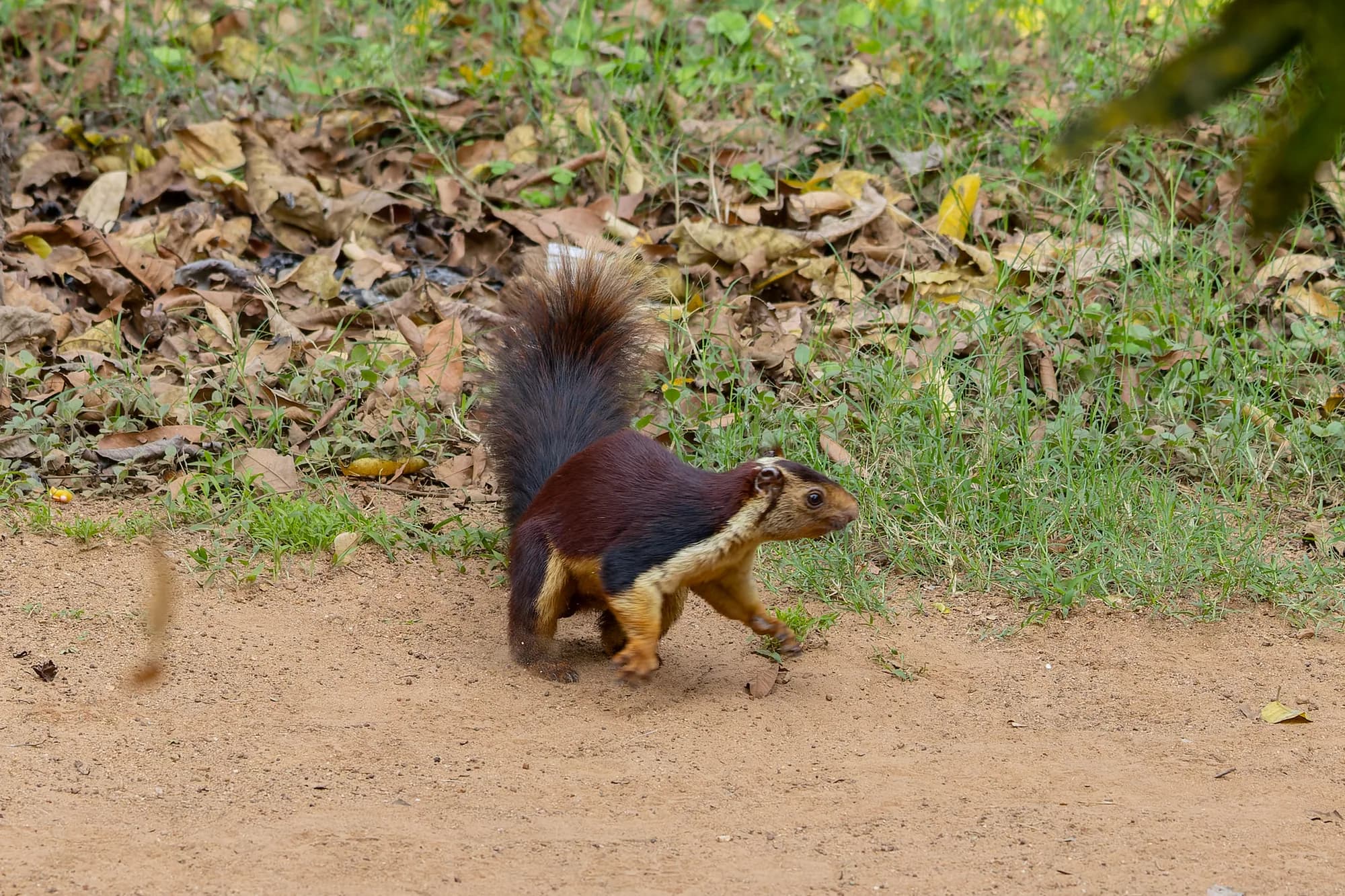
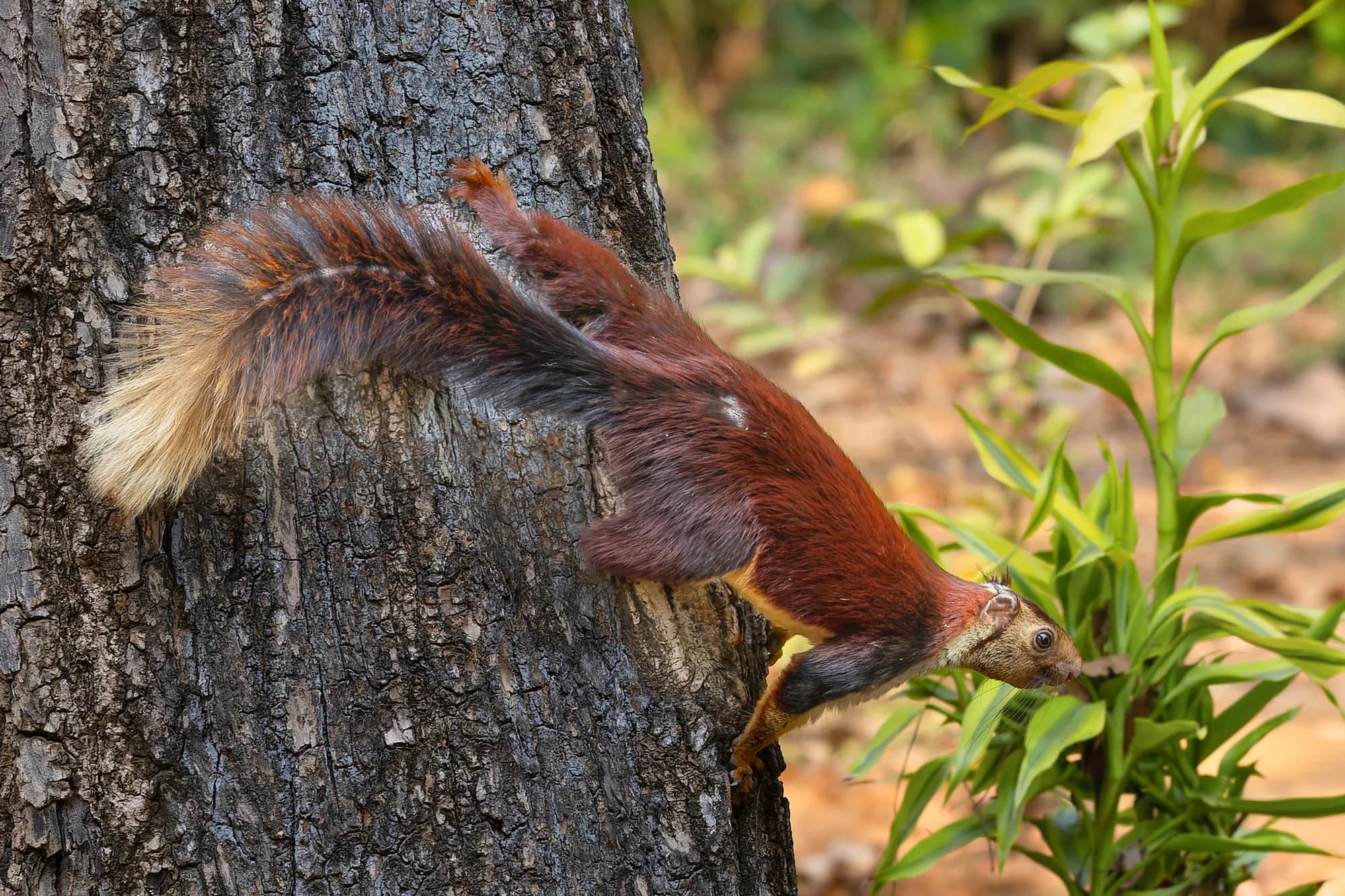
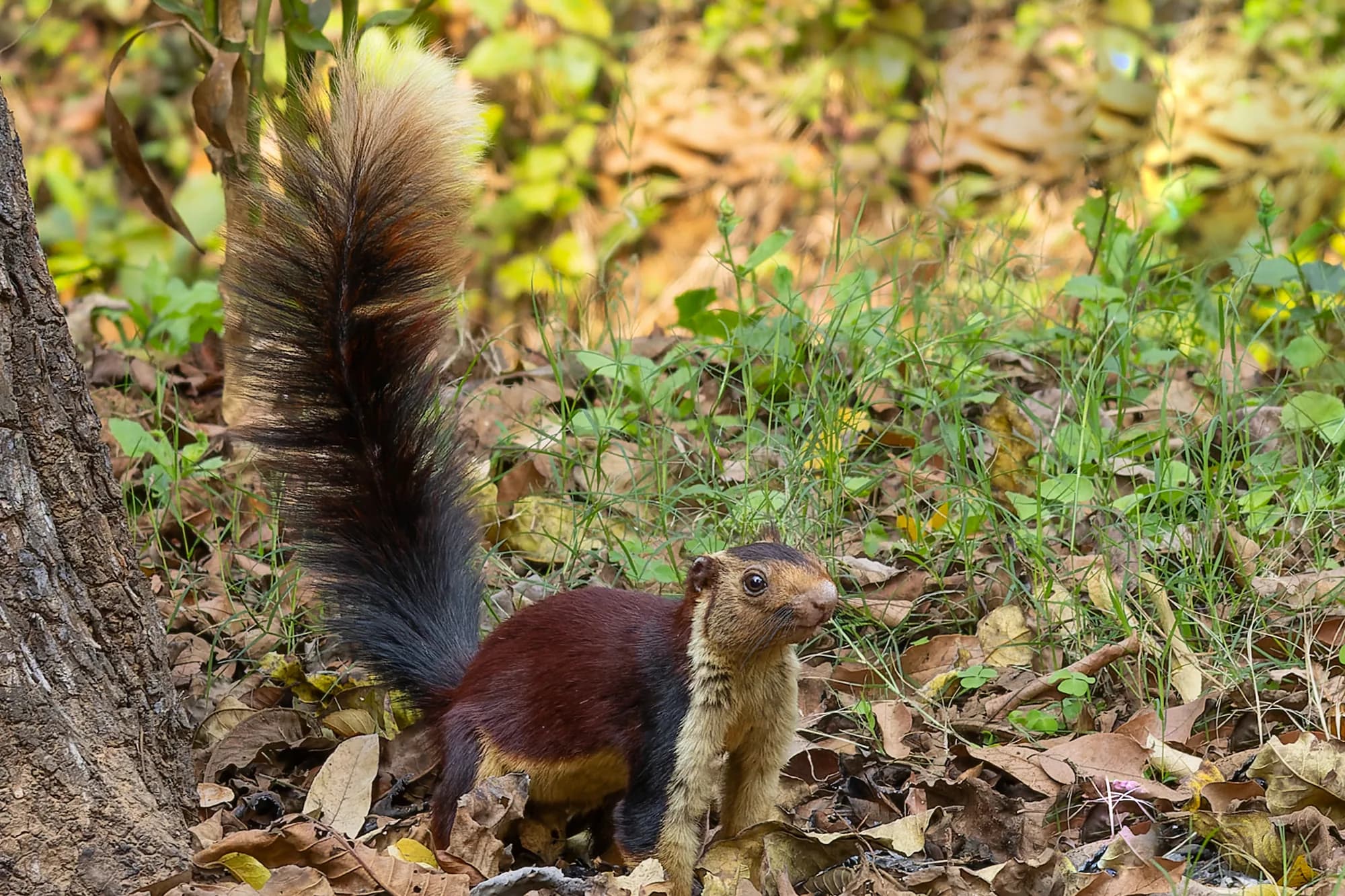
Photographs of Indian giant squirrel in the wild, in Indian reserves. We publish no captive, baited or digitally composited images, and no photograph whose licence we cannot show.
Photographing it
- Lens
- 400mm and upward, and a body that behaves at high ISO — you are shooting into shade, from below, against a bright sky.
- Typical distance
- Fifteen to thirty metres, almost all of it vertical.
- Light
- Contre-jour more often than not. Expose for the animal and accept a blown sky, or move the vehicle until the canopy is behind it rather than the sun.
Where to stopDo not have the driver rev or bang the vehicle to make one move. It works, which is exactly why it is worth naming as the thing not to do.
Signs and calls
- Drey
- A football-sized ball of twigs and leaves wedged into a high fork, usually several in one territory with only one in use. The most reliable sign that you are under the right tree.
- Fallen fruit
- Half-eaten fruit and neatly gnawed husks scattered on the track. Fresh, wet cuts mean the animal is directly above you right now.
- Call
- A loud, rattling chatter given at raptors and at people, and audible far further than the animal is visible. Frequently the way one is found.
- Branch movement
- A whole branch dipping and springing with no wind. They are heavy for a squirrel, and the canopy tells you before your eyes do.
What a sighting is actually like
A branch moves too much for the wind, and then a metre of animal unrolls along it. The scale is the whole thing: people who have registered squirrel in their heads spend several seconds failing to reconcile the word with what is above them.
It leaps six metres between trees without appearing to have decided to.
They feed hanging by the hind feet with both forefeet full, they use the tail as a counterweight rather than a parachute, and they are noisy when annoyed. None of which comes across in a photograph of one asleep on a branch, which is what most people get.
How to actually find one
Look up, and look at the joins. Giant squirrels sit where two big branches meet, flattened along the upper surface, and from a moving vehicle that shape reads as part of the tree.
Fig trees repay attention above everything else. A fruiting fig in a Ghats forest will hold giant squirrels, hornbills, langurs and half a dozen bulbuls at once, and it is the one tree worth building twenty minutes of a drive around.
Status and protection
Status and protection
- IUCN Red List
- Least Concern
- Population trend
- ↓ Decreasing
- Wildlife Protection Act 1972
- Schedule I (post-2022-amendment numbering)
- CITES
- Appendix II
Species-level assessment of Ratufa indica; binomial matches, no subspecies issue.
Assessed 2016 · IUCN Red List assessment
What to book to see one
What you would be booking
- How it is seen
- Jeep safari, or better, a walking safari — on foot you can stop, look up, and wait, which is the entire technique.
- Drives to book
- Any two drives in the right forest. This is a species where the constraint is attention rather than access.
- Zone or shift
- Riverine strips and the tallest canopy in the reserve. At Satpura the Denwa forest, at Kabini the roads through the taller teak.
Tell your driver you want it. A giant squirrel is not a stop worth making in most guides' default hierarchy, and thirty seconds of engine noise under the wrong tree is all it takes to lose one.
Satpura — the park in fullOn the same trip you would also get
- Dhole — the same central Indian reserves, on the ground under the same canopy
- Gaur — Kabini, Periyar and Satpura all hold both
- Great hornbill — shares the fruiting trees, and in the Ghats often the same fig
Questions people ask
How big is an Indian giant squirrel?
Where is the best place to see one?
Is the Malabar giant squirrel a different animal?
Read next
Madhya Pradesh
Satpura — where walking is the point
The one central Indian reserve that permits walking and boat safaris. You see less and understand considerably more.
Satpura, and few others
Walking safaris in India
You see less and understand more. Tracks, scat, alarm calls — the things a vehicle passes at speed.
Karnataka
Kabini — the park in full
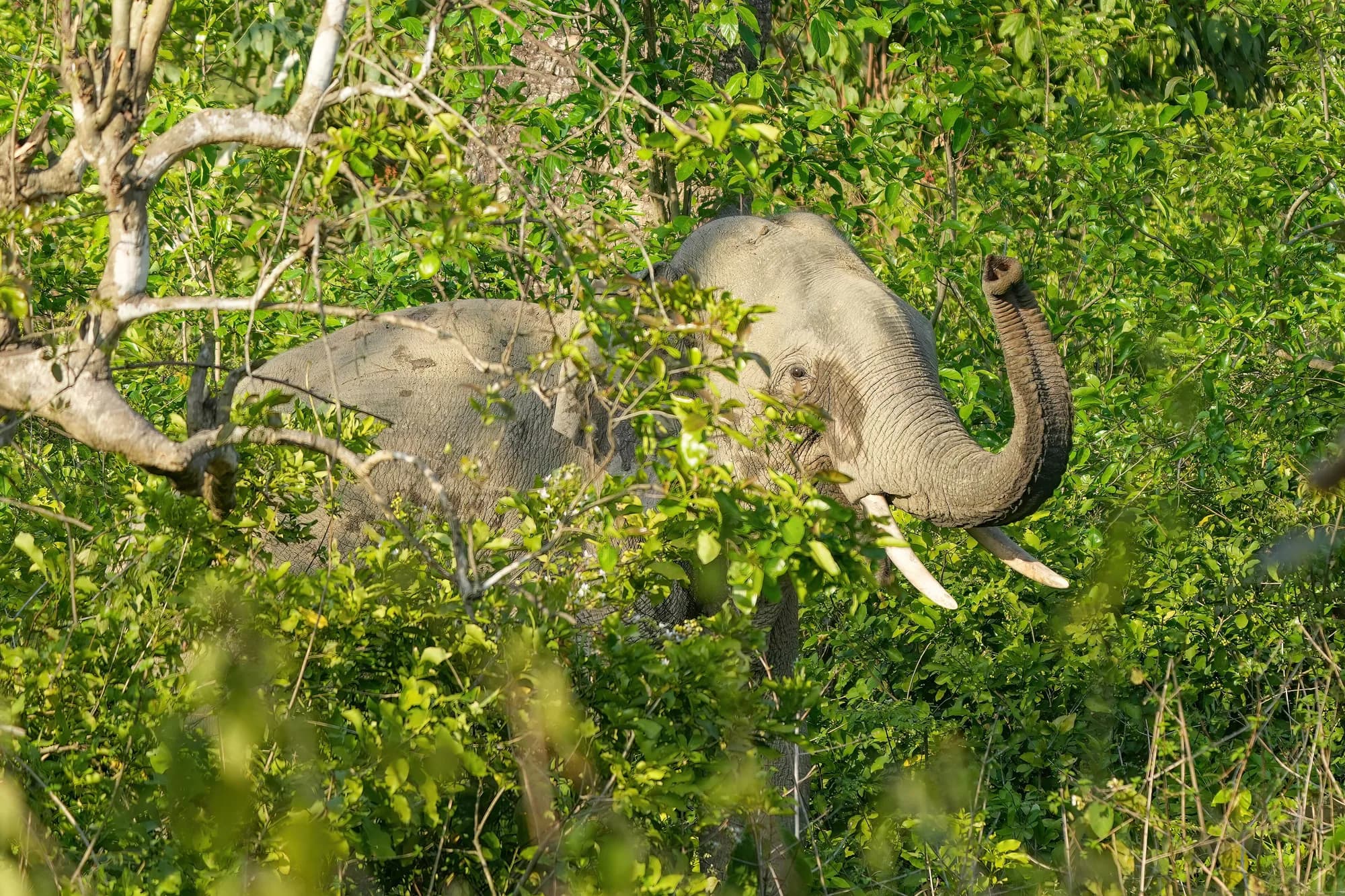
A reservoir edge that pulls every animal in the forest into a narrow strip through the dry months. The best elephants in India.
November to February
Birding on an Indian safari
Every reserve here is a birding destination whether or not it is sold as one. Say so when you book.