
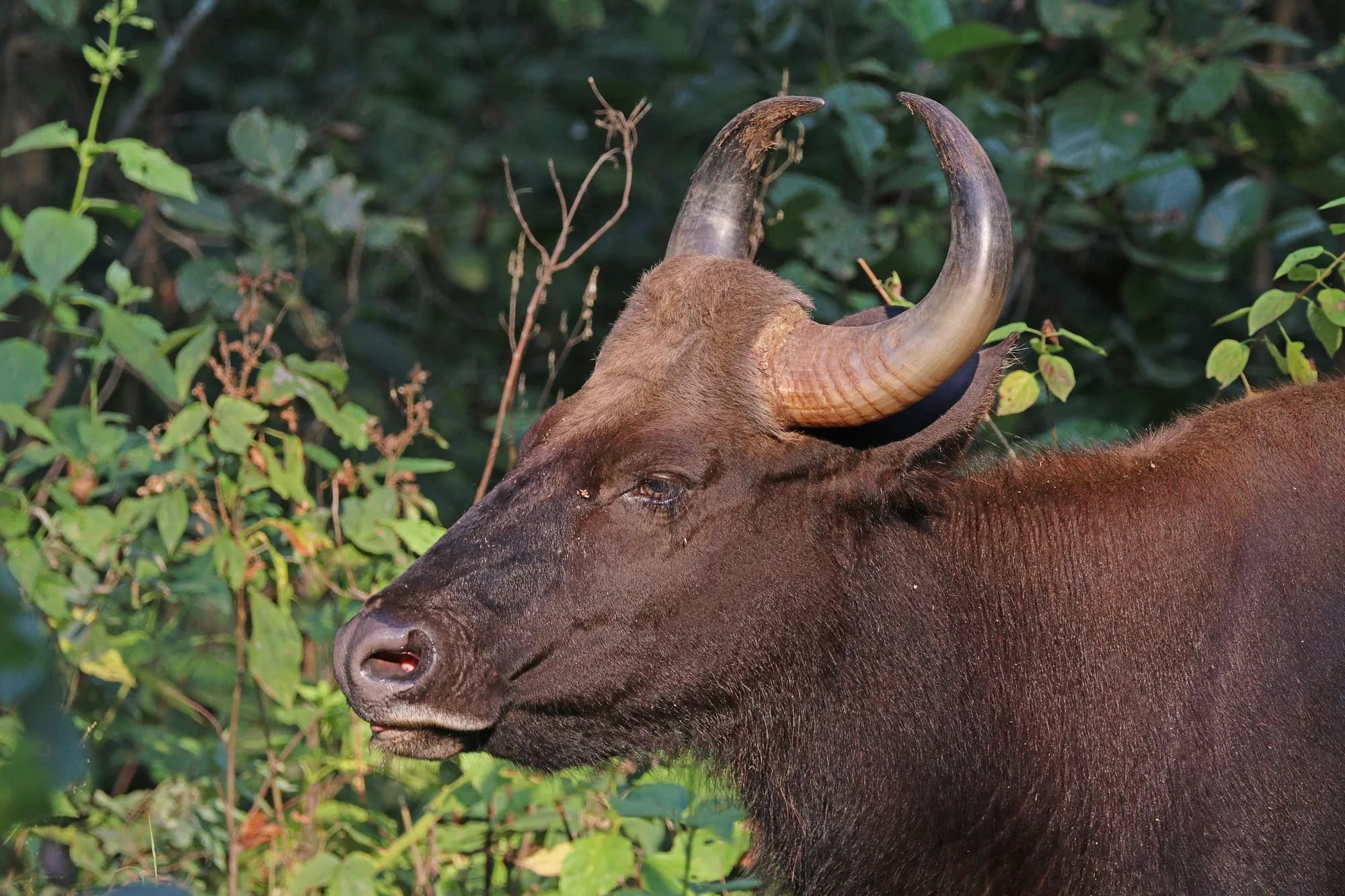
Species · Bos gaurus
Gaur
The largest wild cattle on earth, standing taller at the shoulder than any bison, and routinely dismissed as livestock by people who have travelled a long way to see it.
Also called
- Gaur (गौर) · Hindi
- Gawa · Marathi
- Kaati · Kannada
- Kaattu pothu · Malayalam
Checked 30 Aug 2026
- Where
- Central & southern India
- Best months
- March–June
- Shoulder height
- Up to about 2 m in bulls
- Not
- A bison
A hill-forest animal of the Western Ghats and the central highlands, with a separate population through the Northeast.
Where it is
Where to actually go
Ranked, with the reason each — these are not interchangeable.
- 01KabiniKarnatakaThe backwaters as they recede in April and May draw gaur, elephant and everything else onto open grass. The most reliable and most photographable gaur in the country.Late April to early June, evening shift
- 02PeriyarKeralaSeen from a boat on the lake, which is a completely different angle on the animal and the only place you routinely watch a herd from the water.The boat, not the jeep
- 03TadobaMaharashtraCommon enough in the teak and bamboo that most three-day trips produce several herds, usually while looking for something else.A near-certainty alongside a tiger trip
- 04SatpuraMadhya PradeshA reintroduced population that has taken, and the one reserve where you might meet one on foot — which is an entirely different experience of its size.On the walking safari, at a respectful distance
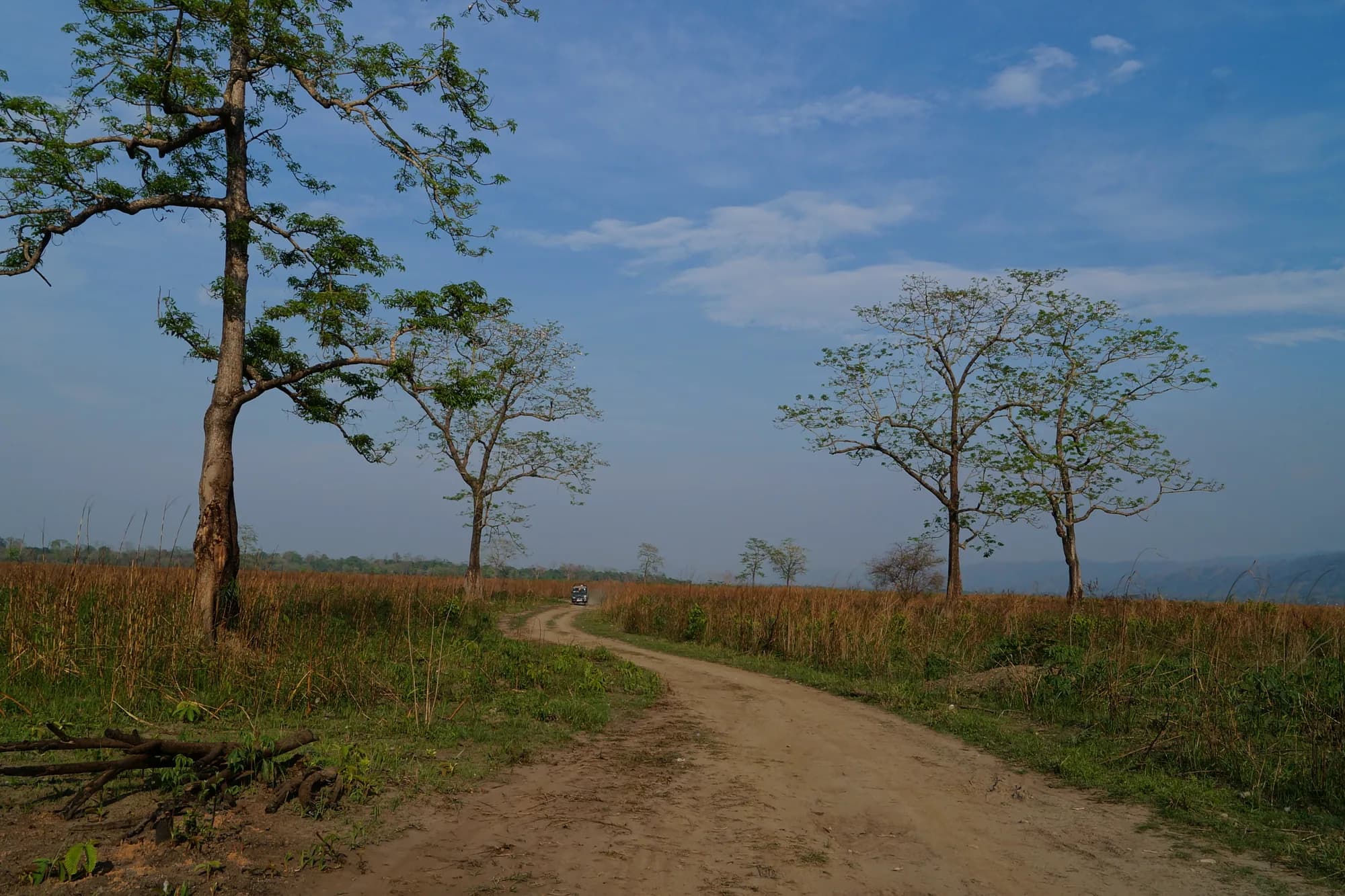
Where you will not see one
- Anywhere, under the name Indian bisonIt is not a bison and it is not closely related to one. Bison are a different genus on other continents; the gaur is wild cattle. The name is a colonial-era error that every Indian guidebook has repeated since, and it is the reason people expect a shaggy American animal and find a black one.
- Ranthambore, Gir and the dry northwestNo gaur. They need hill forest, bamboo and reliable water, none of which the dry thorn reserves have.
- Corbett and the teraiEffectively absent. The northern limit runs well south of the Himalayan foothill reserves, so a Corbett trip is not a gaur trip.
When to go
When to go
- J
- F
- M
- A
- M
- J
- J
- A
- S
- O
- N
- D
January: good. February: good. March: best. April: best. May: best. June: good. July: closed or unproductive. August: closed or unproductive. September: closed or unproductive. October: marginal. November: good. December: good.
Through the day
- Dawn
- Morning
- Midday
- Afternoon
- Dusk
- Night
Dawn: most active. Morning: active. Midday: usually resting. Afternoon: active. Dusk: most active. Night: not normally seen.
Realistic odds on a three-day trip
- Near-certain
- Likely
- Lucky
- Expedition
Telling it apart
Told apart from
Wild water buffalo
Kaziranga, where only the buffalo occurs
Horns settle it. A gaur's sweep up and inward in a shallow curve from a pale, domed forehead; a wild buffalo's sweep out and back in a wide crescent, and are far longer. Ranges also barely meet — buffalo are an Assam floodplain animal.
Domestic buffalo and cattle
Buffer zones and grazing edges, constantly
The white stockings below the knee and hock are diagnostic and visible at any distance — no domestic animal in an Indian forest has them. Add the high muscular ridge over the shoulder, which cattle lack.
Nilgai
Central India at dusk
Not really similar close up, but at distance in poor light a bull nilgai reads as a large dark bovid. Nilgai are slate-grey, much lighter in build, and stand higher at the shoulder than the rump in a way that looks awkward rather than powerful.
Marks chosen to be usable from a moving vehicle — a gaur is rarely still and never close enough for anything subtler.
What it looks like in the field
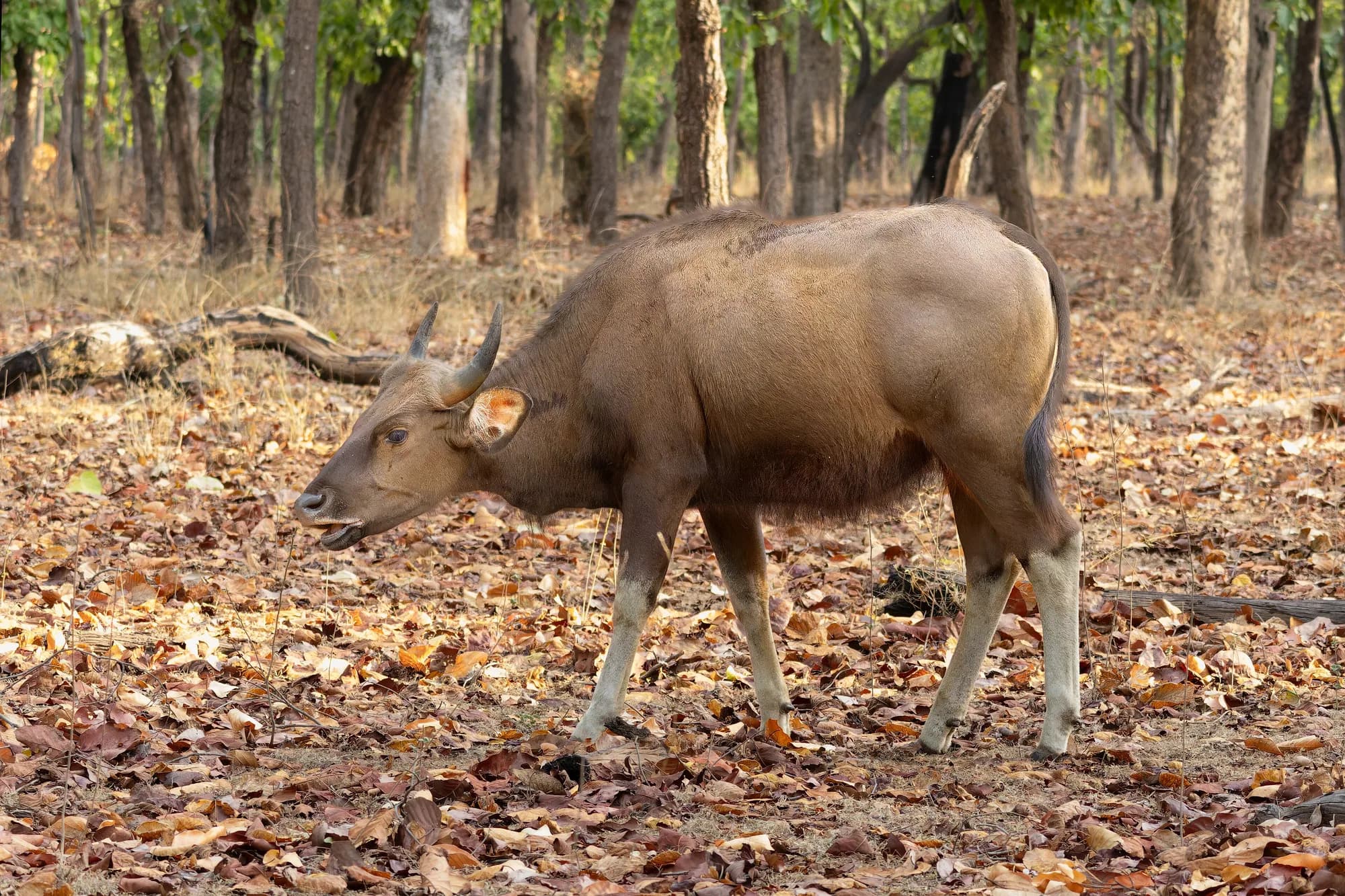
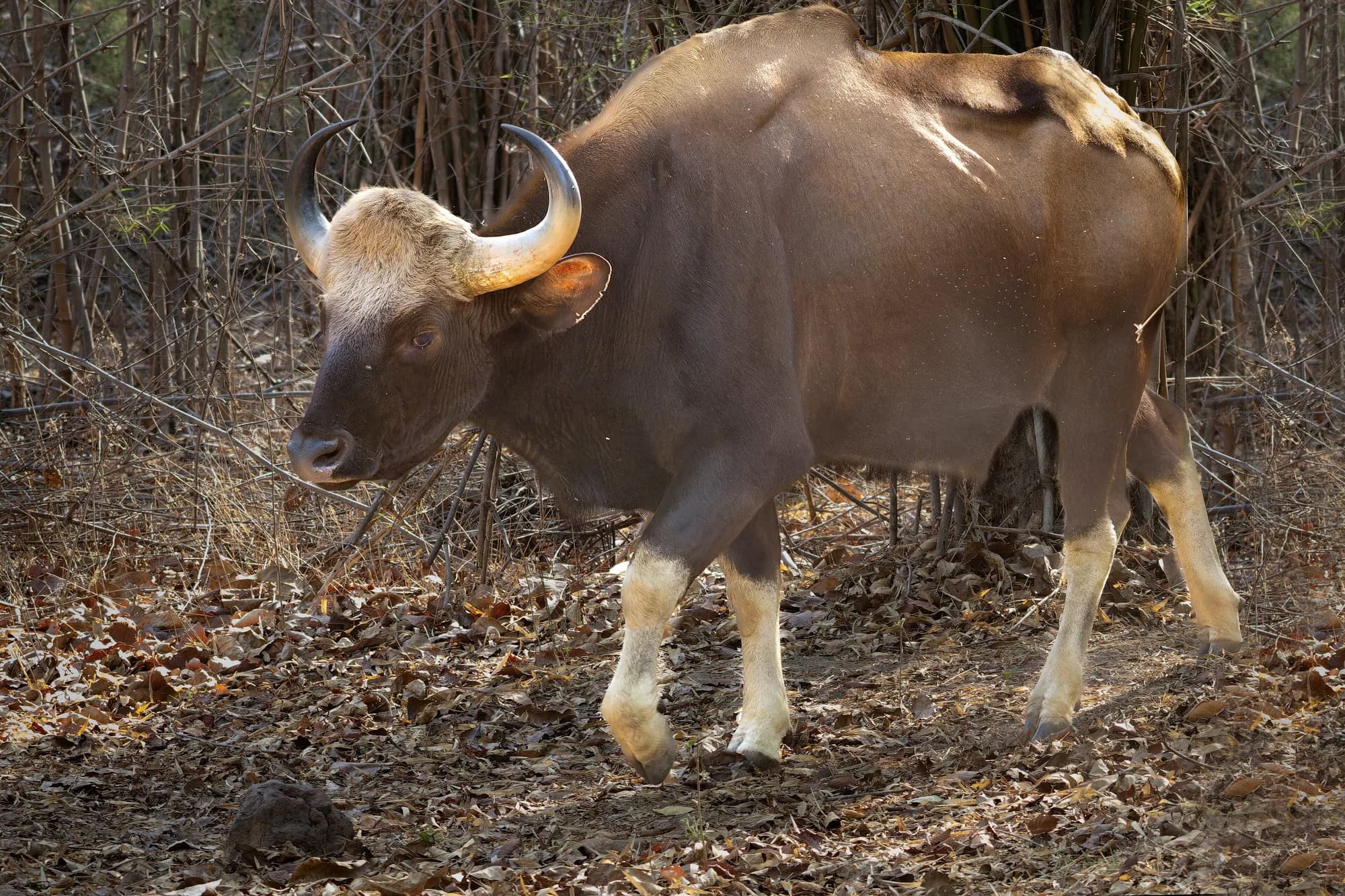
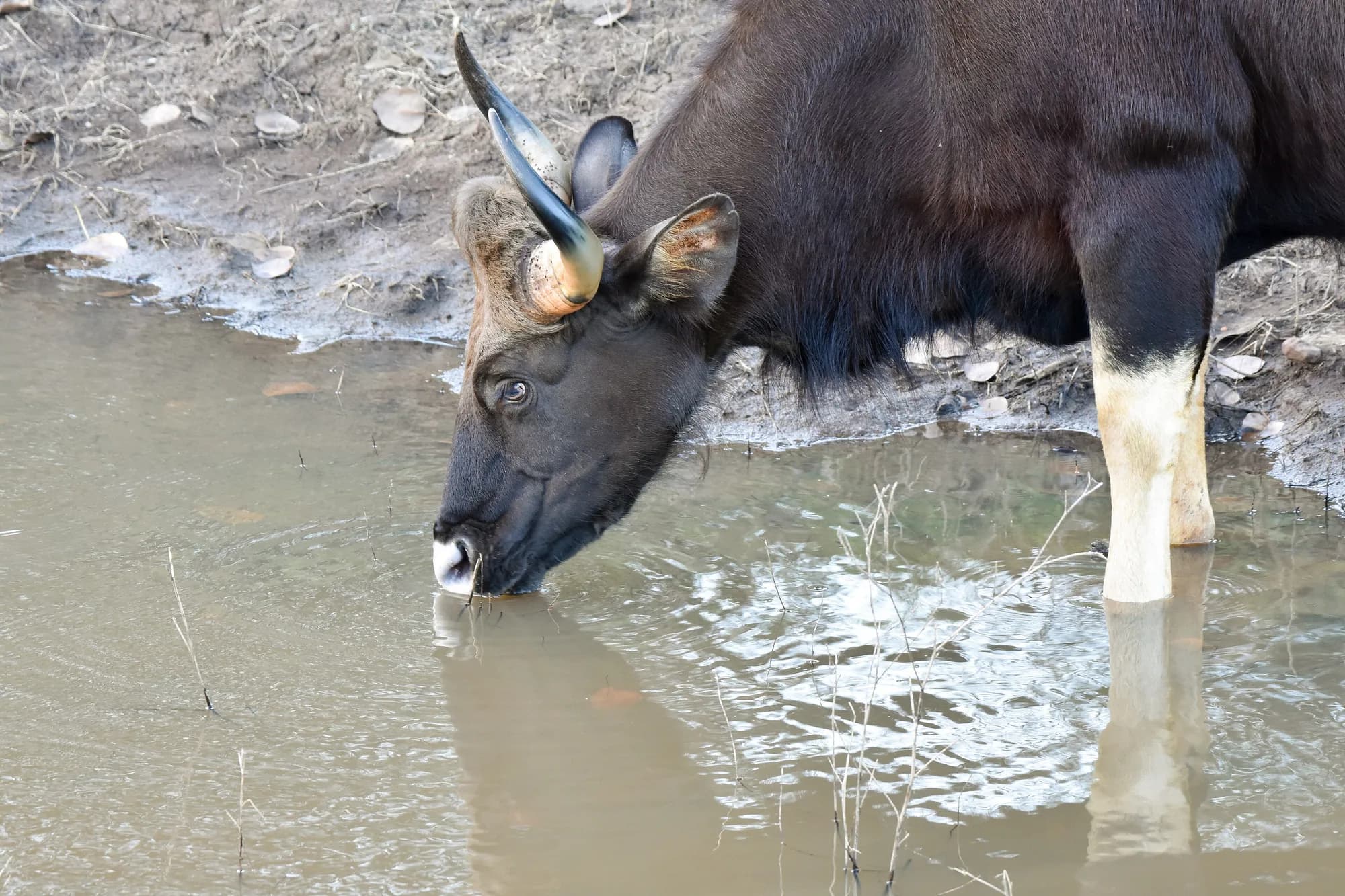
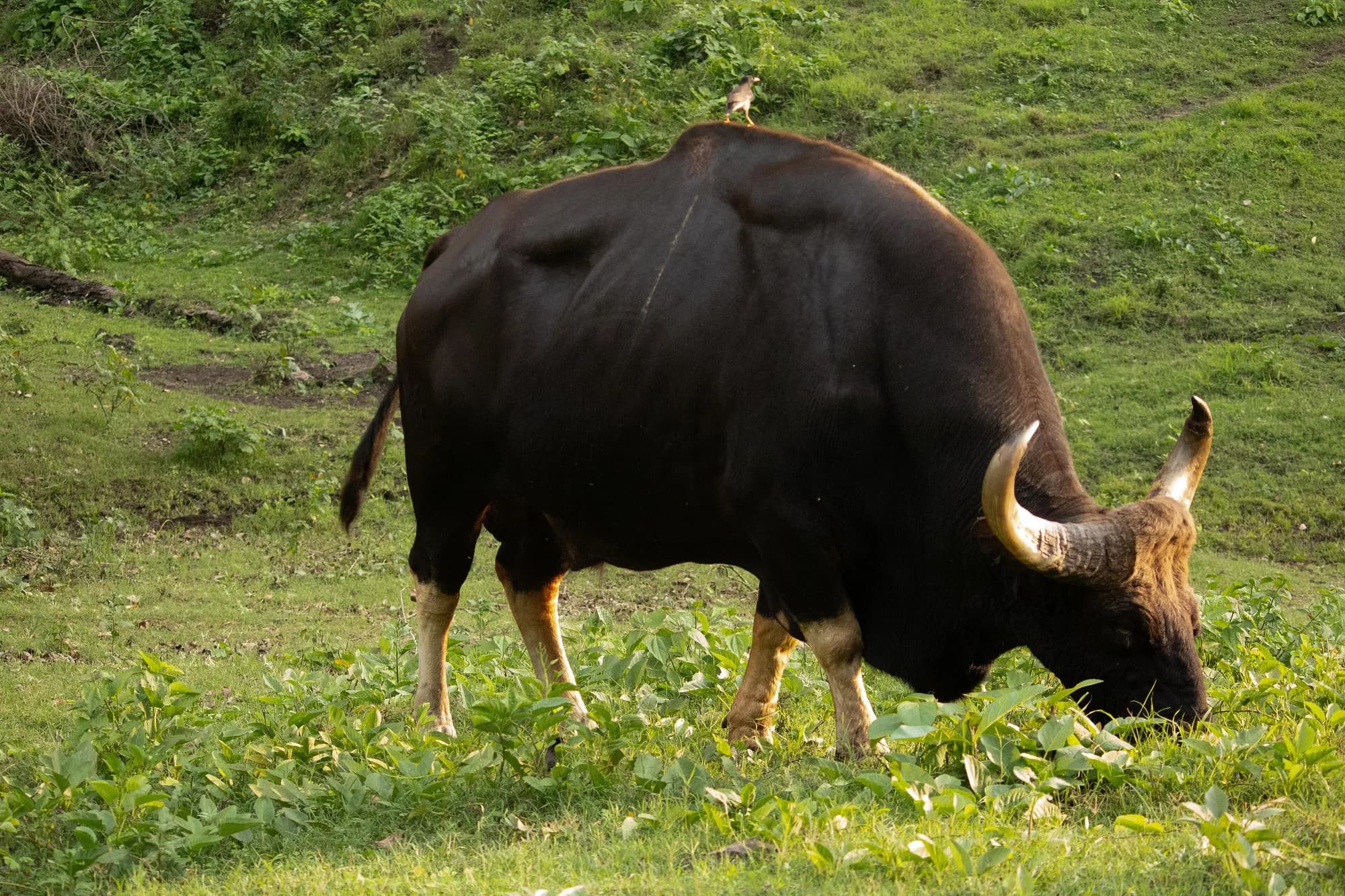
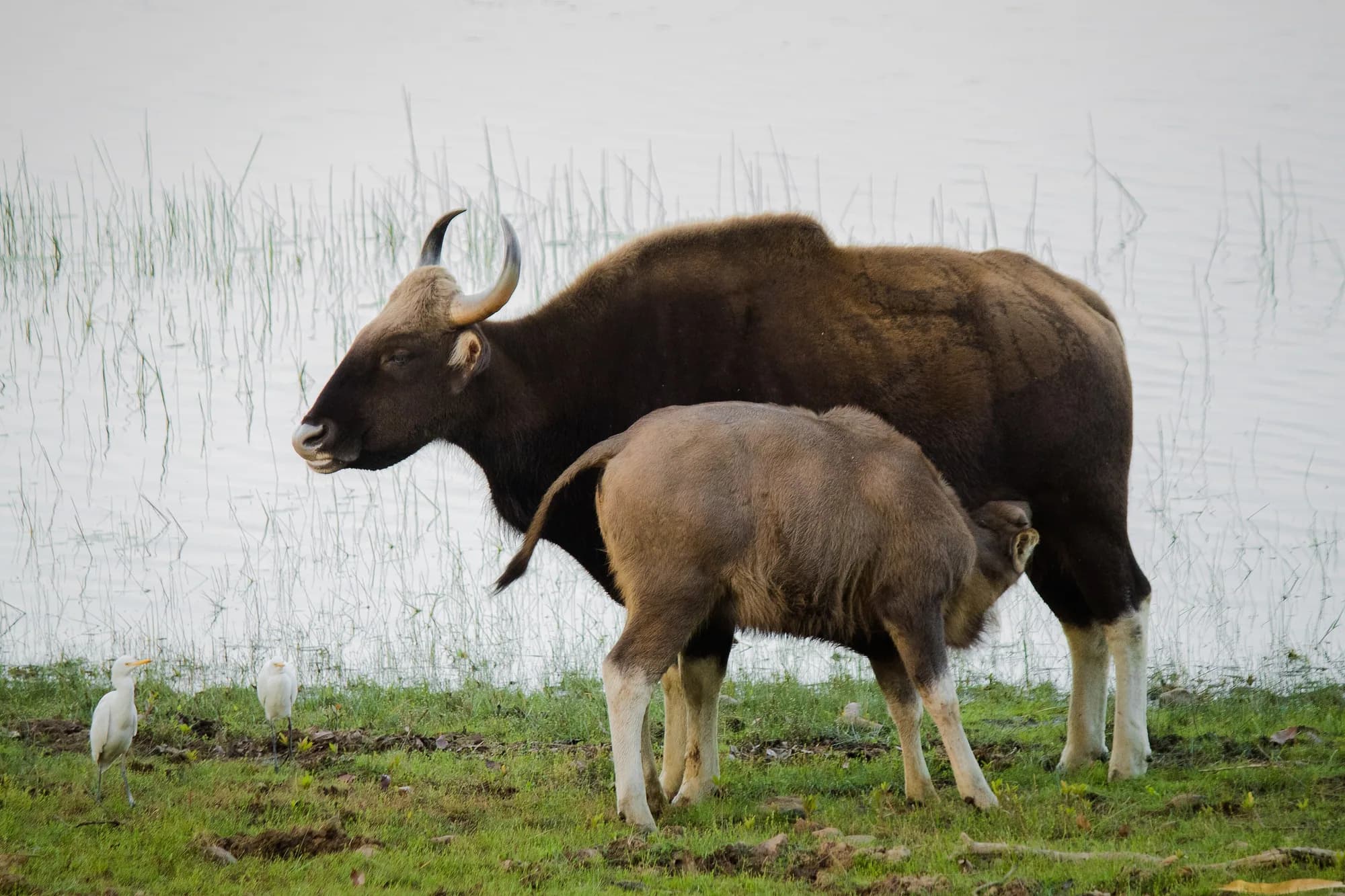
Photographs of Gaur in the wild, in Indian reserves. We publish no captive, baited or digitally composited images, and no photograph whose licence we cannot show.
Photographing it
- Lens
- 300–400mm is plenty. The problem is never distance with this animal; it is exposure.
- Typical distance
- Twenty to sixty metres, and often closer than you would choose in bamboo.
- Light
- The hardest exposure in the Indian forest. A black animal in dappled shade against bright grass will fool any meter — expose for the animal and let the background blow, or you will come home with a silhouette.
Where to stopDo not push a herd with calves, and never manoeuvre between a bull and the herd. Gaur give clear warning — a head raised, a stiff-legged stance, a snort — and the correct response is to withdraw rather than to keep shooting.
Signs and calls
- Track
- A cloven print far larger than any deer's and rounder than a buffalo's, often sunk deep in mud at a water edge. Frequently the first evidence that a herd passed in the night.
- Wallow
- Churned mud hollows at forest edges, used repeatedly. Fresh mud on surrounding tree trunks at shoulder height dates it.
- Dung
- Large flat cattle pats. Distinguishing them from village cattle is largely about where you are standing.
- Browse line
- Bamboo broken and stripped at around two metres — higher than a chital or sambar can reach, lower than an elephant works.
What a sighting is actually like
Quieter than you expect, and larger. A herd feeding at a backwater edge barely acknowledges a vehicle, and the animals are so uniformly dark that the first thing your eye resolves is usually the white stockings moving in the grass rather than the bodies above them.
The size does not register until one stands beside a chital, and then it does not stop registering.
A big bull is close to two metres at the shoulder with a ridge of muscle running back from it, and there is nothing else in an Indian forest with that outline. People who arrive expecting cattle spend the rest of the drive quiet.
The bison problem
Almost every guide, board and brochure in India will call this animal an Indian bison. It is not one. Bison are a separate genus found in North America and Europe; the gaur is wild cattle, and its closest relatives are the banteng and the domestic cow.
The gayal is a separate question. In parts of the Northeast there is a domesticated form, the mithun, kept by hill communities. It is the same species, semi-feral, and it is not a wild sighting however convincing it looks.
Status and protection
Status and protection
- IUCN Red List
- Vulnerable
- Population trend
- ↓ Decreasing
- Wildlife Protection Act 1972
- Schedule I (post-2022 amendment numbering)
- CITES
- Appendix I
Species-level assessment for Bos gaurus (e.T2891A46363646; last assessed 25 May 2016, published 2016). The binomial given is the full species; IUCN lists no infraspecific taxa.
Assessed 2016 · IUCN Red List assessment
What to book to see one
What you would be booking
- How it is seen
- Jeep safari, and at Periyar a boat — the lake shoreline is one of the few places you look down on a herd rather than across at it.
- Drives to book
- Two or three at Kabini in summer is usually enough. This is one of the few large mammals here where the honest answer is that you will probably see one.
- Zone or shift
- Water in the hot months. The Kabini backwaters as they drop in April and May are the single most reliable gaur congregation in India.
Give bulls room. A gaur is not a predator and has no interest in you, but it weighs the better part of a tonne, and a startled one at close range in bamboo is a genuine hazard rather than a photograph.
Kabini — the park in fullOn the same trip you would also get
- Indian elephant — the same Kabini and Periyar water in the same hours
- Dhole — packs at Kanha, Tadoba and Kabini, and gaur calves are among their prey
- Indian giant squirrel — the canopy above the same bamboo
Questions people ask
Is the gaur the same as the Indian bison?
Where is the best place to see a gaur?
Are gaur dangerous?
Read next
Karnataka
Kabini — backwaters and big herds
A reservoir edge that pulls every animal in the forest into a narrow strip through the dry months. The best elephants in India.
Kabini backwaters at dusk
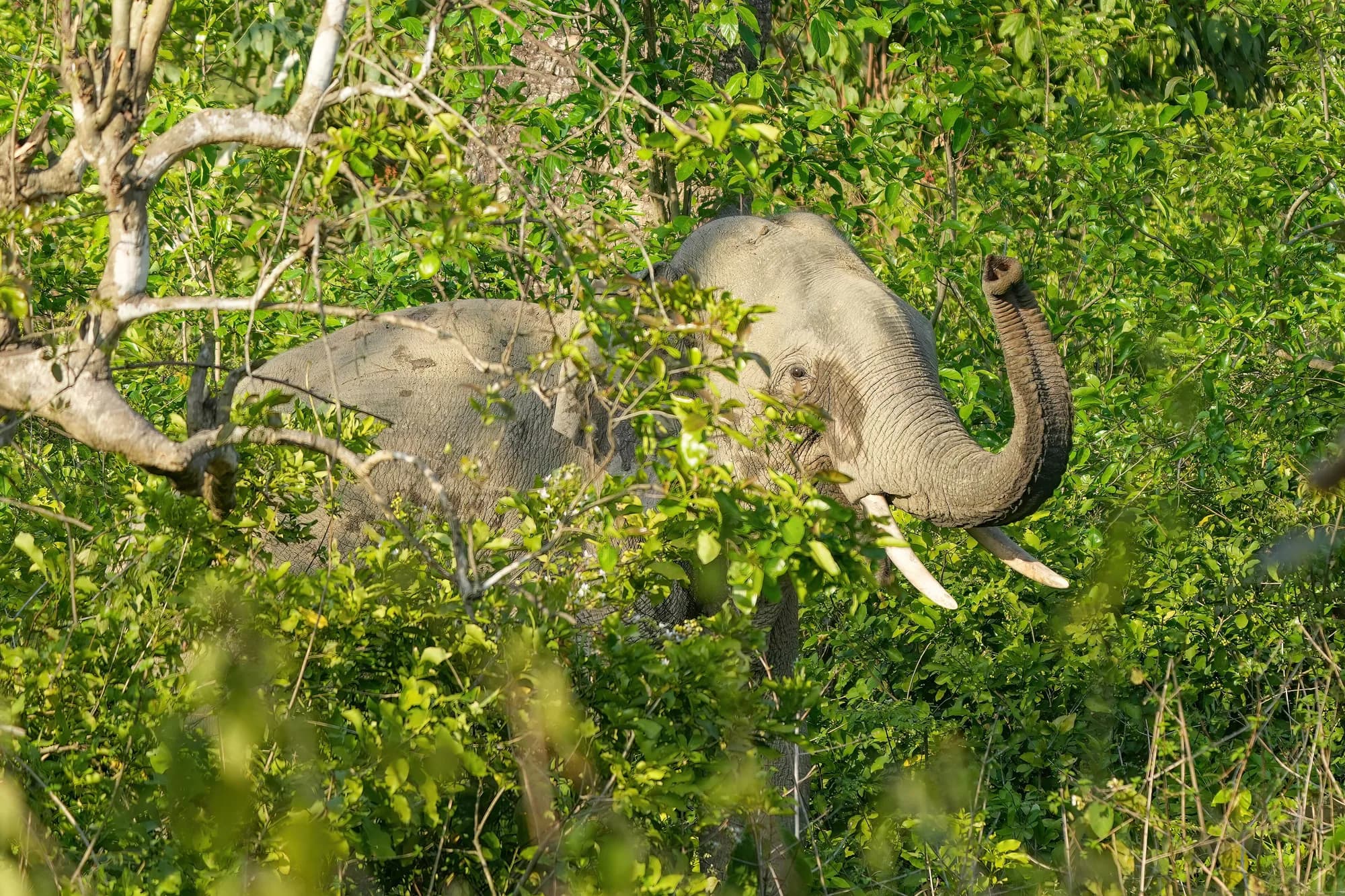
Indian elephant — where and when
One of the few sightings that is better in a herd than alone. Where the numbers gather, and the three months they are actually there.
Kabini, Satpura, Periyar
Boat safaris in India
Quiet, low, and no engine note. In late dry season at Kabini it is the best two hours in the park.
Twelve months, cross-park
When to go, month by month
The single decision that moves the odds most. Heat, crowds, closures and what is actually open, one page per month.