
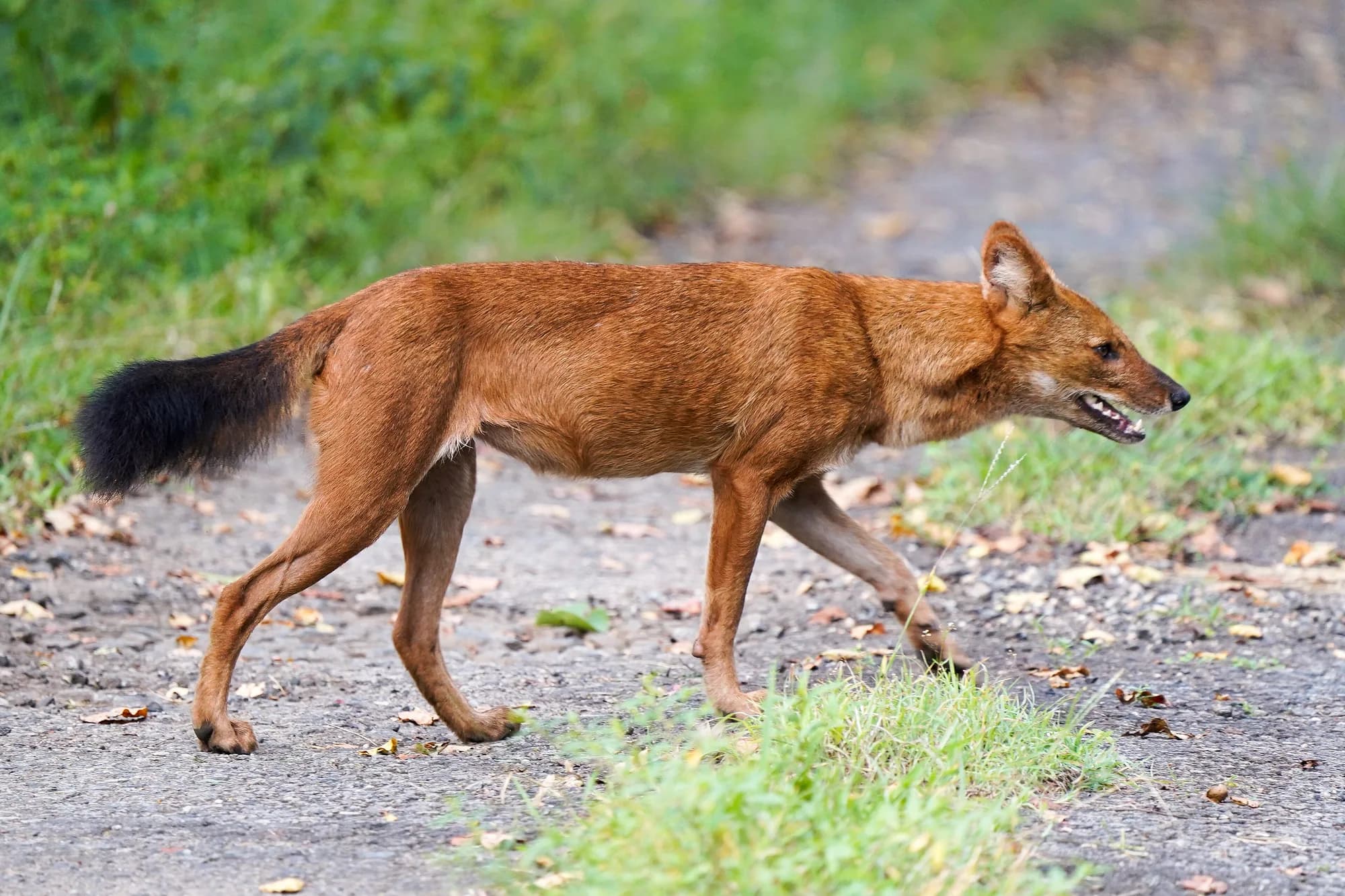
Species · Cuon alpinus
Dhole
The Asiatic wild dog hunts in the open, in the morning, in packs. Which makes a dhole sighting the best thing that can happen on an Indian drive, and the one nobody books for.
Also called
- Son kutta (सोन कुत्ता) · Hindi
- Jangli kutta · Hindi
- Kolsun · Marathi
- Kaadu naayi · Kannada
Checked 30 Aug 2026
- Where
- Central & southern India
- Best months
- November–April
- Hunts
- In daylight, in packs
- Pack size
- Typically 6–12
A central and southern animal now, and effectively gone from the north and northwest where it was once common.
Where it is
Where to actually go
Ranked, with the reason each — these are not interchangeable.
- 01TadobaMaharashtraThe most reliable dhole reserve in India, with packs habituated enough to keep hunting while a vehicle sits still. Open teak means you see the whole pack rather than a flash of one.Winter mornings, and stay with a pack rather than moving on
- 02KanhaMadhya PradeshThe maidans give sightlines nowhere else offers — a pack working a meadow can be watched for twenty minutes rather than twenty seconds.The better sighting when it happens; slightly worse odds than Tadoba
- 03PenchMadhya PradeshResident packs that guides know individually, and enough open ground to follow one at a distance.Quieter than Kanha for comparable odds
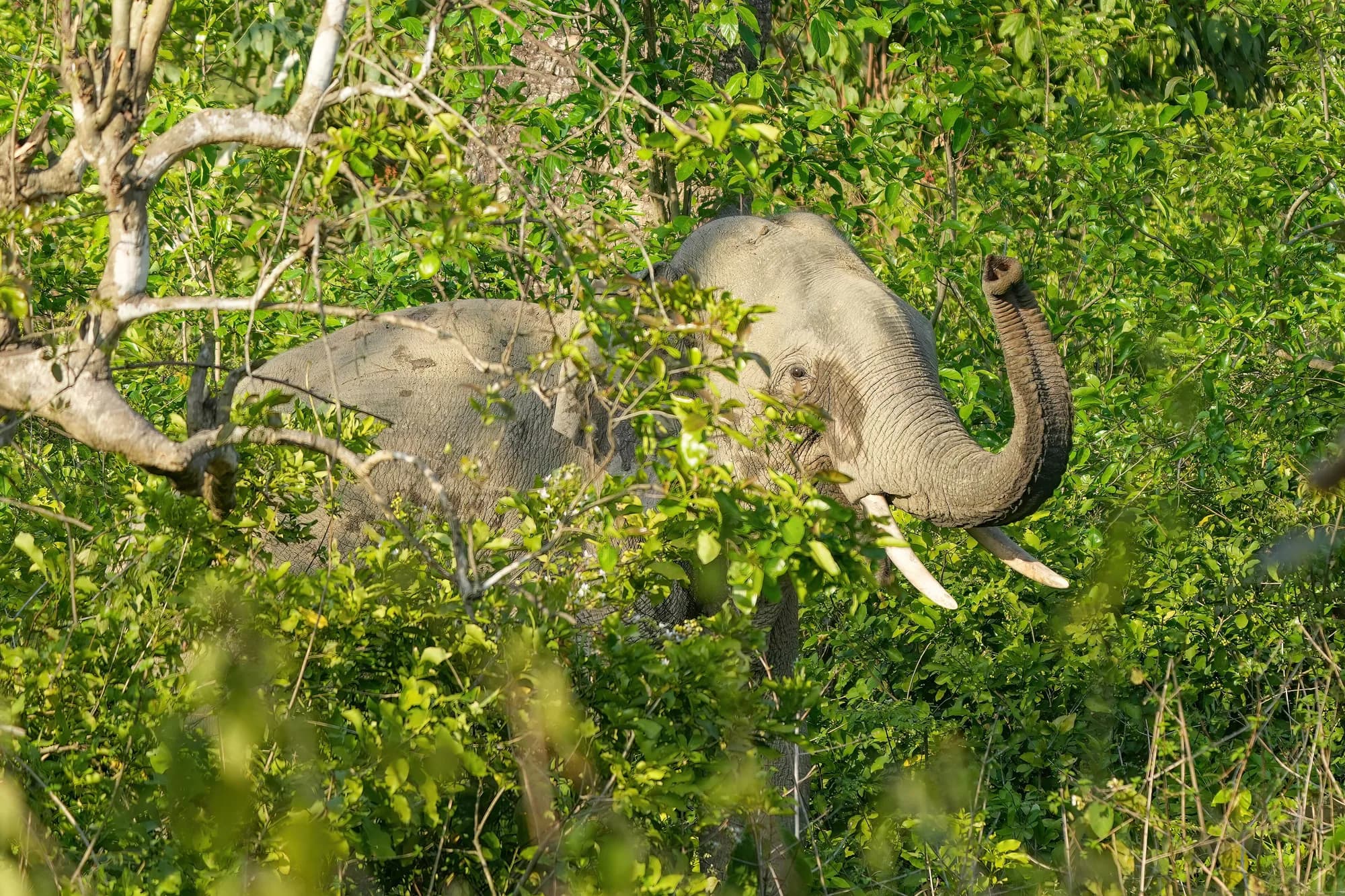
- 04KabiniKarnatakaNagarhole holds strong numbers, and the backwater tracks in summer concentrate everything that drinks.Pairs with elephant and leopard on one trip
Where you will not see one
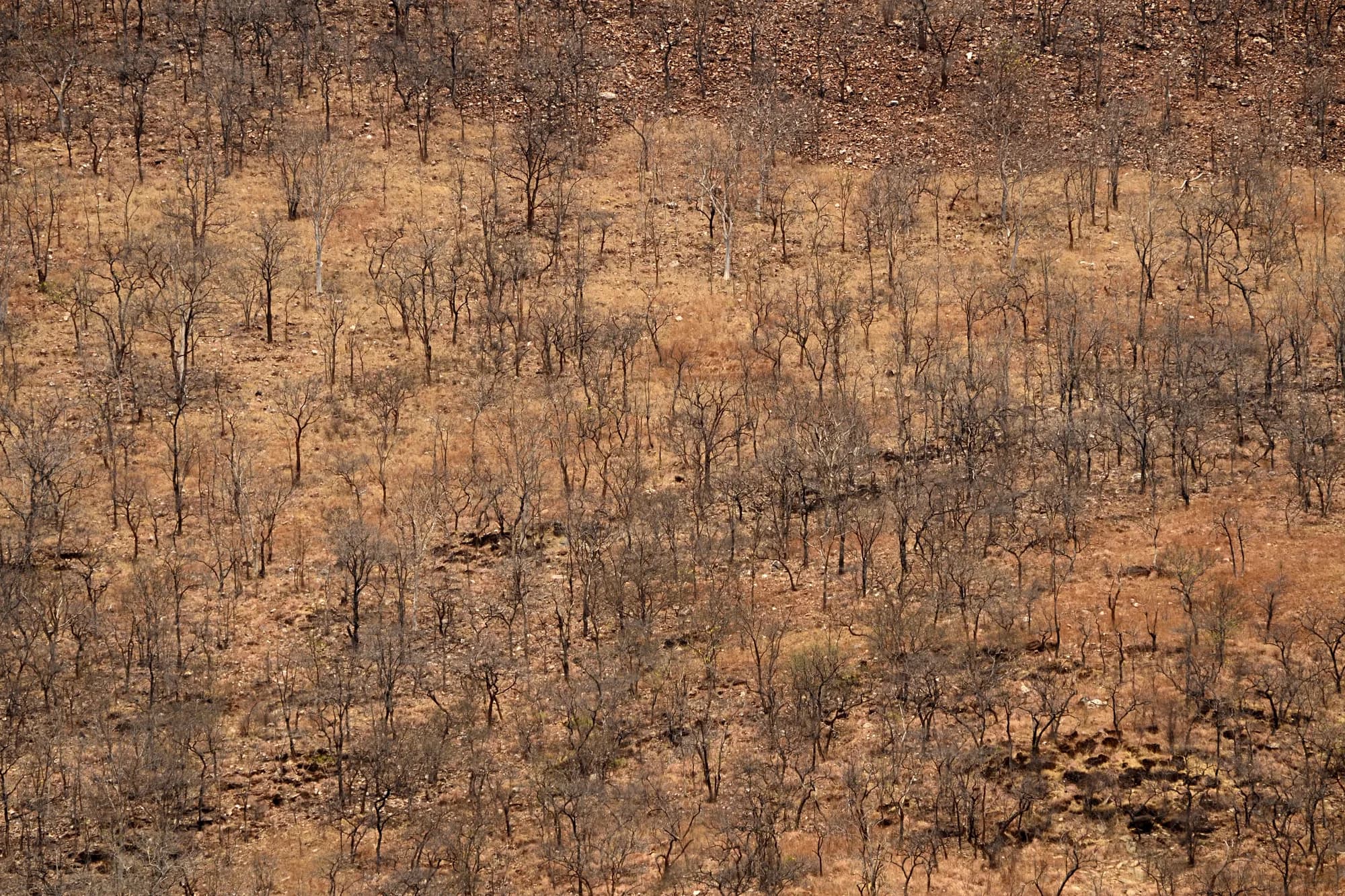
- Ranthambore, Gir and the dry northwestNo dholes. They need water, prey density and closed forest, and the dry thorn reserves have none of the three. This is one of the sharpest range boundaries among Indian predators.
- Expecting a wolfDifferent animal entirely. Rust-red rather than grey, rounder ears, a much shorter muzzle, and a bushy black-tipped tail. Wolves are grassland animals in India; dholes are forest ones, and they barely meet.
- A trip planned only around the core zones at middayPacks cover ten or fifteen kilometres in a morning. If your drives start late and stop early you have narrowed the window to almost nothing.
When to go
When to go
- J
- F
- M
- A
- M
- J
- J
- A
- S
- O
- N
- D
January: best. February: best. March: best. April: good. May: good. June: marginal. July: closed or unproductive. August: closed or unproductive. September: closed or unproductive. October: marginal. November: best. December: best.
Through the day
- Dawn
- Morning
- Midday
- Afternoon
- Dusk
- Night
Dawn: most active. Morning: most active. Midday: usually resting. Afternoon: active. Dusk: most active. Night: not normally seen.
Realistic odds on a three-day trip
- Near-certain
- Likely
- Lucky
- Expedition
Telling it apart
Told apart from
Indian wolf
Grassland edges in Madhya Pradesh, rarely
Colour settles it at any distance — a dhole is rust-red all over, an Indian wolf is sandy grey. Then the tail: bushy and black-tipped on a dhole, thinner and plainer on a wolf. Ranges barely overlap in any case.
Golden jackal
Everywhere, and the most common misidentification
Size and company. A jackal is a third smaller, usually alone or in a pair, and has a noticeably longer, narrower muzzle. Five reddish canids together in a forest are dholes.
Feral dog
Buffer zones and reserve boundaries
A real problem at reserve edges. Dholes have a uniform coat, no dewclaw on the hind foot, and move as a coordinated unit; feral dogs are patchy, straggling and usually near a village.
Marks chosen to be usable from a moving vehicle — a dhole is rarely still and never close enough for anything subtler.
What it looks like in the field
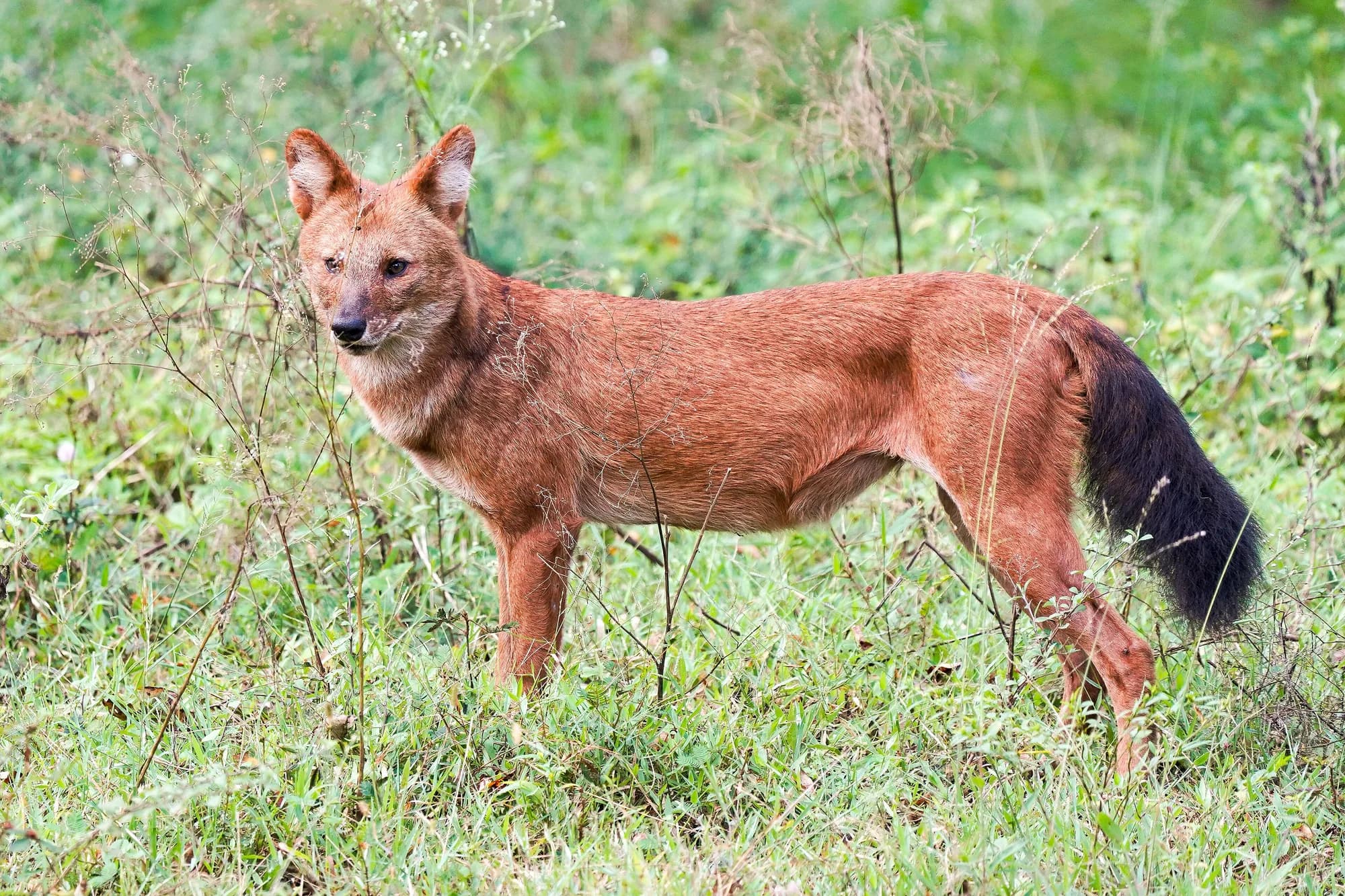
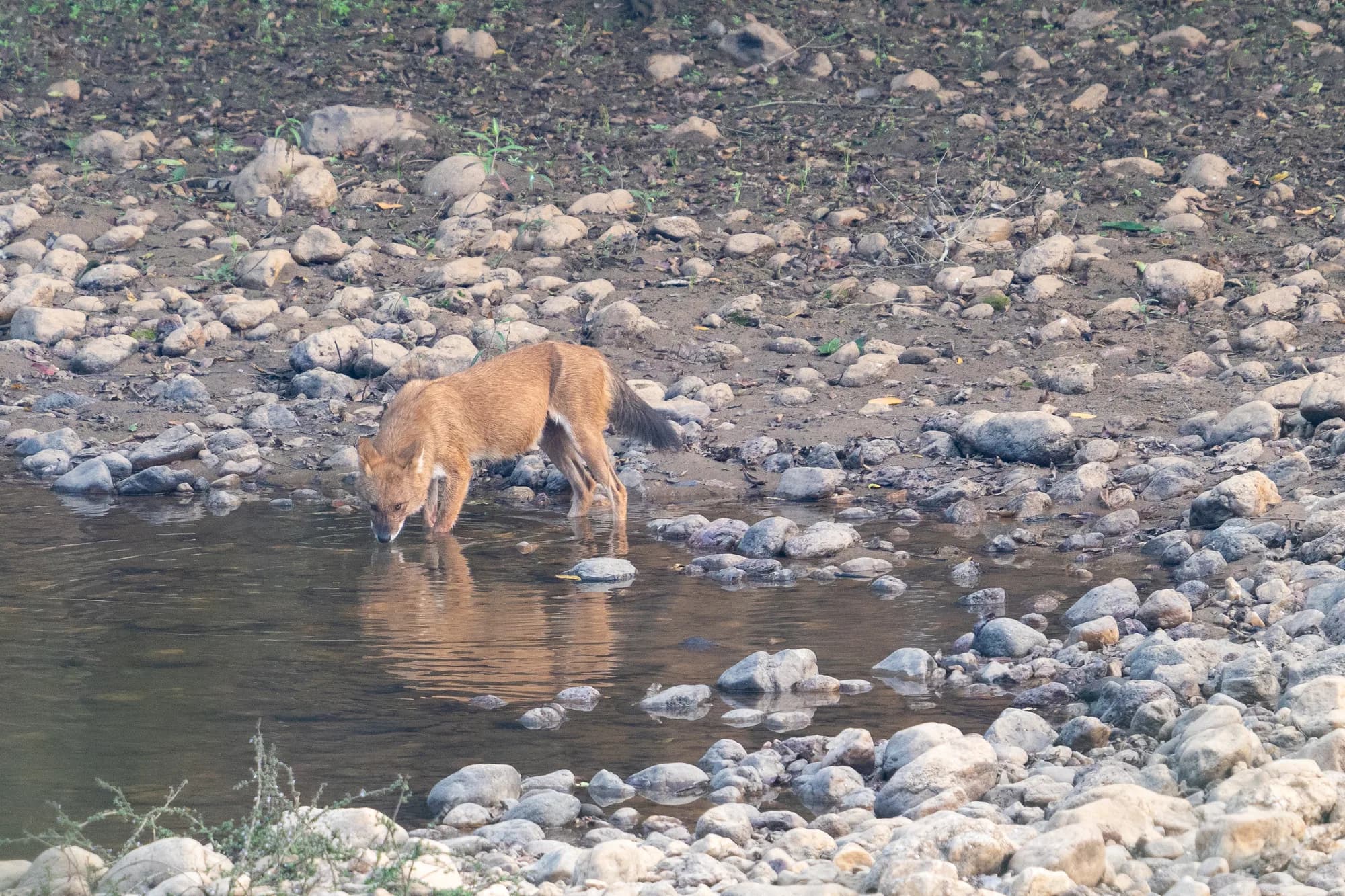
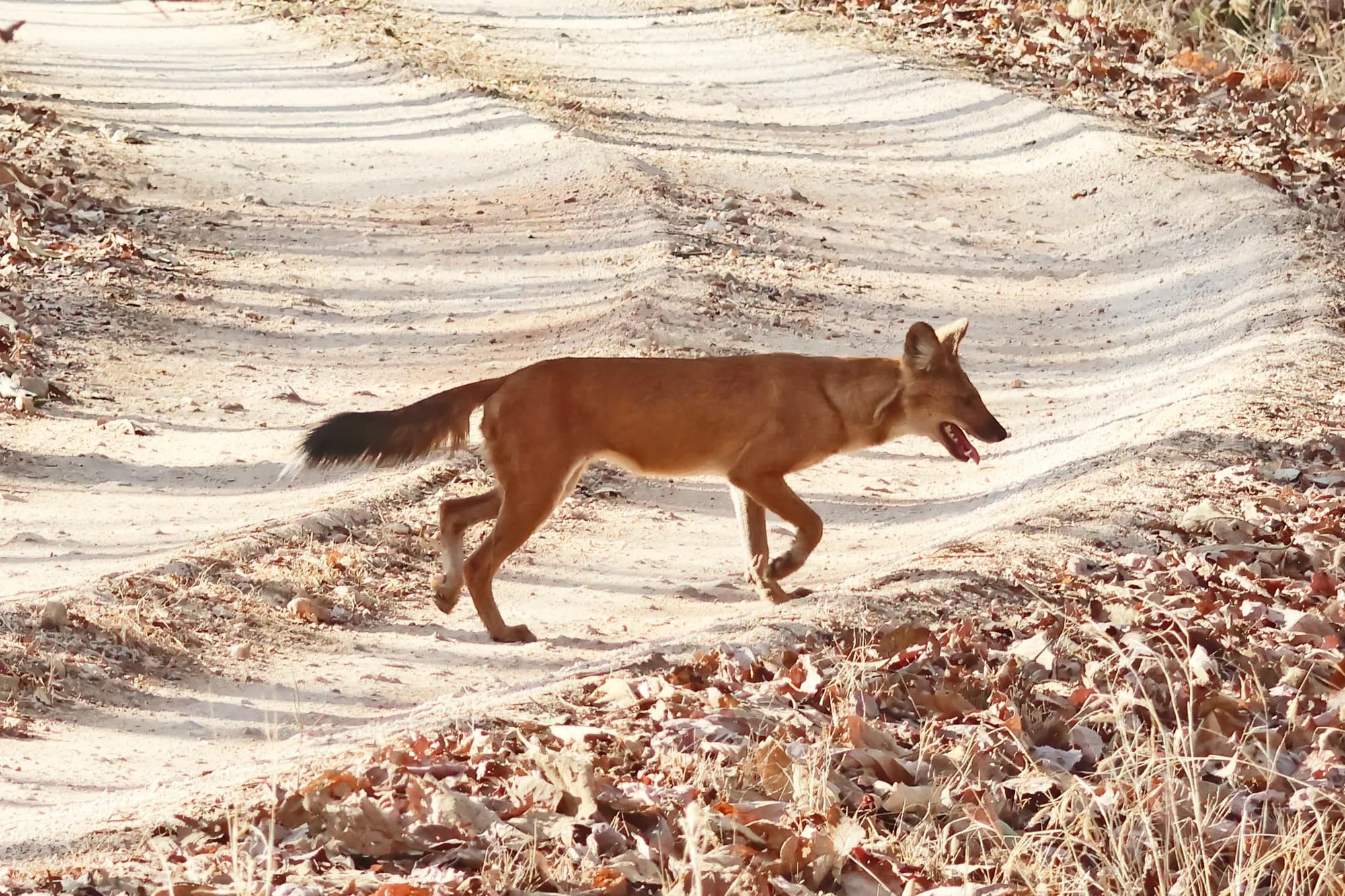
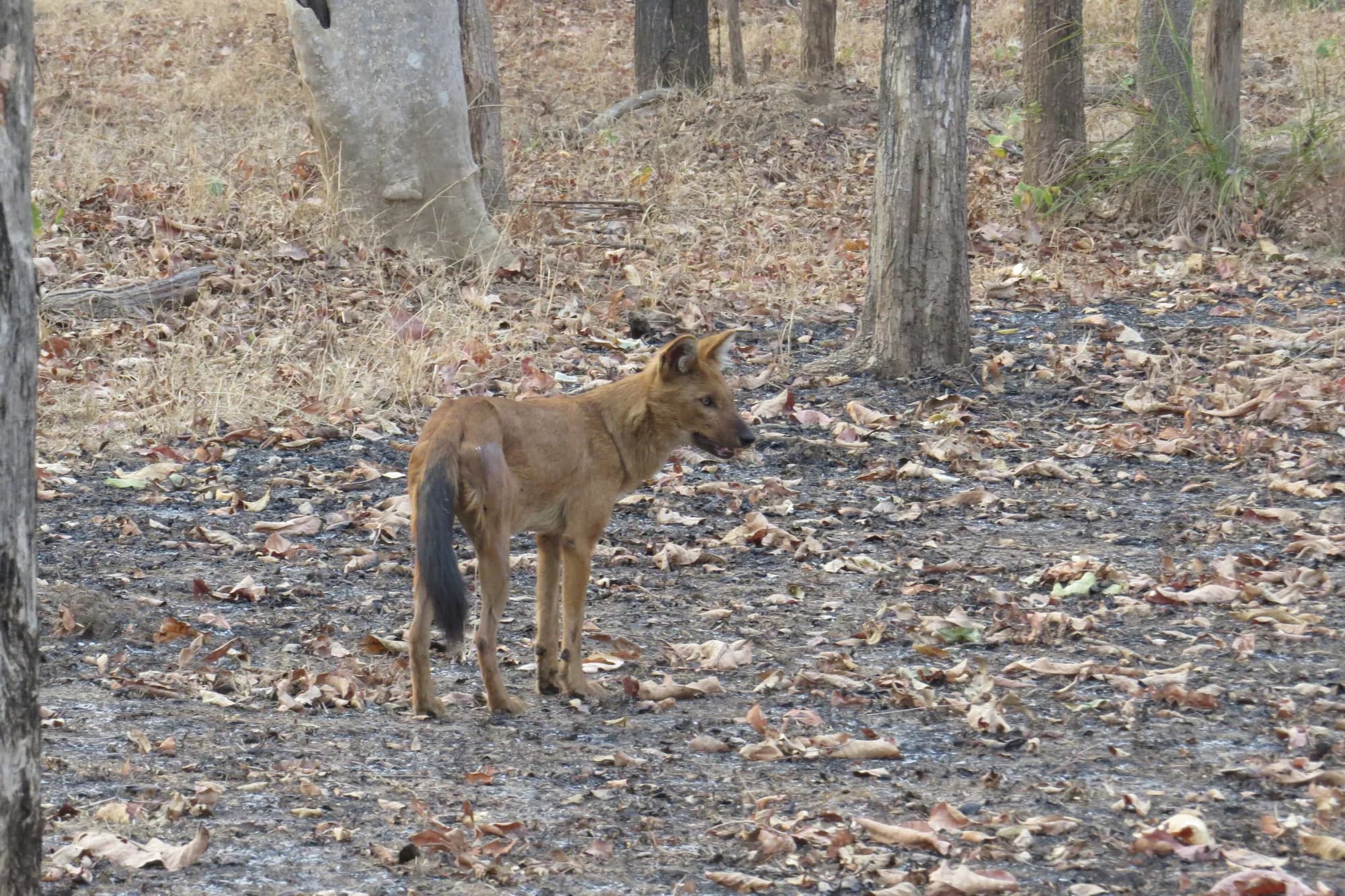
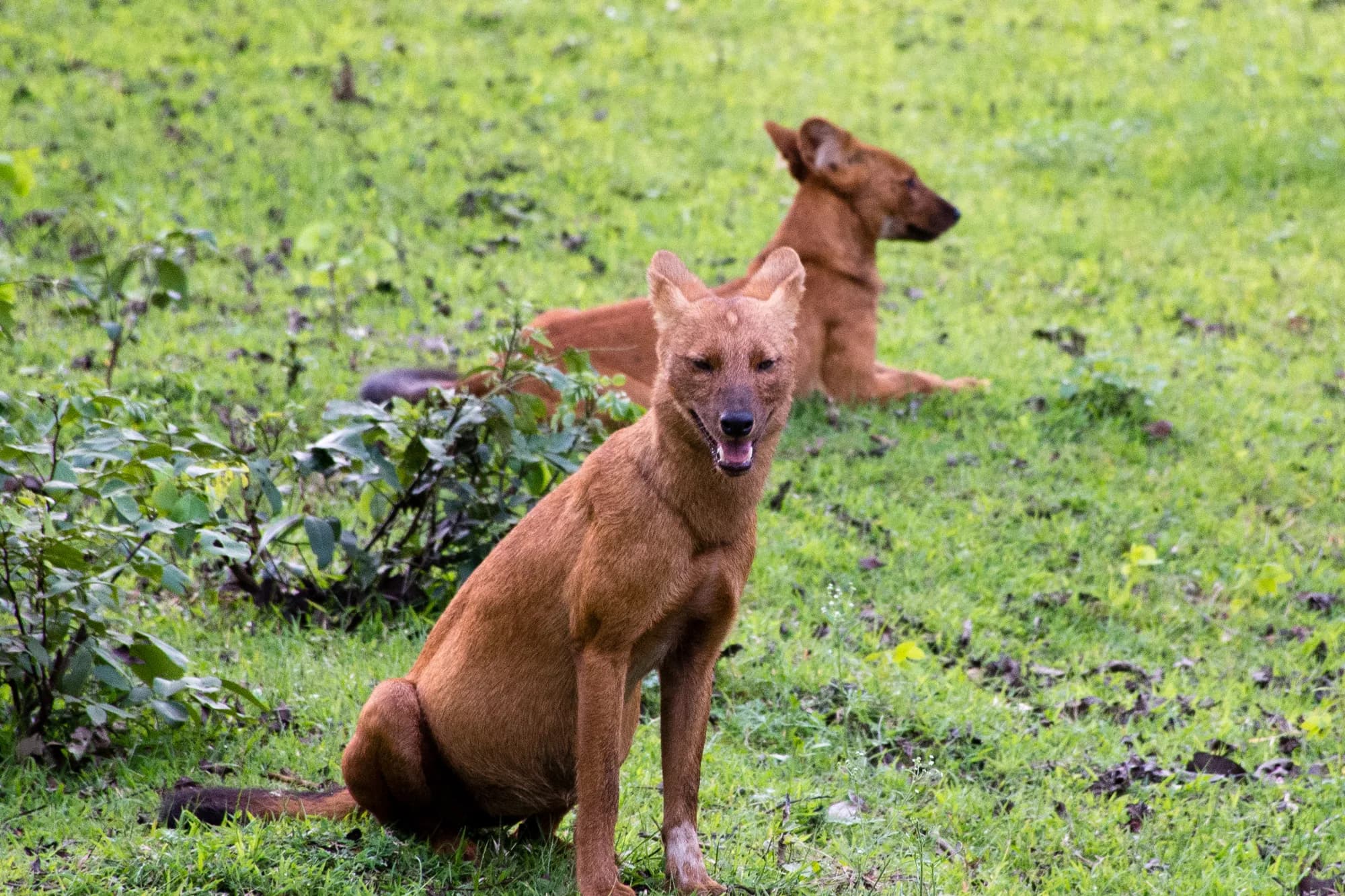
Photographs of Dhole in the wild, in Indian reserves. We publish no captive, baited or digitally composited images, and no photograph whose licence we cannot show.
Photographing it
- Lens
- 300–400mm is enough and easier to handle than a longer prime, because the animals move fast and rarely stay in one plane.
- Typical distance
- Twenty to sixty metres, often crossing rather than static.
- Light
- The best of any Indian predator — they are out in usable morning light, which is why dhole photographs look sharper than tiger photographs taken the same week.
Where to stopNever follow a hunt. A pursued pack that loses its prey has lost a day's food, and the vehicles that push in to keep up are the reason some reserves now restrict following. Hold position and let the hunt come to you or go.
Signs and calls
- Communal latrine
- Several scats deposited together at a track junction or crossroads — a pack signpost, and quite unlike a tiger's single central deposit. The most diagnostic dhole sign there is.
- Track
- Four toes with clear claw marks, because canids do not retract. Narrower and neater than a feral dog's, and usually several sets travelling together.
- Whistle
- A high, clear, rising whistle used to keep the pack in contact through cover — the reason they are sometimes called whistling dogs. Once heard it is unmistakable and it is often the first sign.
- Kill
- Consumed fast and messily, with the carcass opened at the flank rather than the throat. A cat suffocates; a dhole does not, which is why dhole kills look different from fifty metres.
Who gives it away
Chital
The same sharp bark given for a cat, but sustained much longer and often while moving — a herd being pushed rather than a herd frozen.
A running alarm usually means dholes, not a tiger
Sambar
Deep repeated honk, frequently from an animal standing in water. Sambar are dhole prey and take it seriously.
High
Langur
Canopy alarm, though less reliably than for a leopard — langurs are safer from dholes and call less urgently.
Moderate
Alarm calls announce a predator, not specifically a dhole, and a great many of them announce nothing at all. They are a reason to stop the vehicle, which is most of what finding one takes.
What a sighting is actually like
Fast, and busier than anything else you will watch. A pack does not pose: it trots, splits, checks, regroups, and half of it is behind you before you have counted. The usual mistake is to photograph one animal and miss that eleven others are working the same two hundred metres.
A tiger sighting is a held breath. A dhole sighting is a scene with a plot.
They are also unbothered by vehicles in the reserves where they are used to them, which means a good dhole sighting lasts longer than almost any cat sighting and takes place in light you can actually photograph in.
How they actually hunt
By stamina, in the open, in daylight — the opposite of every cat in this forest. There is no stalk and no ambush. A pack picks an animal, runs it until it tires, and eats it quickly and communally, often before it has stopped moving.
They will also take on animals far larger than themselves. A pack of a dozen can pull down an adult sambar, and there are well-documented cases of dholes standing their ground against a tiger at a kill — the only Indian predator that does.
Status and protection
Status and protection
- IUCN Red List
- Endangered
- Population trend
- ↓ Decreasing
- Wildlife Protection Act 1972
- Schedule I (post-2022 amendment numbering)
- CITES
- Appendix II
Species-level assessment for Cuon alpinus (e.T5953A72477893; last assessed 7 May 2015, published 2015). The binomial given is the full species; IUCN lists no infraspecific taxa.
Assessed 2015 · IUCN Red List assessment
What to book to see one
What you would be booking
- How it is seen
- Jeep safari. No special vehicle, no special permit — this is entirely about which reserve and which shift.
- Drives to book
- Six across three days at Tadoba or Kanha. Dhole is the classic case for booking more drives rather than a better room: a pack moves, so it is about how many mornings you are out.
- Zone or shift
- Meadow and open teak beat dense forest. At Kanha the maidans, at Tadoba the open areas around the lakes.
Ask for it explicitly at the gate. Most guides are looking for a tiger by default, and a pack crossing two hundred metres ahead gets driven past if nobody in the vehicle has said the word.
Tadoba — the park in fullOn the same trip you would also get
- Tiger — the same reserves, and tigers displace dholes from kills
- Gaur — Kanha, Tadoba and Kabini all hold both
- Indian giant squirrel — the canopy animal in the same forest, and the easiest of the three
Questions people ask
Where is the best place to see dholes in India?
What time of day are dholes active?
Are dholes dangerous to people?
Read next
Maharashtra
Tadoba — the best odds for a pack
Open teak and bamboo, and a reputation for daylight sightings that has been earned rather than marketed.
58 reserves, six worth the trip
Tiger — where and when
The animal most people come for, and the one most often missed. Where the odds actually are, and how they move by month and by zone.
Madhya Pradesh
Kanha — meadows and long sightlines
Sal forest and wide meadows, larger and calmer than Bandhavgarh. Repays four or five drives far more than two.
Twelve months, cross-park
When to go, month by month
The single decision that moves the odds most. Heat, crowds, closures and what is actually open, one page per month.