
Species · Ophiophagus hannah
King cobra
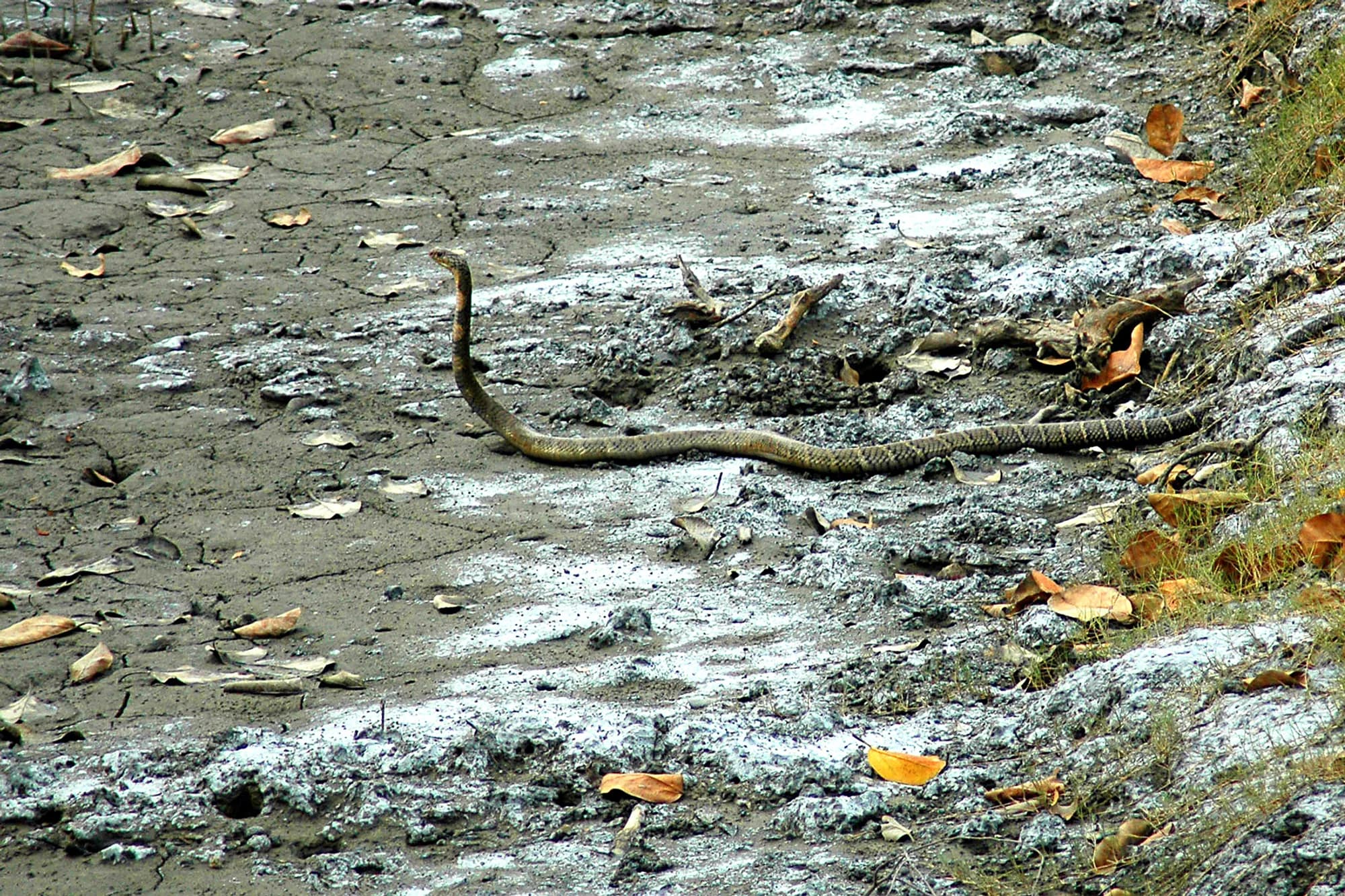
The longest venomous snake on earth, which eats other snakes and builds a nest for its eggs. Enormous name recognition, and essentially no chance of a planned sighting.
Also called
- Rajavembala · Malayalam
- Kalinga sarpa · Kannada
- Raj nag (राज नाग) · Hindi
Checked 30 Aug 2026
- Where
- Western Ghats & the Northeast
- Best months
- November–April
- Length
- Up to about 4 m
- Eats
- Other snakes
Wet evergreen forest, mostly. Two separated strongholds in the Western Ghats and the Northeast, with scattered records along the eastern hills between them.
Where it is
Where to actually go
Ranked, with the reason each — these are not interchangeable.
- 01AgumbeKarnatakaWet Ghats rainforest with the best-studied king cobra population in India, and the research station that established most of what is known about their nesting. Still not a reliable sighting.The only place where anyone can improve your odds at all
- 02PeriyarKeralaPresent in the surrounding forest, occasionally on tracks. Go for the hornbills, the elephants and the boat, and treat this as a lottery ticket.A bonus on a trip booked for something else
- 03KabiniKarnatakaOccasional records crossing forest roads in Nagarhole, usually in the warm mid-morning.Tell your guide you would stop for one
Where you will not see one
- The dry northwestRajasthan, Gujarat and the dry central reserves have none. The cobra you might see at Ranthambore or Gir is the spectacled cobra, a much smaller and unrelated-looking animal.
- On a scheduled safariThere is no drive, no permit and no season that produces one on demand. Almost every king cobra a visitor sees in India is seen by accident, from a vehicle, crossing a road.
- In a snake show or a basketWorth saying plainly. Captive king cobras handled for tourists are common in parts of India and have nothing to do with a wild sighting — and paying for one funds the collection of wild animals.
When to go
When to go
- J
- F
- M
- A
- M
- J
- J
- A
- S
- O
- N
- D
January: good. February: good. March: best. April: best. May: good. June: marginal. July: marginal. August: marginal. September: marginal. October: good. November: best. December: best.
Through the day
- Dawn
- Morning
- Midday
- Afternoon
- Dusk
- Night
Dawn: active. Morning: most active. Midday: active. Afternoon: active. Dusk: usually resting. Night: not normally seen.
Realistic odds on a three-day trip
- Near-certain
- Likely
- Lucky
- Expedition
Telling it apart
Told apart from
Spectacled cobra
Everywhere, and constantly
The one everybody gets wrong. A spectacled cobra is under two metres with a bold spectacle mark on the back of the hood; a king cobra is far longer, plainer, with chevron bands and a narrower hood carrying no spectacle. Nearly every roadside cobra in India is the spectacled.
Indian rat snake
Every Indian forest and garden
Harmless, extremely common, and frequently reported as a king because it gets long and rears when cornered. Rat snakes have a much more slender head barely wider than the neck, and large obvious eyes.
Banded krait
Eastern India and the Northeast
Bold yellow-and-black banding along the whole body and a triangular cross-section. King cobras are olive-brown with pale chevrons and are round in section.
Marks chosen to be usable from a moving vehicle — a king cobra is rarely still and never close enough for anything subtler.
What it looks like in the field
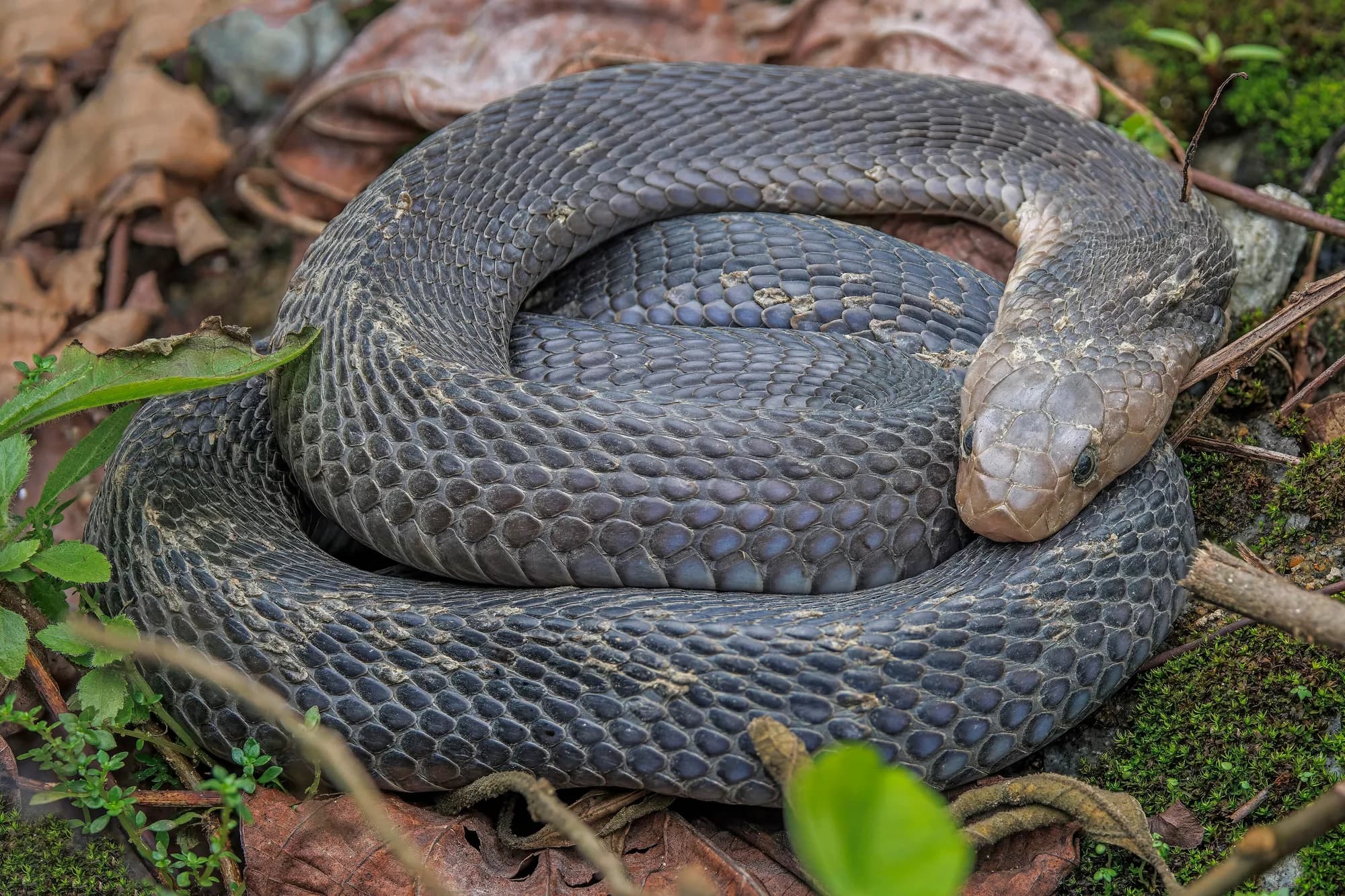
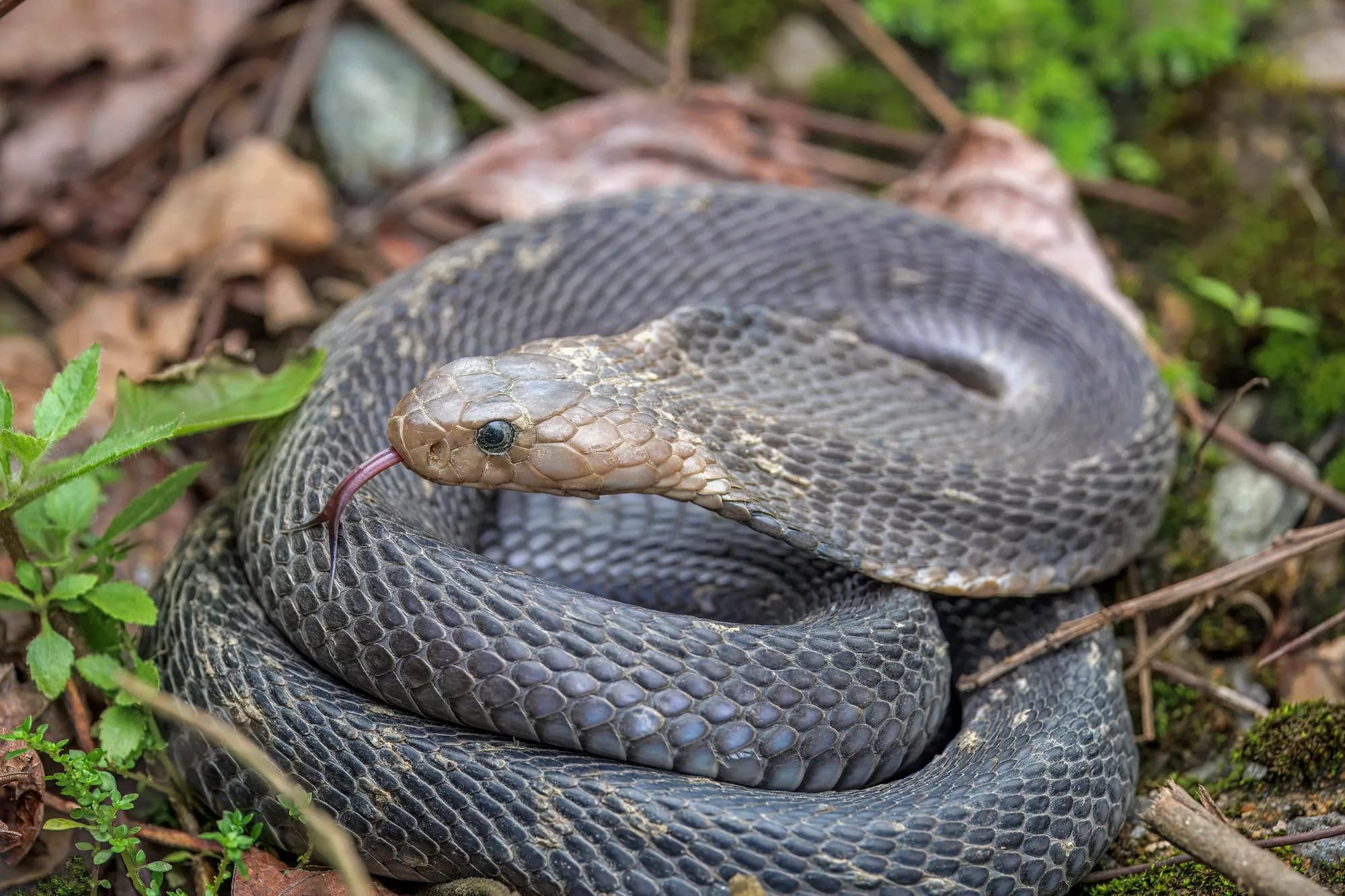
Photographs of King cobra in the wild, in Indian reserves. We publish no captive, baited or digitally composited images, and no photograph whose licence we cannot show.
Photographing it
- Lens
- 300mm or longer. There is no photograph here worth reducing your distance for, and a long lens is a safety tool as much as an optical one.
- Typical distance
- Fifteen metres or more, and further if the animal has raised its forebody.
- Light
- Wet forest, so dark and green. A snake on a road in open light is the realistic frame.
Where to stopNever approach a nesting female, never use a stick, and never ask a guide to move a snake for a better angle. Handling king cobras for photographs is common in parts of India, it is dangerous, and it is not wildlife photography.
Signs and calls
- Nest mound
- A heap of gathered leaf litter up to a metre across, built by the female — the only snake in the world that constructs a nest. Unmistakable once you know it, and to be left entirely alone.
- Shed skin
- Length is the tell. A shed over two and a half metres from Ghats or Northeast forest narrows the possibilities very quickly.
- Track
- A wide, heavy body-drag across dust or wet mud on a forest road, noticeably broader than any rat snake leaves.
What a sighting is actually like
Almost always from a vehicle, almost always brief, and almost always on a road. Something very long is crossing ahead, the driver stops, and by the time anyone has processed what it is the tail is going into the undergrowth.
The length is what stays with people. It keeps going for longer than seems reasonable.
A king cobra that has decided to leave is not interested in you at all. The animal only rears and spreads its narrow hood when it feels cornered, and the correct response to that display is to back away rather than to reach for a longer lens.
The snake that builds a nest
No other snake in the world does this. The female gathers leaf litter into a mound with a loop of her body, lays inside it, and then stays with the nest for weeks while the decomposing vegetation keeps the eggs warm.
The diet is the other unusual thing. Ophiophagus means snake-eater, and that is essentially the whole diet — rat snakes mostly, and other cobras. Which is why king cobras persist where there is enough forest to hold a lot of other snakes, and vanish where there is not.
Status and protection
Status and protection
- IUCN Red List
- Vulnerable
- Population trend
- ↓ Decreasing
- Wildlife Protection Act 1972
- Schedule I (post-2022-amendment numbering)
- CITES
- Appendix II
Species-level assessment of Ophiophagus hannah as a single wide-ranging species. It predates the recent taxonomic split of Ophiophagus into multiple species, so it covers O.
Assessed 2011 (published 2012) · IUCN Red List assessment
What to book to see one
What you would be booking
- How it is seen
- Nothing you can book. Time in wet Ghats or Northeast forest, and a driver who slows for things on the road.
- Drives to book
- Not a numbers game in any useful sense. Your odds are a function of days spent in the right forest rather than drives purchased.
- Zone or shift
- Agumbe and the surrounding Ghats rainforest holds the best-studied population, and the research station there is the reason anything is known about the species' nesting.
If you find one, keep well back and let it go. King cobras are not aggressive and would rather leave, but they are large, fast, and carry enough venom to matter — this is the one animal on this list where the right distance is much further than you think.
Periyar — the park in fullOn the same trip you would also get
- Great hornbill — the same Ghats rainforest, and far more reliable
- Indian giant squirrel — in the canopy above the same track
- Nilgiri langur — the Ghats primate in the same forest belt
Questions people ask
Where can I see a king cobra in India?
How do I tell a king cobra from an ordinary cobra?
Are king cobras aggressive?
Read next
Kerala
Periyar — the park in full
A lake in the Western Ghats, walked and boated rather than driven. Elephants, hornbills and rain — not a tiger destination in any practical sense.
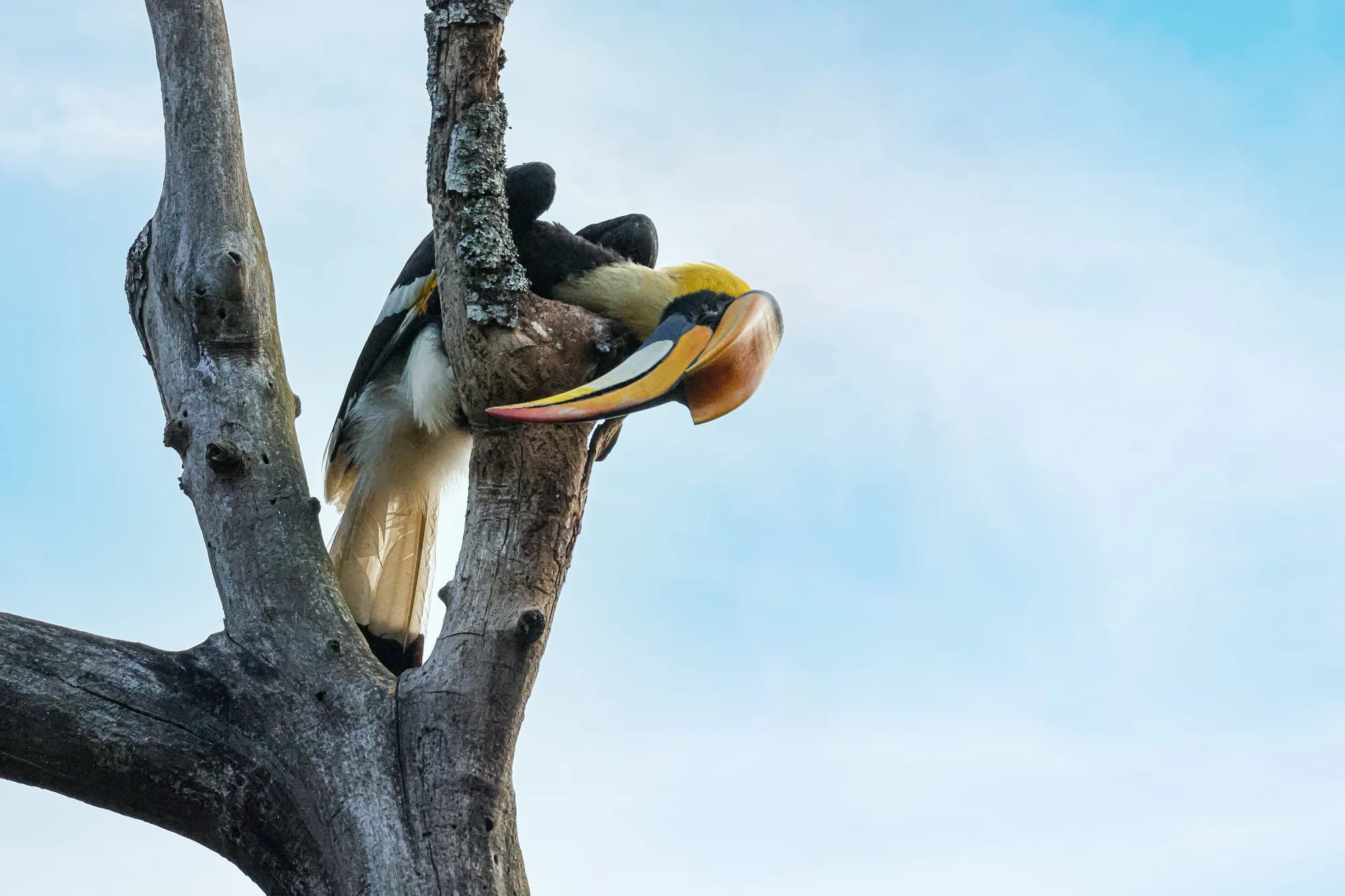
Three reserves, and you hear it first
Great hornbill — the same forest
The bird non-birders stop the vehicle for. You hear the wingbeats several hundred metres before you see it, and the nesting behaviour is stranger than anything a mammal in the same forest does.
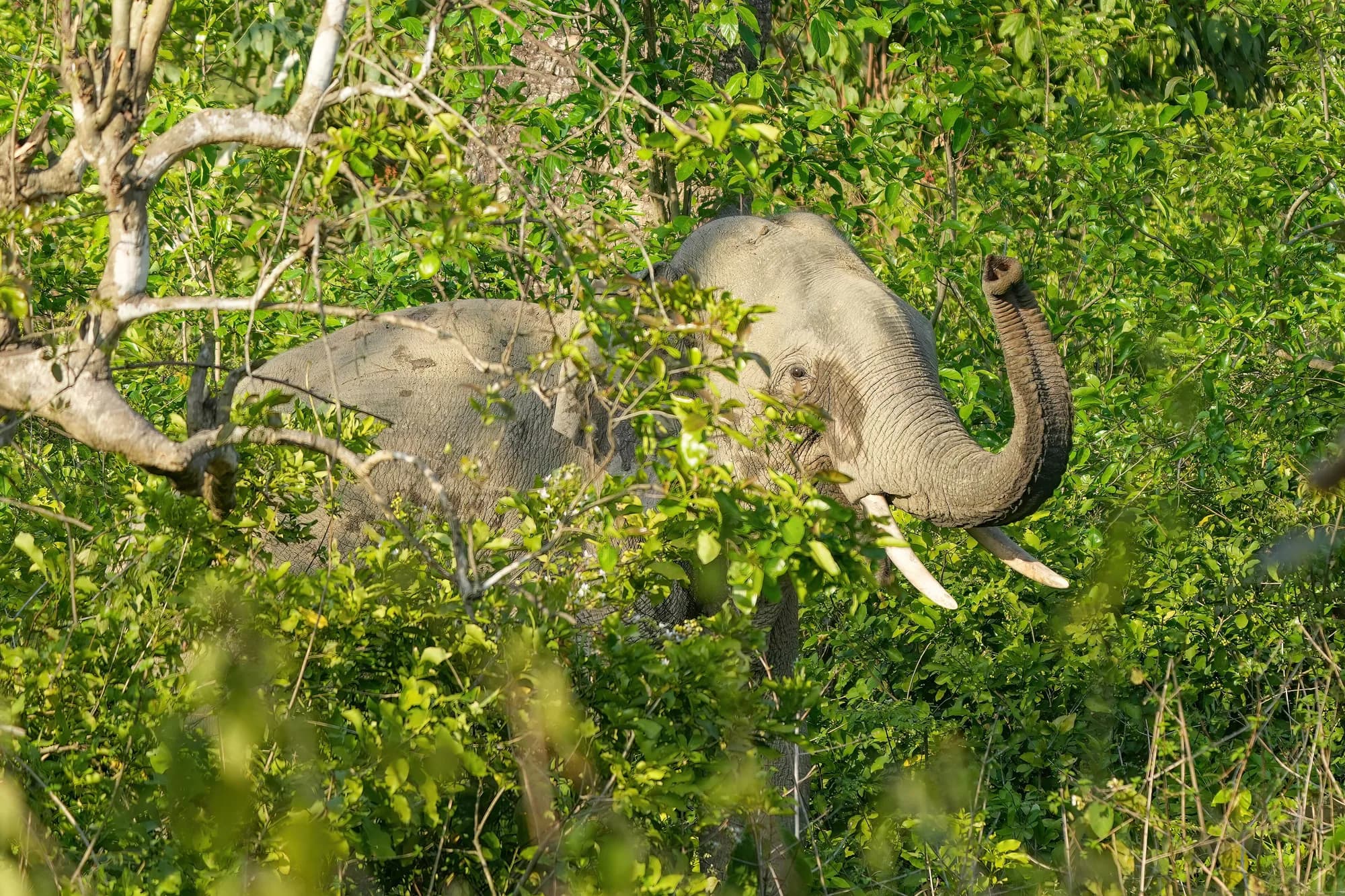
Our position
Travelling responsibly
Where we stand on vehicle crowding, baiting and playback — and what we will not link to, whoever is paying.
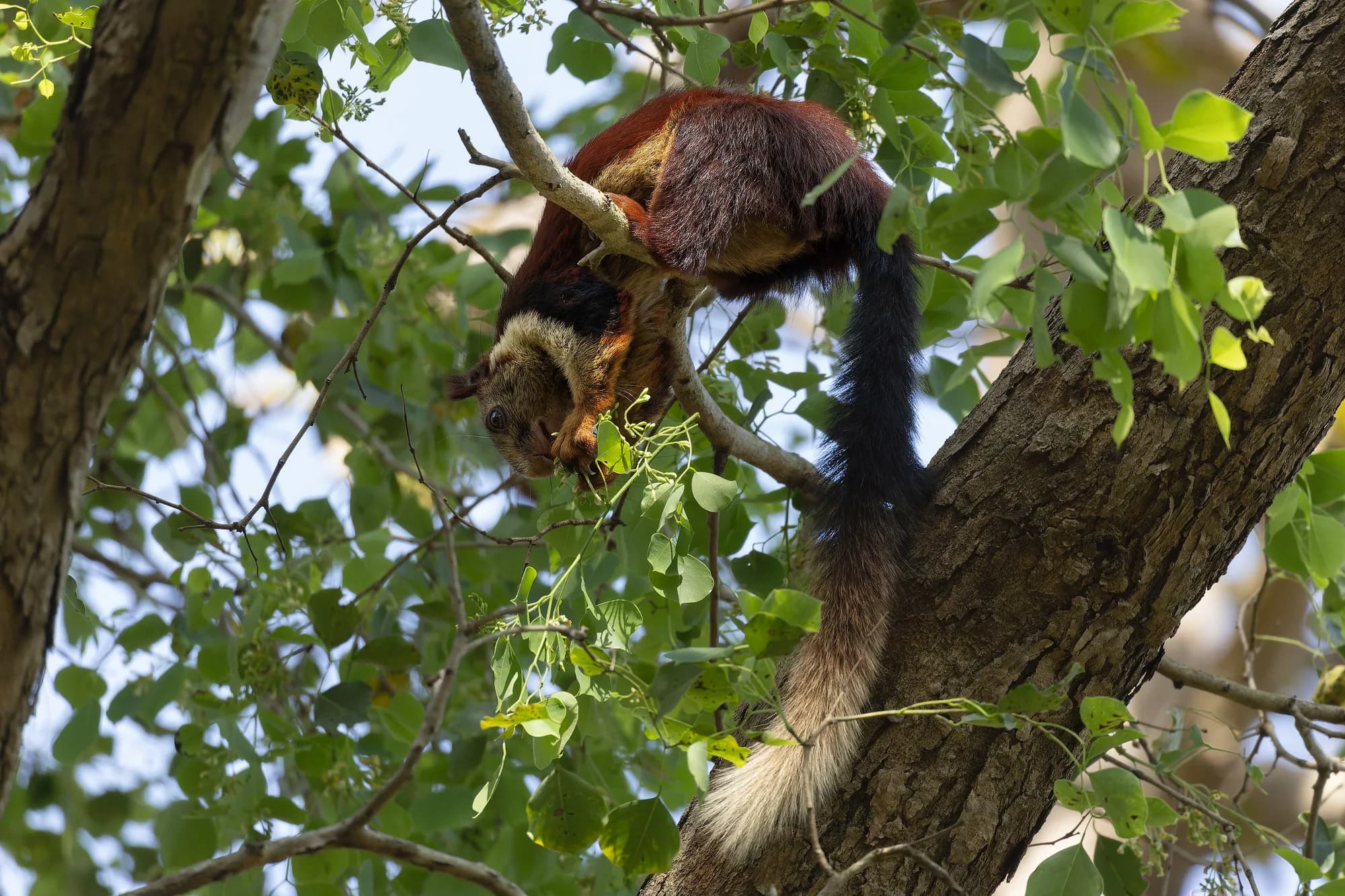
Six reserves, and always overhead
Indian giant squirrel — where and when
A squirrel the length of your arm, in maroon and cream, that leaps six metres between trees. The animal that most reliably delights people who came for a tiger and did not get one.