
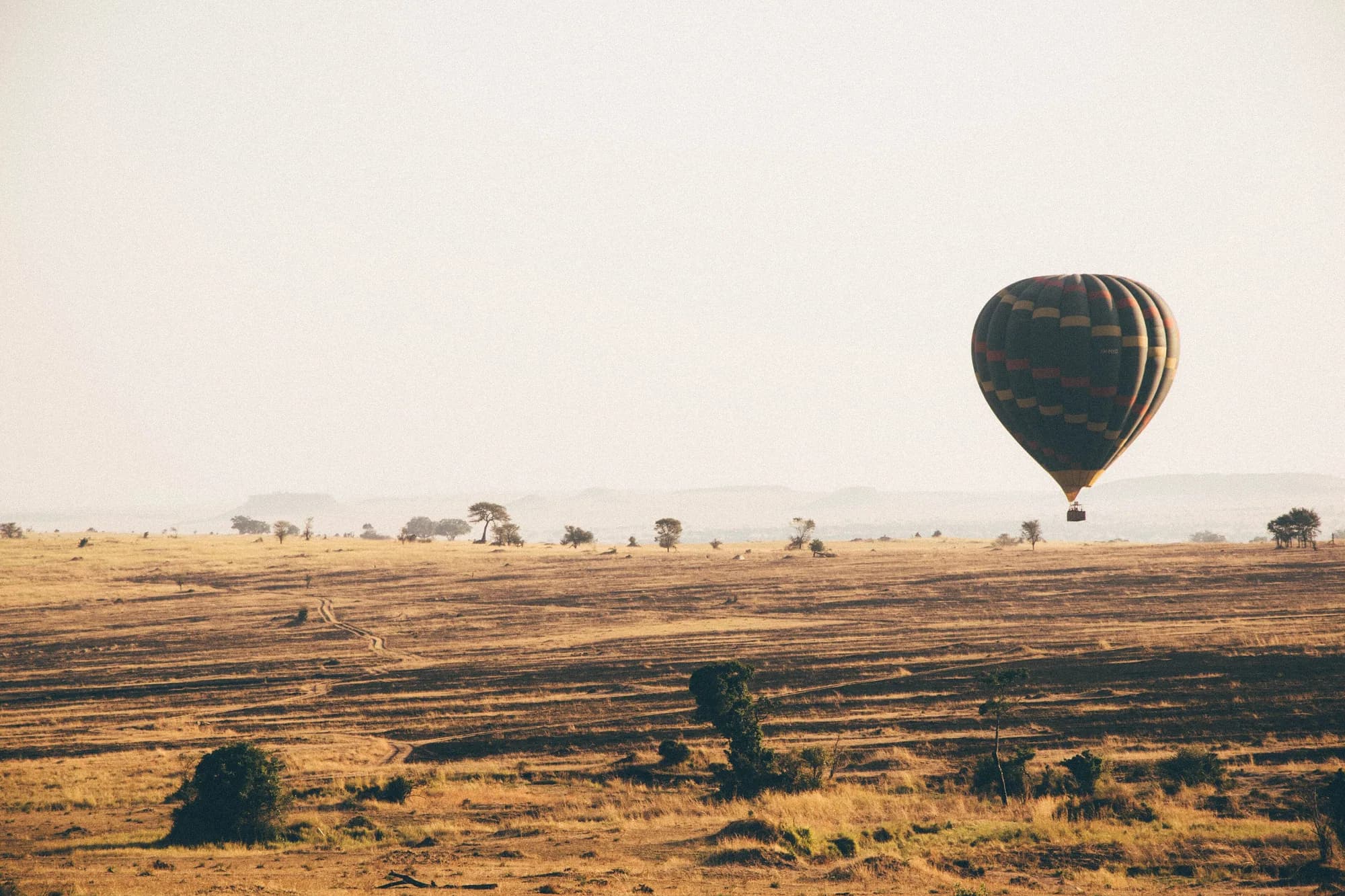
Tanzania / Serengeti / Wildlife — Serengeti
Wildlife — Serengeti
The Serengeti holds the largest terrestrial mammal migration on earth and a resident predator population that does not depend on it.
The migration
Roughly 1.3 million blue wildebeest and several hundred thousand plains zebra move through the ecosystem continuously, with Thomson's gazelle and eland alongside. Zebra go ahead of the wildebeest — they digest the tall coarse grass the wildebeest cannot, and grazing it down exposes the shorter growth underneath.
About half a million wildebeest calves are born on the southern plains across a few weeks in February. The synchrony is the defence: so many at once that predators cannot take a meaningful share.
Why the southern plains and not anywhere else is a question about soil. Ash from the Ngorongoro highland volcanoes settled across that country and produced a shallow, mineral-rich short grass that a lactating wildebeest can crop close and that carries the calcium a growing calf needs. The herds are not choosing scenery. They are choosing the only ground in the ecosystem that will feed a calf, and that is why the calving concentration is so predictable in place even when it moves in time.
Predators, and realistic odds
What to expect over three or four game drives
| Animal | Odds | Where |
|---|---|---|
| Lion | Very high | Seronera valley and the kopjes, any month |
| Cheetah | High | Southern short-grass plains, best Jan–Mar |
| Leopard | Moderate | Seronera sausage trees — look up, not out |
| Spotted hyena | Very high | Throughout; clans commute with the migration |
| African wild dog | Very low | Present but thin. Southern Tanzania is the place for these |
| Black rhino | Low | A small protected population, mostly in the Moru kopjes |
Odds assume three or four drives in the right sector. One drive is a coin toss for anything but lion.
Do not come here for wild dogs
The northern circuit is poor for African wild dog and nobody selling a Serengeti itinerary will volunteer that. Tanzania's population is in the south — Nyerere and Ruaha — which is an entirely different trip.
Beyond the big animals
- Over 500 bird species, with the kopjes holding rock-loving specialists and the plains holding bustards, secretarybirds and larks.
- The Moru kopjes carry San-style rock paintings and a rock gong, which most itineraries drive past.
- Hippo pools along the Seronera and Retina, reliably occupied and reliably smelly.
- Giraffe are Masai giraffe here — ragged vine-leaf blotches, not the crisp lines of the northern Kenyan animal.
The rhino, and the only way you are meant to see one
The Serengeti's black rhino are the quietest thing on this page and the most managed. There is no honest way to describe them as a sighting you might get lucky with on a game drive in the valley — the population is small, protected, and concentrated in the Moru kopjes in the south-west.
The clearest evidence of how that works is in the tariff itself. TANAPA lists "Special Rhino viewing — Moru, Serengeti National Park" at USD 100 per trip, charged identically to East African citizens at TSh 100,000 and to everyone else. A national park does not price an activity per trip unless the activity is arranged, escorted and finite. If the rhino matter to you, this is the line item to ask about; if nobody mentions it, you are not going to see one.
The comparison worth making
Mkomazi, in the north-east of Tanzania, prices rhino viewing at USD 30 an adult for an hour, and TANAPA's Kisima rhino project runs a whole schedule of its own — USD 200 to view, USD 500 to track with trackers, USD 2,000 a year to adopt an animal. Those are sanctuary numbers for a sanctuary experience. The Serengeti's USD 100 is for a wild population in a landscape, which is a different and less certain thing for a similar price.
TANAPA — Tanzania National Parks Tariffs, 1 July 2023 to 30 June 2024
This is the most recent tariff TANAPA has published and it expired on 30 June 2024. No replacement has been issued, and TANAPA's own fees page still badges it "Financial Year 2023/2024". Treat these as a floor rather than as current rates: Tanzanian park fees have risen at every revision, and the document states no VAT treatment, so 18% may be added at the gate. Read 28 September 2026.
https://www.tanzaniaparks.go.tz/uploads/publications/en-1688147569-TARIFFS%20Design%20202324.pdfWhat the Serengeti does not have, and where it is instead
An honest wildlife page has to include the absences, because they are the things people discover on day three. The Serengeti is a grassland and woodland system with a river running through the north, and a great deal of African wildlife is simply not that.
Not here — and the park that has it, with its conservation fee
| What you wanted | Where it actually is | Adult non-EA fee, per day |
|---|---|---|
| Chimpanzees | Gombe, on Lake Tanganyika | USD 100 |
| Chimpanzees, wilder and harder | Mahale Mountains | USD 80 |
| African wild dog in numbers | Nyerere and Ruaha, in the south | USD 70 and USD 30 |
| Tree-climbing lions and forest | Lake Manyara | USD 50 |
| Enormous elephant herds and baobabs | Tarangire, in the dry season | USD 50 |
| Boat safaris and canoeing | Nyerere, Arusha, Lake Manyara | Not offered in the Serengeti |
Read down the last column and the planning point appears: the parks that hold what the Serengeti lacks are mostly cheaper to enter. A Ruaha day is USD 30 against the Serengeti's USD 70.
- Canoeing is priced for Nyerere, Arusha and Lake Manyara, and for Mahale, Burigi-Chato, Rumanyika-Karagwe and Rubondo Island. Not for the Serengeti.
- Boating safaris are priced for Nyerere, Saadani, Gombe, Rubondo Island and others. Not for the Serengeti.
- Night game drives are priced for Katavi, Ruaha, Mikumi, Tarangire, Lake Manyara, Nyerere and others. The Serengeti is not on the list.
- Sport fishing is priced for eight parks. The Serengeti is not one of them.
- What the Serengeti is priced for, beyond the game drive, is walking, ballooning, a bush meal, a sundowner, the Moru rhino trip — and, oddly, a fun run at USD 50 for ten kilometres.
Absence from a tariff is not the same as prohibition
Several of these headings end with the words "and other applicable National Parks", which leaves room the document does not close. What we can say is that TANAPA does not name the Serengeti for a night drive, a boat or a canoe, and that is enough reason not to build an itinerary on one. We could not find a separate document listing which activities are permitted in which park.
TANAPA — Tanzania National Parks Tariffs, 1 July 2023 to 30 June 2024
This is the most recent tariff TANAPA has published and it expired on 30 June 2024. No replacement has been issued, and TANAPA's own fees page still badges it "Financial Year 2023/2024". Treat these as a floor rather than as current rates: Tanzanian park fees have risen at every revision, and the document states no VAT treatment, so 18% may be added at the gate. Read 28 September 2026.
https://www.tanzaniaparks.go.tz/uploads/publications/en-1688147569-TARIFFS%20Design%20202324.pdfReading a river crossing
The Mara river crossing is the single most photographed event in African wildlife and the single most misunderstood. It is not a migration crossing a river once. It is a herd crossing back and forth, sometimes several times in a week, at a small number of traditional crossing points, in response to grazing on either bank rather than to any onward journey.
- A build-up can take hours. Animals gather above a bank, mill, go down to the water, turn, come back up, and repeat. Guides read the density and the direction of the front rank; nobody reads the timing.
- Crocodiles are the visible risk and drowning is the larger one. Most losses at a crossing are trampling and exhaustion in the water, not predation.
- Crossing points are fixed by the shape of the bank, so vehicles gather at them and the etiquette problem is real. In peak season you will be one of many at the same gravel slope.
- The Grumeti crossings in June and July are the same behaviour at a smaller scale, with fewer vehicles and a shorter season, and they are the reason the western corridor exists on an itinerary at all.
- A crossing can happen a kilometre from where the vehicles are waiting. Position is a guess, and a good guide will tell you it is a guess.
Four nights, or treat it as a bonus
With three or four days at the river you are very likely to see something. With one afternoon you are buying a lottery ticket at Serengeti prices — USD 70 a day for the park, plus USD 60 a night for the bed levy, plus the camp, plus the flight north. The failure mode is not that the crossing does not happen; it is that it happens on the day after you left.