
Rwanda / Volcanoes / Best time to visit — Volcanoes
Best time to visit — Volcanoes
There is no cheap season at Volcanoes. The permit is USD 1,500 in the wettest week of April and USD 1,500 in the driest week of August, so the seasons are about ground conditions and availability, nothing else.
The year
Conditions and availability through the year
| Months | Conditions | Permits |
|---|---|---|
| June – September | The long dry window; the main season | Hardest to get |
| December – February | The short dry window | Hard to get |
| March – May | The long rains; deep mud on steep ground | Widely available |
| October – November | The short rains | Widely available |
The permit price is identical in every row. Rwanda has no low-season gorilla rate for foreign visitors, and the discounted tiers that do exist for residents and East African citizens are suspended from June to October 2026.
The gorillas are there in every month. They do not migrate, the families are habituated year-round, and the trackers go out every morning regardless of weather — so the question is never whether the animals will be present. It is how hard the walk to them is and whether a date exists to buy.
Note that this is a mountain forest just south of the equator at considerable altitude, so the seasonal difference is rainfall rather than temperature. It is cool all year and cold at night all year. Nobody comes here for the weather and nobody should plan around a warm afternoon.
Rwanda Development Board — Mountain Gorilla Tracking, booking portal
Read 28 September 2026. RDB publishes the price on the same page it sells from — there is no separate printed tariff for Rwanda. The discounted tiers carry a portal footnote stating they are promotional rates and are NOT applicable from June to October 2026.
https://visitrwandabookings.rdb.rw/rdbportal/mountain-gorilla-trackingThe dry windows
June to September is the long dry window and it is the main season for a reason: the volcanic soil firms up, the walk is materially easier, and the mountains are visible more often than not. December to February is the shorter second window, with the same benefits and slightly less certainty. These are the months in which a Volcanoes trek matches what people imagined when they booked it.
- Ground that holds a boot rather than taking it, which changes the character of a steep climb completely.
- Shorter treks in practice, because you move faster over the same distance.
- Clearer views of the chain, which matters on Bisoke and matters enormously on Karisimbi.
- The busiest briefings at Kinigi, and the hardest dates to buy.
- For residents and East African citizens in 2026, the discounted tiers are switched off across June to October.
Dry does not mean dry
This is montane forest and it rains in every month of the year. A July trek can still finish wet and muddy, and the guides carry machetes and plastic sheeting in August as readily as in April. The dry windows buy you better odds, not a guarantee, and anyone who packs for a dry country has packed wrong.
Rwanda Development Board — Mountain Gorilla Tracking, booking portal
Read 28 September 2026. RDB publishes the price on the same page it sells from — there is no separate printed tariff for Rwanda. The discounted tiers carry a portal footnote stating they are promotional rates and are NOT applicable from June to October 2026.
https://visitrwandabookings.rdb.rw/rdbportal/mountain-gorilla-trackingWhat the wet months cost you, and what they give back
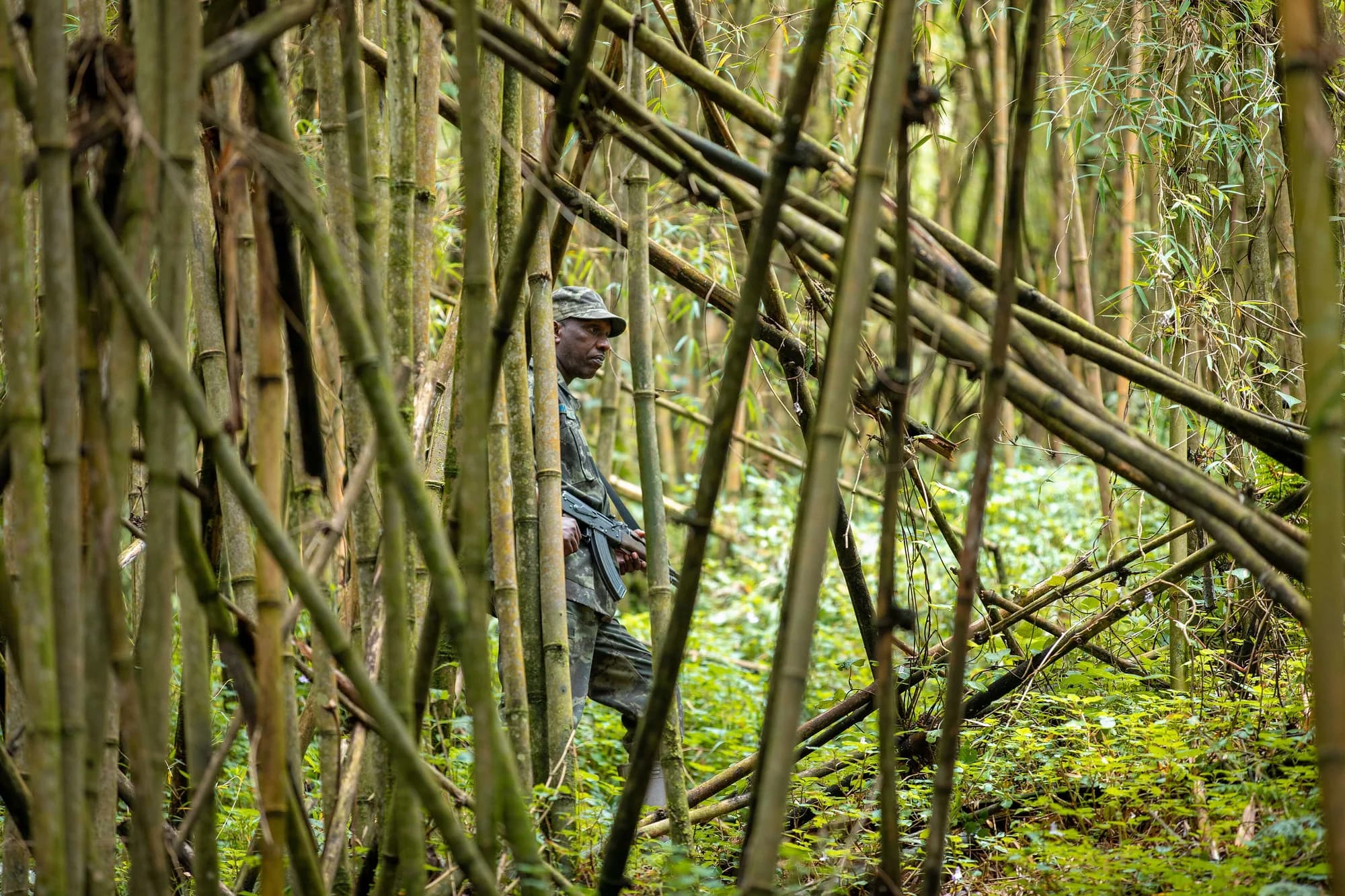
Steep volcanic soil under bamboo, saturated for weeks, is genuinely hard work. The trek is not long in kilometres and it is rarely the distance that tires people — it is the combination of gradient, mud that takes a boot and keeps it, and thin air. A walk that is ninety pleasant minutes in August can be three hours of slipping in April, for the same family in the same place.
March to May and October to November
| Against | For | |
|---|---|---|
| The walk | Much harder; deep mud on steep ground | Fewer people on the mountain |
| Permits | No discount whatsoever | Dates available at short notice |
| The mountains | Cloud and rain, often all day | Often startlingly clear between showers |
| Photography | Low light under canopy | Soft light, no harsh sun, green forest |
| Roads | The Kinigi track deteriorates | Musanze itself is unaffected |
No money is saved in any row. This is the honest summary: Rwanda's wet-season traveller pays full price for a harder day and buys availability with it.
The one group for whom the rains are clearly right
People whose constraint is the calendar rather than the budget — a fixed window of leave, a date that will not move, a decision made three weeks out. If that is you, the rains are a genuine option and a wet trek is still an extraordinary morning. If you are not confident on your feet on wet steep ground, they are not.
Altitude, and when to arrive
This is the part of the timing question that gets least attention and causes the most trouble. Volcanoes is a high park, the treks climb from a high starting point, and Karisimbi tops the chain at 4,507 m. Most gorilla treks stay far below that, but they still begin higher than almost anywhere in Europe and they go up from there. A person who is fit at sea level can be badly out of breath on this ground and be entirely surprised by it.
- Arrive at least a full day before you trek. Landing at Kigali in the afternoon and trekking the next morning is a common plan and a poor one.
- Sleeping at Kinigi rather than lower is marginally better preparation, but not if you got there the same evening.
- Do not plan Bisoke or Karisimbi for your first full day in the country. Put the gorillas first and the mountain later.
- If you are coming from Nyungwe or Akagera rather than straight off a flight, you are already acclimatised to Rwandan altitude and this matters much less.
What we could not verify
The commonly repeated figure for the park's lower boundary is around 2,400 m, and the treks run upward from there. We have not found that stated on an RDB or Visit Rwanda page, so treat it as approximate and editorial. The only altitude we publish as sourced is Karisimbi's 4,507 m, from Visit Rwanda's destination page.
Visit Rwanda — Volcanoes National Park
Read 28 September 2026. The official destination page names the five volcanoes and gives Karisimbi's height. It carries no activity prices and no transfer times, which is why the non-gorilla fees on this site come from the booking portal and why we publish no drive time at all.
https://www.visitrwanda.com/destinations/volcanoes-national-park/Kwita Izina
Rwanda names its baby gorillas in public, once a year, at a ceremony at Kinigi called Kwita Izina. It borrows the form of a Rwandan naming ceremony for a child and applies it to the infants born in the park since the last one. Thousands attend, the names are given by invited namers, and it is a fixed and serious event in the national calendar rather than a piece of tourism theatre.
For a visitor it is a genuine reason to time a trip, and a genuine reason to book early — Musanze and Kinigi fill, the road up is busy, and the town takes on the character of a national occasion. It is also the clearest public expression of the policy behind the permit price: Rwanda treats these animals as national assets and says so, loudly, once a year, in front of the people who live next to them.
We are not giving you a date
The official pages we read describe Kwita Izina as an annual ceremony and as a special time to visit, but do not state the date for the coming year. Rather than print a month we cannot stand behind, check the RDB and Visit Rwanda sites directly if you want to travel around it.
Visit Rwanda — Volcanoes National Park
Read 28 September 2026. The official destination page names the five volcanoes and gives Karisimbi's height. It carries no activity prices and no transfer times, which is why the non-gorilla fees on this site come from the booking portal and why we publish no drive time at all.
https://www.visitrwanda.com/destinations/volcanoes-national-park/What we could not verify about the seasons
This page describes the shape of the Rwandan year and deliberately carries no rainfall figures, no temperature ranges and no average trek durations by month. None of that is published by RDB or Visit Rwanda for Volcanoes on the pages we read, and the numbers that circulate for this park come from aggregators rather than from the authority that runs it.
- No monthly rainfall in millimetres. We have no official source for Kinigi or Musanze.
- No daytime or night-time temperature ranges, for the same reason.
- No average trek time by season. Visit Rwanda publishes one range for the whole year: 30 minutes to four or more hours.
- No visitor numbers by month, and therefore no quantified statement of how much busier August is than April.
Visit Rwanda — Gorilla tracking
Read 28 September 2026. The national tourism board's gorilla page. It carries the USD 1,500 permit price, the eight permits issued per troop per day, the strict one-hour limit, the minimum age of 15, and the only official statement we have found of how long the trek itself takes.
https://www.visitrwanda.com/interests/gorilla-tracking/