
Rwanda / Volcanoes / Wildlife — Volcanoes
Wildlife — Volcanoes
Two habituated primates, one of them world-famous and one of them overlooked, in bamboo and hagenia forest on the flanks of five volcanoes.
Mountain gorillas
Volcanoes holds the Rwandan share of the Virunga massif population — one continuous forest across three countries, running into Uganda's Mgahinga and the DRC's Virunga, with gorillas that do not recognise the border and occasionally cross it. This is a separate population from Bwindi's, in a different kind of forest: open bamboo and hagenia on volcanic slopes rather than the dense, tangled lowland canopy across the Ugandan border.
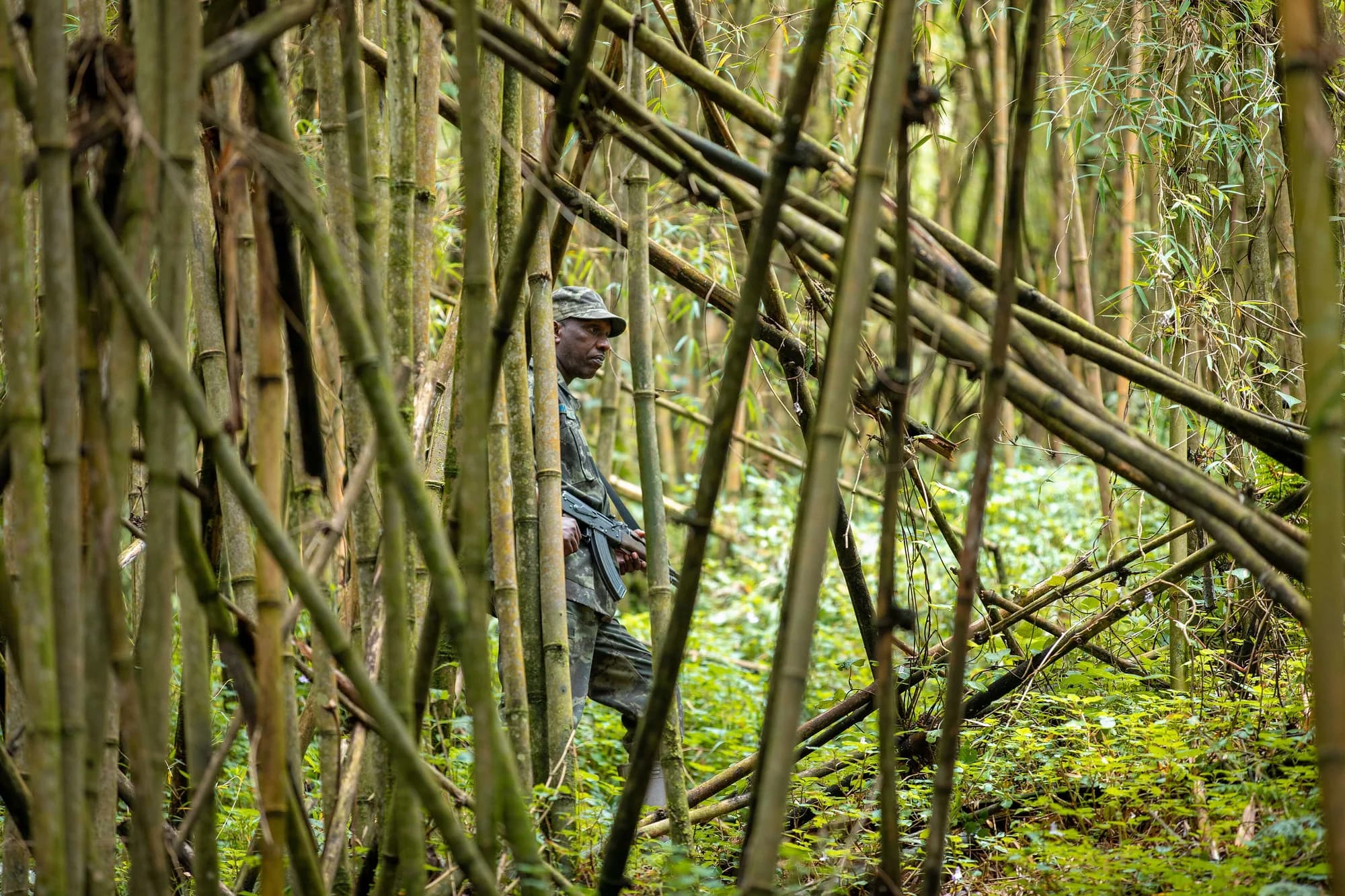
The practical consequence is visibility. Bamboo stands in columns and you can see through it; Bwindi's understory you frequently cannot. Photographers notice within thirty seconds, and it is one of the honest reasons people who have done both pay Rwanda's price a second time. The light is still poor under hagenia and you will still want a fast lens, but you will not spend your hour looking at a shoulder through leaves.
The rules are the same rules
One hour, a maximum of eight visitors per family, minimum age 15, and no tracking with a contagious illness. Gorillas catch human respiratory infections and have died of them, which is why the health rule is a rule and not a courtesy. If you wake up ill on the morning, say so at the briefing.
Rwanda Development Board — Mountain Gorilla Tracking, booking portal
Read 28 September 2026. RDB publishes the price on the same page it sells from — there is no separate printed tariff for Rwanda. The discounted tiers carry a portal footnote stating they are promotional rates and are NOT applicable from June to October 2026.
https://visitrwandabookings.rdb.rw/rdbportal/mountain-gorilla-trackingVisit Rwanda — Gorilla tracking
Read 28 September 2026. The national tourism board's gorilla page. It carries the USD 1,500 permit price, the eight permits issued per troop per day, the strict one-hour limit, the minimum age of 15, and the only official statement we have found of how long the trek itself takes.
https://www.visitrwanda.com/interests/gorilla-tracking/What a family is, and what the hour looks like
A habituated family is a stable social group with a dominant silverback, several adult females, a shifting number of blackbacks and juveniles, and usually an infant or two. Eight permits are issued per troop per day, which is the cap that keeps your group small. The guides will name the family and the silverback at the briefing, and by the end of the hour you will be able to tell several individuals apart, which is not something you expect going in.
- The silverback: enormous, unhurried, and almost entirely uninterested in you. He is the reason the guides watch the group's mood rather than the camera angles.
- Females with infants, which is where most of the movement and all of the noise comes from.
- Juveniles, who are the ones that will break the distance rule on your behalf by walking straight past your knee.
- Blackbacks on the edge of the group, often feeding apart and often the first animal you actually see.
The hour itself is mostly feeding and dozing. Gorillas spend their day eating bamboo shoots and leaves, in a slow circuit, and the drama is that you are three metres from a wild animal the size of a small car that has decided you are furniture. People who arrive expecting chest-beating and charges are the ones who come down disappointed; people who arrive expecting to watch a family have breakfast come down changed.
Visit Rwanda — Gorilla tracking
Read 28 September 2026. The national tourism board's gorilla page. It carries the USD 1,500 permit price, the eight permits issued per troop per day, the strict one-hour limit, the minimum age of 15, and the only official statement we have found of how long the trek itself takes.
https://www.visitrwanda.com/interests/gorilla-tracking/Golden monkeys
The golden monkey is an Albertine Rift endemic, restricted to the bamboo of this mountain chain and almost nowhere else on earth, and Volcanoes has habituated troops you can spend an hour with for USD 100. They are nothing like the gorillas to watch: fast, loud, constantly moving, forty or more animals crashing through bamboo at head height and dropping shoots on you.
Golden monkeys against gorillas, as a morning
| Golden monkeys | Gorillas | |
|---|---|---|
| Fee | USD 100 | USD 1,500 |
| The walk | Lower bamboo, generally shorter | Anything from 30 minutes to four or more hours |
| Time with the animals | One hour | One hour |
| What they do | Move constantly, at speed, above you | Feed and doze, at ground level |
| Photography | Hard — fast animals in dappled bamboo | Easier — slow animals, poor light |
| Who should do it | Almost anyone | Anyone 15 or over who can climb |
Fees are RDB's. The trek range for gorillas is Visit Rwanda's published figure. The rest is our description.
It is the best-value permit in Rwanda
One fifteenth of the gorilla price for a full hour with an endemic primate, on a walk most people find comfortable. It is routinely skipped because visitors budget for the gorillas and then stop thinking about permits, and it is the first thing we would add to any two-night stay.
Rwanda Development Board — Mountain Gorilla Tracking, booking portal
Read 28 September 2026. RDB publishes the price on the same page it sells from — there is no separate printed tariff for Rwanda. The discounted tiers carry a portal footnote stating they are promotional rates and are NOT applicable from June to October 2026.
https://visitrwandabookings.rdb.rw/rdbportal/mountain-gorilla-trackingBirds, and the Albertine Rift
This mountain chain is one of Africa's endemism hotspots, and the birds are a genuine reason to walk slowly on the lower trails rather than a consolation prize. The Rwenzori turaco is the one people come for — crimson-winged, loud, and a real event when it crosses a gap in the canopy. A nature walk permit at USD 55 buys a morning of exactly this, without a primate at the end of it.
- Rwenzori turaco, the headline bird of the Virungas and the reason to look up when something large moves.
- Albertine Rift endemics generally, concentrated in the hagenia zone rather than the bamboo.
- Sunbirds on the lobelias and hypericum, which are the easiest photographs in the park.
- Nyungwe in the south-west is Rwanda's serious birding forest; Volcanoes is the volcanic-slope subset of the same endemic list.
What we could not verify
We publish no species count for Volcanoes. Figures circulate for the park's bird list and for the number of Albertine Rift endemics it holds, and we have not found them on an RDB or Visit Rwanda page. The species named above are the ones we are confident belong here; a number would need a source we do not have.
Buffalo, duiker and the things the guides watch for
Every gorilla group walks with an armed escort and it is not for the gorillas. Buffalo are present throughout this forest, they are the reason the dry-stone wall along the boundary exists, and they are the animal a guide is actually thinking about when he stops the line and listens. A buffalo in thick bamboo at close range is a serious animal, and the escort is a sensible precaution rather than theatre.
- African buffalo, present throughout and largely unseen. Not a sighting you seek out.
- Black-fronted duiker and bushbuck on the trails, usually briefly and usually going away.
- Forest elephant are recorded in the Virungas and are effectively never encountered by visitors.
- Spotted hyena and golden cat exist on the list and belong to camera traps rather than to trekking mornings.
Follow the guide's instructions without discussion
If a guide stops, you stop. If he says move back down the line, you move. The gorillas are habituated and predictable; buffalo in bamboo are neither, and the escort's presence is the clearest signal that this is a working forest rather than a set.
What is not here
There is no savanna game and no big five
No lion, no rhino, no elephant you will see, no plains, no game drives and no waterhole. Volcanoes is a montane forest park you walk in, and a vehicle is only ever transport to a trailhead. Visitors who book Volcanoes expecting a general safari have booked the wrong park.
What they usually wanted is Akagera, on the far side of the country — savanna, lakes and papyrus, with lion reintroduced in 2015 and rhino in 2017, and the only big-five park in Rwanda. It pairs with Volcanoes in a single easy week, and the two together are the strongest argument for a Rwandan trip that is not only about gorillas.
There are no chimpanzees at Volcanoes either. Rwanda's chimpanzees are at Nyungwe in the south-west, in a completely different forest, and the country therefore offers both apes in one small, well-surfaced circuit. That is the direct answer to Uganda's Bwindi-and-Kibale pairing, at a considerably higher price.