
Rwanda / Volcanoes / Zones — Volcanoes
Zones — Volcanoes
Everyone starts in the same car park. Which family you get, and therefore how far and how high you walk, is decided at 07:00 on the morning itself.
There are no zones here
Elsewhere on this site, zones means something administrative: a numbered core zone with a named gate and a jeep quota in India, a trekking sector printed on the permit in Uganda, a block in Yala. Volcanoes has none of that. The park is one continuous forest running up the flanks of five volcanoes, with one visitor information centre at Kinigi, and the only division that matters to you is made fresh every morning by the guides.
That has a consequence worth stating before anything else: you cannot research your way to an easy trek. There is no sector to request, no family to book, no gate that is known to be gentle. What you can do is turn up fit, turn up honest about your fitness, and understand the system well enough to speak up inside it.
Rwanda Development Board — Mountain Gorilla Tracking, booking portal
Read 28 September 2026. RDB publishes the price on the same page it sells from — there is no separate printed tariff for Rwanda. The discounted tiers carry a portal footnote stating they are promotional rates and are NOT applicable from June to October 2026.
https://visitrwandabookings.rdb.rw/rdbportal/mountain-gorilla-trackingThe 07:00 briefing at Kinigi, step by step
Permit holders report to the visitor information centre at Kinigi at 07:00. There is coffee, there are Intore dancers, and behind that there is a real piece of logistics happening. The trackers have been on the mountain since first light and are reporting by radio where each habituated family spent the night and which way it has started moving. The guides are taking that, and the people standing in front of them, and dividing one into the other.
- Permits and passports are checked against the day's list.
- Guides circulate and ask about age, fitness, knees, altitude experience and how much walking you do at home. They watch the answers as much as they listen to them.
- Groups of eight are formed and a family is assigned to each. The trackers' radio reports decide which families are available and roughly where they are.
- A guide briefs his own group: the family's name, its silverback, its size, the rules, and what the walk is likely to involve.
- Everyone drives from the headquarters to the trailhead for their family. This leg is separate from the walk and can be most of an hour on rough track.
- Porters are hired at the trailhead, in cash, before the group sets off.
This takes about an hour and it is not queueing
The briefing is the part of the day most visitors treat as preamble, and it is the part that determines everything else about it. Pay attention, stand near the guides, and answer the fitness questions truthfully rather than optimistically.
Rwanda Development Board — Mountain Gorilla Tracking, booking portal
Read 28 September 2026. RDB publishes the price on the same page it sells from — there is no separate printed tariff for Rwanda. The discounted tiers carry a portal footnote stating they are promotional rates and are NOT applicable from June to October 2026.
https://visitrwandabookings.rdb.rw/rdbportal/mountain-gorilla-trackingHow the allocation actually works
Two things drive it, and neither of them is your preference. The first is where the families are: a group that nested low on the Sabyinyo slopes and has not moved far is a short walk today and might be a long one tomorrow. The second is who is standing in the car park: the guides match the shorter, lower walks to the people who will struggle and the higher, longer ones to the people who look like they will enjoy them.
What moves you up or down the difficulty range
| Factor | Effect on your allocation |
|---|---|
| Where the family nested last night | The dominant factor, and nobody controls it |
| Your stated age and fitness | The main thing the guides act on |
| A declared knee, heart or breathing problem | Moves you to a lower, shorter family |
| Visible hill fitness and proper kit | Makes a longer, higher family more likely |
| Asking, politely, at the briefing | Works in both directions, before groups form |
| Asking after the groups have left | Does nothing at all |
It is a judgement call made in roughly twenty minutes by people who do it every day, and it is usually a good one.
Speak up, in either direction
If you have a knee, a heart, a recent illness or simply no hill fitness, tell a guide at the briefing. They will move you, nobody minds, and it is the routine part of their morning. The same applies in reverse: if you are fit and want the long one, say so. What the guides cannot do is fix it once the groups have split and the vehicles have gone.
The five volcanoes
The park's geography is its volcanoes rather than a grid. Five of the Virunga chain stand on the Rwandan side, in the far north-west of the country, the forest runs up their flanks, and the gorilla families live on those flanks. Where a family is on a given morning is where your day goes, so it is worth knowing the names you will hear at the briefing.
The Rwandan Virungas
| Volcano | What it means for a visitor |
|---|---|
| Karisimbi | The highest of the five at 4,507 m; the two-day climb, with a cold high camp |
| Bisoke | The day climb, to a crater lake on the summit |
| Sabyinyo | The three-country corner — Rwanda, Uganda and the DRC meet on it |
| Gahinga | The smallest of the three shared with Uganda's Mgahinga |
| Muhabura | The eastern cone, and a long steady climb |
Karisimbi's height and the names of the five are from Visit Rwanda's official destination page. The descriptions of each climb are ours. We have not published heights for the other four because that page does not state them.
Karisoke sits in the saddle between Karisimbi and Bisoke, and the camp's name is a contraction of the two. That saddle is the heart of the park's history and the destination of the Fossey hike, and it is why those two mountains come up far more often in conversation than the other three.
Visit Rwanda — Volcanoes National Park
Read 28 September 2026. The official destination page names the five volcanoes and gives Karisimbi's height. It carries no activity prices and no transfer times, which is why the non-gorilla fees on this site come from the booking portal and why we publish no drive time at all.
https://www.visitrwanda.com/destinations/volcanoes-national-park/The ground you will actually walk on
Almost every trek in this park has the same three stages and they are nothing like each other. First, cultivated land: the fields come right up to the boundary, and you walk between potatoes and pyrethrum on a dirt path with the volcano ahead of you. Then the buffalo wall, a low dry-stone boundary built to keep buffalo out of the crops, which you step over — and the park begins on the far side of it, abruptly, with no transition.
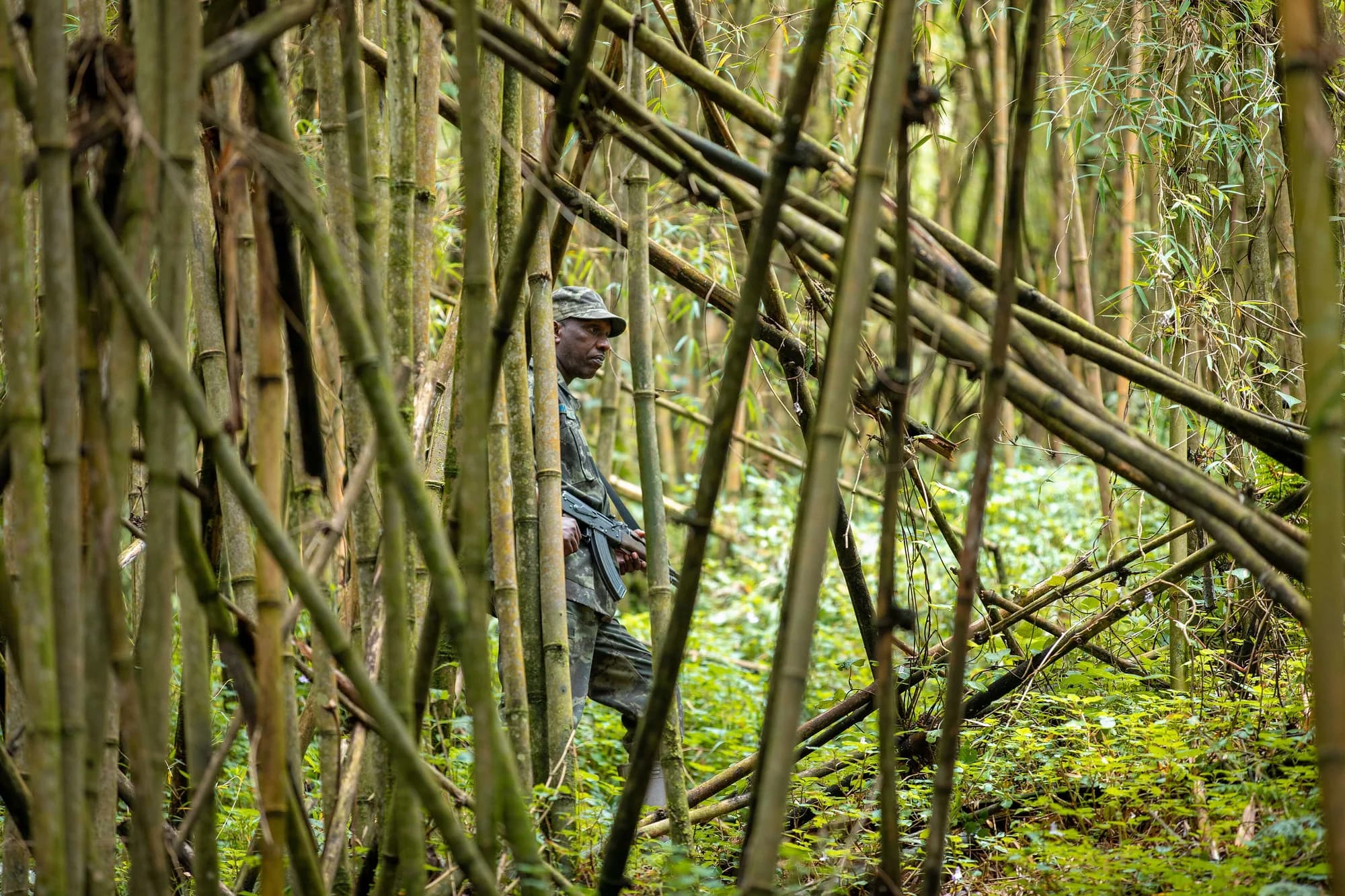
Then the forest, and the gradient. Bamboo first, in open stands that you can see through and that clatter when you push between the stems. Higher, hagenia and hypericum, mossy and dripping and much darker. The soil is volcanic, deep and soft, and when it is wet it holds a boot. There is no path to most families — the guides cut a line through nettles with a machete and you follow it, upward, at altitude.
Nettles, gaiters and the thing nobody warns you about
Stinging nettles are everywhere in this forest and they go straight through thin trousers. Gaiters and gloves are worth more than any other item in your bag, and tucking trousers into socks is not an adequate substitute. Bring them or borrow them; several lodges around Kinigi lend gaiters and walking sticks, though you should not assume yours will.
Visit Rwanda — Gorilla tracking
Read 28 September 2026. The national tourism board's gorilla page. It carries the USD 1,500 permit price, the eight permits issued per troop per day, the strict one-hour limit, the minimum age of 15, and the only official statement we have found of how long the trek itself takes.
https://www.visitrwanda.com/interests/gorilla-tracking/The activities that are not gorillas
What else the park sells, and what the day looks like
| Activity | Fee | The day |
|---|---|---|
| Golden monkey tracking | USD 100 | Lower bamboo, a shorter walk, an hour with a fast and noisy troop |
| Dian Fossey tomb hike | USD 75 | A 30-minute drive from the headquarters, then two to three hours of climbing to the Karisoke site |
| Bisoke crater climb | USD 75 | A full day, steep and usually very muddy, for a lake in a crater |
| Karisimbi | USD 400 | Two days, a night camped high and cold, and the summit of the chain |
| Nature walk | USD 55 | Guided walking without a primate permit |
Fees are RDB's published sale prices. The Fossey hike's drive and walk are Visit Rwanda's published figures. Nothing here includes a porter, and on Bisoke and Karisimbi a porter is close to essential.
If you have one spare morning, the choice is usually between golden monkeys and the Fossey hike, and they are opposite experiences. Golden monkeys is a short walk, an hour of fast bright animals in bamboo and a good-humoured morning that almost anyone can do. The Fossey hike is two to three hours of steady climbing through nettles to a quiet clearing full of graves, and the reward is entirely in what the place is rather than what you see there. Choose the first if you want more wildlife, the second if the history is why you came.
Bisoke against the Fossey hike
Both cost USD 75 and they are not remotely the same day. Bisoke is a hard full-day climb on the muddiest ground in the park to a crater lake that is often in cloud, and it is a real mountain day that will flatten an unprepared walker. The Fossey hike is half of that, on a defined trail, at an altitude most people manage. If you have trekked gorillas the day before, the Fossey hike is the sane choice and Bisoke is the ambitious one.
Visit Rwanda — Gorilla tracking
Read 28 September 2026. The national tourism board's gorilla page. It carries the USD 1,500 permit price, the eight permits issued per troop per day, the strict one-hour limit, the minimum age of 15, and the only official statement we have found of how long the trek itself takes.
https://www.visitrwanda.com/interests/gorilla-tracking/Karisoke, and why this park is known at all
Dian Fossey established the Karisoke Research Center in the saddle between Karisimbi and Bisoke in 1967 and worked there until she was murdered at the camp in December 1985. In the years between, she produced the long-term observation that turned mountain gorillas from a rumour into a studied population, and she campaigned against poaching in terms that made her enemies. The murder has never been satisfactorily resolved.
The camp buildings are gone. What remains on the site is the clearing, her grave, and the graves of gorillas she studied and buried there — including Digit, the young male whose killing by poachers became the event that took her work into the world's newspapers. The hike is a steady climb through nettles to a quiet place, and it is a quiet thing rather than a spectacle.
It is not separable from the permit price
The reason there are gorillas on these slopes to sell an expensive hour with is not separable from the reason there is a grave in that saddle. Rwanda's high-value, low-volume policy is the current chapter of an argument that started at Karisoke, and standing in the clearing is the cheapest way to understand what the USD 1,500 is the end of.