
Rwanda / Volcanoes / Itineraries — Volcanoes
Itineraries — Volcanoes
Two nights is the working minimum and three is better, because the second morning is the only thing standing between USD 1,500 and a head cold.
How long to stay
Shapes that work
| Nights | Shape | For |
|---|---|---|
| 2 | Arrive, trek, leave | The minimum. No margin at all |
| 3 | Arrive, trek, second activity, leave | Golden monkeys or the Fossey hike on the spare morning |
| 3 | Arrive, trek, trek, leave | Two gorilla permits, at a second USD 1,500 |
| 4 | As above plus Bisoke | Walkers, with a full mountain day |
| 5 | As above plus Karisimbi | Karisimbi consumes two of the days and a night |
Every one of these mornings starts at 07:00 at Kinigi, and none of these activities can be doubled up in a single day.
The argument for the third night is not greed, it is insurance. You cannot track with a contagious illness, altitude can flatten someone on their first day off a flight, and a single trekking morning means one chance at the most expensive ticket of the trip. A spare day costs a lodge night. The alternative costs USD 1,500 and is not refundable because you woke up with a cold.
The trekking morning, in order
- Early breakfast, in the dark and the cold, and a drive to Kinigi to report by 07:00.
- Permit and passport checked against the day's list.
- Briefing: coffee, Intore dancers, and the allocation into groups of eight by fitness and by where the trackers say the families slept.
- Your guide briefs your eight: the family's name, its silverback, its size, the rules.
- A drive from the headquarters to your family's trailhead. Short, or most of an hour on rough track.
- Hire a porter at the trailhead, in cash, before you set off — not after you have decided you need one.
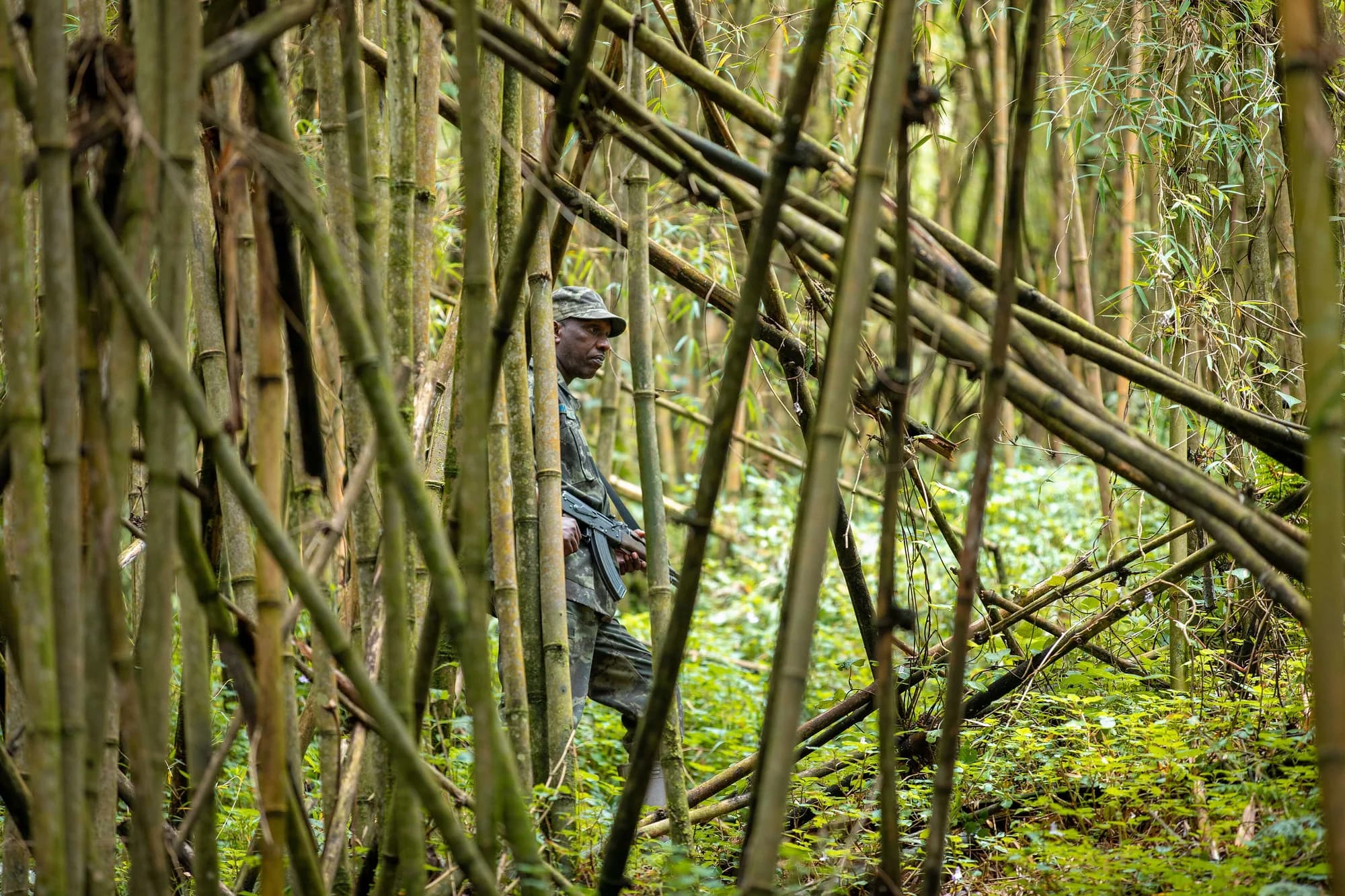
- The walk out: cultivation, over the buffalo wall, then bamboo and hagenia on steep wet ground. From 30 minutes to four or more hours.
- One hour with the family, timed from when the guide says it starts. Bags left with the porters, a few metres back.
- The walk down, which is faster and is where most people fall over.
- Back at the trailhead: pay and tip the porter, and usually receive a certificate at the headquarters.
Plan on being out for the whole day. A short trek gets you back to the lodge for a late lunch; a long one gets you back at four, muddy and finished. Do not schedule the afternoon, do not book a drive to Kigali for that evening, and do not put Bisoke the following morning unless you are a walker.
Visit Rwanda — Gorilla tracking
Read 28 September 2026. The national tourism board's gorilla page. It carries the USD 1,500 permit price, the eight permits issued per troop per day, the strict one-hour limit, the minimum age of 15, and the only official statement we have found of how long the trek itself takes.
https://www.visitrwanda.com/interests/gorilla-tracking/Rwanda Development Board — Mountain Gorilla Tracking, booking portal
Read 28 September 2026. RDB publishes the price on the same page it sells from — there is no separate printed tariff for Rwanda. The discounted tiers carry a portal footnote stating they are promotional rates and are NOT applicable from June to October 2026.
https://visitrwandabookings.rdb.rw/rdbportal/mountain-gorilla-trackingWhat to wear, and why the porter is not about the bag
- Gaiters. The single most useful item, and the one most often left at home. Nettles go straight through thin trousers.
- Gloves — gardening gloves are ideal. You will grab vegetation to stay upright and much of it stings.
- Boots with ankle support and aggressive tread, already worn in. The mud is deep and the gradient is unrelenting.
- A waterproof that actually works, in every month. Layers under it: it is cold at the start, hot on the climb, cold again at the gorillas.
- Long sleeves and long trousers, tucked in. Nothing is gained by bare skin in this forest.
- A small daypack with water, and a dry bag for the camera.
Hire the porter whether or not you need one
He carries the bag, but what you are actually hiring is a hand on the steep muddy sections, a push at altitude, and someone who knows exactly where to put a foot on ground you have never seen. On top of that it is a direct cash payment, decided by you on the day, to someone from a village on the park boundary who has a concrete reason to want the gorillas to stay. The gorilla permit is USD 1,500 and goes to a national agency. The porter is a small fraction of that and goes to the household next to the wall. Hire one.
The spare morning
If you have taken the third night, the second morning is the best-value decision of the trip and there are four real options. They are not interchangeable and the right answer depends on what the gorilla trek left you with.
Choosing the second activity
| Option | Fee | Choose it if |
|---|---|---|
| Golden monkey tracking | USD 100 | You want more wildlife and a comfortable walk. The default, and the best value in the park |
| Dian Fossey tomb hike | USD 75 | The history is why you came. Two to three hours of climbing, a quiet clearing at the end |
| Bisoke crater climb | USD 75 | You are a walker and yesterday did not tire you. A hard full day on the muddiest ground here |
| A second gorilla permit | USD 1,500 | The gorillas are the entire point of the trip and the budget allows it |
Fees are RDB's published sale prices. The Fossey hike timing is Visit Rwanda's. Which one suits you is our judgement.
USD 175 buys two mornings; USD 1,500 buys one
Golden monkeys and the Fossey hike together cost USD 175 and fill two separate days with two entirely different things. A second gorilla permit costs USD 1,500 and repeats the first day with a different family. Both are defensible. But the second gorilla trek is a luxury purchase and the other two are not, and a great many people discover this only after they have spent the money.
The rest of Rwanda
Rwanda is small and well surfaced, which makes a multi-park trip unusually easy to build. Volcanoes is the northern anchor; the other two serious parks sit east and south-west of it, and neither is a gorilla park. The whole circuit is drivable and needs no internal flight.
A full Rwandan circuit
| Nights | Where | Why |
|---|---|---|
| 2–3 | Volcanoes | Gorillas, golden monkeys, the volcanoes themselves |
| 2 | Akagera | Savanna and big-five game; lion since 2015, rhino since 2017 |
| 2–3 | Nyungwe | Montane rainforest, chimpanzees and the canopy walkway |
| 1 | Lake Kivu | Warm, low and restful. Best placed after the mountains |
| 1 | Kigali | The Genocide Memorial, which is not an optional footnote |
Akagera's reintroduction dates are from the park record on this site. Night counts are ours, and no drive times are given.
Volcanoes and Nyungwe together give you both apes in one small country, which is Rwanda's direct answer to Uganda's Bwindi-and-Kibale pairing. If the trip is crossing into Uganda instead, Volcanoes pairs naturally with Mgahinga and with Bwindi's southern sectors, and Kigali is the sensible airport for all three.
What goes wrong with the plan
- Two nights with no spare day, then a cold on the trekking morning. The single most expensive mistake available at this park.
- Landing at Kigali and trekking the next morning, with no acclimatisation and no margin for a delayed flight.
- Booking Bisoke for the morning after the gorillas and discovering that yesterday was already the hard day.
- Bringing a fourteen-year-old. The minimum age is 15 and it is absolute — plan a separate morning for them before you travel, not at the briefing.
- Turning up in trainers and jeans in April, which is a decision you will regret within twenty minutes of the buffalo wall.
- Assuming you can request a specific family. You cannot; the allocation happens at 07:00 on the day.
- Scheduling the drive back to Kigali for the trekking afternoon. A long trek gets you back at four, finished.
One rule covers most of this
Protect the trekking morning. Everything else on a Volcanoes trip is cheap, flexible and replaceable, and that one morning is neither cheap nor repeatable. Build the itinerary outward from it.