
South Africa / Addo Elephant / Best time to visit — Addo Elephant
Best time to visit — Addo Elephant
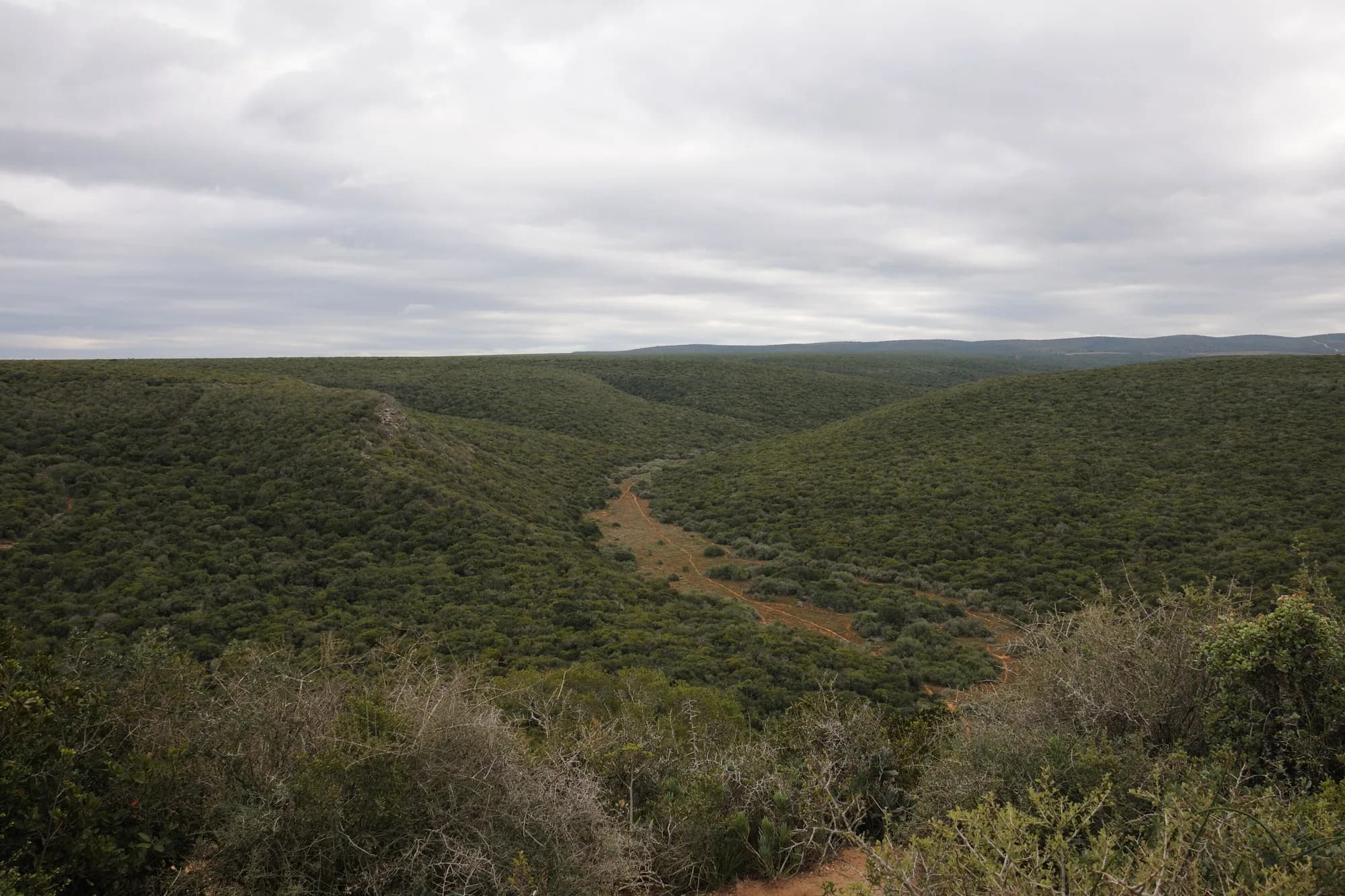
Most parks on this site have one right answer about when to come, and it is the dry season. Addo does not, and the reason is in the vegetation rather than in the rainfall chart.
Why the dry-season argument does not work here
The standard logic runs: in the dry season the seasonal water disappears, the animals are forced onto permanent waterholes, and you sit at one and wait. It is why Etosha is a June-to-October park and why Kruger's winter is better than its summer. Addo's thicket does not behave that way. Gough and Kerley, examining Addo's long-term elephant data, describe the habitat as aseasonal succulent thicket in which elephants can use accumulated vegetation biomass — a system whose resources are not seasonally limited. That is the technical reason there is no month when the park suddenly concentrates.
The practical consequence is liberating. There is no bad month at Addo in the way there is a bad month at Etosha. The elephant population is dense enough in a small enough area that the animals are findable in February as well as in August. What the calendar changes at Addo is heat, rain, daylight, and how many other cars are on the road — not whether the park works.
This is the single biggest difference from Kruger
A Kruger trip planned for January is a compromise and everyone knows it. An Addo trip planned for January is just an Addo trip in the heat. If your dates are fixed by school terms or by a flight, that is a genuine reason to choose Addo, and it is a better reason than most of the ones usually given.
Gough & Kerley (2006), Demography and population dynamics in the elephants Loxodonta africana of Addo Elephant National Park, South Africa: is there evidence of density dependent regulation?, Oryx 40, 434-441
Abstract read 28 September 2026 via Crossref. Estimated carrying capacity 0.1 to 0.5 elephants per square kilometre against stocking rates that have been as high as 4 per square kilometre; population growth rate positively correlated with increasing density; mean inter-calf interval 3.3 years; no evidence of density dependent regulation, which the authors attribute to the aseasonal succulent thicket and the elephants' ability to use accumulated vegetation biomass. This is the paper that explains, in one sentence, why Addo looks the way it does.
https://doi.org/10.1017/s0030605306001189What the gate times tell you about the shape of the year
Addo does not publish a high and low wildlife season, but it does publish a gate calendar, and the gate calendar is the closest thing to an official statement about the year that we could read. It splits the year in two and the split is about daylight rather than about game.
Game gate times by month, as the park's map prints them
| Months | Open | Close | Usable daylight in the park |
|---|---|---|---|
| October to March | 05h30 | 18h30 | 13 hours |
| April to September | 06h00 | 18h00 | 12 hours |
The map lists all twelve months individually and they resolve to these two blocks: January, February, March, October, November and December at 05h30 to 18h30, and April through September at 06h00 to 18h00. It also carries the warning "Check the closing times thoroughly — you may not drive after stipulated times!" These are 2016 figures from a 2016 document and should be confirmed at the gate.
An extra hour of open gate in summer sounds minor and is not. The productive hours at Addo are the first two and the last two, and the summer calendar gives you a 05h30 start — which means being at a waterhole before the heat rather than driving towards one. In winter you are starting at 06h00 into a colder, shorter day, and the middle of it is far more comfortable than a summer middle.
SANParks — Addo Elephant National Park visitor's map
Read 28 September 2026. The park's own printed visitor map, hosted by Nelson Mandela Bay Tourism because sanparks.org was unreachable. The file's embedded metadata gives a creation date of 12 August 2016, so it is a decade old and everything on it — gate times, distances, contact numbers, what exists at which camp — should be treated as needing confirmation. It is nonetheless the only document we could reach that carries game gate times by month, the internal speed limit, the park rules, the section-by-section activity lists and the camp-to-camp distances, and it is the park's own. It describes the larger marine protected area as proposed, which is consistent with a 2016 date; the area was declared in 2019.
https://www.nmbt.co.za/uploads/1/files/doc_addo_elephant_national_park_map.pdfThe year, month by month
What each part of the year is actually like
| Months | Conditions | What it changes | Crowding |
|---|---|---|---|
| December to January | Hot, long days, summer gate hours | Early starts are easy; the middle of the day is for the camp pool | The South African summer holidays — the busiest weeks of the year |
| February to March | Still hot, the heat easing through March | Summer gate hours without the holiday traffic | Moderate |
| April to May | Mild, shorter days, winter gate hours begin | Comfortable all day; the most pleasant driving of the year | Quiet outside the Easter break |
| June to August | Cool to cold mornings, mild days, clear | You want a jacket at 06h00 and not at 11h00 | Quiet, apart from the June and July school holidays |
| September to November | Warming, days lengthening, summer hours from October | The gate reopens at 05h30 in October and the long days come back | Moderate, rising into December |
The gate hours column is sourced to the park's map. Everything else in this table is our reading of the Eastern Cape's seasons rather than a departmental statement, and we have deliberately not printed rainfall or temperature figures, because we could not source a station record for the park.
SANParks — Addo Elephant National Park visitor's map
Read 28 September 2026. The park's own printed visitor map, hosted by Nelson Mandela Bay Tourism because sanparks.org was unreachable. The file's embedded metadata gives a creation date of 12 August 2016, so it is a decade old and everything on it — gate times, distances, contact numbers, what exists at which camp — should be treated as needing confirmation. It is nonetheless the only document we could reach that carries game gate times by month, the internal speed limit, the park rules, the section-by-section activity lists and the camp-to-camp distances, and it is the park's own. It describes the larger marine protected area as proposed, which is consistent with a 2016 date; the area was declared in 2019.
https://www.nmbt.co.za/uploads/1/files/doc_addo_elephant_national_park_map.pdfThe South African school holidays are the real calendar
Because there is no wildlife season, the thing that actually varies across the Addo year is how many people are in the park. Addo is 72 km from a city of over a million people, it is on the Garden Route, and it is malaria-free, which makes it the default family destination for the whole Eastern Cape. The December and January holidays are the peak, the Easter break and the June and July holidays are secondary peaks, and the rest of the year is comparatively empty.
- If you can choose, choose a shoulder month. February, March, May, September and November give you the same park with fewer cars at the waterhole.
- If you cannot choose, go early. The first ninety minutes after the gate opens are quiet in every month of the year, including the last week of December.
- The Main Game Area is compact, which is exactly why crowding shows. Twenty cars in Kruger is invisible; twenty cars at one Addo waterhole is a queue.
- Camps fill on the domestic holiday calendar rather than on a wildlife calendar. That is a different booking rhythm from Kruger's and it favours anyone with flexible dates.
Malaria: the one thing with no season here at all
This is the fact that decides more Addo trips than any other, and it is worth stating precisely rather than as a slogan. The CDC's 2026 Yellow Book names the malaria risk areas in South Africa as the Mopani and Vhembe districts of Limpopo, the Ehlanzeni district of Mpumalanga, and the uMkhanyakude district of KwaZulu-Natal, and adds that Kruger National Park is considered endemic for malaria with seasonal transmission. Addo is in the Eastern Cape, which appears nowhere in that list.
What that changes for a family, in practice
| Decision | At Kruger | At Addo |
|---|---|---|
| Chemoprophylaxis | Recommended by CDC at all times of year for the endemic area | Not a question that arises for the Eastern Cape |
| Travelling with a small child | A conversation with a travel clinic about which drug and what dose | No conversation |
| Travelling while pregnant | A genuine constraint | Not a malaria constraint |
| Evening outdoors | Covered arms, repellent, the whole routine | Ordinary |
| Season | Transmission is seasonal, which makes winter the lower-risk half | There is no season to plan around |
The malaria risk areas and Kruger's endemic status are the CDC's; the rest of this table is the practical consequence of them and is our framing. Malaria is not the only health question a traveller has, and this table is not medical advice — it is the one comparison that changes which park people book.
Why this belongs on the timing page and not just the wildlife page
Because at a malaria park the season is part of the risk calculation, and at Addo it is not. Take the malaria question out of the diary and the only things left to plan around are the heat, the daylight and the school holidays — which is why an Addo trip can be built around a school term, a cheap flight or a wedding, and a Kruger trip usually cannot.
CDC Yellow Book 2026 — South Africa, travel-associated infections
Read 28 September 2026; the page carries a publication date of 16 April 2025 for the 2026 edition. On malaria it names the risk areas precisely: "Plasmodium falciparum malaria occurs along the borders with Zimbabwe and Mozambique in the Mopani and Vhembe Districts of Limpopo Province; in the Ehlanzeni District of Mpumalanga Province; and in the uMkhanyakude District of KwaZulu-Natal Province." It adds that "Kruger National Park spans 2 provinces, Mpumalanga and Limpopo, and is considered endemic for malaria with seasonal transmission." The Eastern Cape appears nowhere in that list.
https://www.cdc.gov/yellow-book/hcp/africa-middle-east/south-africa.htmlWhat we could not verify
The whale season, which we are not going to invent
Southern right whale is half of Addo's claim to a marine Big Seven, and the obvious question is which months. We could not source an answer we are willing to print. The park's map gives no season. The marine protected area declaration is a legal instrument and gives none. An open-access habitat paper we tried to read returned HTTP 401. Southern right whales are seasonal visitors to the South African coast and Algoa Bay is one of the places they use, but the specific months for this bay, from a source we actually read, we do not have. Ask a licensed operator in Gqeberha, because they are the people whose season it is.
- No monthly rainfall or temperature figures for the park, because we found no station record we could attribute.
- No visitor numbers by month, because SANParks' annual report lives on a site we could not reach.
- No statement from SANParks about a best game-viewing season at Addo, because there appears not to be one and because we could not read the park's own pages to confirm that.
- No current gate times. The times on this page are from a document created in August 2016.