
South Africa / Addo Elephant / Wildlife — Addo Elephant
Wildlife — Addo Elephant
Addo is a park built around one species and one number. Everything else here — the dung beetle with right of way, the thicket, the Big Seven marketing — follows from what happened to the elephants after 1931.
The bottleneck, and what it produced
Addo Elephant National Park was created in 1931 to protect the last of a hunted-out elephant population, on 2,270 hectares. Whitehouse and Hall-Martin's reconstruction of that population, published in Oryx in 2000, traced it from the park's creation to the late 1990s using photographic identification — elephants can be identified throughout their lives by facial wrinkle patterns and the blood-vessel patterns in their ears, both of which are unique and do not change. The paper states that at the time of writing every elephant living in the park was known individually. That is not a claim any other elephant population of comparable size can make.
What grew out of that founding group is the reason Addo is the one park on this site where the headline animal is close to a certainty. Gough and Kerley, working on the same long-term dataset, put the estimated carrying capacity at 0.1 to 0.5 elephants per square kilometre and note that stocking rates at Addo have been as high as 4 per square kilometre — up to forty times the estimated capacity. They found the population's growth rate rose with density rather than falling, no evidence of density-dependent regulation at all, low juvenile mortality, and a mean interval between calves of 3.3 years.
Why that matters to you, standing at a waterhole
Because a population growing without density-dependent brakes in a small fenced area is a population you will meet. At Etosha you sit at water and wait to see what the dry season pushes in. At Addo the arithmetic has already been done for you: there are more elephants per hectare than the thicket is thought able to support, and they are in front of you. The corollary — that this is a management problem as much as a wildlife spectacle — is on the record in the same paper, which found a loss of phytomass and biodiversity alongside the growth.
Whitehouse & Hall-Martin (2000), Elephants in Addo Elephant National Park, South Africa: reconstruction of the population's history, Oryx 34, 46-55
Bibliographic record and abstract read 28 September 2026 via Crossref. The paper reconstructs the Addo elephant population from the creation of the park in 1931 to the late 1990s, using photographic identification of facial wrinkle and ear blood-vessel patterns, and states that every elephant then living in the park was known individually. We read the abstract, not the full text, and have not printed any figure from the body of the paper.
https://doi.org/10.1046/j.1365-3008.2000.00093.xGough & Kerley (2006), Demography and population dynamics in the elephants Loxodonta africana of Addo Elephant National Park, South Africa: is there evidence of density dependent regulation?, Oryx 40, 434-441
Abstract read 28 September 2026 via Crossref. Estimated carrying capacity 0.1 to 0.5 elephants per square kilometre against stocking rates that have been as high as 4 per square kilometre; population growth rate positively correlated with increasing density; mean inter-calf interval 3.3 years; no evidence of density dependent regulation, which the authors attribute to the aseasonal succulent thicket and the elephants' ability to use accumulated vegetation biomass. This is the paper that explains, in one sentence, why Addo looks the way it does.
https://doi.org/10.1017/s0030605306001189Every elephant figure we can source, with its year
Addo's elephant number is quoted everywhere and dated almost nowhere. It is a growing population in a park that has repeatedly grown around it, so a figure without a year attached is worse than no figure. Here is every one we could trace to a document we read, with what kind of claim it is.
Published figures, and what each one actually says
| Figure | What it is | Source and vintage |
|---|---|---|
| Park created 1931 | The date the population reconstruction starts from | Whitehouse & Hall-Martin, Oryx 2000 |
| 2,270 hectares | The area the park was originally proclaimed on | GEF publication, written around 2011-12 |
| Over 550 elephants | A descriptive figure for the park's wildlife at the time of writing | GEF publication, reporting a project that ended in March 2010 |
| Up to 4 elephants per square kilometre | A peak stocking rate from the long-term dataset, against an estimated capacity of 0.1 to 0.5 | Gough & Kerley, Oryx 2006 |
| 2,700 | A proposed target population for elephant in the enlarged park, modelled as being reached in 2043 | Woodd, Koedoe 1999 |
None of these is a current count. The most recent of them describes a park as it stood around 2010, sixteen years ago, in a population with a 3.3-year calving interval and no density-dependent brake.
We do not publish a current elephant number
SANParks counts its elephants and reports the figure; that report lives on sanparks.org, which returned HTTP 403 and HTTP 522 to every request on the day this page was written. Rather than round up a decade-old figure or borrow one from a tour operator, we are saying plainly: the current Addo elephant population is a number we could not source on 28 September 2026. What we can tell you, sourced, is that the population had no evidence of density-dependent regulation as of 2006, that it was described as over 550 around 2010, and that a 1999 model put the enlarged park's target at 2,700 by 2043.
Global Environment Facility — Addo Elephant National Park: From Planning to the Implementation of a Successful Conservation and Socio-Economic Model
Read 28 September 2026. A retrospective on the GEF-funded Greater Addo project, written with SANParks and the World Bank and reporting results to the project's end in March 2010. The publication carries no cover date; internally it describes the park as "originally proclaimed 80 years ago", which places the writing around 2011 or 2012. Every figure taken from it on this page is labelled with that vintage, because a 2012 number about a growing park is not a 2026 number.
https://www.thegef.org/sites/default/files/publications/AENP-web_0.pdfWoodd (1999), A demographic model to predict future growth of the Addo elephant population, Koedoe
Abstract read 28 September 2026 on Koedoe's own site; the article PDF is a scan without a text layer, so we read the abstract only. It gives the proposed target population for elephant within the enlarged park as 2,700 and models that figure being reached in 2043.
https://koedoe.co.za/index.php/koedoe/article/view/226The flightless dung beetle, which has right of way
The road signs at Addo asking you not to drive over elephant dung are not a joke and are not a conservation gesture aimed at tidiness. The park's own map prints the instruction and the reason together: "Do not drive over elephant dung. The dung is used by the ENDANGERED, ENDEMIC FLIGHTLESS DUNG BEETLE for food and reproduction." A beetle that cannot fly cannot get out of the way of a tyre, and a dung pat on a game road is where it feeds and breeds.
- Endemic means it is found here and in a handful of neighbouring thicket patches and nowhere else on earth. Driving around a dung pat is a small thing that is actually doing something.
- The park's own sightings game on the back of the visitor map scores a flightless dung beetle at 8 points — the same as a Cape grysbok or a Cape bulbul, and more than an elephant at 4. That is a deliberate piece of interpretation and it is the right instinct.
- The practical version: if the dung is fresh and there is a beetle on it, it is worth stopping for. A dung beetle rolling a ball across a road is one of the better ten minutes of an Addo day and nobody photographs it.
- This is the only park on this site where an invertebrate is a headline species, and Addo's park record on this site lists it alongside the elephant, buffalo, black rhino, lion and spotted hyena for exactly that reason.
SANParks — Addo Elephant National Park visitor's map
Read 28 September 2026. The park's own printed visitor map, hosted by Nelson Mandela Bay Tourism because sanparks.org was unreachable. The file's embedded metadata gives a creation date of 12 August 2016, so it is a decade old and everything on it — gate times, distances, contact numbers, what exists at which camp — should be treated as needing confirmation. It is nonetheless the only document we could reach that carries game gate times by month, the internal speed limit, the park rules, the section-by-section activity lists and the camp-to-camp distances, and it is the park's own. It describes the larger marine protected area as proposed, which is consistent with a 2016 date; the area was declared in 2019.
https://www.nmbt.co.za/uploads/1/files/doc_addo_elephant_national_park_map.pdfThe Big Five on land, and what else is here
The GEF account of the park describes it as holding elephants, lions and leopards, spotted hyaenas, black rhinos, buffalo, antelopes and zebras. That is the land half of the Big Seven claim and it is a real list — but the five are not equally available to a visitor, and the honest ordering is very different from the marketing ordering.
The land five, ordered by how likely you are to see one
| Species | Realistically | Where |
|---|---|---|
| Elephant | Near-certain, repeatedly, from your own car | Main game area, at the waterholes and on the roads |
| Buffalo | Likely over two or three days | Main game area; the Nyathi section overlooks a waterhole used by both |
| Black rhino | Possible, not likely, and not something to plan around | Main game area; we publish no population figure |
| Lion | Possible; thick thicket is very good at hiding a lion | Main game area; scored at 8 points on the park's own sightings game |
| Leopard | Unlikely, as everywhere | Scored at 10 points on the park's sightings game, alongside aardvark and aardwolf |
The park's visitor map scores its sightings game by difficulty — kudu and warthog at 1 point, elephant at 4, lion at 8, leopard and aardvark at 10 — and that scale is a better guide to what is hard to see here than any strike-rate claim. The species list is the GEF publication's.
The list of what else the map expects you to look for is more interesting than the Big Five and is where Addo's thicket earns its reputation: kudu, Burchell's zebra, red hartebeest, bushbuck, eland, warthog, common duiker, Cape grysbok, black-backed jackal, yellow mongoose, scrub hare, bat-eared fox, caracal, meerkat, honey badger, porcupine, leopard tortoise, rock monitor and puff adder. The night drive list adds African wild cat, striped polecat, hedgehog, springhare, barn owl, nightjar, spotted eagle owl and spotted thick-knee.
Global Environment Facility — Addo Elephant National Park: From Planning to the Implementation of a Successful Conservation and Socio-Economic Model
Read 28 September 2026. A retrospective on the GEF-funded Greater Addo project, written with SANParks and the World Bank and reporting results to the project's end in March 2010. The publication carries no cover date; internally it describes the park as "originally proclaimed 80 years ago", which places the writing around 2011 or 2012. Every figure taken from it on this page is labelled with that vintage, because a 2012 number about a growing park is not a 2026 number.
https://www.thegef.org/sites/default/files/publications/AENP-web_0.pdfSANParks — Addo Elephant National Park visitor's map
Read 28 September 2026. The park's own printed visitor map, hosted by Nelson Mandela Bay Tourism because sanparks.org was unreachable. The file's embedded metadata gives a creation date of 12 August 2016, so it is a decade old and everything on it — gate times, distances, contact numbers, what exists at which camp — should be treated as needing confirmation. It is nonetheless the only document we could reach that carries game gate times by month, the internal speed limit, the park rules, the section-by-section activity lists and the camp-to-camp distances, and it is the park's own. It describes the larger marine protected area as proposed, which is consistent with a 2016 date; the area was declared in 2019.
https://www.nmbt.co.za/uploads/1/files/doc_addo_elephant_national_park_map.pdfThe Big Seven, honestly
The claim is real and it has a real source. The GEF publication states that the park's expansion, and the reintroduction of key large species, "resulted in the park now holding the title of the world's first 'Big Seven' conservation area, home to elephants, lions, rhinos, buffalos and leopards, plus the southern right whale and the great white shark". The reason it can say that is legal and geographic: the park includes a marine protected area over Algoa Bay, and those two animals live in it.
The caveat is not a quibble, and the park itself supplies it. Its own visitor map states that trips to Bird Island are not offered to visitors because of the ecological sensitivity of the islands, and that whale watching boat trips are offered only by private licensed operators in Port Elizabeth and not by the park. So the two marine members of the Big Seven are in a section with no gate, no road and no park-run access, and seeing either of them means chartering a boat from a commercial operator in the city — on their schedule, at their price, with no guarantee, and in the whale's case in a season we could not source. What we would tell a reader who came for the Big Seven is this: come for the elephants, which are the best in Africa for sheer reliability, and treat the marine section as a second, separate, city-based day out that may or may not happen. If the boat trip matters to you, book it with a Gqeberha operator as its own thing, and do not assume the park has anything to do with it — because the park's own map says it does not.
The Big Seven as a visitor actually experiences it
| Member | Where it lives | How you would see it |
|---|---|---|
| Elephant | Main game area | Your own car, on the first afternoon |
| Buffalo | Main game area | Your own car, over a couple of days |
| Black rhino | Main game area | Your own car, with luck |
| Lion | Main game area | Your own car or a guided drive, with luck |
| Leopard | Main game area | Realistically, not at all |
| Southern right whale | The marine protected area, Algoa Bay | A private licensed operator's boat from Gqeberha, seasonally |
| Great white shark | The marine protected area, Algoa Bay | Not something the park offers in any form |
Five in one section from a hire car; two in a section that is closed to visitors, on a boat the park does not run. The claim is true as a statement about what the protected area contains. It is not a statement about what a four-day trip delivers, and it is routinely quoted as though it were.
Global Environment Facility — Addo Elephant National Park: From Planning to the Implementation of a Successful Conservation and Socio-Economic Model
Read 28 September 2026. A retrospective on the GEF-funded Greater Addo project, written with SANParks and the World Bank and reporting results to the project's end in March 2010. The publication carries no cover date; internally it describes the park as "originally proclaimed 80 years ago", which places the writing around 2011 or 2012. Every figure taken from it on this page is labelled with that vintage, because a 2012 number about a growing park is not a 2026 number.
https://www.thegef.org/sites/default/files/publications/AENP-web_0.pdfSANParks — Addo Elephant National Park visitor's map
Read 28 September 2026. The park's own printed visitor map, hosted by Nelson Mandela Bay Tourism because sanparks.org was unreachable. The file's embedded metadata gives a creation date of 12 August 2016, so it is a decade old and everything on it — gate times, distances, contact numbers, what exists at which camp — should be treated as needing confirmation. It is nonetheless the only document we could reach that carries game gate times by month, the internal speed limit, the park rules, the section-by-section activity lists and the camp-to-camp distances, and it is the park's own. It describes the larger marine protected area as proposed, which is consistent with a 2016 date; the area was declared in 2019.
https://www.nmbt.co.za/uploads/1/files/doc_addo_elephant_national_park_map.pdfFive biomes, and the birds that come with them
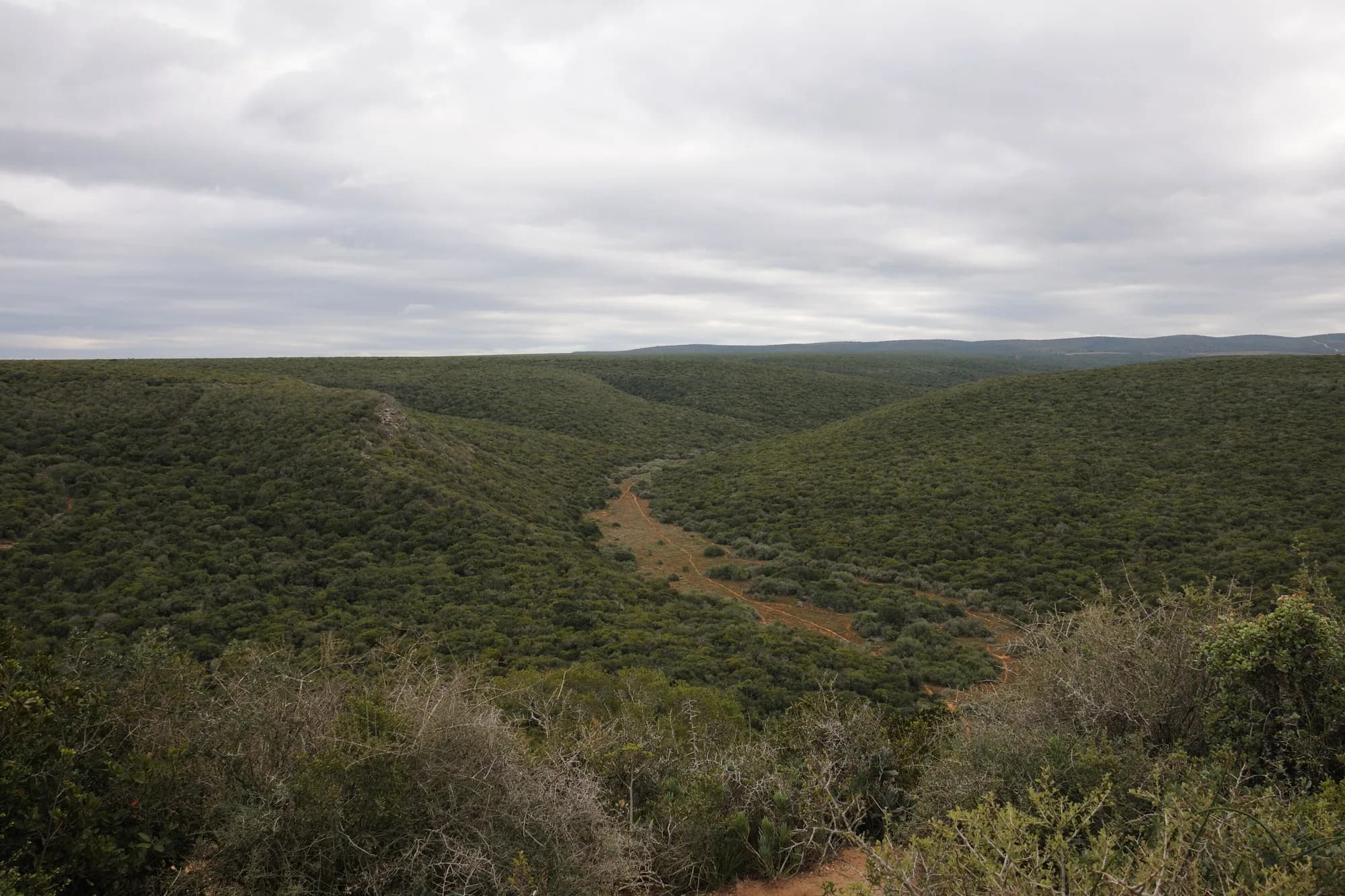
Addo's other real distinction is that it is not one habitat. The GEF publication describes the park as containing five of South Africa's nine terrestrial biomes — thicket, forest, fynbos, nama-karoo and Indian Ocean coastal belt — with grassland elements also present, across marine and coastal zones as well. That is what the assembly of separate sections bought: the Zuurberg is fynbos and grassland, Darlington is karoo, Woody Cape is forest and dune, the main game area is subtropical thicket.
The park's map attaches the same line to almost every section — "experience birds across all five biomes" — and points birders at the Sasol Bird Hide in the main camp area. The map's own sightings game scores secretary bird and blue crane at 10 points each, redbilled oxpecker at 10, red bishop and Cape batis and Cape bulbul at 8, greater double-collared sunbird at 6, and bokmakierie at 4, which is a reasonable snapshot of what the thicket holds and how hard each is.
The Albany centre of plant endemism sits in the thicket biome here, and the GEF account notes it has some of the highest levels of plant endemism per square kilometre seen anywhere. Spekboom — the succulent that gives one of the lookout points and one of the camps its name — is the plant that does most of the work in that system, and the 500-hectare botanical reserve around Jack's Picnic Site exists specifically to measure what the elephants are doing to it.
Global Environment Facility — Addo Elephant National Park: From Planning to the Implementation of a Successful Conservation and Socio-Economic Model
Read 28 September 2026. A retrospective on the GEF-funded Greater Addo project, written with SANParks and the World Bank and reporting results to the project's end in March 2010. The publication carries no cover date; internally it describes the park as "originally proclaimed 80 years ago", which places the writing around 2011 or 2012. Every figure taken from it on this page is labelled with that vintage, because a 2012 number about a growing park is not a 2026 number.
https://www.thegef.org/sites/default/files/publications/AENP-web_0.pdfSANParks — Addo Elephant National Park visitor's map
Read 28 September 2026. The park's own printed visitor map, hosted by Nelson Mandela Bay Tourism because sanparks.org was unreachable. The file's embedded metadata gives a creation date of 12 August 2016, so it is a decade old and everything on it — gate times, distances, contact numbers, what exists at which camp — should be treated as needing confirmation. It is nonetheless the only document we could reach that carries game gate times by month, the internal speed limit, the park rules, the section-by-section activity lists and the camp-to-camp distances, and it is the park's own. It describes the larger marine protected area as proposed, which is consistent with a 2016 date; the area was declared in 2019.
https://www.nmbt.co.za/uploads/1/files/doc_addo_elephant_national_park_map.pdfWhat we could not verify
The numbers we deliberately left blank
There is no current elephant count on this page, no lion population, no black rhino population and no date for when lion were returned to the park, because sanparks.org was unreachable on 28 September 2026 and none of those figures appears in any document we could read. Black rhino numbers in particular are a figure that conservation authorities often withhold deliberately, and we would not publish one for a South African park even if we had it from a secondary source.
- No current population figure for any species at Addo.
- No date for the reintroduction of lion, spotted hyena or any other predator.
- No current seabird counts. The 120,000 Cape gannets on Bird Island and the 6,500 African penguin breeding pairs on St Croix are 2016 figures from a document that itself reports a 70% penguin decline since 2004.
- No whale season, for the reason set out on the best time to visit page.
- No species checklist. The map says a bird list is available on request at reception, which is where to get one.