
Species · Colobus guereza
Black-and-white colobus
The monkey with no thumbs and a white cape, and the one people photograph most on a forest trek without ever learning its name. A troop leaping between crowns with the mantle streaming is the best thing that happens on a gorilla trek that is not the gorillas.
Also called
- Mbega mweupe · Swahili
- Enkende · Rukiga
Checked 28 Sept 2026
- Where
- Kenya, Uganda, Rwanda, Tanzania
- Best months
- Year-round; drier months for walking
- Diet
- Leaves — a ruminant-like gut
- Odds
- High in the right forest
Forest across equatorial Africa from Nigeria to Ethiopia and south into Tanzania. The guereza is one of several black-and-white colobus species; the Angolan colobus of the Kenyan coast and Rwanda is a different animal with a shaggier cape.
Where it is
HabitatMontane and riverine forest, from lowland gallery strips to well above 3,000 m. Unlike most monkeys it is a specialist leaf-eater, which lets it live at densities and altitudes fruit-eaters cannot.
Worth travelling for
Kibale has thirteen primate species and this is the easiest of them; also common in Bwindi and on Mount Elgon.
Nyungwe holds troops of several hundred — among the largest colobus groups recorded anywhere.
Kakamega forest and the Aberdare highlands, where they are easy to watch from a track.
The forest on Kilimanjaro and Mount Meru, seen on the way up rather than as a destination.
Also occurs
EthiopiaCameroonNigeriaChadDR Congo
Present, but not where you would go to see one.
Where to actually go
Ranked, with the reason each — these are not interchangeable.
- 01NyungweRwandaTroops of several hundred — among the largest recorded anywhere — and a canopy walkway that puts you level with them.The canopy walkway
- 02KibaleUgandaThirteen primate species in one forest, and this is the easiest and most visible of them.Easiest of the thirteen
- 03KakamegaKenyaKenya's only tract of Guineo-Congolian rainforest, walkable on marked trails, with colobus throughout.Kenya's forest outlier
- 04AberdareKenyaHighland forest where they are regularly seen from the road, unusually for a canopy animal.Visible from a vehicle
- 05ArushaTanzaniaAn easy half-day from the airport, with colobus in the forest around the Ngurdoto crater.The spare-day option
Where you will not see one
- The savanna parksThe Serengeti, the Mara, Kruger, Etosha — none. This is a forest canopy animal and it does not come down.
- On the groundColobus are almost entirely arboreal. If a black-and-white monkey is walking around your picnic site it is a vervet or a baboon.
When to go
When to go
- J
- F
- M
- A
- M
- J
- J
- A
- S
- O
- N
- D
January: good. February: good. March: good. April: marginal. May: marginal. June: best. July: best. August: best. September: good. October: marginal. November: marginal. December: good.
Through the day
- Dawn
- Morning
- Midday
- Afternoon
- Dusk
- Night
Dawn: active. Morning: most active. Midday: usually resting. Afternoon: active. Dusk: active. Night: not normally seen.
What it looks like in the field
Photographs of Black-and-white colobus in the wild, in Indian reserves. We publish no captive, baited or digitally composited images, and no photograph whose licence we cannot show.
The missing thumb
Colobus have no thumb — the name comes from the Greek kolobos, mutilated or docked. What looks like a handicap is the adaptation: the four remaining fingers work as a hook, and a hook is faster and more secure than a grip when you are swinging through branches at speed.
The other specialisation is internal. Colobus eat leaves, which almost no other monkey can live on, and they digest them in a complex multi-chambered stomach with fermenting bacteria — functionally the same solution a cow uses. It lets them occupy forest that fruit-eating monkeys cannot, and it is why they rest so much.
Born white
An infant colobus is pure white for its first weeks and is passed around the troop constantly — females other than the mother carry it, which is unusual and makes a newborn the easiest thing to spot in a canopy. It darkens to adult black-and-white over a couple of months.
Status and protection
Status and protection
- IUCN Red List
- Pending
- Population trend
- · Unknown
Not yet verified against the source. These four values are written from knowledge and are awaiting a checked IUCN assessment, schedule and appendix — treat them as indicative until this line disappears.
Assessed not yet retrieved
What to book to see one
What you would be booking
- How it is seen
- Any forest walk or chimp trek. No permit of its own — you see them while looking for something else.
- Drives to book
- None needed. A half-day forest walk at Kibale or Nyungwe is enough.
- Zone or shift
- Kibale's main trail network; Nyungwe's canopy walkway, which puts you level with them rather than under them.
Nyungwe's canopy walkway is the one place on this site where you look across at colobus instead of up at them, and it changes the sighting completely. Book it as a separate activity.
NyungweOn the same trip you would also get
- Blue monkey — the same canopy, often the same tree
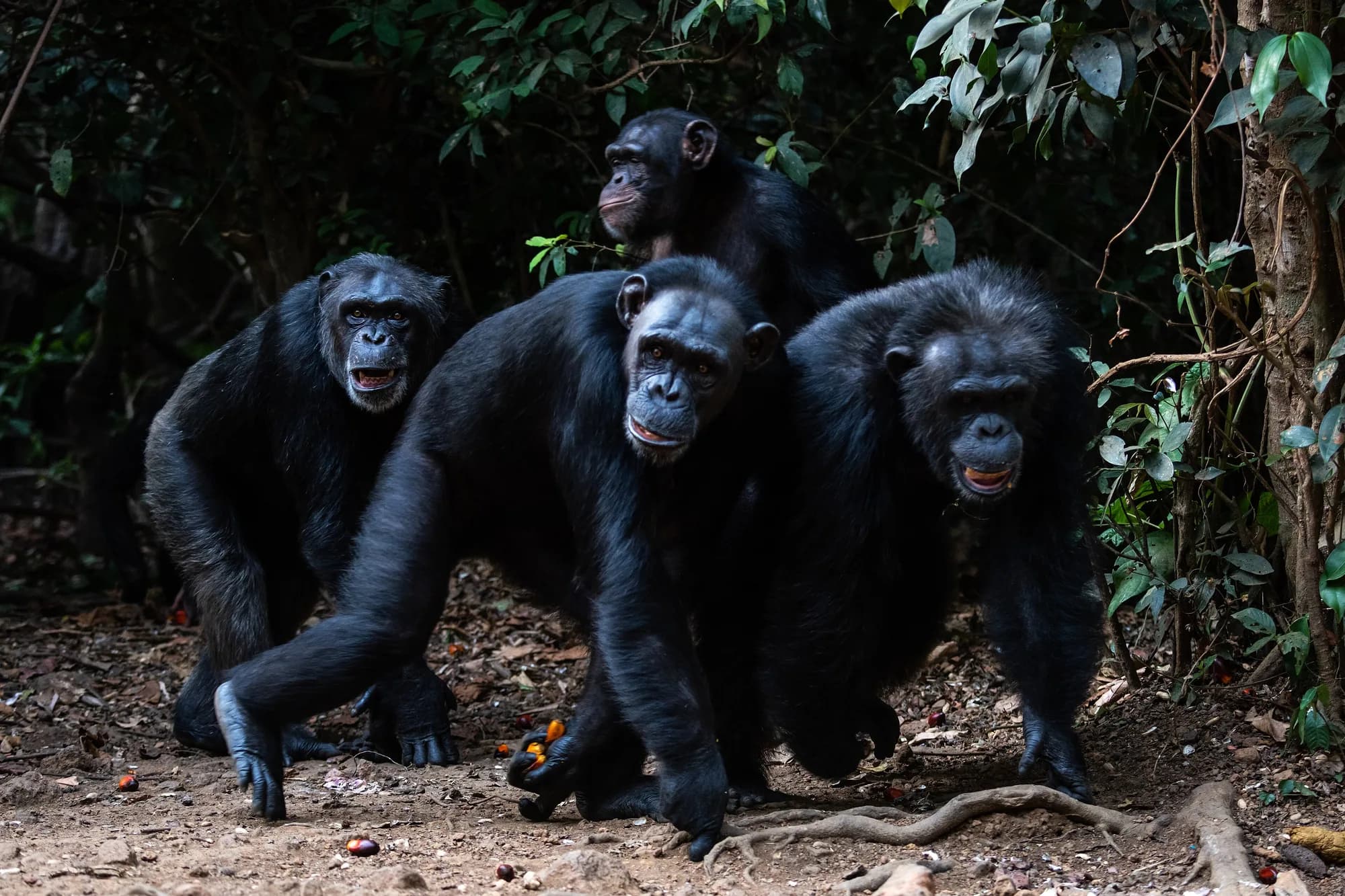
- Chimpanzee — the same forest — and a predator on colobus
Questions people ask
Where is the best place to see black-and-white colobus?
Why do colobus monkeys have no thumbs?
Why are baby colobus white?
Read next

Forest canopy, from Kakamega to Kasanka
Blue monkey — the same canopy
It is not blue, it is not one animal, and the samango a guide pointed out to you in South Africa is the same species under a different name. This is the commonest forest monkey in East Africa and the one most people photograph without ever learning what they photographed.
Uganda, Rwanda and western Tanzania
Chimpanzee
Louder, faster and far harder to keep up with than a gorilla, and the trek is nothing like the same experience. Kibale is the reliable one; Mahale, on the shore of Lake Tanganyika, is the one people remember.
Nyungwe