
Species · Gavialis gangeticus
Gharial
A fish-eating crocodilian with a snout like a pair of tongs, down to a few hundred breeding adults, and hauled out on Chambal sandbanks in winter in numbers that make it look common.
Also called
- Gharial (घड़ियाल) · Hindi
- Nakar · Hindi
Checked 30 Aug 2026
- Where
- Chambal & a few northern rivers
- Best months
- November–March
- Seen from
- A boat, mid-morning
- Eats
- Fish, essentially only
Deep, fast, clean rivers with sandbanks to nest on. That combination has become rare, which is most of the species' problem.
Where it is
Where to actually go
Ranked, with the reason each — these are not interchangeable.
- 01National Chambal SanctuaryMadhya Pradesh & Uttar PradeshThe world stronghold. A winter morning on this river produces gharial, mugger, skimmers and often dolphins in a couple of hours, in a gorge that looks like nowhere else in northern India.November to March, mid-morning, from a boat
- 02KatarniaghatUttar PradeshThe Girwa river holds a smaller but genuine population, in a quieter and much less visited setting.For a second look, or a quieter one
- 03CorbettUttarakhandSmall numbers in the Ramganga, and a real bonus if you are there for tigers. Not a reason to go.A bonus, not a plan
Where you will not see one
- Ranthambore, Bandhavgarh and the tiger reservesThe large crocodilian basking at a tiger reserve waterhole is a mugger, every time. Gharials need big rivers, not forest lakes, and there are none in the central Indian parks.
- The Sundarbans and the coastThat is the saltwater crocodile, a completely different and far more dangerous animal. Gharials are strictly freshwater and strictly fish-eating.
- Expecting dangerThe snout is built for catching fish and cannot take large prey. Gharials are among the least hazardous large crocodilians alive, and the reputation they inherit from the mugger is unearned.
When to go
When to go
- J
- F
- M
- A
- M
- J
- J
- A
- S
- O
- N
- D
January: best. February: best. March: best. April: good. May: marginal. June: marginal. July: marginal. August: marginal. September: marginal. October: good. November: best. December: best.
Through the day
- Dawn
- Morning
- Midday
- Afternoon
- Dusk
- Night
Dawn: usually resting. Morning: most active. Midday: most active. Afternoon: active. Dusk: usually resting. Night: not normally seen.
Realistic odds on a three-day trip
- Near-certain
- Likely
- Lucky
- Expedition
Telling it apart
Told apart from
Mugger crocodile
The Chambal, in the same frame
The snout settles it instantly and at any distance: a gharial's is pencil-thin and parallel-sided, a mugger's is broad and triangular. Both bask on the same Chambal banks, which is what makes it the standard mix-up.
Saltwater crocodile
Only in the planning
A range question rather than a shape one — salties are coastal and estuarine, in Odisha, the Sundarbans and the Andamans. They do not occur in the Chambal at all.
Male versus female gharial
Every basking group
Not two species. Only adult males grow the ghara, the bulbous pot at the snout tip that gives the animal its name. A large gharial without one is a female.
Marks chosen to be usable from a moving vehicle — a gharial is rarely still and never close enough for anything subtler.
What it looks like in the field
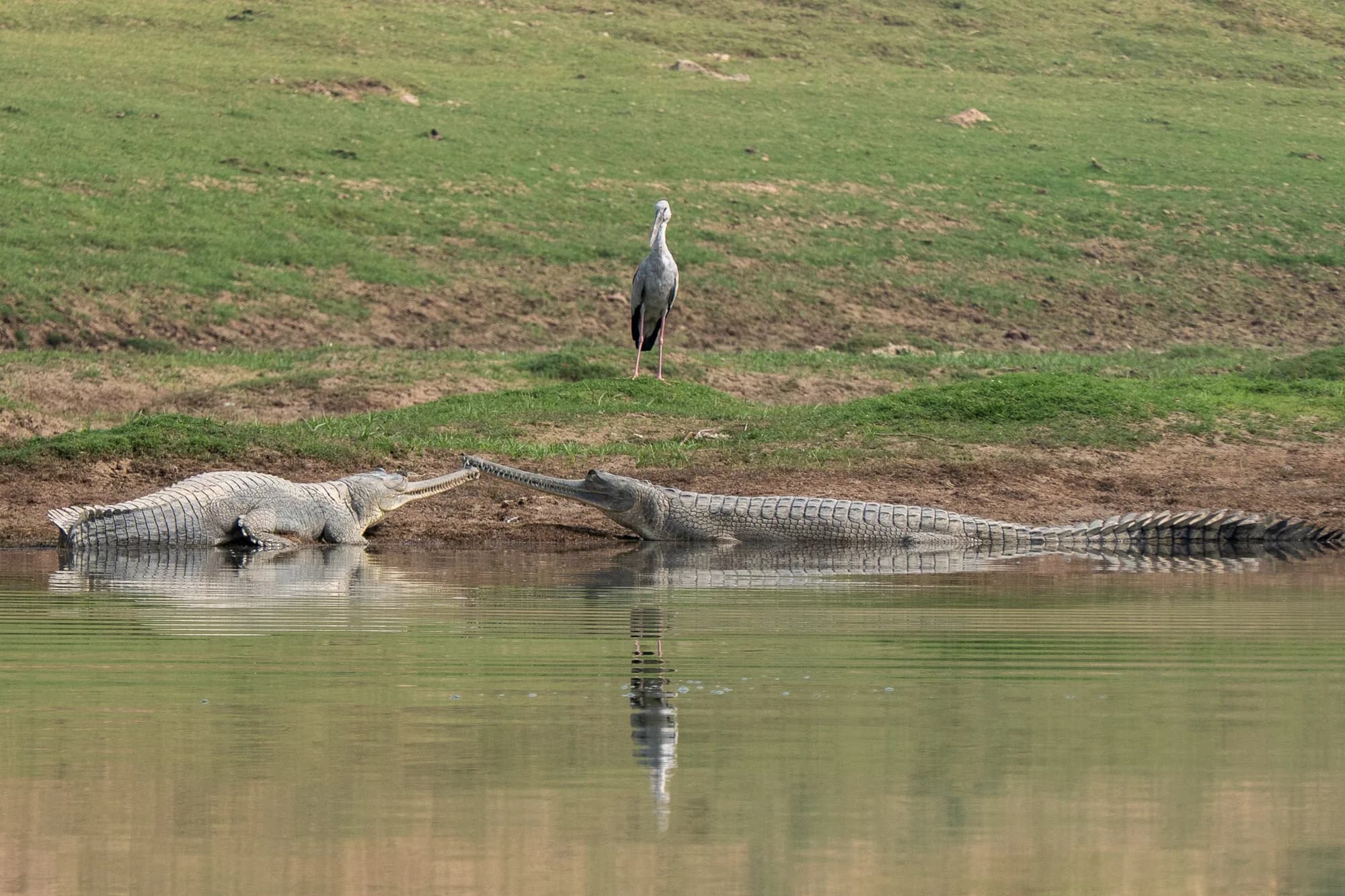
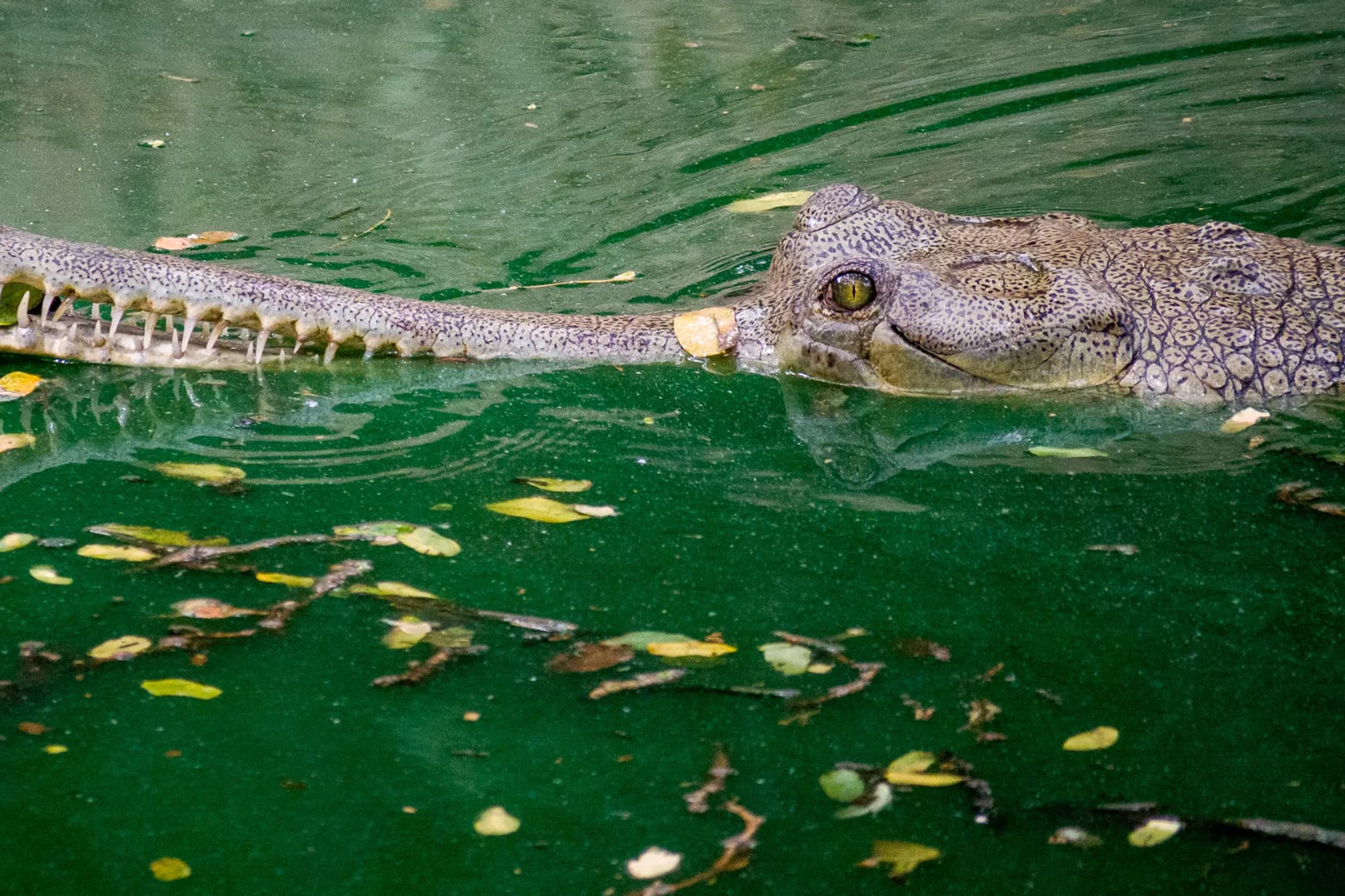
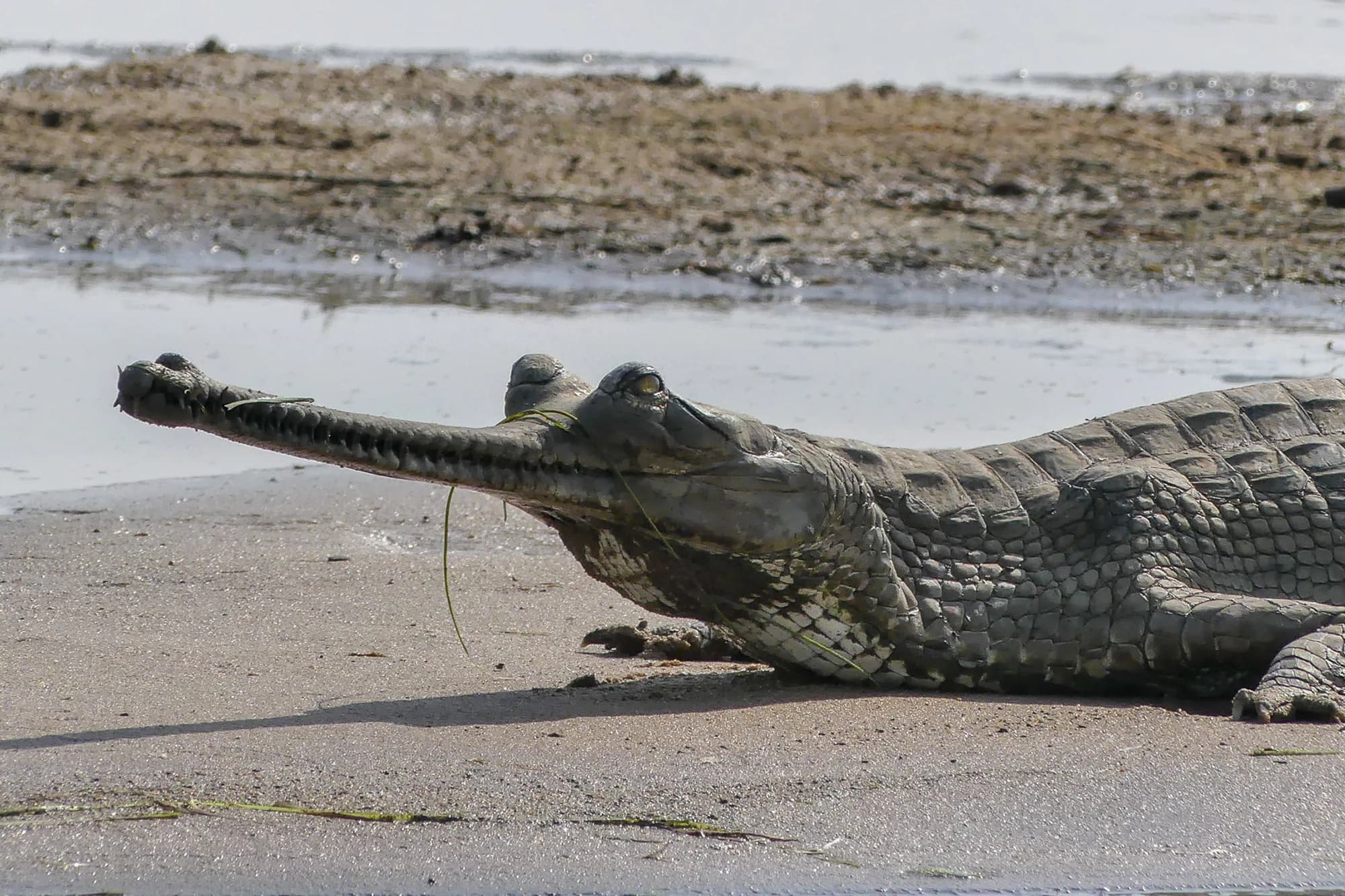
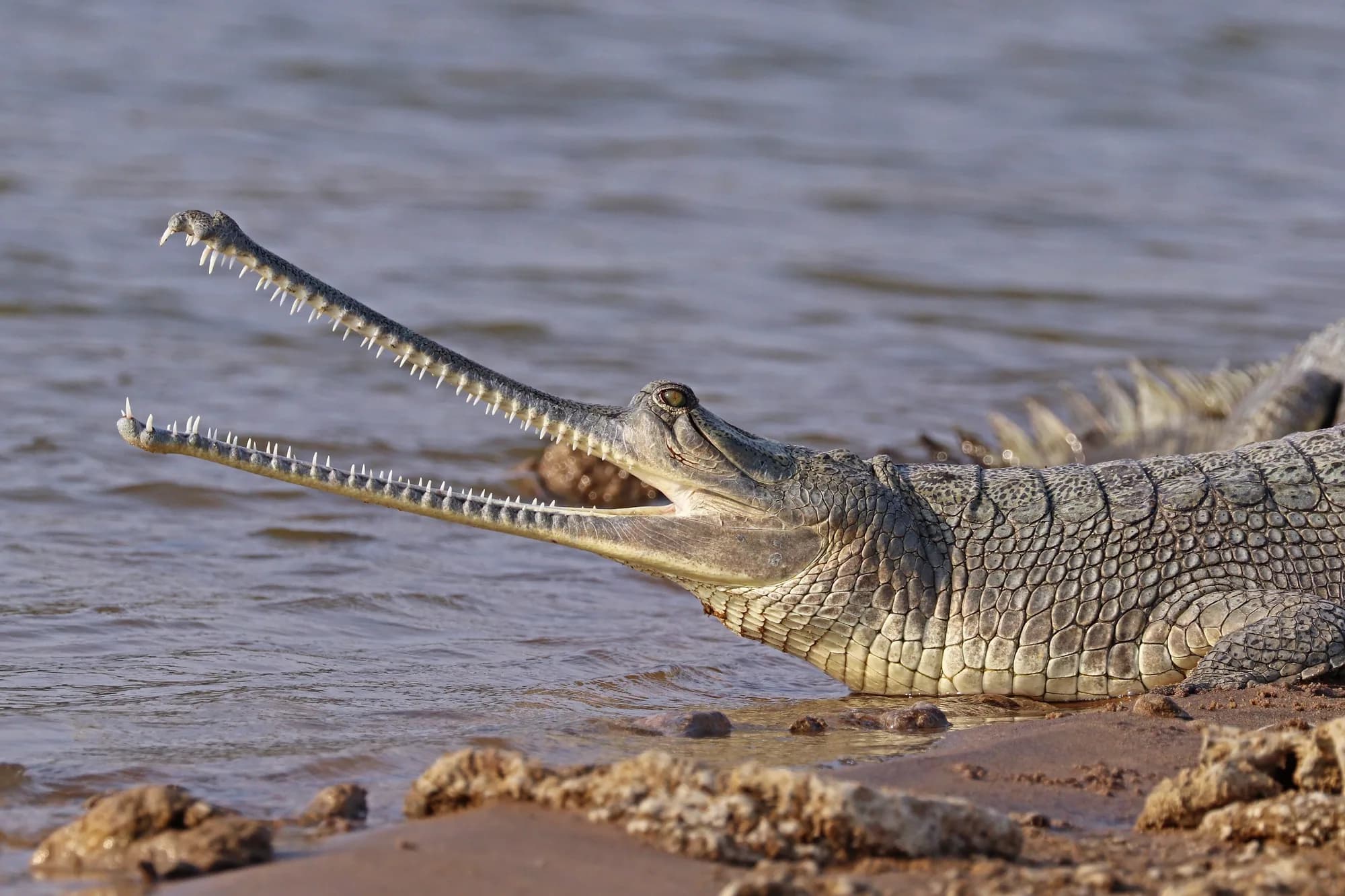
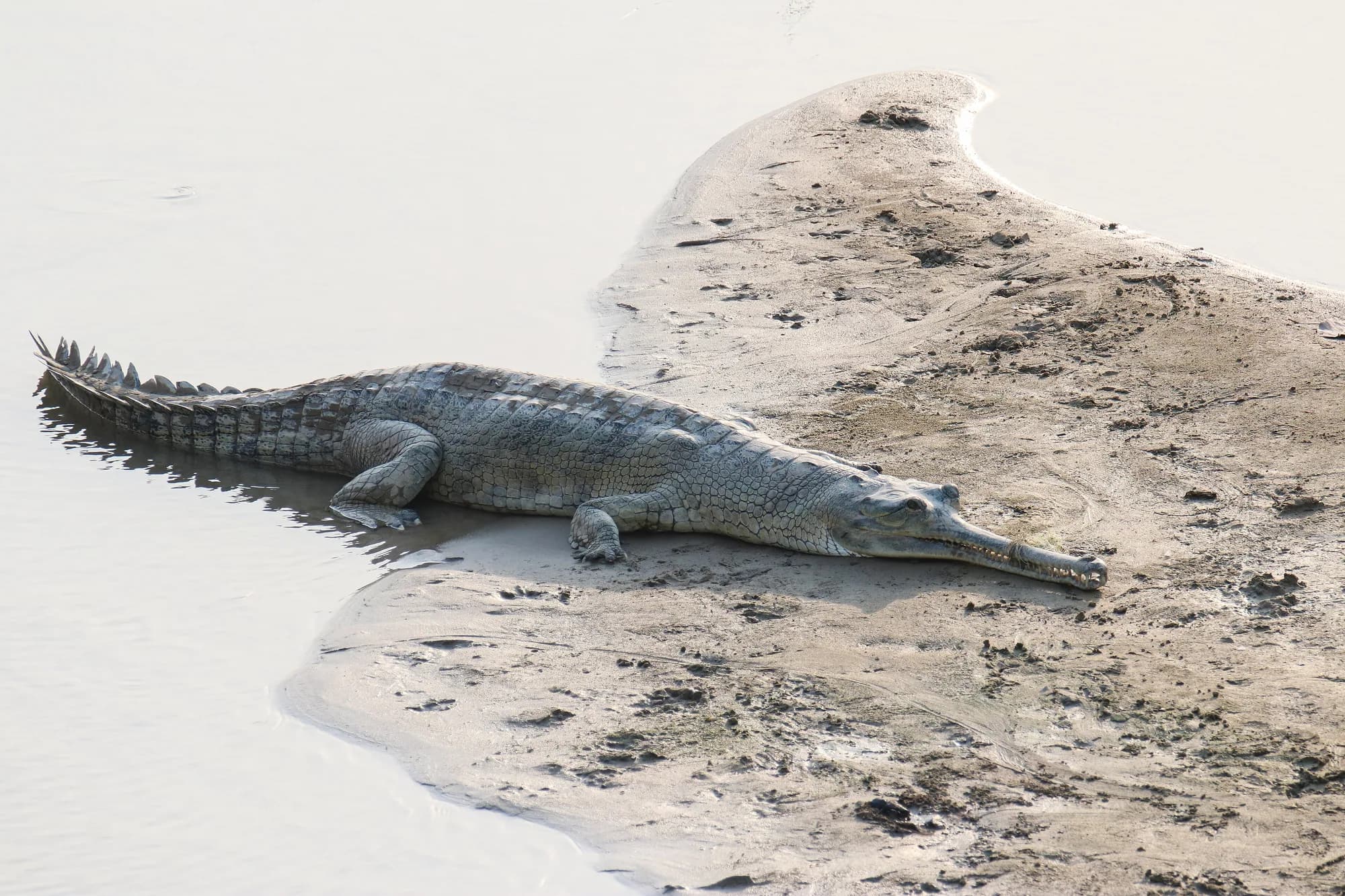
Photographs of Gharial in the wild, in Indian reserves. We publish no captive, baited or digitally composited images, and no photograph whose licence we cannot show.
Photographing it
- Lens
- 400mm from a boat, and something wide for the gorge. A beanbag on the gunwale beats any tripod on moving water.
- Typical distance
- Thirty to a hundred metres. The boatman controls this entirely, so brief him before you set off.
- Light
- Mid-morning, which is both when they haul out and when the light is still usable. By midday the sand is blowing out every highlight.
Where to stopDo not have the boat pushed in to make animals move. A basking gharial driven into the water has lost the heat it needs to digest, and repeated flushing along a stretch of river is a measurable cost to a species with a few hundred breeding adults left.
Signs and calls
- Haul-out trails
- Belly-drag grooves with foot marks either side running from the water up a sandbank. Fresh trails with sharp edges mean the animals are still there or just left.
- Nest banks
- Steep sand banks above the waterline with dug hollows, used in March and April. Approaching them is the fastest way to cause a female to abandon a clutch.
- Basking posture
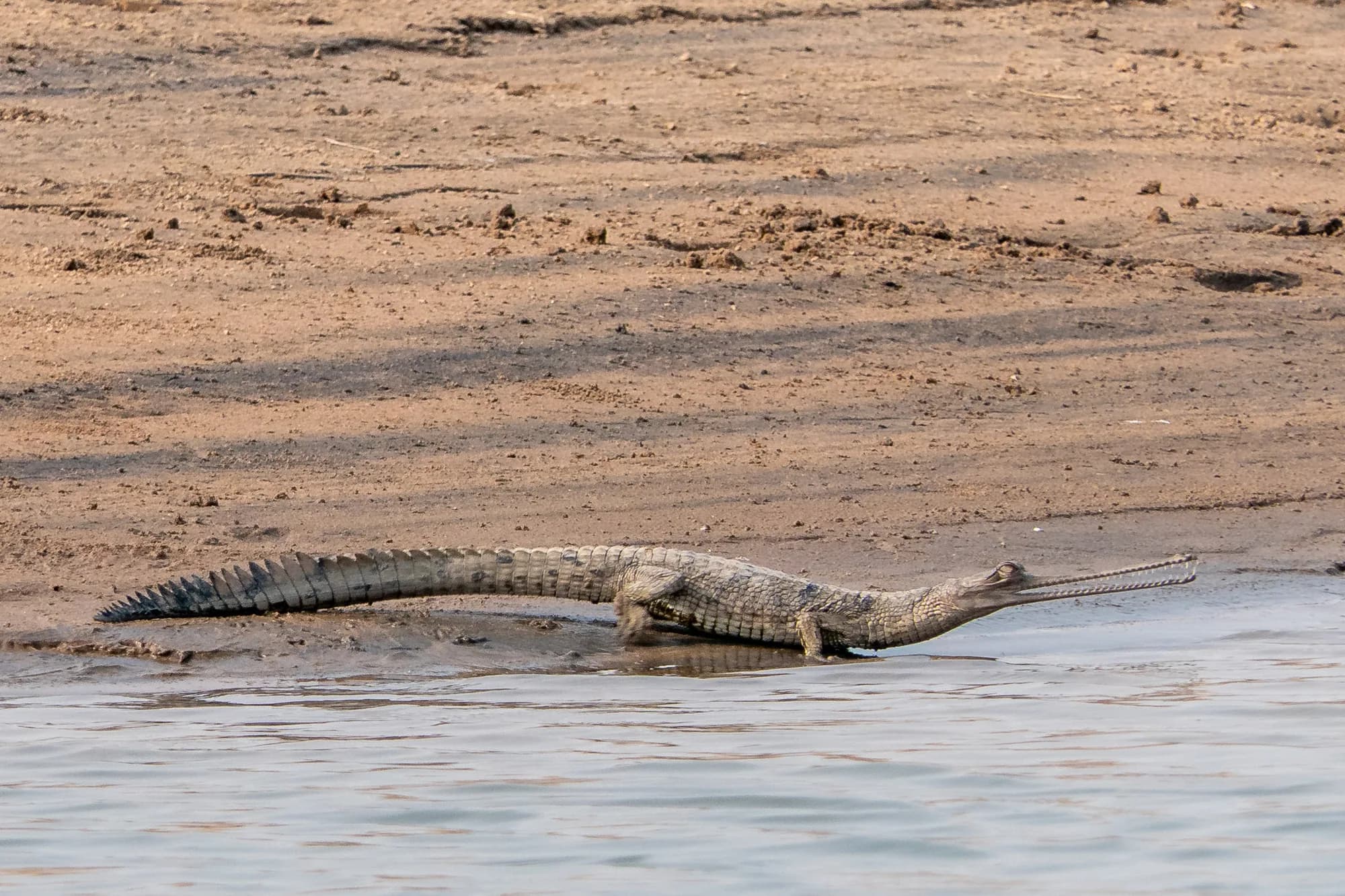
- Jaws held wide open while motionless on sand. It is thermoregulation rather than threat, and it is the classic Chambal photograph.
What a sighting is actually like
Unusually generous. On a winter morning a single Chambal sandbank can hold a dozen gharials lined up with their jaws open, entirely unbothered by a boat holding position sixty metres off, for as long as you care to watch.
It is the only critically endangered animal in India that will let you look at it for an hour.
The snout is the thing that lands. It is absurdly narrow, lined with interlocking needle teeth, and it exists to be swept sideways through water at speed — an animal built for exactly one job and no other.
Why so few are left
Gharials need deep, fast, clean river with sandbanks to nest on, and almost every river in northern India has been dammed, mined for sand, drawn down for irrigation or netted.
The Chambal is the exception that proves it. It is relatively undammed, it runs through ravines that were never easy to farm, and it holds most of the world’s gharials as a direct consequence. The sand mining pressure on it is the thing worth following.
Status and protection
Status and protection
- IUCN Red List
- Critically Endangered
- Population trend
- ↑ Increasing
- Wildlife Protection Act 1972
- Schedule I (post-2022-amendment numbering)
- CITES
- Appendix I
Species-level assessment of Gavialis gangeticus; binomial matches, monotypic, no subspecies issue.
Assessed 2017 (published 2019) · IUCN Red List assessment
What to book to see one
What you would be booking
- How it is seen
- A flat-bottomed boat on the Chambal, usually launched from Dholpur or Bah. Not a jeep safari, and not a national park in the usual sense.
- Drives to book
- One morning boat trip is usually enough in winter. Two if you want the skimmers and the dolphins properly as well.
- Zone or shift
- The Chambal between roughly Dholpur and Bah, where the sandbanks are widest.
It pairs neatly with Ranthambore or Agra, which is how most people reach it. Go between November and March — in summer the animals are dispersed and the heat on an open boat is punishing.
Boat safaris in IndiaOn the same trip you would also get
- Ganges river dolphin — the same Chambal boat, in the deeper pools
- Indian skimmer — nests on the same sandbanks, and the Chambal is its stronghold
- Mugger crocodile — on the same banks, and the identification exercise
Questions people ask
Where can I see a gharial in India?
Are gharials dangerous?
What is the bulge on the end of the snout?
Read next
Kabini, Satpura, Periyar
Boat safaris in India
Quiet, low, and no engine note. In late dry season at Kabini it is the best two hours in the park.
Rajasthan
Ranthambore — the usual pairing
Dry forest around a fort, and the easiest reserve to reach from Delhi — which is exactly why it is the busiest.
58 reserves, six worth the trip
Tiger — where and when
The animal most people come for, and the one most often missed. Where the odds actually are, and how they move by month and by zone.
Twelve months, cross-park
When to go, month by month
The single decision that moves the odds most. Heat, crowds, closures and what is actually open, one page per month.