
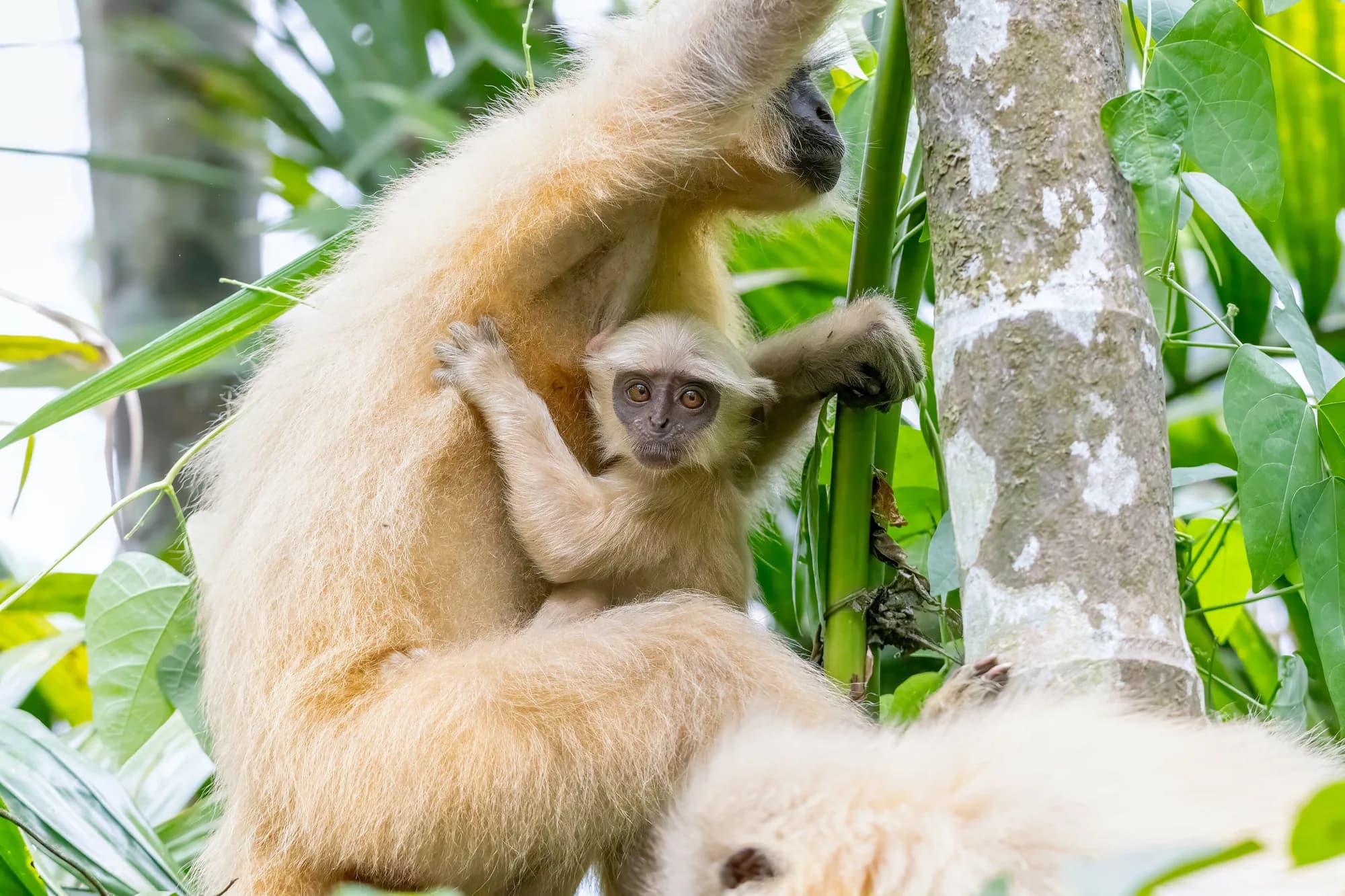
Species · Trachypithecus geei
Gee's golden langur
A cream-and-gold monkey living in a wedge of forest between two Assamese rivers and the Bhutan border. Unmistakable, findable, and almost entirely absent from Indian safari itineraries.
Also called
- Xonali bandar · Assamese
- Mwsou mwkhra · Bodo
Checked 30 Aug 2026
- Where
- Western Assam
- Best months
- November–March
- Range
- Between the Sankosh and Manas
- Described
- 1953, by E. P. Gee
One of the smallest ranges of any Indian primate — bounded by the Sankosh river to the west, the Manas to the east, the Brahmaputra to the south and Bhutan to the north.
Where it is
- Manas
Where to actually go
Ranked, with the reason each — these are not interchangeable.
- 01ChakrashilaAssamA hill protected largely through village effort, holding a well-known and reasonably relaxed population. The most reliable golden langurs in India, and a genuinely different model of conservation to see working.Arrange a village guide in advance
- 02ManasAssamThe eastern edge of the range, in a reserve that also holds tiger, rhino, pygmy hog and hispid hare. Lower langur odds, far higher everything-else odds.The trip to take if you only make one
- 03KakoijanaAssamSmall, close to the road, with a habituated troop. Easy, and worth being thoughtful about how that habituation happened.Convenient; ask how the troop got used to people
Where you will not see one
- KazirangaWrong side of the Manas river. Kaziranga has capped langurs and rhesus macaques and no golden langurs at all, which catches out visitors who assume one Assam trip covers the state's primates.
- Anywhere south of the BrahmaputraThe river is an absolute boundary. Everything about this species is contained in one wedge of land, and that is both why it is special and why it is fragile.
- Expecting a hanuman langur that happens to be paleDifferent animal. Hanuman langurs are grey with a black face and are common across most of India; golden langurs are cream to deep gold depending on season and light, and are found in one district.
When to go
When to go
- J
- F
- M
- A
- M
- J
- J
- A
- S
- O
- N
- D
January: best. February: best. March: best. April: good. May: marginal. June: marginal. July: marginal. August: marginal. September: marginal. October: good. November: best. December: best.
Through the day
- Dawn
- Morning
- Midday
- Afternoon
- Dusk
- Night
Dawn: active. Morning: most active. Midday: usually resting. Afternoon: active. Dusk: active. Night: not normally seen.
Realistic odds on a three-day trip
- Near-certain
- Likely
- Lucky
- Expedition
Telling it apart
Told apart from
Capped langur
Manas, where both occur
Overlaps at the eastern edge of the range and is the real field problem. Capped langurs are grey-brown above with an orange-buff belly and a dark cap; golden langurs are uniformly cream to gold with no cap and no contrast.
Hanuman langur
The Assam plains generally
Grey rather than gold, larger, and far more comfortable on the ground. If it is walking across open ground near a village it is a hanuman.
Rhesus macaque
Everywhere in the Northeast
Stocky, brown, short-tailed and ground-loving. Not really similar except in silhouette at distance, which is exactly when people record it wrongly.
Marks chosen to be usable from a moving vehicle — a gee's golden langur is rarely still and never close enough for anything subtler.
What it looks like in the field
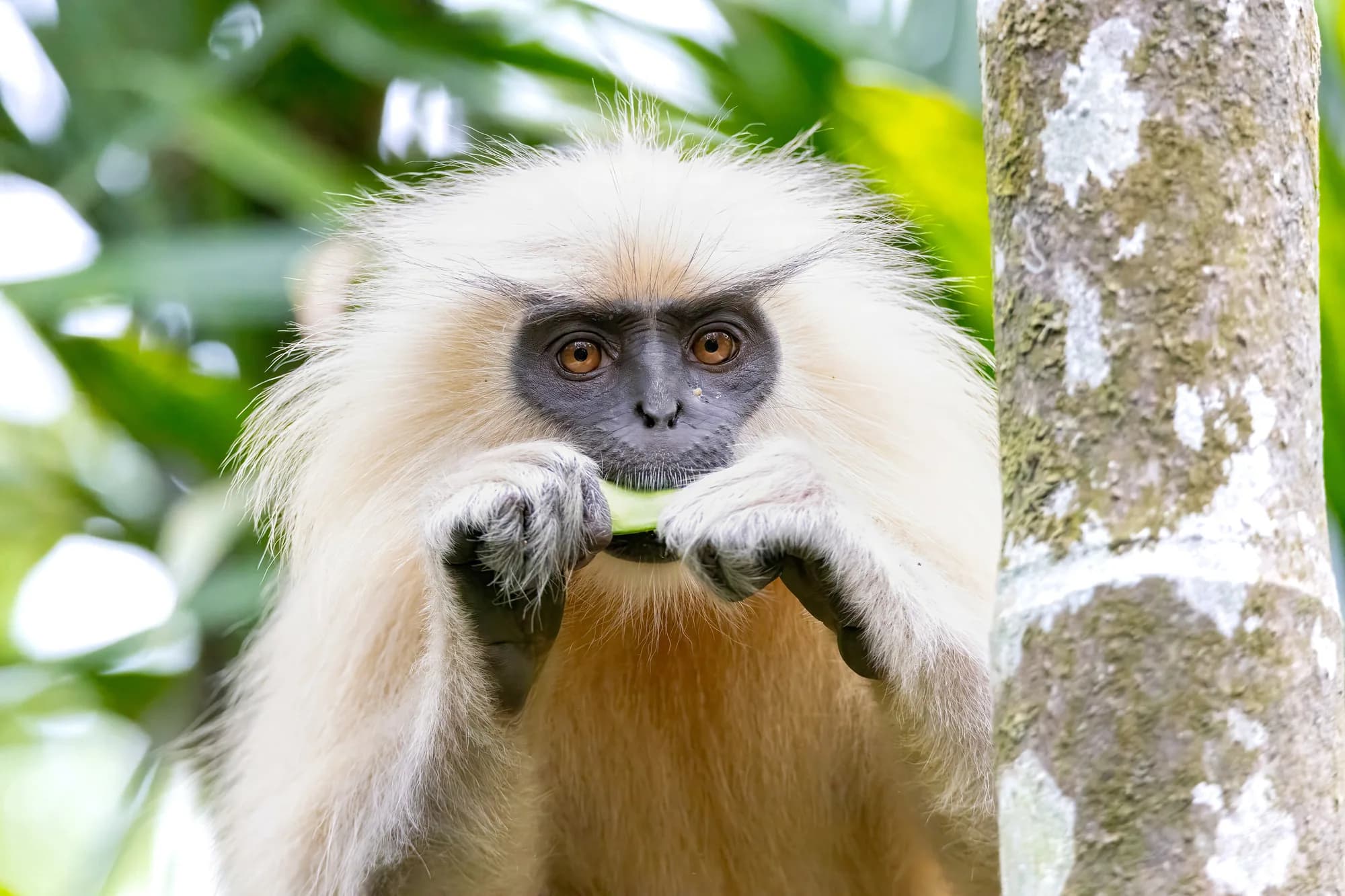
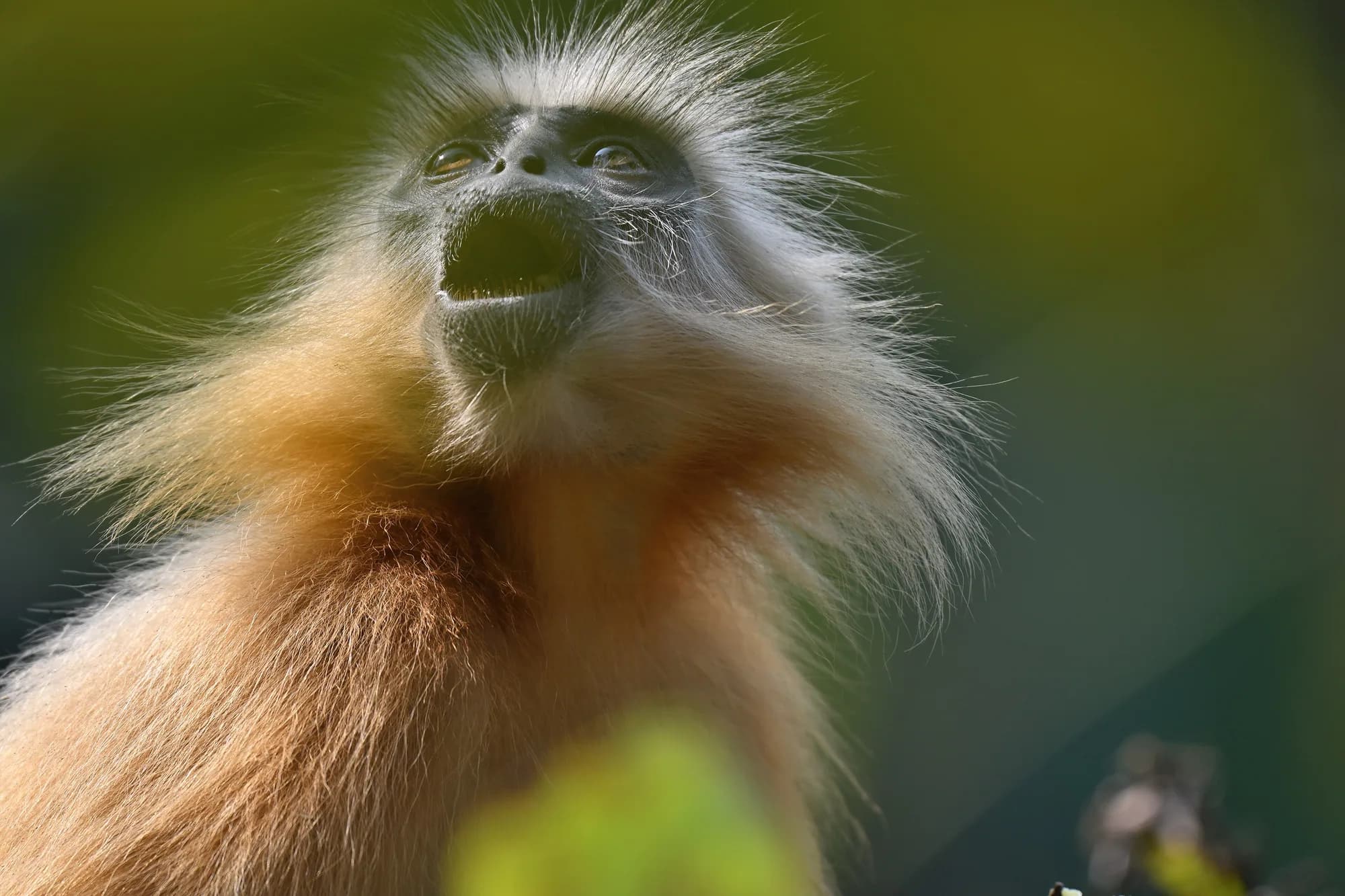
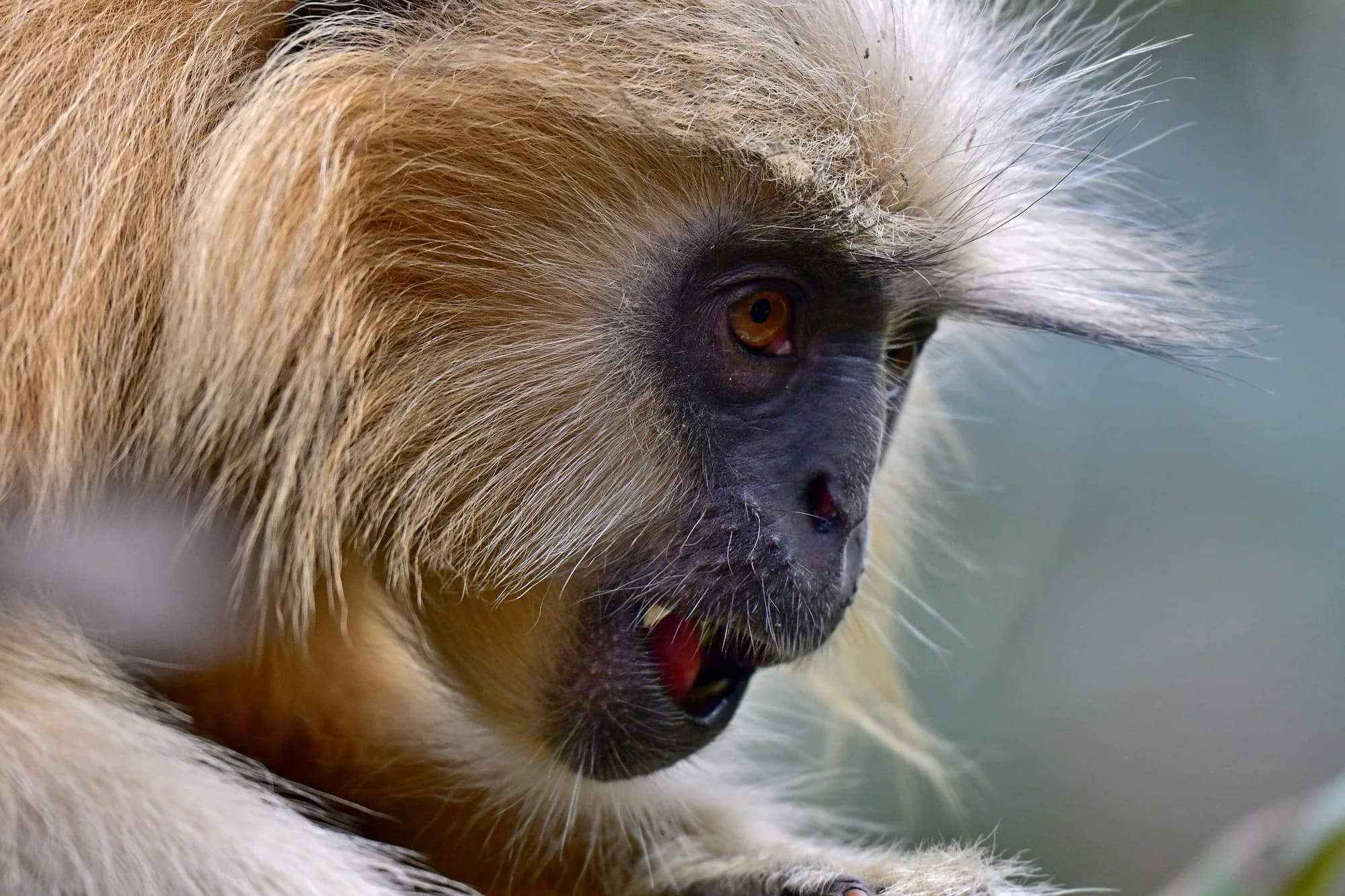
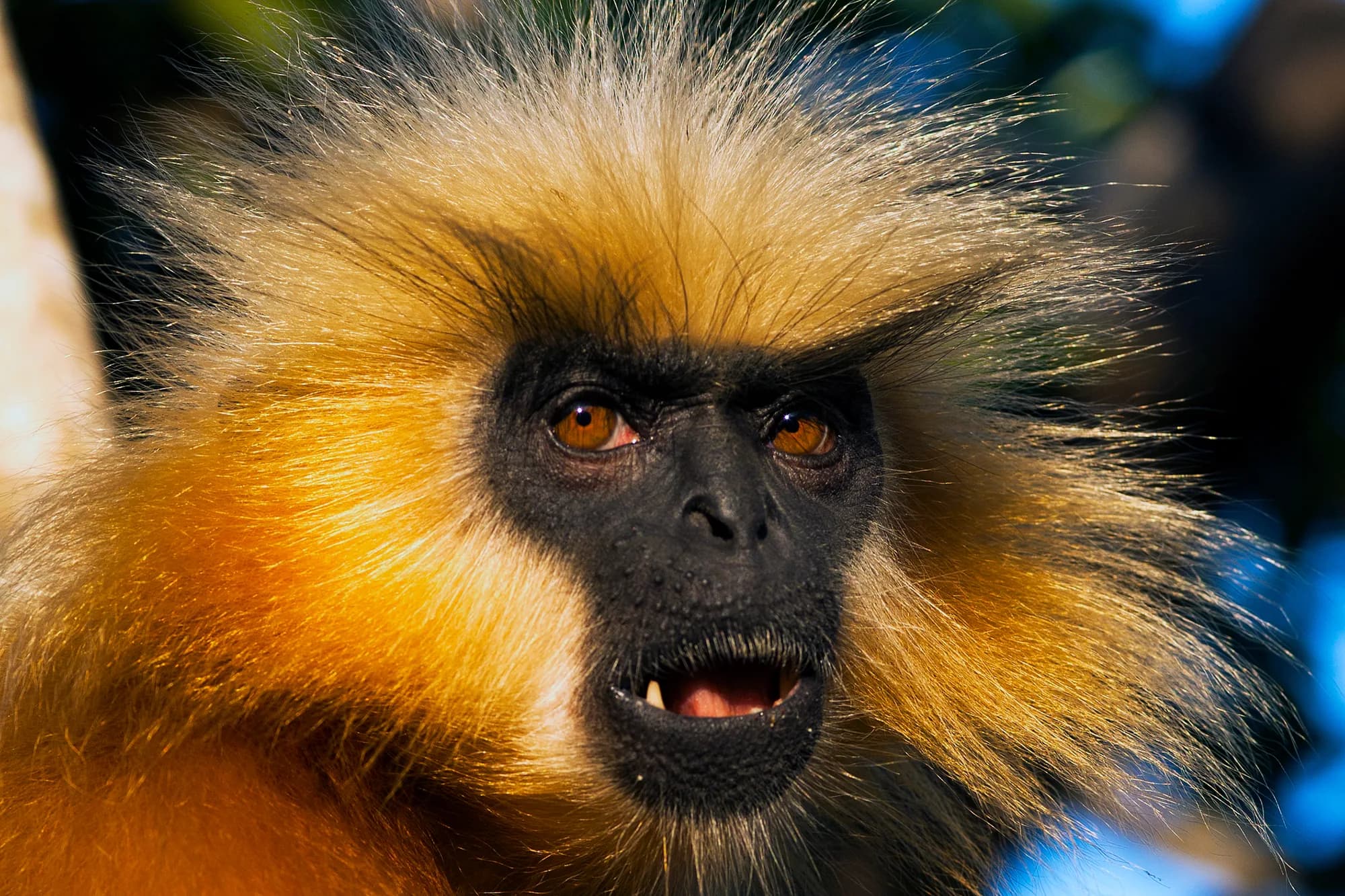
Photographs of Gee's golden langur in the wild, in Indian reserves. We publish no captive, baited or digitally composited images, and no photograph whose licence we cannot show.
Photographing it
- Lens
- 400mm minimum. The animals are high, the canopy is dense, and the gold reads badly against bright sky.
- Typical distance
- Twenty to forty metres, mostly vertical.
- Light
- Backlit more often than not. The coat is the whole photograph, so wait until the troop moves to a branch with forest rather than sky behind it, or the gold turns to silhouette.
Where to stopDo not feed them, and do not visit a troop that has been habituated by feeding. Provisioned troops in this range have become road-side beggars with the road deaths that follow, and paying to see one funds the mechanism.
Signs and calls
- Feeding remains
- Dropped leaf stalks and unripe fruit beneath a canopy tree, fresh and green rather than browned. Troops feed heavily in one tree and then move.
- Canopy trails
- Habitual routes through connected canopy, visible as worn, bark-scuffed branches. Golden langurs cross gaps reluctantly, so the trails are stable and worth learning.
- Call
- A deep whooping contact call between troop members, and a harsher alarm when a raptor passes. Carries well in still morning air.
What a sighting is actually like
Calm, high, and unexpectedly long. A troop that has settled in a feeding tree will stay for half an hour or more, and unlike almost everything else on this list you are not waiting for a two-second crossing — you are watching a group get on with its morning.
The colour is the thing. In low side-light the coat goes from cream to something close to brass.
Infants are near-white and darken with age, so a troop shows the whole gradient at once. It is one of the more photogenic primates in Asia and it is seen by a tiny fraction of the people who visit Assam.
Why the range is so small
Golden langurs occupy a wedge bounded by the Sankosh river to the west, the Manas to the east, the Brahmaputra to the south and the Bhutan hills to the north. That is essentially the entire world range, split between India and Bhutan.
It was described only in 1953. E. P. Gee brought it to scientific attention, which is why the common name carries his. For a large, bright, diurnal monkey to have gone unrecorded that long says something about how little of the Northeast was being looked at.
Status and protection
Status and protection
- IUCN Red List
- Endangered
- Population trend
- ↓ Decreasing
- Wildlife Protection Act 1972
- Schedule I (post-2022-amendment numbering)
- CITES
- Appendix I
Species-level assessment of Trachypithecus geei; binomial matches. This is the current assessment — the older 2008 assessment at /species/22037/9348940 is flagged by IUCN as…
Assessed 2015 (published 2024) · IUCN Red List assessment
What to book to see one
What you would be booking
- How it is seen
- A guided walk or a short drive to a known troop. This is a community-forest visit rather than a national park safari, and it works differently.
- Drives to book
- One or two mornings. At Chakrashila and Kakoijana the troops are known and reasonably habituated, so this is not a numbers game.
- Zone or shift
- Chakrashila for reliability, Manas if you want the langur alongside tiger, rhino and pygmy hog country.
Arrange it locally and in advance. There is no booking portal for this the way there is for a tiger reserve, and the people who can actually find the troop are village guides rather than a forest department roster.
Community-run wildlife tourismOn the same trip you would also get
- Western hoolock gibbon — the same Assam trip, a few hours east
- Greater one-horned rhino — Manas holds both, and Kaziranga is a day away
- Capped langur — the identification exercise, in the same canopy at Manas
Questions people ask
Where can I see a golden langur?
Can I see golden langurs at Kaziranga?
Why is it called Gee's golden langur?
Read next
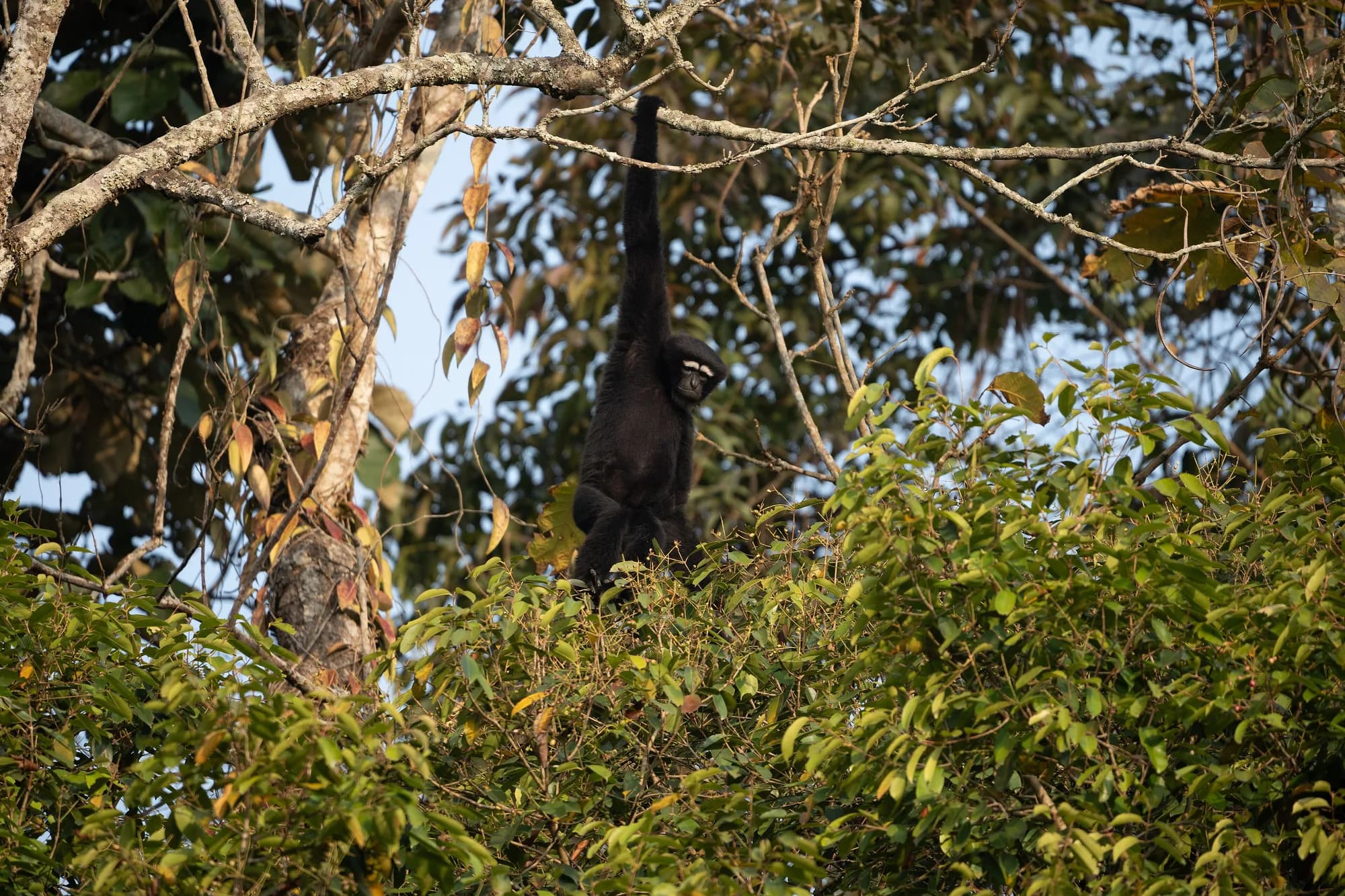
Assam, and India's only ape
Hoolock gibbon — the same Assam trip
The only ape in India, in a forest island surrounded by tea. You will hear the pair duet across a kilometre of canopy before you have any idea where to look.
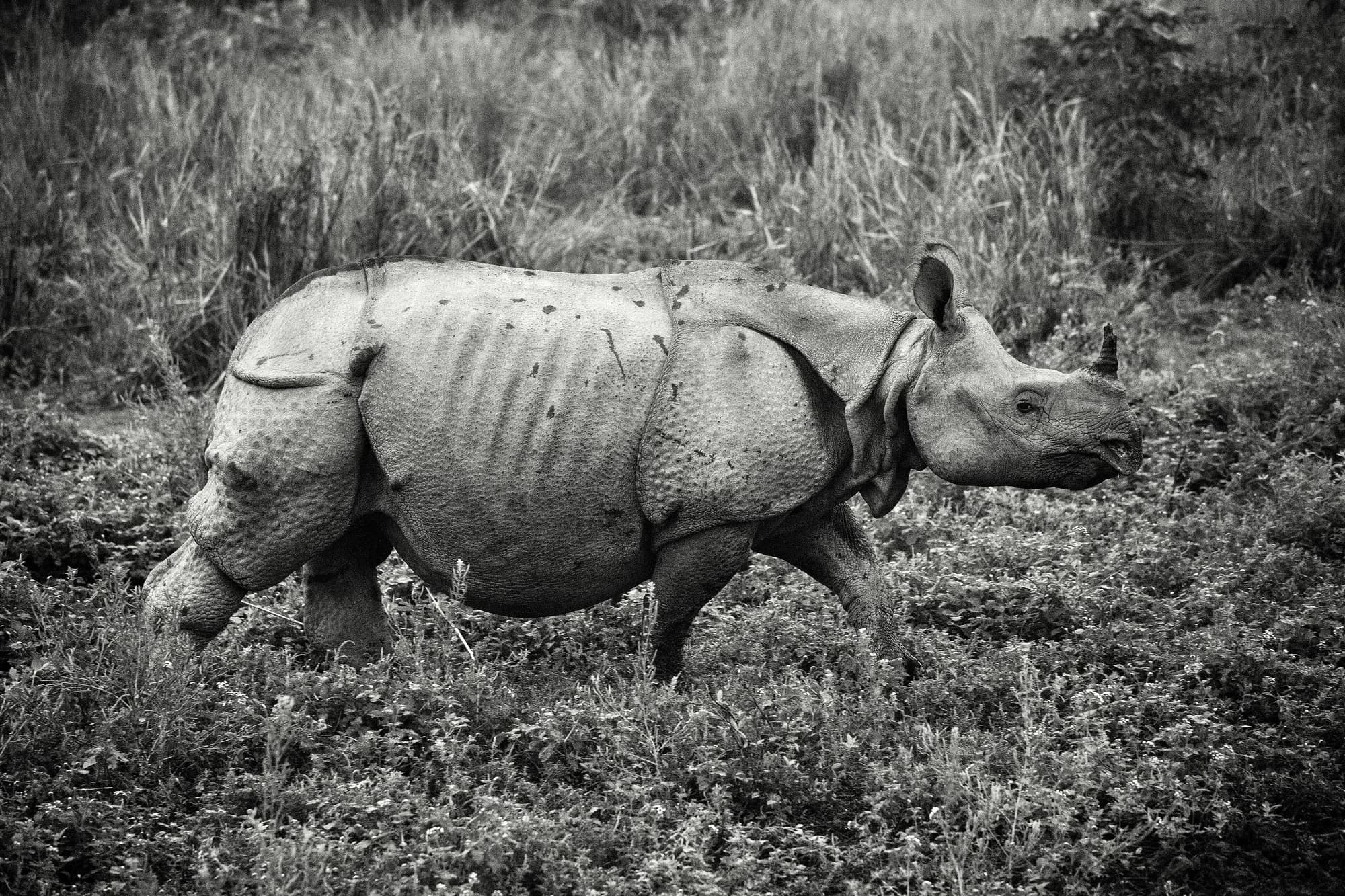
Assam floodplain, near-certain
One-horned rhino — where and when
The easiest large mammal in India to see well. Two-thirds of the world's population stands in open grass, in daylight, in one Assam floodplain.
Our position
Travelling responsibly
Where we stand on vehicle crowding, baiting and playback — and what we will not link to, whoever is paying.
Assam
Kaziranga — the park in full
Floodplain grassland, one-horned rhino in daylight, and the one Indian park where the headline animal is close to certain.