

Species · Equus zebra hartmannae
Hartmann's mountain zebra
Read the trend before the category. This is a genuine subspecies assessment and it says Vulnerable and increasing — the listing records how far the animal fell, not where it is going. It lives on the arid escarpment above the Namib, it digs its own wells in dry riverbeds, and most of them are not in national parks at all.
Also called
- Hartmann se bergsebra · Afrikaans
- Hartmann-Bergzebra · German
Checked 28 Sept 2026
- Where
- Namibia's escarpment, and just over both borders
- Best months
- The dry season, roughly May–Oct
- Trend
- Increasing — against a Vulnerable listing
- Odds
- Good in the right rocky country
A long north-south band down the Namibian escarpment from the Kunene to the Orange river, spilling into south-western Angola and across into the South African Richtersveld. The Cape mountain zebra, the other subspecies, is confined to the Eastern and Western Cape and the two do not meet.
Where it is
HabitatArid mountain and escarpment — broken rock, inselbergs and steep slopes above the Namib gravel plains, and the dry riverbeds that run off them. It needs gradient and it needs water within reach of the slopes, which is a narrower combination than the map of Namibia suggests.
Worth travelling for
The heart of the range. The Naukluft mountains were set aside for this animal in the 1960s and the Naukluft section of Namib-Naukluft is still the most reliable protected-area sighting.
The Richtersveld, south of the Orange river, is the only part of the subspecies' range in South Africa — and it is the Hartmann's animal there, not the Cape one.
Also occurs
Angola
Present, but not where you would go to see one.
Where to actually go
Ranked, with the reason each — these are not interchangeable.
- 01Namib-NaukluftNamibiaThe Naukluft mountains were proclaimed for this animal and it remains the most reliable protected-area sighting anywhere. Drive the mountain tracks and the waterholes, not the gravel plains.The park made for it
- 02Ai-Ais Hot SpringsNamibiaFish River Canyon country at the southern end of the range, with mountain zebra on the rim and in the side kloofs, and almost nobody looking for them.Canyon country, no crowd
- 03|Ai-|Ais / Richtersveld TransfrontierSouth AfricaThe only place in South Africa where this subspecies occurs, in some of the harshest mountain desert on the continent. Four-wheel drive, self-sufficiency and real effort required.The South African side
Where you will not see one
- The Eastern and Western CapeThose are Cape mountain zebra — the other subspecies, stockier, with broader stripes and a heavier dewlap. Mountain Zebra National Park near Cradock is theirs, not this animal's.
- The dune sea at SossusvleiA common disappointment. Mountain zebra want rock and gradient, not sand. They are up on the Naukluft and along the escarpment, not among the dunes an hour's drive west.
- Flat open plain, in big herdsA large herd of zebra on level ground is a plains zebra. Mountain zebra live in small harems of a stallion, a few mares and their foals, on slopes.
When to go
When to go
- J
- F
- M
- A
- M
- J
- J
- A
- S
- O
- N
- D
January: good. February: good. March: good. April: good. May: best. June: best. July: best. August: best. September: best. October: best. November: good. December: good.
Through the day
- Dawn
- Morning
- Midday
- Afternoon
- Dusk
- Night
Dawn: most active. Morning: most active. Midday: usually resting. Afternoon: active. Dusk: most active. Night: usually resting.
Realistic odds on a three-day trip
- Near-certain
- Likely
- Lucky
- Expedition
Telling it apart
Told apart from
Geography settles it completely: this animal is Namibia, southern Angola and the Richtersveld, and the Cape animal is the Eastern and Western Cape. Where you can compare them, Hartmann's is slightly taller and paler with narrower stripes and wider white gaps between them.
Namibia, where both occur and people assume all zebra are the same
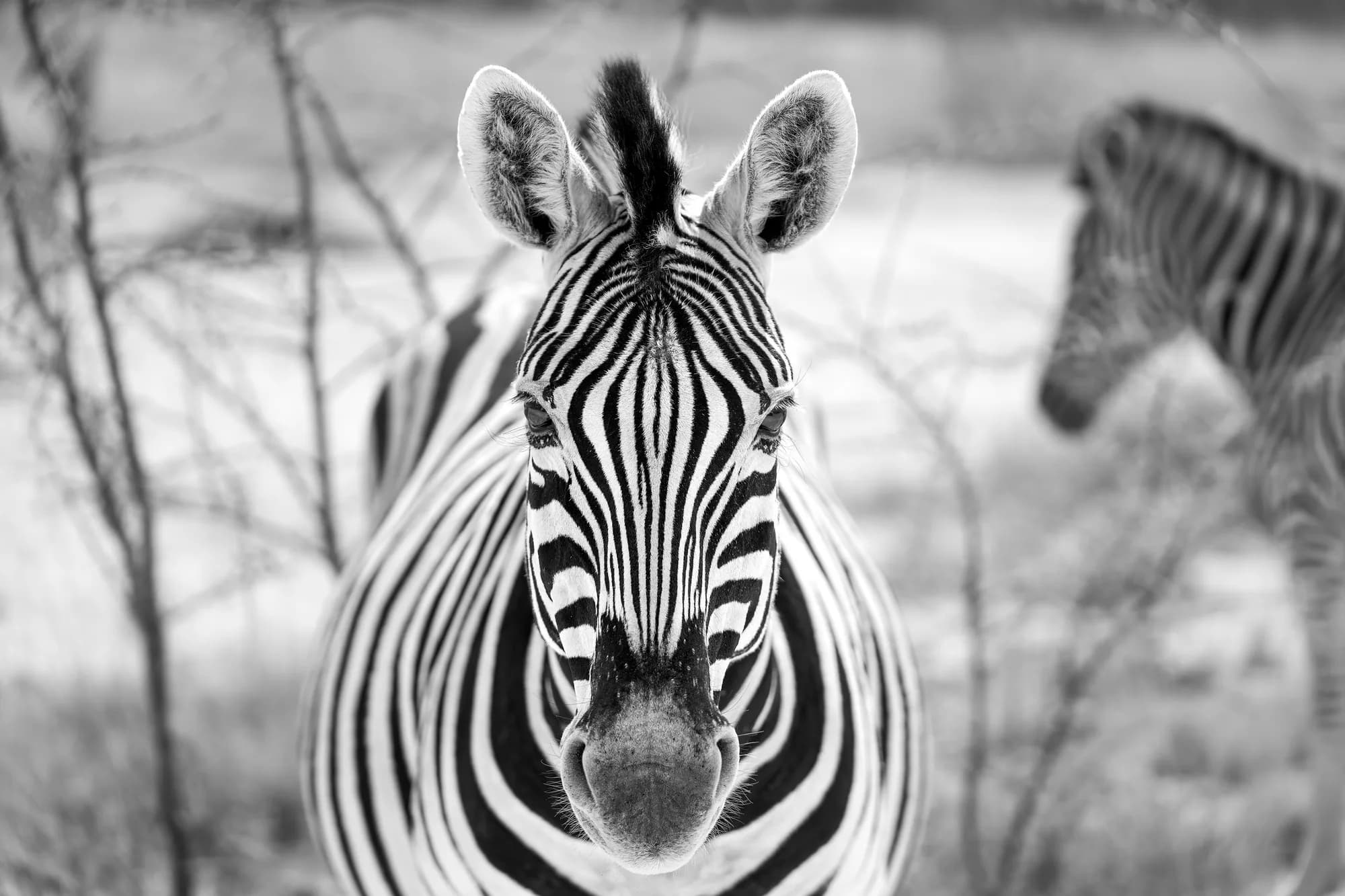
Look underneath and at the throat. A mountain zebra has a plain unstriped white belly, a loose dewlap hanging below the jaw, and a gridiron of short horizontal bars across the rump. A plains zebra has stripes wrapping right under the belly and none of the other three.
Marks chosen to be usable from a moving vehicle — a hartmann's mountain zebra is rarely still and never close enough for anything subtler.
What it looks like in the field


Photographs of Hartmann's mountain zebra in the wild, in Indian reserves. We publish no captive, baited or digitally composited images, and no photograph whose licence we cannot show.
Photographing it
- Lens
- 300-500mm. The animals are usually above you and further off than they look against a big slope.
- Typical distance
- Sixty metres upwards, and often considerably more. A short lens here produces a landscape with a zebra in it, which is sometimes the better photograph anyway.
- Light
- Early and late. Side light across broken rock separates a striped animal from a striped background; flat midday light merges the two completely.
Where to stopDo not push them off a slope or a waterhole in the dry season. These are animals living on a tight water budget in hard country, and a herd displaced from a riverbed well at the wrong hour pays for it in a way a photograph does not justify.
Signs and calls
- Wells
- Open pits dug into the sand of a dry riverbed, sometimes half a metre deep, with hoof prints all around them. Zebra dig them to reach subsurface water and half the other animals in the area then drink from them.
- Tracks
- A single rounded unsplit hoof print, larger and blunter than anything cloven, on stony ground and along riverbed sand.
- Dust bowls
- Shallow scraped hollows on flat ground near the base of a slope, used repeatedly for rolling and easy to read from a vehicle.
Vulnerable, and increasing
Two things about the status block on this page are unusual and both matter. The first is that it is a real subspecies assessment — the Red List has assessed Equus zebra ssp. hartmannae in its own right, which is rare enough on this site that most of our status notes exist to warn you that a page is quoting a species-level figure instead. This one is not.
The second is the trend, and it is the whole story. The category says Vulnerable and the trend says increasing, and if you quote the first without the second you hand a reader precisely the wrong picture. Hartmann’s mountain zebra were shot hard through the twentieth century as competitors for stock grazing, and the listing is a record of that fall. What has happened since is that Namibia gave landholders and communal conservancies a direct financial stake in the wildlife on their ground, and the great majority of the animals today live on freehold farms and conservancy land rather than inside national parks. The population has been recovering for decades.
It is not a finished story. The escarpment is drought country, and severe droughts kill mountain zebra in large numbers and knock the recovery back years at a time. Fencing cuts the movements they use to get through a dry year. But the honest summary is a recovering animal with a listing that has not caught up, and a reader planning a trip should know it is going the right way.
The zebra that digs wells
The single best thing to watch this animal do is dig. In the dry season a mountain zebra will paw a hole in the sand of a dry riverbed, sometimes deep enough to put its head into, to reach the water moving below the surface — and then stand over it and defend it. The holes persist afterwards, and gemsbok, springbok, baboons, birds and anything else short of water use them. In a landscape with no surface water for weeks at a time, a zebra with strong forelegs and a habit of excavation is doing something the rest of the community depends on.
The rest of it is a mountain animal in the strict sense. Small harems — a stallion, a few mares, their foals — on ground a plains zebra would walk around; hard hooves that grow fast to cope with rock; a habit of standing high and still, which is why the first one you see will almost certainly be above you rather than in front. And the three marks that separate every mountain zebra from every plains zebra: the plain white unstriped belly, the loose dewlap under the throat, and the gridiron of short horizontal bars laid across the stripes of the rump.
Status and protection
Status and protection
- IUCN Red List
- Vulnerable
- Population trend
- ↑ Increasing
A genuine subspecies assessment of Equus zebra ssp. hartmannae, not the species figure.
Assessed 2019 · IUCN Red List assessment
What to book to see one
What you would be booking
- How it is seen
- Self-drive, and a high-clearance vehicle for the escarpment tracks. The Naukluft section is drivable; the Richtersveld on either side of the border needs four-wheel drive.
- Drives to book
- Two or three days in the right country. They are not rare where they occur, but the country is large and the animals are on slopes rather than beside the road.
- Zone or shift
- The Naukluft section of Namib-Naukluft, especially the waterholes and the mountain tracks rather than the gravel plains. The Fish River Canyon rim at Ai-Ais. The Richtersveld mountains on the South African side of the Orange.
Look up, not out. The commonest mistake is scanning the flat ground on the drive in; the animals are on the broken slope above you, standing still, and the first thing that resolves is usually the vertical black-and-white against grey rock rather than the shape of a horse.
Namib-NaukluftOn the same trip you would also get
- Gemsbok — the same escarpment and the same dry riverbeds
- Klipspringer — the rock faces directly above them
Questions people ask
Is Hartmann's mountain zebra endangered?
What is the difference between Hartmann's and Cape mountain zebra?
Where is the best place to see Hartmann's mountain zebra?
Will I see them at Sossusvlei?
Read next
The Eastern and Western Cape, and nowhere else on earth
Cape mountain zebra — the other subspecies
It got down to about eighty animals in the 1950s and there are several thousand now — one of the few genuine recoveries on this site. A dewlap under the throat, an unstriped white belly and a gridiron of bars across the rump separate it from every other zebra.
Five countries here, and half the migration
Plains zebra — the common one
Seen on the first morning of every trip and worth more attention than it gets. Zebra make up a large part of the great migration, they are the reason the wildebeest can eat, and the three zebra species on this site are not interchangeable.
Namib-Naukluft
|Ai-|Ais / Richtersveld Transfrontier