
Species · Equus zebra zebra
Cape mountain zebra
It got down to about eighty animals in the 1950s and there are several thousand now — one of the few genuine recoveries on this site. A dewlap under the throat, an unstriped white belly and a gridiron of bars across the rump separate it from every other zebra.
Also called
- Kaapse bergsebra · Afrikaans
- Iqwarhashe lentaba · isiXhosa
Checked 28 Sept 2026
- Where
- South Africa's Cape only
- Best months
- Year-round
- Low point
- About 80 animals, 1950s
- Odds
- High in the right Cape park
Confined to the Eastern and Western Cape of South Africa. The closely related Hartmann's mountain zebra of Namibia and the Northern Cape is the other subspecies, and the two do not meet.
Where it is
HabitatSteep rocky slopes and mountain grassland in the Cape fold mountains and the Karoo escarpment. It is a mountain animal in a way the plains zebra is not — it wants gradient, and it will use ground a plains zebra would walk around.
Worth travelling for
The entire world population. Mountain Zebra National Park near Cradock was created for this subspecies and is the place to see it.
Gone from
Most of the Cape fold mountains, where it was shot out as competition for sheep grazing by the early twentieth century
Range this species has been lost from. It is the fact a map of where it currently lives cannot show you.
Where to actually go
Ranked, with the reason each — these are not interchangeable.
- 01Mountain ZebraSouth AfricaThe park created for this animal, near Cradock. The Rooiplaat plateau loop is the most reliable sighting anywhere, with cheetah and buffalo alongside.The Rooiplaat loop
- 02KarooSouth AfricaEscarpment country above Beaufort West, with mountain zebra on the slopes and very few visitors.Quiet escarpment
- 03CamdebooSouth AfricaWrapped around Graaff-Reinet, with the Valley of Desolation and mountain zebra in the same short visit.Scenery and zebra together
- 04BontebokSouth AfricaA tiny Western Cape park that exists for another recovered endemic, and holds mountain zebra too.Two recoveries in one park
Where you will not see one
- Anywhere outside the CapeKruger, the Kalahari, East Africa — none. This subspecies exists only in the Eastern and Western Cape, and it is the whole point of the animal.
- NamibiaThose are Hartmann's mountain zebra — the other subspecies, slightly larger and paler, on the Namibian escarpment. Related, not the same.
- On flat ground, in big herdsMountain zebra live in small harems on slopes. A large herd on an open plain is a plains zebra.
When to go
When to go
- J
- F
- M
- A
- M
- J
- J
- A
- S
- O
- N
- D
January: good. February: good. March: good. April: best. May: best. June: best. July: best. August: best. September: best. October: good. November: good. December: good.
Through the day
- Dawn
- Morning
- Midday
- Afternoon
- Dusk
- Night
Dawn: most active. Morning: most active. Midday: usually resting. Afternoon: active. Dusk: most active. Night: usually resting.
What it looks like in the field
Photographs of Cape mountain zebra in the wild, in Indian reserves. We publish no captive, baited or digitally composited images, and no photograph whose licence we cannot show.
Three zebras, and the belly
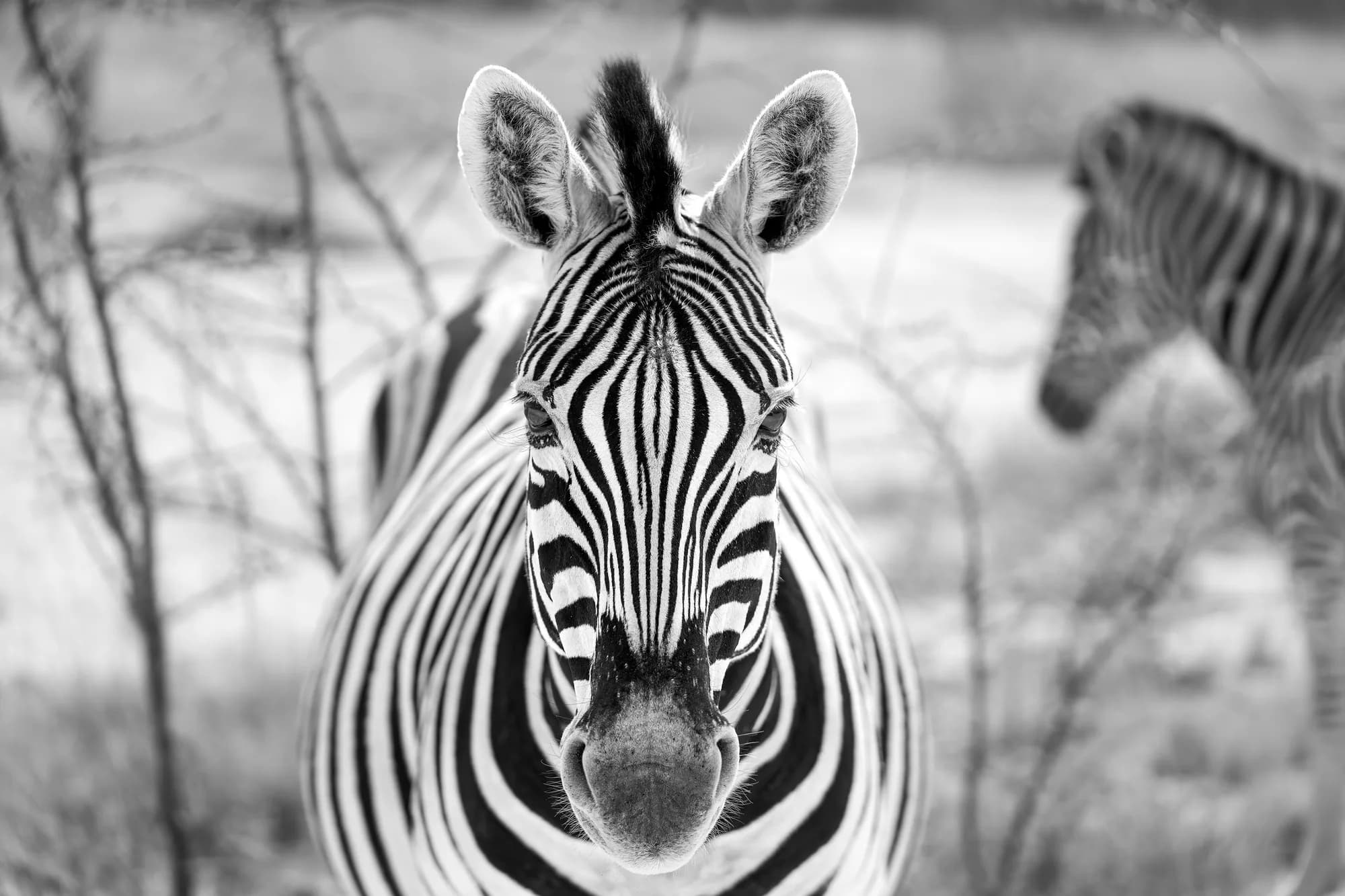
Look underneath. A mountain zebra has a plain white unstriped belly; a plains zebra’s stripes wrap right under. Then look at the throat: mountain zebras have a dewlap, a loose fold of skin hanging below the jaw, which no other zebra has. Then the rump, which carries a distinctive gridiron — a set of short horizontal bars laid across the broad stripes.
Separating the two mountain zebras from each other is harder and mostly geographic. Hartmann’s, in Namibia and the Northern Cape, is slightly larger and paler with narrower stripes; the Cape animal is stockier with broader black stripes and a more pronounced dewlap. If you are in the Eastern Cape it is the Cape subspecies, and if you are on the Namibian escarpment it is Hartmann’s.
Eighty animals
By the 1950s the Cape mountain zebra was down to roughly eighty animals in three relict groups, having been shot out of the Cape fold mountains as competition for sheep grazing. Mountain Zebra National Park was proclaimed in 1937 to save it and the original herd there died out anyway; the park was restocked from surviving farm populations.
There are several thousand now across a network of parks and private land, and the IUCN category on this page has improved more than once. It is one of the very few animals on this site where the honest story is recovery rather than decline — and the reason it is worth driving to Cradock for.
Status and protection
Status and protection
- IUCN Red List
- Pending
- Population trend
- · Unknown
Not yet verified against the source. These four values are written from knowledge and are awaiting a checked IUCN assessment, schedule and appendix — treat them as indicative until this line disappears.
Assessed not yet retrieved
What to book to see one
What you would be booking
- How it is seen
- Self-drive. Mountain Zebra National Park is built for it, and the loops go up onto the plateau where the animals are.
- Drives to book
- One or two. In the right park they are common and unhurried.
- Zone or shift
- The Rooiplaat plateau loop at Mountain Zebra National Park is the reliable place, especially in the morning.
Mountain Zebra National Park was proclaimed in 1937 specifically to save this animal, and it very nearly failed — the original herd died out and the park was restocked from neighbouring farms. Almost every Cape mountain zebra alive descends from three tiny relict groups.
Mountain ZebraOn the same trip you would also get
- Hartmann's mountain zebra — the other subspecies, further north
- Grey rhebok — the same Cape slopes
Questions people ask
Where can I see Cape mountain zebra?
How do I tell a mountain zebra from a plains zebra?
How rare is the Cape mountain zebra?
Read next

The Namibian escarpment, from the Kunene to the Orange
Hartmann's mountain zebra
Read the trend before the category. This is a genuine subspecies assessment and it says Vulnerable and increasing — the listing records how far the animal fell, not where it is going. It lives on the arid escarpment above the Namib, it digs its own wells in dry riverbeds, and most of them are not in national parks at all.
Five countries here, and half the migration
Plains zebra
Seen on the first morning of every trip and worth more attention than it gets. Zebra make up a large part of the great migration, they are the reason the wildebeest can eat, and the three zebra species on this site are not interchangeable.
Mountain Zebra National Park