

Species · Allochrocebus lhoesti
L'Hoest's monkey
A dark monkey with a white bib and a chestnut saddle that spends much of its day walking on the forest floor, which no other monkey in these forests does. Almost nobody books a trip for it and almost everybody who treks for gorillas or chimpanzees walks past one.
Also called
- Mountain monkey · English, in the field
Checked 28 Sept 2026
- Where
- Rwanda, Uganda, and the Albertine Rift
- Best months
- Jun–Sep and Dec–Feb, for walking
- Unusual for
- A guenon that forages on the ground
- Odds
- Good over two or three forest walks
An Albertine Rift endemic: the forests of eastern DR Congo, Rwanda, Burundi and western Uganda, and nowhere else. Its two closest relatives live thousands of kilometres west — the sun-tailed monkey in Gabon and Preuss's monkey on the Cameroon–Nigeria border — which is the clue that this is an old lineage left stranded by forest that has since retreated.
Where it is
HabitatMontane and mid-altitude rainforest, roughly 900 to 2,500 m, with a strong preference for the understorey and the forest floor rather than the high canopy. It tolerates secondary growth and forest edge, and it will cross into gardens next to the park.
Worth travelling for
Nyungwe is the most reliable place on this site to see one, and often from the trail or the main road rather than from a trek.
Regular along the Buhoma road in Bwindi and on gorilla treks, and one of the thirteen primate species at Kibale.
Also occurs
DR CongoBurundi
Present, but not where you would go to see one.
Gone from
The forest that once connected the Albertine Rift blocks, now farmland — what is left is a chain of islands rather than a range
Range this species has been lost from. It is the fact a map of where it currently lives cannot show you.
Where to actually go
Ranked, with the reason each — these are not interchangeable.
- 01NyungweRwandaThe most reliable park for this species and the only one where it is worth planning around. Groups work the trail network and the main road, and the park's primate list is long enough to justify two or three days of walking.Worth its own day here
- 02Bwindi ImpenetrableUgandaRegular along the Buhoma road and encountered on gorilla treks. You will be here for the gorillas; this is what you see on the walk in and out.A bonus on a gorilla permit
- 03KibaleUgandaOne of thirteen primate species in one forest, and not the easiest of them. Ask for a general primate walk rather than a chimpanzee permit if this is what you want.Ask for the primate walk
Where you will not see one
- Kenya and TanzaniaThe whole world range is the Albertine Rift. There is no L'Hoest's monkey at Kakamega, on Kilimanjaro, in the Mara or anywhere in the Eastern Arc, and a dark monkey in those forests is something else.
- The Virunga volcanoesVolcanoes and Mgahinga are bamboo and high montane forest, and the monkey to look for there is the golden monkey. L'Hoest's is a forest-understorey animal of the lower, wetter blocks.
- The savanna side of the Ugandan parksQueen Elizabeth's plains, Murchison's grassland, Akagera. Forest primate, forest only.
When to go
When to go
- J
- F
- M
- A
- M
- J
- J
- A
- S
- O
- N
- D
January: good. February: good. March: marginal. April: marginal. May: marginal. June: best. July: best. August: best. September: good. October: marginal. November: marginal. December: good.
Through the day
- Dawn
- Morning
- Midday
- Afternoon
- Dusk
- Night
Dawn: active. Morning: most active. Midday: usually resting. Afternoon: active. Dusk: usually resting. Night: not normally seen.
Realistic odds on a three-day trip
- Near-certain
- Likely
- Lucky
- Expedition
Telling it apart
Told apart from
Blue monkey
All three parks, constantly
The bib settles it. L'Hoest's carries a clean white throat and chest patch and a chestnut saddle across the back; a blue monkey is uniformly grizzled grey with a pale brow band and no bib. Also look at where the animal is: if it is walking on the ground, it is not a blue monkey.
Grey-cheeked mangabey
Kibale, where both are on the primate list
Shaggier, with a mane over the shoulders and pale grey cheek tufts, and it has a loud whooping call that carries for hundreds of metres. It also stays high. L'Hoest's is compact, glossy and quiet.
Olive baboon
Forest edges and roadsides in all three parks
The other monkey you will meet walking on the ground here, and four times the size, with a long dog-like muzzle. Baboons travel in large noisy parties on roads and clearings; L'Hoest's slips across a trail in ones and twos and is gone.
Marks chosen to be usable from a moving vehicle — a l'hoest's monkey is rarely still and never close enough for anything subtler.
What it looks like in the field


Photographs of L'Hoest's monkey in the wild, in Indian reserves. We publish no captive, baited or digitally composited images, and no photograph whose licence we cannot show.
Photographing it
- Lens
- A fast 300mm. The subject is often at twenty metres in deep shade under closed canopy, and it will not wait.
- Typical distance
- Ten to thirty metres, roughly level with you, which is a rarity among these forest primates.
- Light
- The darkest conditions on this site outside a night drive. Understorey at dawn under montane cloud forest. Push the ISO and accept the grain.
Where to stopDo not follow a group off the trail. These are shy animals in parks where leaving the path is also against the rules, and pursuing a group that has already moved away just teaches it that people are a pressure.
Signs and calls
- Turned litter
- Freshly flipped leaves, lifted bark and rolled rotten wood along a metre or two of trail edge. This is a monkey that forages like a small pig, and the disturbance is recent enough to be worth standing still for.
- A tail going up
- The commonest actual sighting is the last quarter-second of one: a dark shape crossing the trail with the tail carried in a raised hook. Learn that silhouette, because it is often all you get.
- Silence where there was noise
- Groups fall quiet when they detect people and freeze rather than flee. If the understorey has gone abruptly still around you, stop walking and wait two minutes rather than pushing on.
The guenon that walks
Nearly every forest monkey in these parks lives above your head and stays there. This one does not. L’Hoest’s spends a large part of the day on the forest floor and in the low understorey, turning leaf litter, lifting bark and rolling rotten wood for insects, and it sleeps in trees mainly because the ground at night belongs to something else. That habit is the reason it is worth a paragraph: it is the one monkey here you are likely to meet at eye level, on a trail, at walking pace.
It also means you find it differently. A blue monkey is located by listening for debris falling out of the canopy; L’Hoest’s is located by stopping when the understorey goes quiet, or by catching a dark body with a white bib crossing twenty metres ahead with its tail carried up in a hook. Groups are small, usually one adult male with several females and young, and they are shy in a way habituated apes are not.
Bonus animal, or its own morning
In Bwindi and Kibale this is a bonus. The permit in your pocket is for a gorilla group or a chimpanzee community, the day is organised around that, and L’Hoest’s is what crosses the road on the drive to the trailhead or moves off the path ahead of the trackers. Nobody should book Bwindi for this monkey and nobody needs to.
Nyungwe is the exception, and it is a real one. It is a large, old montane forest with a long primate list and a trail network that puts you into the understorey for hours at a time, plus a main road that works as one of the better primate transects in Africa if you drive it slowly at first light. A day at Nyungwe spent walking rather than chimpanzee tracking is a day this species can actually fill.
Status and protection
Status and protection
- IUCN Red List
- Vulnerable
- Population trend
- ↓ Decreasing
Species-level assessment, filed under Allochrocebus lhoesti; older sources use Cercopithecus lhoesti.
Assessed 2019 · IUCN Red List assessment
What to book to see one
What you would be booking
- How it is seen
- A guided forest walk, or whatever trek you already booked. Every one of these three parks requires you to be with a guide on the trails, so there is nothing extra to arrange.
- Drives to book
- None of its own. If you are in Nyungwe for two days of trail walking you will very likely see one; if you are in Bwindi for a single gorilla permit, treat it as a bonus.
- Zone or shift
- In Nyungwe, the Igishigishigi and Karamba trails and the main road through the park, which is one of the best primate transects in Africa from a slow-moving vehicle. In Bwindi, the Buhoma road and the trail up from the park headquarters. In Kibale, the main trail grid on a general primate walk rather than on a chimpanzee permit.
This is a bonus animal in Bwindi and Kibale, where the permit in your pocket is for something much larger. Nyungwe is the one park where a day spent looking for monkeys rather than apes is a day well spent, because the primate list there is long and the trails deliver it.
NyungweOn the same trip you would also get
- Chimpanzee — Nyungwe and Kibale, the trek you booked
- Mountain gorilla — Bwindi, and the reason you are there
- Black-and-white colobus — the same trails, high instead of low
Questions people ask
Where can you see L'Hoest's monkey?
How do you tell L'Hoest's monkey from a blue monkey?
Is L'Hoest's monkey endangered?
Do I need a permit to see one?
Read next
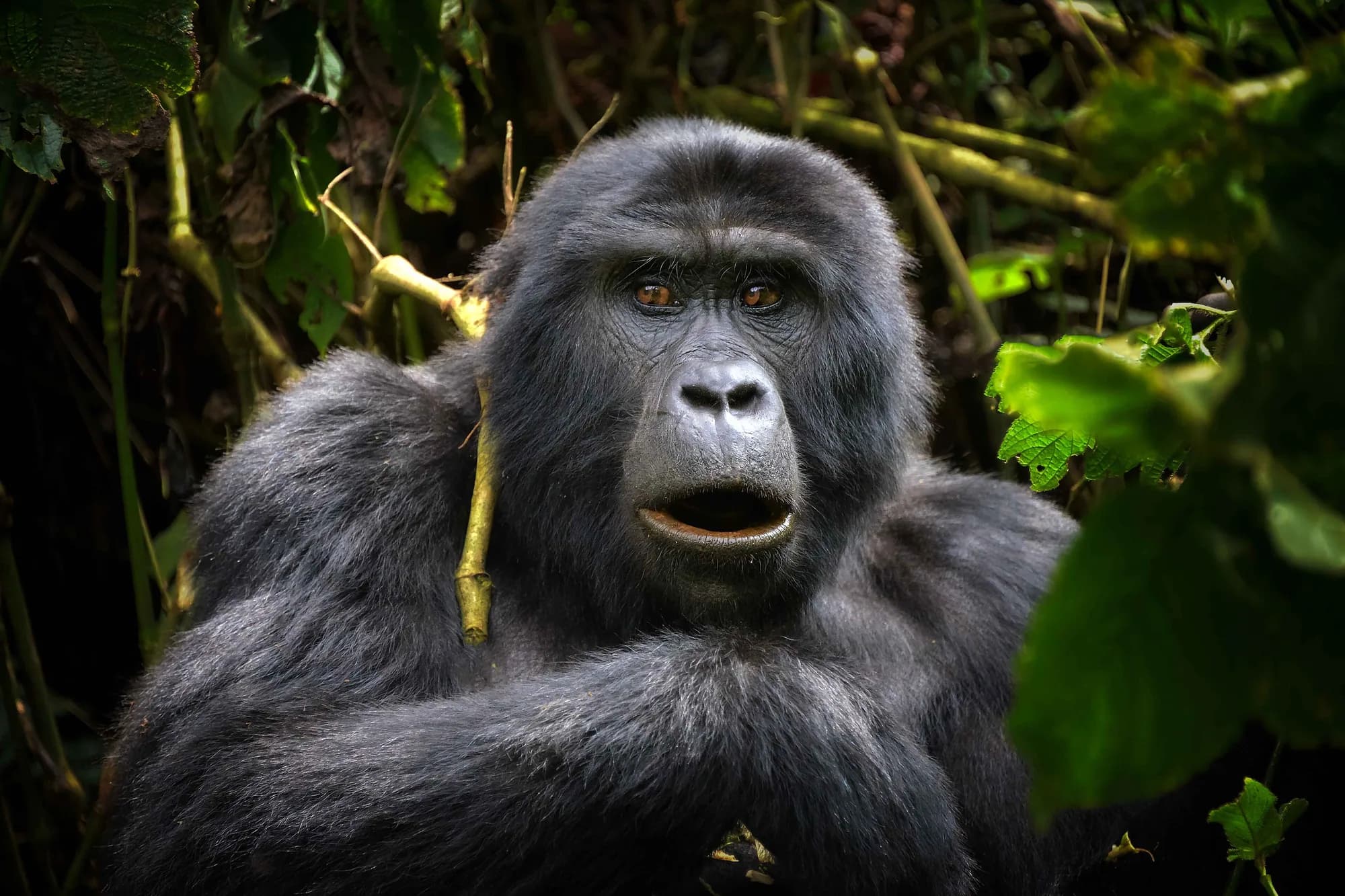
Bwindi, Mgahinga, Volcanoes — and nowhere else on earth
Mountain gorilla — the permit you bought
Three national parks on this site hold the entire world population, and one hour with a habituated group is the most expensive and most reliably delivered wildlife encounter in Africa. It is also the rare conservation story that has gone the right way.
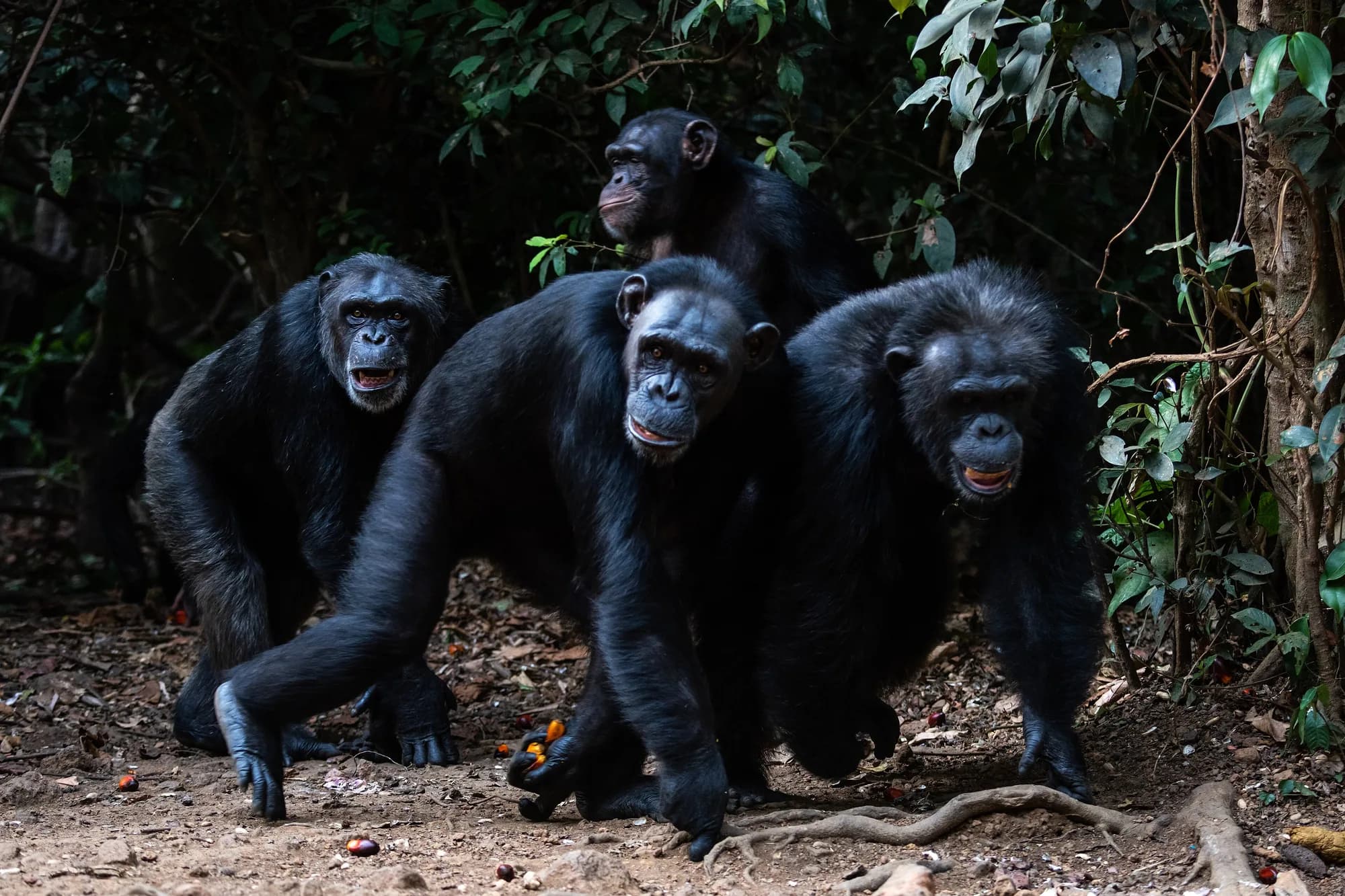
Uganda, Rwanda and western Tanzania
Chimpanzee
Louder, faster and far harder to keep up with than a gorilla, and the trek is nothing like the same experience. Kibale is the reliable one; Mahale, on the shore of Lake Tanganyika, is the one people remember.
Nyungwe