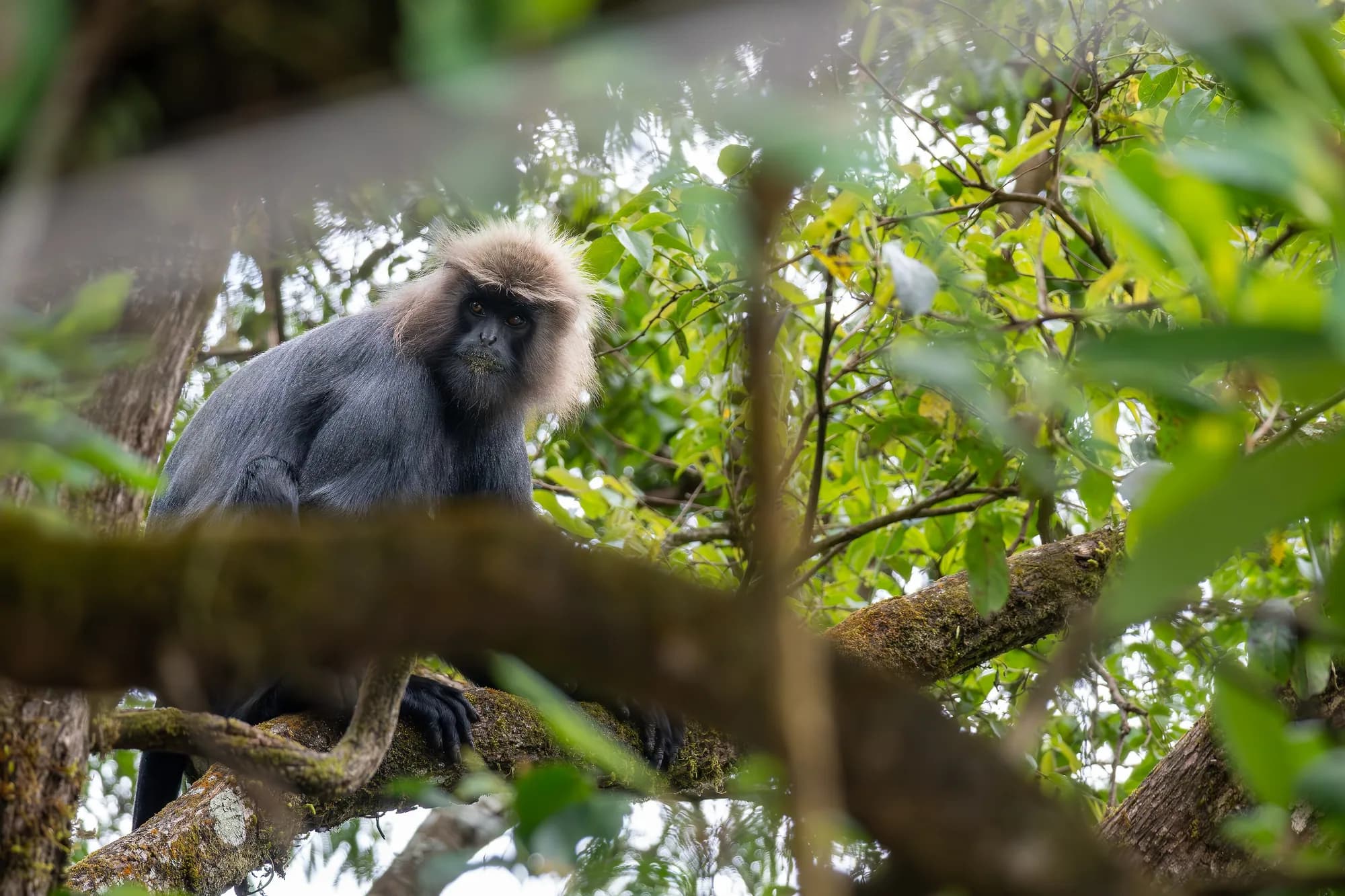
Species · Semnopithecus vetulus
Purple-faced langur
An Endangered monkey found on one island and nowhere else, in four forms that look different enough to be argued over. The shaggy highland one at Horton Plains — the bear monkey — is what most visitors actually meet, and the lowland form in the wet zone west of Colombo is among the most threatened primates in South Asia.
Also called
- Kalu wandura · Sinhala
- Bear monkey · English, hill country
Checked 28 Sept 2026
- Where
- Sri Lanka, and nowhere else
- Best months
- Jan–Mar; Jan–Apr and Aug–Sep in the wet zone
- Forms
- Four, and the hill one looks different
- Odds
- Good at Horton Plains, on foot
Endemic to Sri Lanka and found across most of the island's remaining forest, from the wet-zone lowlands through the hill country to dry-zone patches in the north and east. The four recognised forms divide roughly along those lines, and the one at Horton Plains looks so unlike the one at Sinharaja that visitors regularly report them as different animals.
Where it is
HabitatClosed forest of almost any kind the island still has: lowland rainforest, riverine strips in the dry zone, plantation edge, and montane cloud forest to well above 2,000 m. It is a leaf-eater, so it needs canopy rather than fruiting trees, and a troop will hold a very small patch of forest for years.
Worth travelling for
The whole world range. Horton Plains for the highland bear monkey, Sinharaja for the lowland wet-zone form, Wasgamuwa for the dry-zone one and almost no other vehicles.
Gone from
Most of the wet-zone lowland forest in the west of the island, now the built-up belt around Colombo — the langurs there survive in home gardens and rubber rather than in forest
Range this species has been lost from. It is the fact a map of where it currently lives cannot show you.
Where to actually go
Ranked, with the reason each — these are not interchangeable.
- 01Horton PlainsSri LankaCloud forest at over two thousand metres and the home of the shaggy highland bear monkey, on a walking loop most visitors are doing anyway for World's End. The form most people see, in the place they are most likely to be.The bear monkey, on foot
- 02SinharajaSri LankaThe island's last substantial tract of primary lowland rainforest and a UNESCO site, holding the wet-zone form. High closed canopy, a compulsory guide, and the best forest walking in the country.The lowland form, with a guide
- 03WasgamuwaSri LankaDry-zone riverine forest between the Mahaweli and the Amban, with the northern form and almost no other vehicles. A jeep park rather than a walking one.The dry-zone form, and no crowds
Where you will not see one
- IndiaThis is a Sri Lankan endemic. The very similar dark langur of the Western Ghats is the Nilgiri langur, a separate species on the other side of the Palk Strait.
- On the ruins at Sigiriya, Anuradhapura and PolonnaruwaThe grey monkeys sitting on the stonework are tufted grey langurs, and the brown ones going through your bag are toque macaques. Purple-faced langurs are darker, shyer and stay in the trees.
- Horton Plains, expecting the lowland animalThe langur up there is the highland form and it is shaggy, browner and thicker-coated. If you have seen one at Sinharaja and one at World's End and thought they were different species, that is a reasonable mistake and this page exists partly to settle it.
- The open dry-zone plainsSections of Yala, Bundala and Udawalawe that are scrub and grassland hold no langurs at all. They follow the riverine forest and the wooded patches.
When to go
When to go
- J
- F
- M
- A
- M
- J
- J
- A
- S
- O
- N
- D
January: best. February: best. March: best. April: good. May: marginal. June: marginal. July: marginal. August: good. September: good. October: marginal. November: good. December: good.
Through the day
- Dawn
- Morning
- Midday
- Afternoon
- Dusk
- Night
Dawn: most active. Morning: active. Midday: usually resting. Afternoon: active. Dusk: active. Night: not normally seen.
Realistic odds on a three-day trip
- Near-certain
- Likely
- Lucky
- Expedition
Telling it apart
Told apart from
Tufted grey langur
Everywhere in the dry zone, and at every cultural site
Pale silver-grey with a pinkish-grey face, and comfortable on the ground, on walls and beside roads. The purple-faced langur is near-black with pale side-whiskers and stays up. If it is sitting on a temple wall in the open, it is the grey one.
Toque macaque
Car parks, rest houses and every roadside stall on the island
Brown, short-tailed, with a whorl of hair on the crown, and the monkey that raids. Macaques travel on the ground in large noisy troops; langurs move through the canopy in smaller quiet ones.
The bear monkey versus the lowland form
Horton Plains against Sinharaja
Not two species. The highland form is shaggier, browner and thicker-coated, with a paler head, and lives above roughly 1,500 m; the wet-zone lowland form is sleeker and darker. Same species, different subspecies, and the difference is real enough to be worth knowing before you are asked to identify one.
Nilgiri langur
Across the Palk Strait, in books rather than in the field
A different species in a different country, and the closest relative this animal has — glossy black with a golden-brown head, in the Western Ghats. Not in Sri Lanka, and the purple-faced langur is not in India.
Marks chosen to be usable from a moving vehicle — a purple-faced langur is rarely still and never close enough for anything subtler.
What it looks like in the field


Photographs of Purple-faced langur in the wild, in Indian reserves. We publish no captive, baited or digitally composited images, and no photograph whose licence we cannot show.
Photographing it
- Lens
- 300mm to 400mm, and a body you trust at high ISO. Wet-zone canopy under cloud is dark even at ten in the morning.
- Typical distance
- Fifteen to thirty-five metres, steeply upward, and at Horton Plains often through mist.
- Light
- Consistently poor and high in contrast — a black animal against white sky. Expose for the langur, let the sky go, and look for the rare troop that comes down to the forest edge where the light is lateral.
Where to stopDo not feed them, and do not let a driver or guide do it to bring a troop closer. Roadside feeding is exactly how the western population ended up dependent on gardens and exactly what kills monkeys on Sri Lankan roads and power lines.
Signs and calls
- Falling debris
- Bitten shoots, leaf stalks and fragments dropping onto a wet path. In Sinharaja's closed canopy this is usually the first thing you notice, and it arrives several seconds before anyone finds the animal.
- Canopy movement
- Crowns swaying in sequence with no wind, and the heavy crash of a langur landing — they are large monkeys and they do not land quietly. Follow the line, not the sound.
- Mist and silhouette
- At Horton Plains the sighting is often a shape in cloud twenty metres up. A long tail hanging straight down below a hunched body is the shape to learn, because colour will tell you nothing in that light.
- Company
- Purple-faced langurs are frequently in or near the mixed-species bird flocks that Sinharaja is known for, because both are working the same trees. If the flock arrives, look up as well as across.
Who gives it away
Male purple-faced langur
A loud, harsh whooping bark, repeated, given mostly at dawn and carrying a long way through wet forest. It is territorial as much as anything, and it is the single most reliable way to locate a troop.
The sound to walk towards at first light
The troop, disturbed
Sharp coughing barks and a burst of crashing as the group moves away through the canopy. Usually a person on the path rather than anything else.
Means they have already seen you
Toque macaque
A thin, rising scream and a great deal of chattering. Constant, and nearly always about another macaque.
Low — it is almost never about a predator
Alarm calls announce a predator, not specifically a purple-faced langur, and a great many of them announce nothing at all. They are a reason to stop the vehicle, which is most of what finding one takes.
The bear monkey
Above roughly 1,500 metres the purple-faced langur grows a different coat, and the result is strange enough to have earned its own name. The highland form is shaggy, thick and brown-tinged where the lowland animal is sleek and near-black, with a paler, almost grizzled head, and in cloud and drizzle at Horton Plains it genuinely reads as a small bear in a tree. Sri Lankans call it the bear monkey, and so does everyone who has seen one.
It is also, for most visitors, the only purple-faced langur they will meet. Horton Plains sits on almost every hill-country itinerary because of World’s End, the loop has to be walked before nine before the cloud closes in, and the cloud-forest sections of that walk are where the bear monkeys are. That is an unusual piece of luck: the rarest-looking form of an Endangered endemic is the one on the standard tourist route.
Four forms, one island
Four subspecies are generally recognised and they sort roughly by climate zone: the wet-zone lowland form in the southwest around Sinharaja, the western form in the lowlands behind Colombo, the northern and dry-zone form at places like Wasgamuwa, and the highland bear monkey. They differ in coat length, in how brown or black they are, and in how pale the head and rump patches read.
The status above is a species-level assessment of Semnopithecus vetulus — Endangered, and decreasing — across all four. That is the honest figure to quote, and it flattens some real differences: the forms are not equally threatened, and one of them is in far more trouble than the number suggests.
The langur in the suburbs
The western purple-faced langur lives in the wet lowlands behind Colombo, which is the most densely populated part of the island and almost entirely without forest. What is left of the population survives in home gardens, rubber smallholdings and roadside trees, eating cultivated fruit and jackfruit leaves, electrocuted on power lines and killed on roads. It has appeared repeatedly on the list of the world’s twenty-five most endangered primates that primatologists publish every two years.
You will not see it in a national park, because it does not live in one. It is worth knowing about anyway: it is the clearest illustration on this site of a species being Endangered as a whole while one part of it is in genuinely critical trouble, and of how little a single category can carry.
Status and protection
Status and protection
- IUCN Red List
- Endangered
- Population trend
- ↓ Decreasing
Species-level assessment for Semnopithecus vetulus, endemic to Sri Lanka. Older sources file it under Trachypithecus vetulus.
Assessed 2020 · IUCN Red List assessment
What to book to see one
What you would be booking
- How it is seen
- On foot, and in two of the three parks with a guide. Horton Plains is a self-guided walk on a fixed loop; Sinharaja requires a licensed guide to enter; Wasgamuwa is a jeep park where the langurs are along the river forest.
- Drives to book
- One early walk at Horton Plains gives good odds on the bear monkey. At Sinharaja, two mornings with a guide, because the canopy is high and closed and the birds will keep distracting everyone. At Wasgamuwa, two game drives.
- Zone or shift
- At Horton Plains, the cloud-forest sections of the World's End loop rather than the open patana grassland — and start at first light, because the loop has to be walked before nine or the cloud closes the view anyway. At Sinharaja, the main research-station trail. At Wasgamuwa, the forest along the Mahaweli and Amban rivers.
Horton Plains is the one most people will reach without planning for it, because the World's End walk is on almost every hill-country itinerary. Sinharaja is worth its own day or two, and the guide is compulsory rather than optional, so build it into the timing.
Horton PlainsOn the same trip you would also get
- Sri Lankan elephant — Wasgamuwa, on the same drive
- Sambar — Horton Plains, on the grassland at dawn
- Sloth bear — Wasgamuwa, if you are very lucky