
Uganda / Bwindi Impenetrable / Best time to visit — Bwindi Impenetrable
Best time to visit — Bwindi Impenetrable
The gorillas are tracked every day of the year. What changes is the mud, the price, and how hard the walk is.
Two dry windows
The year
| Months | Conditions | Permit |
|---|---|---|
| June – September | Drier; the main season | USD 800 |
| December – February | Drier; second season | USD 800 |
| March, October | Wet, fewer people | USD 800 |
| April, May, November | Wettest | USD 600 |
The low-season discount lands precisely on the three wettest months. That is not a coincidence — UWA introduced it to stimulate travel when demand falls.
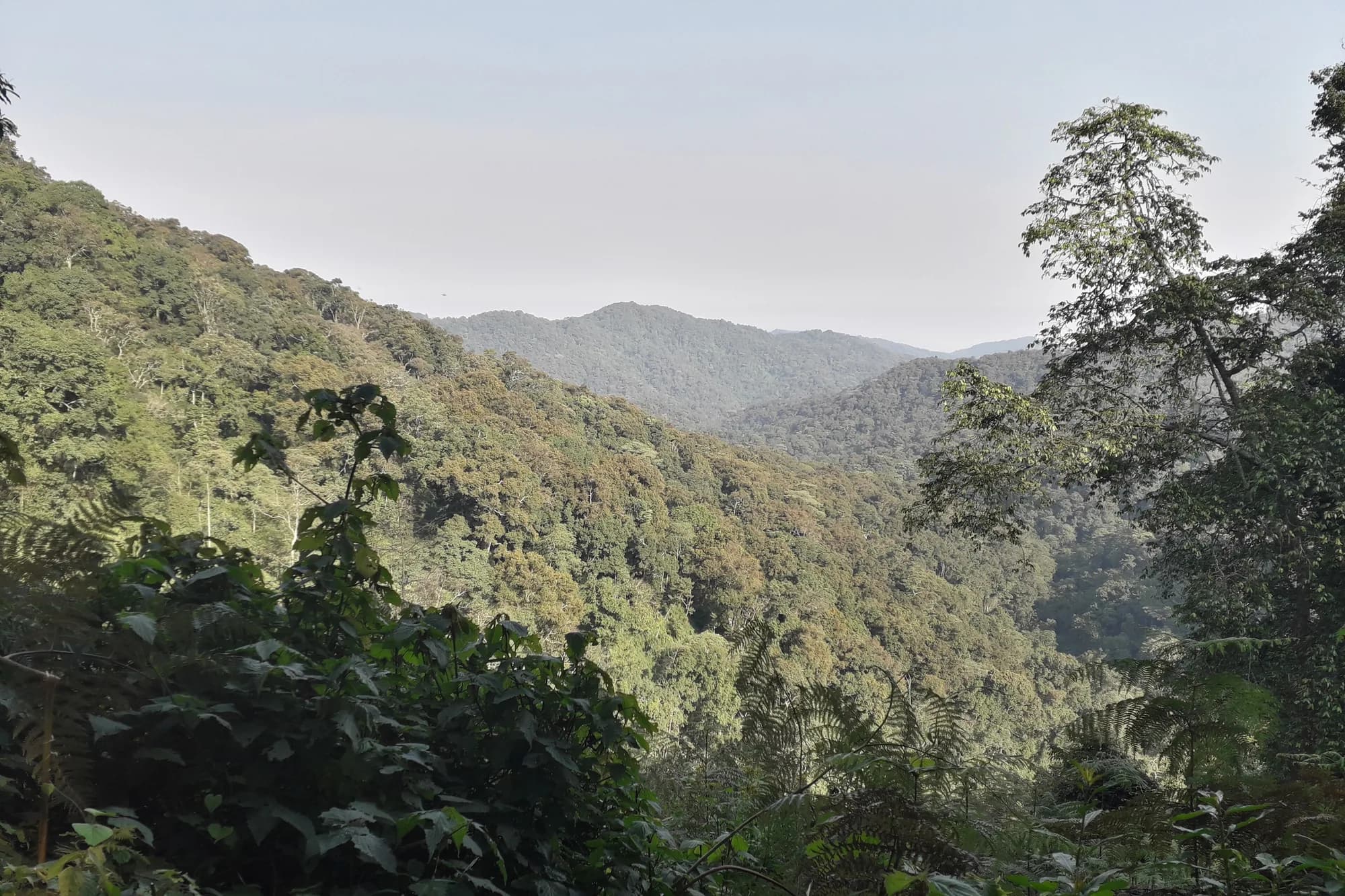
Bwindi is rainforest and it rains in every month. The dry windows are relative rather than dry, and a trek in July can still be a mud bath. What the dry months buy is a shorter, less slippery walk on steep ground.
Altitude does the rest. UWA gives the park as running from 1,160 to 2,607 metres, and Ruhija sits near the top of that. Even in the dry windows the high sectors are cold at night and often in cloud by mid-morning. Nobody packs for cold in equatorial Africa, and at Ruhija in July everybody wishes they had.
UWA — Introduction of low season gorilla and chimpanzee permit rates, 26 February 2026
The Executive Director's circular, reference TDO 93/04, signed by Dr James Musinguzi. A scanned two-page letter. It introduces the April, May and November rates with immediate effect, publishes the structure taking effect 1 January 2027, and suspends the seven-day reservation window from 1 March 2026. Read 28 September 2026.
https://ugandawildlife.org/wp-content/uploads/2026/03/Tariff-changes-2026-2027.pdfUganda Wildlife Authority — Bwindi Impenetrable National Park
UWA's own park page. Read 28 September 2026. The source here for the park's area and altitude, the gorilla population figure, the species counts, the number of habituated groups, and UWA's own published road distances and routes.
https://ugandawildlife.org/national-parks/bwindi-impenetrable-national-park/The case for the wet months
- The permit is USD 600 rather than USD 800 — a saving of USD 200 per person, per trek.
- Lodges discount heavily, and availability opens up at short notice.
- Fewer trekkers in the forest and on the trails.
- The forest is at its most striking wet, and photography in soft overcast light is better than in harsh sun.
And the case against
Steep, deep mud makes the trek materially harder and longer, and the roads around the park deteriorate. Low-season permits cannot be rescheduled. If you are not confident on your feet on wet ground, the USD 200 is worth paying.
The reschedule point is the one that catches people, because it interacts with everything else. A normal-season permit rescheduled late costs 25 per cent of the fee — USD 200 on an USD 800 permit. A low-season permit cannot be rescheduled at any price. So the saving and the penalty are the same number, and the low-season permit is the one you cannot move if you wake up with a cold. For a traveller with firm dates and a strong constitution it is free money. For anyone else it is a bet.
Month by month
Bwindi through the year, with the permit price attached
| Month | Permit, FNR | What it means on the ground |
|---|---|---|
| January | USD 800 | Second dry window; book 6 months out, lodges are full |
| February | USD 800 | Driest end of the second window; the same competition |
| March | USD 800 | Long rains start; full price and wet — the worst value month |
| April | USD 600 | Long rains; cheapest permit, hardest ground, no reschedule |
| May | USD 600 | Long rains ease late; the best of the three cheap months |
| June | USD 800 | Main dry window opens; permits for it went months ago |
| July | USD 800 | Peak. Book 6 to 12 months ahead or take what is left |
| August | USD 800 | Peak, and the busiest briefing rooms of the year |
| September | USD 800 | Dry window closing; slightly easier availability late |
| October | USD 800 | Short rains begin; full price again, like March |
| November | USD 600 | Short rains; the shortest of the three cheap months |
| December | USD 800 | Dry window reopens; Christmas is as tight as July |
The permit column is UWA's. Note what it does at the edges: March and October are wet and cost USD 800, while April, May and November are wet and cost USD 600. If you are travelling in the shoulder anyway, moving a March trip into April saves USD 200 a head for very little change in conditions.
Arriving in the long rains without kit
This is the April and May failure mode and it is entirely self-inflicted. Someone books the USD 600 permit, flies in with the same soft duffel they would take to the Serengeti, and discovers on the morning that a seven-hour trek on 30-degree mud in a cotton shirt and trail runners is a different activity from the one in the brochure. They are not in danger. They are miserable, slow, and holding up seven other people who are also paying by the hour.
- Boots with an aggressive sole and ankle support, worn in before you fly. Not trail runners. The ground is steep mud and tree roots.
- Gaiters. Bwindi's understory is nettles, thorny vines and safari ants, and gaiters are the single item that most changes the day.
- Gardening-weight gloves. You will grab vegetation to stay upright and much of it stings or has thorns.
- A proper waterproof shell, not a poncho. It rains sideways and you are pushing through wet foliage constantly.
- A dry bag or a liner for the camera. Waterproof-ish camera bags lose in Bwindi.
- Long trousers tucked in, long sleeves. Insect cover and vegetation cover in one.
- Two litres of water and something to eat before or after — UWA's rules prohibit eating during the hour with the gorillas.
- A warm layer for Ruhija and Nkuringo at night. The park goes to 2,607 metres.
Weight, if you are flying in
The light aircraft to Kihihi and Kisoro run strict baggage limits in a soft bag, which is exactly the constraint that makes people leave the boots and the shell at home. The answer is to fly in the boots and the shell and check the rest. Nobody has ever regretted wearing their boots on a Kihihi flight.
Timing against the 1 January 2027 change
For most travellers the 2027 structure changes nothing — gorilla tracking is USD 800 before and after. There are exactly three Bwindi lines that move, and if none of them is on your itinerary you can ignore the date entirely.
What changes at Bwindi on 1 January 2027, foreign non-resident
| Line | 2026 | 2027 | Difference |
|---|---|---|---|
| Gorilla tracking | USD 800 | USD 800 | None |
| Gorilla habituation | USD 1,500 | USD 1,800 | USD 300 |
| Long walk, Buhoma to Nkuringo | USD 60 | USD 100 | USD 40 |
| Guided long walk, Rushaga to Nyabaremura | USD 60 | USD 80 | USD 20 |
| Park entrance | USD 40 | Not restated | Unchanged in the circular |
The circular reprices activities, not entrance. Park entrance is set by the 2024–2026 tariff, which runs to June 2026 on its cover and is still the current published document as read in September 2026.
UWA — Introduction of low season gorilla and chimpanzee permit rates, 26 February 2026
The Executive Director's circular, reference TDO 93/04, signed by Dr James Musinguzi. A scanned two-page letter. It introduces the April, May and November rates with immediate effect, publishes the structure taking effect 1 January 2027, and suspends the seven-day reservation window from 1 March 2026. Read 28 September 2026.
https://ugandawildlife.org/wp-content/uploads/2026/03/Tariff-changes-2026-2027.pdfUganda Wildlife Authority — Conservation Tariff 2024–2026
Read 27 September 2026. Read alongside the Executive Director's circular of 26 February 2026, which adds low-season gorilla permits for April, May and November and suspends the seven-day unpaid reservation window. The tariff is printed "subject to change without prior notice".
https://ugandawildlife.org/wp-content/uploads/2024/03/UWA-Conservation-Tariff-July-2024-June-2026.pdfThe three cheap months are not the same month
UWA prices April, May and November identically, and they are not identical. April and May are the long rains — the heavier, more sustained of Uganda's two wet seasons — and November is the tail of the short rains. Treating the three as interchangeable is the commonest mistake made by people who have correctly spotted the discount.
- April is the wettest and the one where roads around the park degrade most. Cheapest permit, hardest logistics.
- May often dries through the second half, which makes late May the best-conditioned of the three low-season months at the same USD 600.
- November is shorter and less intense than the long rains, and it butts directly onto December's dry window — a late-November trip can catch the turn.
- All three are equally non-reschedulable. The permit rule does not soften with the weather.