
Uganda / Bwindi Impenetrable / Wildlife — Bwindi Impenetrable
Wildlife — Bwindi Impenetrable
Bwindi holds roughly half the world's mountain gorillas. It is also the best birding forest in Uganda, which almost no visitor comes for.
Mountain gorillas
Bwindi holds roughly half the entire world population of mountain gorillas, in a forest of about 321 square kilometres. UWA puts the park's own population at approximately 459 individuals. Groups are tracked daily, so a permit is close to a guarantee of a sighting — the variable is how far you walk, not whether you find them.
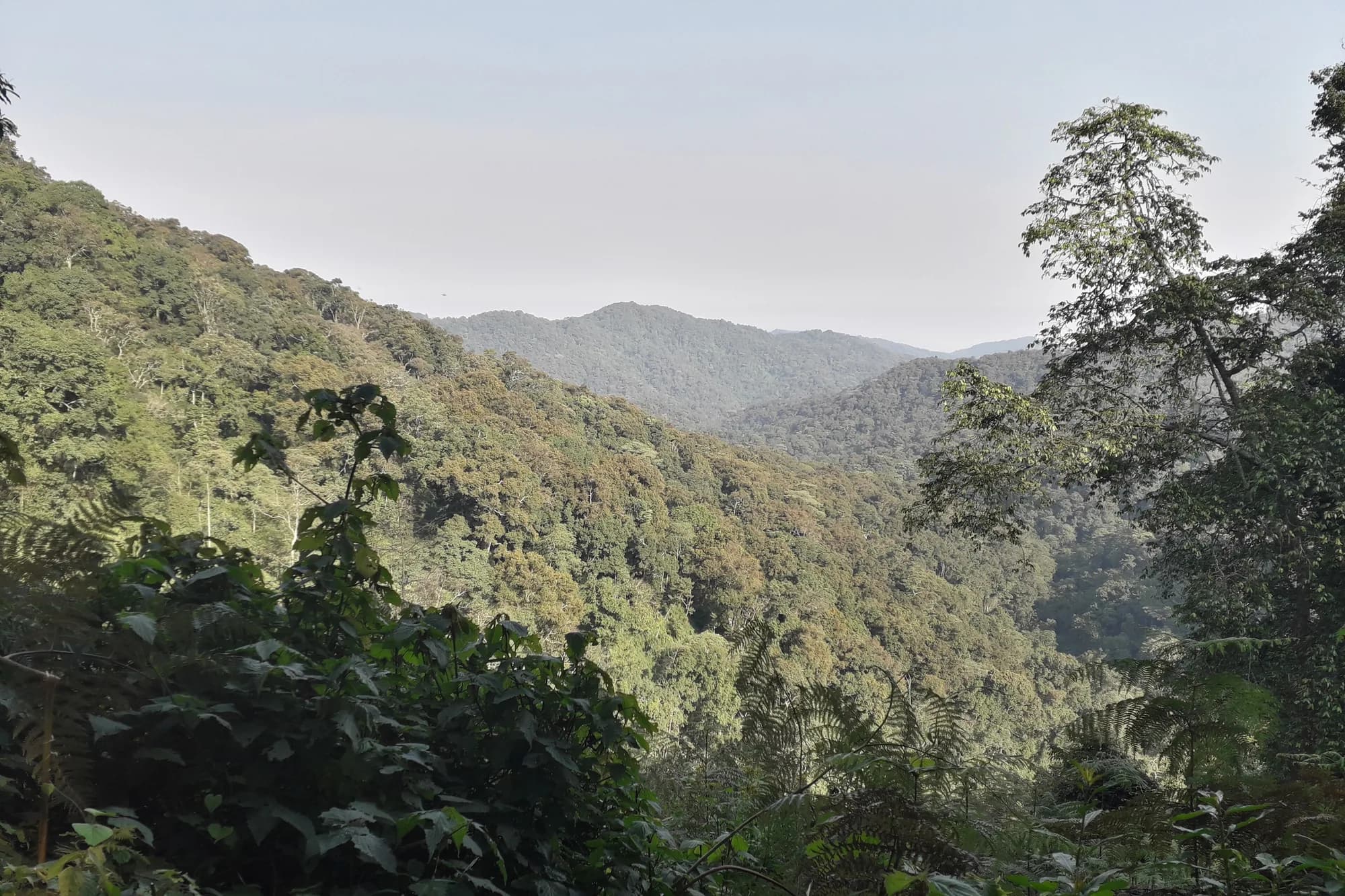
The forest is old in a way that matters to the animals in it. UWA describes Bwindi as over 25,000 years old, which is the reason a patch this size carries 120 mammal species, over 350 birds and 400 plants — it was never cleared and never glaciated, so it kept things the rest of the region lost.
UWA's tracking rules
| Rule | Detail |
|---|---|
| Distance | 10 metres |
| Group size | Maximum 8 visitors per gorilla group |
| Duration | One hour per group per day |
| Health | Do not visit with a cold or other infectious illness |
| Minimum age | 15 |
These are not formalities. Gorillas catch human respiratory infections and have died of them. If you are ill on the morning, say so — you will usually be rebooked rather than lose the permit.
Uganda Wildlife Authority — Bwindi Impenetrable National Park
UWA's own park page. Read 28 September 2026. The source here for the park's area and altitude, the gorilla population figure, the species counts, the number of habituated groups, and UWA's own published road distances and routes.
https://ugandawildlife.org/national-parks/bwindi-impenetrable-national-park/Everything else in the forest
- Around 350 bird species, including roughly two dozen Albertine Rift endemics found nowhere outside this mountain chain. Ruhija is the sector for them, and the Mubwindi Swamp trail is the target.
- L'Hoest's monkey, blue monkey, black-and-white colobus and red-tailed monkey, all commonly seen on forest walks.
- Chimpanzees are present and very rarely seen — do not plan for them here. Kibale is the chimp park.
- Forest elephant exist in the park and are effectively never encountered by visitors.
UWA's counts for Bwindi
| Group | Count | Endemics |
|---|---|---|
| Mammals | 120 species | Includes chimpanzee, baboon, elephant, forest antelope |
| Birds | Over 350 species | 23 Albertine Rift endemics |
| Butterflies | Over 200 species | 8 Albertine Rift endemics |
| Plants | 400 species | Forest age given as over 25,000 years |
Twenty-three endemic birds and eight endemic butterflies in one 321-square-kilometre forest is the statistic that explains why biologists talk about Bwindi differently from the way tour brochures do.
There is no savanna game here at all
No lion, no elephant you will see, no buffalo on a plain, no antelope herds. Bwindi is montane rainforest and the trip is a gorilla trek and a forest walk. Visitors who book Bwindi expecting a general safari have booked the wrong park — Queen Elizabeth or Murchison Falls is what they wanted, and both pair with it easily.
Uganda Wildlife Authority — Bwindi Impenetrable National Park
UWA's own park page. Read 28 September 2026. The source here for the park's area and altitude, the gorilla population figure, the species counts, the number of habituated groups, and UWA's own published road distances and routes.
https://ugandawildlife.org/national-parks/bwindi-impenetrable-national-park/The habituated groups, and what UWA actually publishes
Every operator page carries a confident list of gorilla families by sector. UWA's own park page carries something much thinner, and the gap between the two is worth knowing about before you get attached to the idea of tracking a particular group.
- UWA states that Bwindi has 25 habituated groups, of which nine are available for tourism and one is dedicated to research.
- UWA names Mubare as the first group habituated for tourism in Uganda, in April 1993, which makes Bwindi's tourism programme older than most of the lodges on its boundary.
- UWA's own articles name Oruzogo in Ruhija, Bikyingi in Rushaga — the group the habituation experience is run on — and Bushaho in Nkuringo, which was still under habituation when that page was written.
- UWA does not publish a current roster of which family is open in which sector. It is not on the park page and it is not in the tariff.
Uganda Wildlife Authority — Bwindi Impenetrable National Park
UWA's own park page. Read 28 September 2026. The source here for the park's area and altitude, the gorilla population figure, the species counts, the number of habituated groups, and UWA's own published road distances and routes.
https://ugandawildlife.org/national-parks/bwindi-impenetrable-national-park/Birding — the 23 endemics
Bwindi is the best birding forest in Uganda and it is almost entirely wasted on the people who come here. The reason is the Albertine Rift: a mountain chain running down the western arm of the Rift Valley with a set of species that evolved on it and occur nowhere else on earth. Twenty-three of them are in this one park.
- African green broadbill and Shelley's crimsonwing are the two UWA names, and both are Ruhija birds. The crimsonwing in particular is one of the hardest birds in Africa to see.
- The Mubwindi Swamp trail out of Ruhija is where a serious birding day goes. It is a long walk and a wet one.
- A birding or day nature walk at Bwindi is USD 40 for a foreign non-resident, USD 30 foreign resident, UGX 30,000 EAC, and excludes the entrance fee.
- A night nature walk is USD 50, USD 30 and UGX 20,000 — the only activity in the park where the foreign non-resident pays more than for the daytime version.
- Eight of Bwindi's 200-plus butterfly species are Albertine Rift endemics too, which is the kind of fact that turns a rained-off afternoon into something.
Book a second night at Ruhija, not a second permit
If birds are any part of why you are here, the marginal spend that changes your trip most is not a second gorilla permit at USD 800. It is one more night at Ruhija and a day's walk at USD 40 plus USD 40 entrance. That is USD 80 of UWA fees against USD 800, for the thing Bwindi is actually world-class at and the gorillas are merely famous for.
Uganda Wildlife Authority — Conservation Tariff 2024–2026
Read 27 September 2026. Read alongside the Executive Director's circular of 26 February 2026, which adds low-season gorilla permits for April, May and November and suspends the seven-day unpaid reservation window. The tariff is printed "subject to change without prior notice".
https://ugandawildlife.org/wp-content/uploads/2024/03/UWA-Conservation-Tariff-July-2024-June-2026.pdfUganda Wildlife Authority — Bwindi Impenetrable National Park
UWA's own park page. Read 28 September 2026. The source here for the park's area and altitude, the gorilla population figure, the species counts, the number of habituated groups, and UWA's own published road distances and routes.
https://ugandawildlife.org/national-parks/bwindi-impenetrable-national-park/The rules you will actually be asked to follow
UWA prints its gorilla tracking rules in two parts — before you set out, and when you are with the gorillas. They are read to you at the briefing and they are enforced by the ranger. This is the full list, because the short version everybody quotes leaves out half of it.
Before you set out
| Rule | Detail |
|---|---|
| Documents | Carry your payment receipts and your permit |
| Illness | Do not visit the gorillas with a cold or other infectious illness |
| Age | Minimum 15 years |
| Waste | Human waste is buried 30 cm deep |
| Party size | Maximum eight persons per gorilla group |
When you are with the gorillas
| Rule | Detail |
|---|---|
| Distance | Maintain 10 metres |
| Consumption | No smoking, eating or drinking during the tracking |
| Coughs | Cover your face and turn away from the gorillas |
| Time | One hour per gorilla group per day |
| Photography | No flash |
| Litter | Do not leave litter in the forest |
The no-eating rule catches people out. The trek in can be seven hours and you may not eat during the hour with the group, so lunch happens before or after, not there.
Uganda Wildlife Authority — Conservation Tariff 2024–2026
Read 27 September 2026. Read alongside the Executive Director's circular of 26 February 2026, which adds low-season gorilla permits for April, May and November and suspends the seven-day unpaid reservation window. The tariff is printed "subject to change without prior notice".
https://ugandawildlife.org/wp-content/uploads/2024/03/UWA-Conservation-Tariff-July-2024-June-2026.pdfHabituation — four hours, and a different animal
The gorilla habituation experience is not a longer version of the trek. It puts you with a group that is still being habituated, alongside the researchers and trackers doing the habituating, for four hours rather than one. UWA runs it at Rushaga, and its own articles name Bikyingi as the group it is conducted on.
Tracking against habituation, foreign non-resident
| Tracking | Habituation | |
|---|---|---|
| Time with the group | 1 hour | 4 hours |
| Price now | USD 800 | USD 1,500 |
| Price from 1 Jan 2027 | USD 800 | USD 1,800 |
| Where | All four sectors | Rushaga |
| Daily capacity | 8 per group | Very limited |
The extra three hours cost USD 700 today and USD 1,000 from January 2027. Put differently, an hour of habituation costs USD 233 against USD 800 for the tracking hour — it is the better value per hour and the worse value per pound sterling, which is exactly why it is a real decision.
Who it suits: people who have tracked before and found the hour too short, photographers, and anyone more interested in the research than the encounter. Who it does not: first-timers, anyone unsure of their fitness, and families, since the party is out for most of the day on the same ground. A group under habituation is also by definition less relaxed around people than a tourism group, so the four hours are not four times the intimacy.
Uganda Wildlife Authority — Conservation Tariff 2024–2026
Read 27 September 2026. Read alongside the Executive Director's circular of 26 February 2026, which adds low-season gorilla permits for April, May and November and suspends the seven-day unpaid reservation window. The tariff is printed "subject to change without prior notice".
https://ugandawildlife.org/wp-content/uploads/2024/03/UWA-Conservation-Tariff-July-2024-June-2026.pdfUWA — Introduction of low season gorilla and chimpanzee permit rates, 26 February 2026
The Executive Director's circular, reference TDO 93/04, signed by Dr James Musinguzi. A scanned two-page letter. It introduces the April, May and November rates with immediate effect, publishes the structure taking effect 1 January 2027, and suspends the seven-day reservation window from 1 March 2026. Read 28 September 2026.
https://ugandawildlife.org/wp-content/uploads/2026/03/Tariff-changes-2026-2027.pdf