
Uganda / Lake Mburo / Itineraries — Lake Mburo
Itineraries — Lake Mburo
Almost every Lake Mburo itinerary is one night, and almost every one of them is planned around the drive rather than around the park. The difference between a good stop here and a wasted one is about four hours of scheduling.
How long this park actually needs
What each length buys at Lake Mburo
| Length | What fits | What you miss |
|---|---|---|
| A few hours in transit | One drive on the eastern tracks; zebra, impala, topi, eland | The boat, the salt lick, the night drive, Rubanga — in other words, everything that distinguishes this park |
| One night, arriving late afternoon | Evening drive, night drive, full morning, boat before you leave | Rubanga forest, Kazuma Lookout, a second habitat |
| One night, arriving mid-morning | A morning drive and an afternoon activity, then the clock runs out | The same list, plus you pay a second entrance day for the privilege |
| Two nights | Everything above plus Rubanga, Kazuma, cycling or a horse ride, and a second night drive | Nothing a visitor to this park is likely to want |
| Three or more | Repeat visits to the salt lick and the lake in different light | Nothing — but three nights is more than the park's content supports for most people |
Two nights is the length at which Lake Mburo stops being a stopover and starts being a destination, and the step up in cost is small because the expensive lines here are entrance and the boat rather than a permit. A second night at Rwonyo is UGX 130,000 for a double room including breakfast plus one more day's entrance.
The honest recommendation
One night, arriving in the late afternoon, is the right answer for most people and it is what the park is designed around — UWA's own brochure calls it "ideally placed for an overnight break between Kampala and the protected areas of western Uganda". Two nights is the right answer if you are a birder, if you want to ride or cycle, or if you are coming out from Kampala specifically for this park rather than passing it. A few hours in transit is the version to avoid: it costs a full Category A entrance of USD 40 a head and gives you the one thing — savanna grazers from a vehicle — that Uganda's other parks do better.
Uganda Wildlife Authority — Lake Mburo National Park park brochure, 2018
UWA's own two-page park brochure, linked from the download button at the foot of its Lake Mburo page and hosted on ugandawildlife.org. An 11.6 MB file with a text layer; read 14 October 2026. It is the only UWA document that names the third gate, gives the gate road distances, names the tracks and the two viewpoints, describes the salt lick platform and Rubanga forest, sets out the rainfall months, names the lodges, and states who operates horseback riding and mountain biking here. It disagrees with UWA's own park page on the park's area, its bird count, the number of gates and the status of lion — and in one case it disagrees with itself. Every one of those disagreements is published on this page rather than resolved silently.
https://ugandawildlife.org/wp-content/uploads/2024/05/LMNP-2018-4.pdfUganda Wildlife Authority — Conservation Tariff 2024–2026
Read page by page on 14 October 2026. The 24-page tariff covering entrance, vehicles, boats, aircraft, game drives, walks, camping, UWA accommodation, sport fishing, research fees, fines and a per-park fees summary. Lake Mburo appears in six separate places in it — the Category A entrance band, the launch-cruise table, the nature-walk band, the sport-fishing permit table, the accommodation table and its own one-page summary on document page 22 — and those six places do not always agree with each other. The tariff is printed "subject to change without prior notice" and its cover period, July 2024 to June 2026, expired on 30 June 2026 without a successor appearing anywhere on UWA's site.
https://ugandawildlife.org/wp-content/uploads/2024/03/UWA-Conservation-Tariff-July-2024-June-2026.pdfOne night, hour by hour, built around the ticket
This is a real plan for two foreign non-residents with their own vehicle, arriving from Kampala, sleeping inside the park. Every time in it is chosen against a published constraint: gates at 07:00–19:00, the 24-hour entrance clock, the two-hour boat, and the night-drive rule.
Day one
| Time | What happens | Why this time |
|---|---|---|
| 12:30 | Leave Kampala after an unhurried morning | The 3½-hour UWA drive time puts you at the turning mid-afternoon |
| 16:15 | Turn south off the highway near Akagate for Nshara Gate | The first gate from Kampala, and 9 km of dirt in daylight |
| 16:45 | Through the barrier — the 24-hour clock starts | A late start means expiry at 16:45 tomorrow, well after you leave |
| 17:00 | Check in at Rwonyo; drop bags | Headquarters, and the night drive must be arranged here |
| 17:30 | Evening drive on the eastern tracks or up the Lakeside Track to Kigarama Hill | Last light on the grazers; Kigarama for the view over the lake |
| 19:00 | Back at Rwonyo for dinner | Gates close; you are inside, which is the point |
| 20:00 | Night game drive with a UWA ranger — USD 30 each | Bushbaby, potto, and the park's only realistic leopard chance |
The night drive is the reason the whole plan is built this way. It requires a UWA guide and it is restricted to tourists sleeping within the park, so it is unavailable to anyone who booked a highway bed or a lodge outside the boundary — and it cannot be moved to the morning.
Day two
| Time | What happens | Why this time |
|---|---|---|
| 06:30 | Out on the eastern tracks at first light | You are already inside; no gate to wait for, no access road in the dark |
| 09:00 | Back for breakfast at Rwonyo | Included in the UGX 130,000 guesthouse rate |
| 10:00 | Salt lick walk from Rwonyo with a ranger — USD 25 each | A fixed point animals come to, viewed from the timber platform |
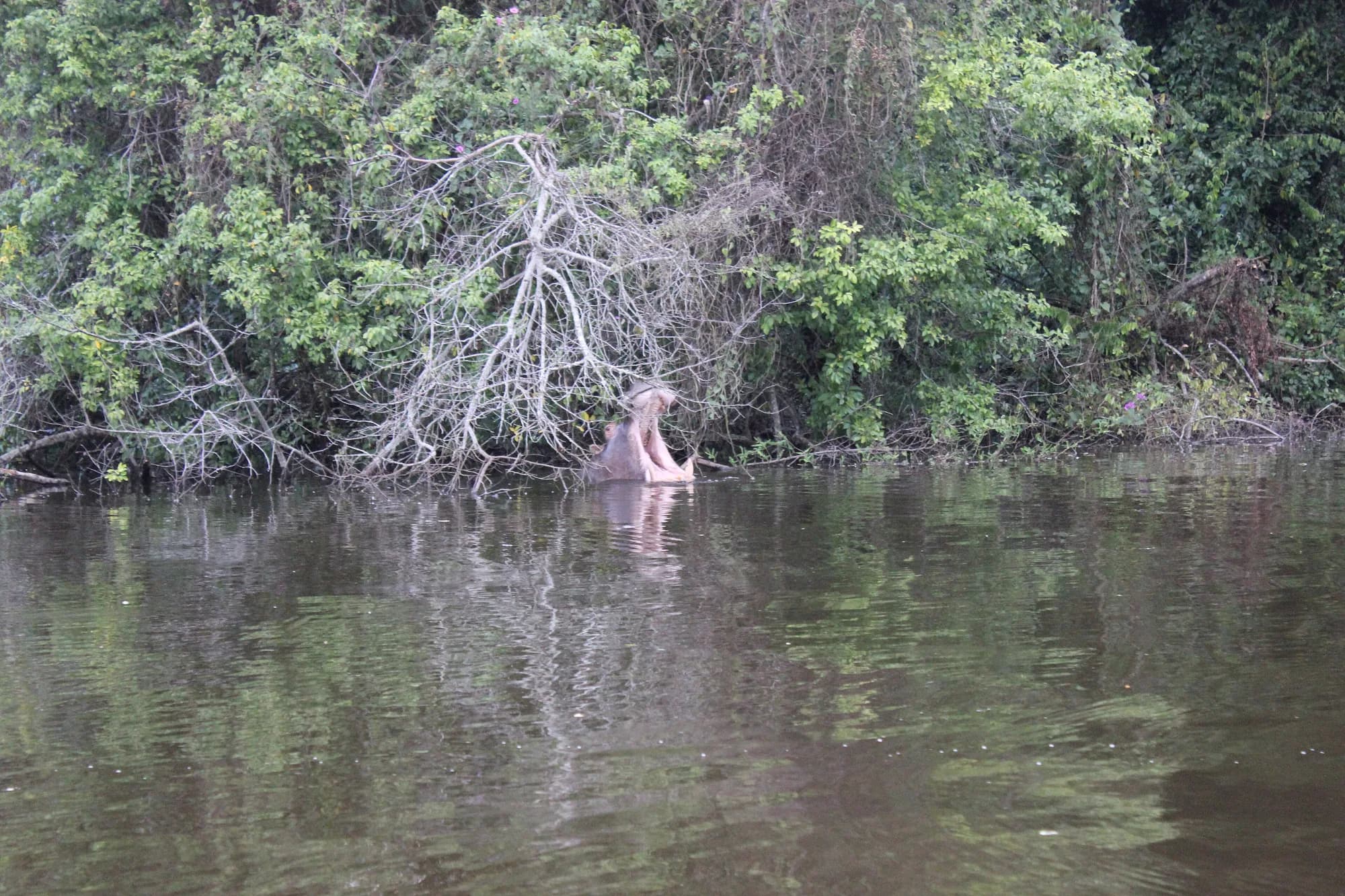
| 12:00 | Boat from the jetty at the lakeside campsite — two hours | Hippo, crocodile, finfoot, the papyrus fringe, the sitatunga swamps |
| 14:15 | Lunch, pack, settle any outstanding fees | The receipt carries your 16:45 expiry; you are comfortably inside it |
| 15:15 | Out through Sanga Gate, westbound | Sanga puts you back on the highway heading for Mbarara and the west |
Total time inside: about 22½ hours, on one entrance ticket. The plan deliberately uses a different gate on the way out — entering at Nshara from the east and leaving at Sanga to the west costs nothing extra and saves backtracking, because entrance is charged per person per 24 hours rather than per gate.
Where this plan breaks
Two places. If you are a couple and nobody else wants the boat, that 12:00 departure costs USD 120 rather than USD 60 because of the four-person minimum — ask at Rwonyo the evening before so staff can combine you with the campsite guests. And if your Kampala departure slips past about 14:30, you are driving the last dirt stretch in failing light towards a 19:00 gate closure; at that point take a bed on the highway and enter fresh at 07:00, accepting that you lose the night drive.
Uganda Wildlife Authority — Conservation Tariff 2024–2026
Read page by page on 14 October 2026. The 24-page tariff covering entrance, vehicles, boats, aircraft, game drives, walks, camping, UWA accommodation, sport fishing, research fees, fines and a per-park fees summary. Lake Mburo appears in six separate places in it — the Category A entrance band, the launch-cruise table, the nature-walk band, the sport-fishing permit table, the accommodation table and its own one-page summary on document page 22 — and those six places do not always agree with each other. The tariff is printed "subject to change without prior notice" and its cover period, July 2024 to June 2026, expired on 30 June 2026 without a successor appearing anywhere on UWA's site.
https://ugandawildlife.org/wp-content/uploads/2024/03/UWA-Conservation-Tariff-July-2024-June-2026.pdfUganda Wildlife Authority — Lake Mburo National Park park brochure, 2018
UWA's own two-page park brochure, linked from the download button at the foot of its Lake Mburo page and hosted on ugandawildlife.org. An 11.6 MB file with a text layer; read 14 October 2026. It is the only UWA document that names the third gate, gives the gate road distances, names the tracks and the two viewpoints, describes the salt lick platform and Rubanga forest, sets out the rainfall months, names the lodges, and states who operates horseback riding and mountain biking here. It disagrees with UWA's own park page on the park's area, its bird count, the number of gates and the status of lion — and in one case it disagrees with itself. Every one of those disagreements is published on this page rather than resolved silently.
https://ugandawildlife.org/wp-content/uploads/2024/05/LMNP-2018-4.pdfWhat the second night actually adds
At most parks the second night is more of the first. At Lake Mburo it is a different park, because the things that do not fit into one night are in different habitats from the things that do.
The second day's options, and what each is for
| Option | Cost to UWA | What it adds that day one did not |
|---|---|---|
| Rubanga forest with a ranger | USD 25 / 20 / UGX 20,000 nature walk | The only forest habitat in the park, on the western side; forest birds found nowhere else here |
| Kazuma Lookout | Nothing beyond the day's entrance | The eight-lake view; the geography of the chain made visible |
| Cycling | USD 30 / 25 / UGX 30,000 permit, plus the bike from a camp | The tracks at ground level and at a speed that is not 40 km/h |
| Horseback ride | No UWA fee — a Mihingo Lodge product | The grassy ridges in the east, which UWA says is where the horses go |
| A second night drive | USD 30 / 15 / UGX 50,000 | A second roll of the dice on leopard, which is the only way to improve those odds |
| Sport fishing | USD 15 for one day, USD 25 for four | From the campsite, with your own equipment, by arrangement |
Only one of these — the forest walk at Rubanga — is in a habitat day one does not touch, and only one, the horse ride, is unavailable at any UWA price. Note that a 4-day sport fishing permit at USD 25 costs USD 10 more than a 1-day permit, which is the only taper UWA publishes for this park and is aimed squarely at someone staying longer than two nights.
The arithmetic of the second night
For two foreign non-residents sleeping at Rwonyo, a second night adds one more day's entrance at USD 80, a second night's room at UGX 130,000 with breakfast — about USD 35 — and whatever activities you choose. Call it USD 115 before activities. Set that against what it unlocks: a forest habitat, a viewpoint, a second predator attempt, and the option to be on a horse or a bicycle. On a Uganda circuit where a single gorilla permit is USD 800, a second Lake Mburo night is the cheapest material improvement available anywhere on the itinerary.
Uganda Wildlife Authority — Conservation Tariff 2024–2026
Read page by page on 14 October 2026. The 24-page tariff covering entrance, vehicles, boats, aircraft, game drives, walks, camping, UWA accommodation, sport fishing, research fees, fines and a per-park fees summary. Lake Mburo appears in six separate places in it — the Category A entrance band, the launch-cruise table, the nature-walk band, the sport-fishing permit table, the accommodation table and its own one-page summary on document page 22 — and those six places do not always agree with each other. The tariff is printed "subject to change without prior notice" and its cover period, July 2024 to June 2026, expired on 30 June 2026 without a successor appearing anywhere on UWA's site.
https://ugandawildlife.org/wp-content/uploads/2024/03/UWA-Conservation-Tariff-July-2024-June-2026.pdfUganda Wildlife Authority — Lake Mburo National Park park brochure, 2018
UWA's own two-page park brochure, linked from the download button at the foot of its Lake Mburo page and hosted on ugandawildlife.org. An 11.6 MB file with a text layer; read 14 October 2026. It is the only UWA document that names the third gate, gives the gate road distances, names the tracks and the two viewpoints, describes the salt lick platform and Rubanga forest, sets out the rainfall months, names the lodges, and states who operates horseback riding and mountain biking here. It disagrees with UWA's own park page on the park's area, its bird count, the number of gates and the status of lion — and in one case it disagrees with itself. Every one of those disagreements is published on this page rather than resolved silently.
https://ugandawildlife.org/wp-content/uploads/2024/05/LMNP-2018-4.pdfWhere it sits on a Uganda circuit
Lake Mburo is on the road to everything in south-western Uganda, which is both why it gets visited and why it gets visited badly. UWA's brochure names the road as the one "that links Kampala to Bwindi, Kabale and the Rwandan border", so the question is never whether you pass it but which night you give it.
The two placements, compared
| First night out of Kampala | Last night before Entebbe | |
|---|---|---|
| Typical arrival | Mid-to-late afternoon if you leave after breakfast | Afternoon, with nothing left to drive to |
| Pressure on the schedule | High — the big permit is ahead of you | Low — the trip's fixed points are behind you |
| Effect on the 24-hour ticket | Tempts an early departure next morning, wasting the back half | Rewards a late arrival and an unhurried departure |
| Night drive | Workable if you arrive by 17:00 | Workable, and you are not tired from a dawn permit |
| Risk if the day runs late | You push on and arrive after 19:00 | You have slack; nothing downstream depends on you |
| Gate you will use | Nshara, the first from Kampala | Sanga, the first from Mbarara |
The asymmetry is about what sits on the other side of the night. A first-night stop has a gorilla permit two days away and a long drive tomorrow, so the instinct is to leave Lake Mburo at 07:00 — which converts a USD 40 entrance into about fourteen hours of use. A last-night stop has an Entebbe flight with a whole day's slack, which is exactly the shape the 24-hour ticket pays for.
The decompression argument
There is a non-financial case for the last night too. A Uganda circuit's fixed points — an 08:00 gorilla briefing at Bwindi, a chimpanzee trek at Kibale — are early, strenuous and scheduled. Lake Mburo has no briefing, no quota, no permit to lose and no dawn obligation, and it is the one park on the route where you can walk around. As the last stop it is a good day. As the first it is an obstacle between you and the thing you came for, and it tends to get treated like one.
Uganda Wildlife Authority — Lake Mburo National Park park brochure, 2018
UWA's own two-page park brochure, linked from the download button at the foot of its Lake Mburo page and hosted on ugandawildlife.org. An 11.6 MB file with a text layer; read 14 October 2026. It is the only UWA document that names the third gate, gives the gate road distances, names the tracks and the two viewpoints, describes the salt lick platform and Rubanga forest, sets out the rainfall months, names the lodges, and states who operates horseback riding and mountain biking here. It disagrees with UWA's own park page on the park's area, its bird count, the number of gates and the status of lion — and in one case it disagrees with itself. Every one of those disagreements is published on this page rather than resolved silently.
https://ugandawildlife.org/wp-content/uploads/2024/05/LMNP-2018-4.pdfUganda Wildlife Authority — Conservation Tariff 2024–2026
Read page by page on 14 October 2026. The 24-page tariff covering entrance, vehicles, boats, aircraft, game drives, walks, camping, UWA accommodation, sport fishing, research fees, fines and a per-park fees summary. Lake Mburo appears in six separate places in it — the Category A entrance band, the launch-cruise table, the nature-walk band, the sport-fishing permit table, the accommodation table and its own one-page summary on document page 22 — and those six places do not always agree with each other. The tariff is printed "subject to change without prior notice" and its cover period, July 2024 to June 2026, expired on 30 June 2026 without a successor appearing anywhere on UWA's site.
https://ugandawildlife.org/wp-content/uploads/2024/03/UWA-Conservation-Tariff-July-2024-June-2026.pdfThe Kampala weekend, which is a different trip entirely
Everything above assumes an international visitor on a circuit. For somebody living in Kampala, Lake Mburo is not a stopover at all — it is the only national park in Uganda that works as a weekend, and UWA's own page says why: it is "the closest of all Uganda's national parks to the capital city".
A Saturday-to-Sunday for a Kampala-based couple, East African citizens
| Line | Rate | Two people |
|---|---|---|
| Park entrance, EAC adult, one 24-hour ticket | UGX 20,000 | UGX 40,000 |
| Vehicle, Ugandan-registered 4x4 | UGX 30,000 | UGX 30,000 |
| Rwonyo guesthouse, double room, breakfast included | UGX 130,000 | UGX 130,000 |
| Night game drive, per person | UGX 50,000 | UGX 100,000 |
| Guided day game drive | UGX 20,000 | UGX 20,000 |
| Total to UWA, one night | UGX 320,000 |
About USD 86 at an approximate rate, for two people, one night, in a national park three and a half hours from home — including the room and the night drive. The day game drive is entered once on the assumption that UWA's "per guide" unit holds; if the gate charges per person it is UGX 40,000 and the total is UGX 340,000. Rates are exclusive of local tax or levy, by UWA's own note on the accommodation block.
Why the annual pass changes this calculation and the boat does not
Run that weekend four times a year and entrance alone is UGX 160,000 for the couple, against an EAC couple annual pass at UGX 500,000 that covers every protected area in Uganda. The pass does not pay for itself on Lake Mburo visits alone — but Lake Mburo is the park that makes a habit of park visits possible, and one Queen Elizabeth trip and one Murchison trip added to those four weekends takes a couple past the line. What the pass will never cover is the boat: at UGX 30,000 a head with a UGX 120,000 minimum, the boat is outside the pass and is the single largest variable in a repeat visitor's budget here.
Uganda Wildlife Authority — Conservation Tariff 2024–2026
Read page by page on 14 October 2026. The 24-page tariff covering entrance, vehicles, boats, aircraft, game drives, walks, camping, UWA accommodation, sport fishing, research fees, fines and a per-park fees summary. Lake Mburo appears in six separate places in it — the Category A entrance band, the launch-cruise table, the nature-walk band, the sport-fishing permit table, the accommodation table and its own one-page summary on document page 22 — and those six places do not always agree with each other. The tariff is printed "subject to change without prior notice" and its cover period, July 2024 to June 2026, expired on 30 June 2026 without a successor appearing anywhere on UWA's site.
https://ugandawildlife.org/wp-content/uploads/2024/03/UWA-Conservation-Tariff-July-2024-June-2026.pdfUganda Wildlife Authority — Lake Mburo National Park
UWA's own Lake Mburo park page, read 14 October 2026. Note the path: the page lives at /national-parks/lake-mburo/, and the longer /national-parks/lake-mburo-national-park/ that matches most of UWA's other parks returns a 404. The source here for the park-size infobox, the district, the 50 km wetland system, the three historical causes of wildlife loss, the revenue-share percentage, the species list, the absence of elephants, the bird count of over 315, the two-gate access description and the charter-flight routing.
https://ugandawildlife.org/national-parks/lake-mburo/When to drive past
This is the section an operator will not write. Lake Mburo is a good park and it is also the Ugandan park most often inserted into an itinerary because it is on the way rather than because anybody wanted it. Here are the cases where the honest answer is to keep driving.
- You have under four hours and you are not sleeping here. A Category A entrance of USD 40 a head buys you grazers from a vehicle, which is the one thing Queen Elizabeth, Murchison Falls and Kidepo all do better. The walking, the boat, the salt lick and the night drive are what you came for and none of them fits.
- You are sleeping outside the boundary and the night drive was the draw. It is unavailable to you at any price, by UWA's own rule, and the daytime product alone is not worth a detour.
- You want big game or predators. UWA's own page says leopard and hyena sightings are rare, there are no elephants, and the current page does not mention lion at all. If your list is the Big Five, this park cannot deliver three of them and you should put the night into Queen Elizabeth.
- You are a solo traveller without a vehicle. The boat costs you USD 120 alone, the UWA game drive vehicle has a three-person minimum at USD 90, and you cannot ride a motorcycle in. The economics are hostile to one person.
- It is April or November, you have no 4x4, and the schedule has no slack. UWA names these as the heaviest months and the access roads are 9 and 13 kilometres of dirt.
And the cases where it is the best stop on the circuit
The mirror image is worth stating as plainly. If you have been in a vehicle for a week, if you have children who need to be allowed to move, if you are a birder who wants papyrus endemics and acacia specials in one morning, if you want to see an impala in the only Ugandan park that has one, or if you simply want one day of a Uganda trip that does not start with a briefing — Lake Mburo is not a compromise on those days. It is the only park in the country that offers them, and that is a much better reason to stop than the fact that it is on the road.
Uganda Wildlife Authority — Lake Mburo National Park
UWA's own Lake Mburo park page, read 14 October 2026. Note the path: the page lives at /national-parks/lake-mburo/, and the longer /national-parks/lake-mburo-national-park/ that matches most of UWA's other parks returns a 404. The source here for the park-size infobox, the district, the 50 km wetland system, the three historical causes of wildlife loss, the revenue-share percentage, the species list, the absence of elephants, the bird count of over 315, the two-gate access description and the charter-flight routing.
https://ugandawildlife.org/national-parks/lake-mburo/Uganda Wildlife Authority — Conservation Tariff 2024–2026
Read page by page on 14 October 2026. The 24-page tariff covering entrance, vehicles, boats, aircraft, game drives, walks, camping, UWA accommodation, sport fishing, research fees, fines and a per-park fees summary. Lake Mburo appears in six separate places in it — the Category A entrance band, the launch-cruise table, the nature-walk band, the sport-fishing permit table, the accommodation table and its own one-page summary on document page 22 — and those six places do not always agree with each other. The tariff is printed "subject to change without prior notice" and its cover period, July 2024 to June 2026, expired on 30 June 2026 without a successor appearing anywhere on UWA's site.
https://ugandawildlife.org/wp-content/uploads/2024/03/UWA-Conservation-Tariff-July-2024-June-2026.pdf