
Uganda / Lake Mburo / Wildlife — Lake Mburo
Wildlife — Lake Mburo
Lake Mburo's species list is interesting for two reasons: what it has that no other Ugandan park has, and what it lacks that every other savanna park has. UWA is careful about the first and explicit about the second.
The headline numbers, and the two that disagree
UWA publishes a species count for Lake Mburo in two documents. One of the two figures matches between them and one does not.
What UWA counts here
| Measure | Brochure, 2018 | Park page, read 14 Oct 2026 |
|---|---|---|
| Mammal species | 69 | Not stated |
| Bird species | 332 | "over 315" |
| Park area | 260 km² in one panel, 370 km² in another | 370 km² in the infobox |
| Wetland share | 20% of the park's surface | 20% of the park's surface |
| Lakes inside the park | Five | Five |
| Altitude | 1,220 m – 1,828 m | Not stated |
The bird figures are not reconcilable: 332 is a specific count and "over 315" is a floor that 332 would satisfy, but a page written after the brochure quoting a lower floor is a page that is not using the brochure's number. Both are UWA's. We publish both and we use neither as the figure.
The area figure contradicts itself inside one two-page document
This is worth separating out, because it is not a disagreement between two sources — it is a disagreement inside one. The Lake Mburo brochure's "Park at a Glance" panel opens: "Lake Mburo covers an area of 260 km² between 1220m – 1828m above sea level." Its "Wildlife" panel, on the same spread, opens: "At only 370km2, Lake Mburo National Park is small compared to many East African parks." Two figures, 110 km² apart, printed within a few centimetres of each other. UWA's current park page infobox gives 370 km².
A third UWA document resolves it, and the park's history is the reason
UWA settles this itself in its State of Wildlife Resources in Uganda 2026. That report says the park "was also created in 1983 with an estimated size of 680sq.km", and then that the following years "witnessed the reduction of Lake Mburo National Park to almost half of the original size, leaving it at the current size of 370sq.km". So 370 km² is the current area — stated by UWA's most recent publication and matching its park page infobox — and the brochure's 260 km² is a relic of the boundary reductions of the mid-1980s rather than a rival measurement of the same ground. Use 370. We print the 260 only because it is still in a document UWA still distributes, and anyone who downloads that brochure deserves to know why its two panels disagree.
Uganda Wildlife Authority — State of Wildlife Resources in Uganda, 2026
UWA's own national status report, a 57 MB PDF published April 2026 and linked from ugandawildlife.org/publications/. Downloaded and read 14 October 2026. This is the most recent authority on what lives where in Uganda and on several points it supersedes the 2018 park brochure. The source here for the national lion range, the four protected areas holding zebra, the restocking of impala into Pian Upe, the giraffe numbers, the topi range and the 2024 Lake Mburo census result, and the park's creation at 680 km² and later reduction to 370 km². Where it contradicts UWA's older Lake Mburo brochure this page follows this document, and says that it is doing so.
https://ugandawildlife.org/wp-content/uploads/2026/04/State-of-Wildlife-Resources-in-Uganda-2026-Book-final-1-1.pdfUganda Wildlife Authority — Lake Mburo National Park park brochure, 2018
UWA's own two-page park brochure, linked from the download button at the foot of its Lake Mburo page and hosted on ugandawildlife.org. An 11.6 MB file with a text layer; read 14 October 2026. It is the only UWA document that names the third gate, gives the gate road distances, names the tracks and the two viewpoints, describes the salt lick platform and Rubanga forest, sets out the rainfall months, names the lodges, and states who operates horseback riding and mountain biking here. It disagrees with UWA's own park page on the park's area, its bird count, the number of gates and the status of lion — and in one case it disagrees with itself. Every one of those disagreements is published on this page rather than resolved silently.
https://ugandawildlife.org/wp-content/uploads/2024/05/LMNP-2018-4.pdfUganda Wildlife Authority — Lake Mburo National Park
UWA's own Lake Mburo park page, read 14 October 2026. Note the path: the page lives at /national-parks/lake-mburo/, and the longer /national-parks/lake-mburo-national-park/ that matches most of UWA's other parks returns a 404. The source here for the park-size infobox, the district, the 50 km wetland system, the three historical causes of wildlife loss, the revenue-share percentage, the species list, the absence of elephants, the bird count of over 315, the two-gate access description and the charter-flight routing.
https://ugandawildlife.org/national-parks/lake-mburo/Impala and zebra — what UWA actually claims
This park is sold on two words: only impala, only zebra. UWA makes one of those claims without qualification and qualifies the other carefully, and the qualification is the whole story.
The claims, in UWA's own words
| Species | Brochure, 2018 | Park page, read 14 Oct 2026 | Verdict |
|---|---|---|---|
| Impala | "Lake Mburo is the only park that contains impalas" | "The park boasts Uganda's only population of impalas" | Both UWA sources say only. But see below — UWA's own 2026 report has since put impala elsewhere. |
| Zebra | "the only one in western Uganda with Burchell's zebra and eland" | "Lake Mburo is one of Uganda's best places to see zebras" | Neither source claims Uganda-wide exclusivity, and UWA's 2026 report names four protected areas with zebra. The claim is false. |
| Eland | "the only one in western Uganda with Burchell's zebra and eland" | "Africa's largest antelope species is frequently spotted here" | Same regional qualifier as zebra. |
| Topi | "Topi are only found elsewhere in Queen Elizabeth National Park" | Listed among "bushpigs, warthogs, and topis" | A precise two-park claim, and the most carefully worded on the page. |
Read the zebra row carefully, because this is where most published copy about Lake Mburo goes wrong. UWA's brochure says western Uganda, not Uganda. Its park page says one of the best places, not the only place. Two UWA documents written eight years apart both decline to claim that Lake Mburo is the only Ugandan park with zebra — and UWA writes the unqualified version two lines earlier for impala, in the same sentence, which shows the qualifier is deliberate rather than loose.
The honest sentence about zebra, and the document that settles it
UWA's State of Wildlife Resources in Uganda 2026 states it plainly: "The population of zebras in Uganda is stable and they are found in only four Protected Areas (Lake Mburo National Park, Kidepo Valley National Park, Pian Upe Wildlife Reserve and Katonga Wildlife Reserve)." Two of those four are national parks. So Lake Mburo is the only park in WESTERN Uganda with Burchell's zebra, it is one of the best places in the country to see them, and it is not the only Ugandan park that has them — Kidepo Valley, in the far north-east, is exactly the part of the country the brochure's phrase "western Uganda" is drawn to exclude. The practical consequence for a visitor is small, because Kidepo is a long day's drive from Kampala and Lake Mburo is three and a half hours. The consequence for anyone writing about this park is not: "the only park in Uganda with zebra" is a claim UWA's own documents twice decline to make and its 2026 report directly contradicts.
The impala claim is the stronger one, but it needs the word "park"
Impala is the superlative that survives, and it survives with a qualification UWA itself has introduced since the brochure was written. The Government of Uganda's own Ramsar sheet for this wetland system said in 2006 that it is "the only area in Uganda in which the Impala is found", and UWA's park page still says "Uganda's only population of impalas". But UWA's State of Wildlife Resources in Uganda 2026 records that "in 2018 and 2019, Pian Upe Wildlife Reserve was restocked with impalas (92)", and UWA's own Katonga page describes impala translocated there in 2015. Pian Upe and Katonga are Wildlife Reserves rather than national parks. So the accurate sentence today is that Lake Mburo is the only NATIONAL PARK in Uganda with impala — which is still a genuinely unusual thing to be, and is a better reason to come than the zebra it is usually sold on. "Uganda's only impala", flat, is now out of date by UWA's own reckoning.
Uganda Wildlife Authority — State of Wildlife Resources in Uganda, 2026
UWA's own national status report, a 57 MB PDF published April 2026 and linked from ugandawildlife.org/publications/. Downloaded and read 14 October 2026. This is the most recent authority on what lives where in Uganda and on several points it supersedes the 2018 park brochure. The source here for the national lion range, the four protected areas holding zebra, the restocking of impala into Pian Upe, the giraffe numbers, the topi range and the 2024 Lake Mburo census result, and the park's creation at 680 km² and later reduction to 370 km². Where it contradicts UWA's older Lake Mburo brochure this page follows this document, and says that it is doing so.
https://ugandawildlife.org/wp-content/uploads/2026/04/State-of-Wildlife-Resources-in-Uganda-2026-Book-final-1-1.pdfRamsar Site 1634 — Lake Mburo-Nakivali Wetland System, designated by the Government of Uganda, 15 September 2006
The Ramsar Information Sheet filed by the Government of Uganda for the wetland system this park sits in, read 14 October 2026. The source here for Lake Mburo being by far the largest of the park's five lakes, and for the impala claim as it stood at designation in 2006.
https://rsis.ramsar.org/ris/1634Uganda Wildlife Authority — Lake Mburo National Park park brochure, 2018
UWA's own two-page park brochure, linked from the download button at the foot of its Lake Mburo page and hosted on ugandawildlife.org. An 11.6 MB file with a text layer; read 14 October 2026. It is the only UWA document that names the third gate, gives the gate road distances, names the tracks and the two viewpoints, describes the salt lick platform and Rubanga forest, sets out the rainfall months, names the lodges, and states who operates horseback riding and mountain biking here. It disagrees with UWA's own park page on the park's area, its bird count, the number of gates and the status of lion — and in one case it disagrees with itself. Every one of those disagreements is published on this page rather than resolved silently.
https://ugandawildlife.org/wp-content/uploads/2024/05/LMNP-2018-4.pdfUganda Wildlife Authority — Lake Mburo National Park
UWA's own Lake Mburo park page, read 14 October 2026. Note the path: the page lives at /national-parks/lake-mburo/, and the longer /national-parks/lake-mburo-national-park/ that matches most of UWA's other parks returns a 404. The source here for the park-size infobox, the district, the 50 km wetland system, the three historical causes of wildlife loss, the revenue-share percentage, the species list, the absence of elephants, the bird count of over 315, the two-gate access description and the charter-flight routing.
https://ugandawildlife.org/national-parks/lake-mburo/No elephants, and what that does to everything else
UWA states it directly on the park page: "Unlike Uganda's other savanna parks, Lake Mburo lacks elephants, allowing woodlands to thrive without being tamed." That sentence is the single most consequential fact about this park and it explains most of what makes a visit here different.
- It is why you are allowed out of the vehicle. Walking, cycling and the salt lick platform are products UWA can sell here and largely cannot sell at Murchison Falls or Queen Elizabeth.
- It is why the woodland is dense. UWA's own phrasing — woodlands thriving "without being tamed" — describes acacia that is not being pushed back by elephant browsing, which is why the habitat list runs to acacia woodland, bush and forest rather than open plain.
- It is why the game viewing is close rather than wide. Thicker woodland means shorter sightlines; this is a park of encounters at fifty metres rather than herds at a kilometre.
- It is why a saloon car is a defensible choice in the dry months, at USD 40 foreign-registered against USD 150 for a 4x4.
- It is why the Big Five framing does not apply and should not be used. Of the five, Lake Mburo reliably has buffalo, has leopard rarely and at night, and has none of elephant, rhino or lion as a dependable sighting.
The trade, stated as a trade
A reader choosing between Lake Mburo and Queen Elizabeth is choosing between two different activities, not between a better and a worse park. Queen Elizabeth has elephants, lions, a two-hour Kazinga Channel launch past hundreds of hippo, and the Ishasha tree-climbing lions — and it keeps you in the vehicle. Lake Mburo has no elephants and, by UWA's own 2026 reckoning, no lions at all, and it lets you walk to a salt lick, cycle a track network and ride a horse along a ridge. If what you want is big game, Queen Elizabeth wins and it is not close. If what you want is to be out of the car in a Ugandan savanna, Lake Mburo is the only park that offers it, and Queen Elizabeth cannot match it at any price.
Uganda Wildlife Authority — Lake Mburo National Park
UWA's own Lake Mburo park page, read 14 October 2026. Note the path: the page lives at /national-parks/lake-mburo/, and the longer /national-parks/lake-mburo-national-park/ that matches most of UWA's other parks returns a 404. The source here for the park-size infobox, the district, the 50 km wetland system, the three historical causes of wildlife loss, the revenue-share percentage, the species list, the absence of elephants, the bird count of over 315, the two-gate access description and the charter-flight routing.
https://ugandawildlife.org/national-parks/lake-mburo/Uganda Wildlife Authority — Lake Mburo National Park park brochure, 2018
UWA's own two-page park brochure, linked from the download button at the foot of its Lake Mburo page and hosted on ugandawildlife.org. An 11.6 MB file with a text layer; read 14 October 2026. It is the only UWA document that names the third gate, gives the gate road distances, names the tracks and the two viewpoints, describes the salt lick platform and Rubanga forest, sets out the rainfall months, names the lodges, and states who operates horseback riding and mountain biking here. It disagrees with UWA's own park page on the park's area, its bird count, the number of gates and the status of lion — and in one case it disagrees with itself. Every one of those disagreements is published on this page rather than resolved silently.
https://ugandawildlife.org/wp-content/uploads/2024/05/LMNP-2018-4.pdfThe predator question, and the document that answers it
Lion status at Lake Mburo is the thing operators overstate most reliably, and until April 2026 the only UWA sources were a park page that omitted lion and a 2018 brochure that said they were coming back. UWA has since published a national status report that settles it, so here is the whole picture rather than the older half of it.
What each UWA source says about predators
| Source | Exact wording |
|---|---|
| Brochure, 2018 | "Leopards and hyenas are also present and, after years of absence, lions are once more sighted." |
| Park page, read 14 Oct 2026 | "Leopards and hyenas lurk in the woodlands, though sightings are rare" — lion is not mentioned anywhere on the page |
| Brochure, night drives | "Night drives with a ranger guide provide the chance to see nocturnal animals such as bushbabys, pottos and perhaps even a leopard." |
| Conservation Tariff 2024–2026 | Prices Experiential Lion tracking and Lion tracking as activities at Queen Elizabeth. No lion product of any kind exists at Lake Mburo. |
Read down that list and the brochure is the odd one out. The park page lists seven other species groups by name and omits lion entirely; the tariff sells lion tracking at Queen Elizabeth and nothing here. The 2018 brochure line is the only UWA text suggesting lions are present, and the next block is the document that overrides it.
UWA's 2026 report excludes Lake Mburo from lion range
UWA's State of Wildlife Resources in Uganda 2026, under "Status and Trends of Lion in Uganda", states: "Lions are currently restricted to Queen Elizabeth National Park, Kidepo Valley National Park, and Murchison Falls National Park." Lake Mburo is not in that list and is not on the report's lion distribution map. This is UWA's most recent publication and it post-dates the brochure by eight years. UWA's own carnivore action plan explains how the park got here: Lake Mburo "lost all its lions in the early 2000s due to poisoning by local cattle keepers", and the same plan records that a handful of individuals had since been sighted — which is the claim the 2018 brochure is repeating. Sightings of wandering individuals are not a population, and no UWA document records a breeding one.
So: do not plan on lions, and do not let anyone sell you one
The honest statement is that lion is functionally absent from Lake Mburo. UWA's current national report excludes the park from the species' range; UWA's carnivore plan records the extirpation and dates it to the early 2000s; the park page does not mention lion at all; and UWA sells no lion product here while selling lion tracking at Queen Elizabeth for USD 200. If an itinerary, a lodge or a guide tells you Lake Mburo is a place to see lions, that is contradicted by the Uganda Wildlife Authority's own current publication. We would rather print this flatly than hedge it, because hedging is what lets the claim survive.
Leopard and hyena are the real predator list
Both are present and both UWA sources agree on it, and UWA's 2026 report lists Lake Mburo among the national parks holding leopard. UWA's park page adds the warning that matters: sightings are rare. Note what "rare" is doing there — it is a statement about seeing them in dense acacia woodland, not necessarily about how many there are. On spotted hyena, UWA's own carnivore action plan is disarmingly direct: hyenas occur at Lake Mburo and "We do not know the numbers." We have found no published UWA figure for either species at this park that we would put in a table, and we are not going to borrow one. Present, rare to see, numbers unpublished — that is the whole of what the authority supports.
Why there are few predators here, and why it is not a failure
UWA's park page gives the park's history in three bullets: wildlife here was "nearly wiped out multiple times" by "attempts to eliminate tsetse flies", "conversion of land into ranches" and "subsistence poaching". A park that was cleared for cattle ranching and tsetse control is a park whose large carnivores went first and come back last. The herbivore populations that make Lake Mburo worth visiting are themselves the recovery — UWA describes the park as "a conservation success story" — and a thin predator list is what a recent recovery looks like rather than a defect in the park.
The history UWA tells in its own survey report
The park page's three bullets are the polite version. UWA's own 2019 Lake Mburo survey report is blunter: "In 1983, the Uganda Government, worried by the increased settlement and heavy grazing pressure of the area, created the Lake Mburo National Park... All families living in the area were evicted without compensation and forcefully pushed from their homes. The park opened to the public in 1984; when the government weakened and finally fell, the evicted families returned and joined by others in search of land they drove out the park staff and killed much of the wildlife. By 1986 the entire park had been re-occupied." And then: "In 1987 the government saw the need to regain control of the park. Aware of the injustices of the past it consulted the local people and their leaders... and decided to reduce the park's area by 60% and handed that land back to the people." That is the 680 km² to 370 km² reduction, described by the authority that carried it out. It is also why the ranches outside the boundary hold more impala and zebra than the park does, and why the 20 per cent revenue share to boundary parishes is not a gesture but a settlement.
Uganda Wildlife Authority — State of Wildlife Resources in Uganda, 2026
UWA's own national status report, a 57 MB PDF published April 2026 and linked from ugandawildlife.org/publications/. Downloaded and read 14 October 2026. This is the most recent authority on what lives where in Uganda and on several points it supersedes the 2018 park brochure. The source here for the national lion range, the four protected areas holding zebra, the restocking of impala into Pian Upe, the giraffe numbers, the topi range and the 2024 Lake Mburo census result, and the park's creation at 680 km² and later reduction to 370 km². Where it contradicts UWA's older Lake Mburo brochure this page follows this document, and says that it is doing so.
https://ugandawildlife.org/wp-content/uploads/2026/04/State-of-Wildlife-Resources-in-Uganda-2026-Book-final-1-1.pdfUganda Wildlife Authority — Strategic Action Plan for Large Carnivore Conservation 2010–2020
UWA's own carnivore action plan, still the only edition published on ugandawildlife.org as at 14 October 2026. The source here for the loss of Lake Mburo's lions to poisoning by cattle keepers in the early 2000s, and for UWA's own statement that it does not know the park's spotted hyena numbers. A 2024–2034 successor plan was launched in February 2025 but is not published online, so its Lake Mburo content has not been read by anyone outside UWA and is not relied on here.
https://ugandawildlife.org/wp-content/uploads/2022/07/UWA_Strategic_Action_Plan_for_large_Carnivore_Conservation_2010-2020.pdfUganda Wildlife Authority — Lake Mburo National Park ground count / survey report, 2019
UWA's own survey report for this park, published on ugandawildlife.org/publications/ and read 14 October 2026. Its opening section is the most candid account UWA publishes of how the park was created — the 1983 gazettement, the eviction of resident families without compensation, the re-occupation of the whole park by 1986 and the decision in 1987 to give 60 per cent of it back. Worth knowing for what it lacks as well: the report contains no carnivore data at all, so it cannot be used for lion, leopard or hyena.
https://ugandawildlife.org/wp-content/uploads/2023/09/LMNP-survey-report-2019.pdfUganda Wildlife Authority — Lake Mburo National Park
UWA's own Lake Mburo park page, read 14 October 2026. Note the path: the page lives at /national-parks/lake-mburo/, and the longer /national-parks/lake-mburo-national-park/ that matches most of UWA's other parks returns a 404. The source here for the park-size infobox, the district, the 50 km wetland system, the three historical causes of wildlife loss, the revenue-share percentage, the species list, the absence of elephants, the bird count of over 315, the two-gate access description and the charter-flight routing.
https://ugandawildlife.org/national-parks/lake-mburo/Uganda Wildlife Authority — Lake Mburo National Park park brochure, 2018
UWA's own two-page park brochure, linked from the download button at the foot of its Lake Mburo page and hosted on ugandawildlife.org. An 11.6 MB file with a text layer; read 14 October 2026. It is the only UWA document that names the third gate, gives the gate road distances, names the tracks and the two viewpoints, describes the salt lick platform and Rubanga forest, sets out the rainfall months, names the lodges, and states who operates horseback riding and mountain biking here. It disagrees with UWA's own park page on the park's area, its bird count, the number of gates and the status of lion — and in one case it disagrees with itself. Every one of those disagreements is published on this page rather than resolved silently.
https://ugandawildlife.org/wp-content/uploads/2024/05/LMNP-2018-4.pdfThe giraffe that were moved here, and the rest of the list
One line in UWA's brochure records a deliberate change to this park's species list, and it is the only dated wildlife event UWA publishes for Lake Mburo: "The species list was expanded in 2015 when a number of Rothschild's giraffe were relocated to Lake Mburo from Murchison Falls National Park."
The mammals UWA names at Lake Mburo
| Species | Where UWA names it | What UWA says |
|---|---|---|
| Impala | Both sources | Uganda's only population |
| Burchell's zebra | Both sources | The only park in western Uganda with them |
| Eland | Both sources | Africa's largest antelope; frequently spotted |
| Topi | Both sources | Found elsewhere in Uganda only at Queen Elizabeth |
| Giraffe (brochure: Rothschild's) | Brochure and State of Wildlife Resources 2026 | Fifteen relocated from Murchison Falls in 2015; about 52 by 2025 |
| Buffalo | Park page | Roams the open savanna |
| Defassa waterbuck | Park page | Roams the open savanna |
| Reedbuck | Park page | Roams the open savanna |
| Bushpig and warthog | Park page | Add to the park's diversity |
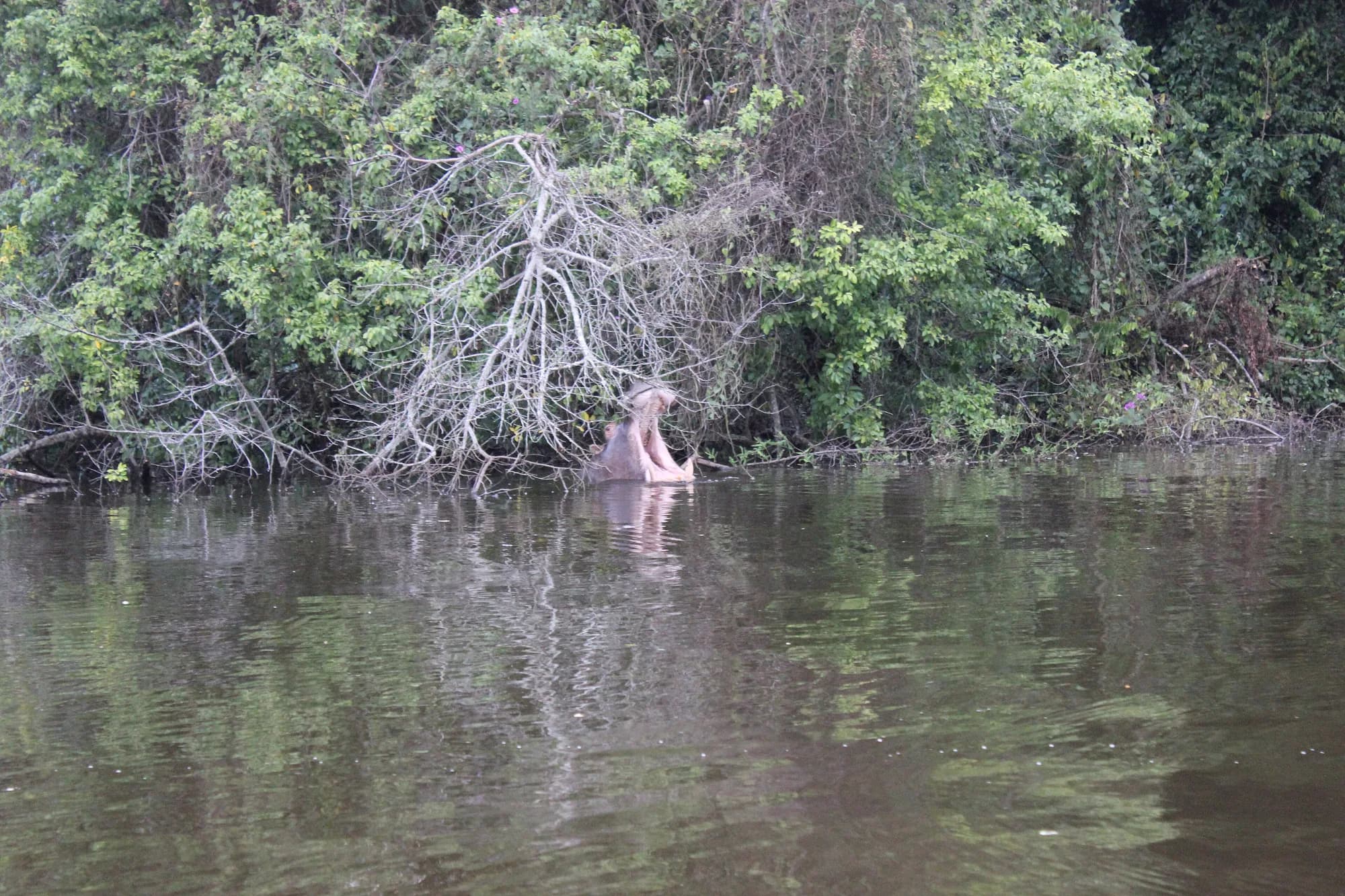
| Hippopotamus and crocodile | Both sources | In the park's five lakes; dominate the lakeshores |
| Sitatunga | Brochure | A secretive wetland antelope hidden in the fringing swamps |
| Leopard and hyena | Both sources | Present; sightings rare |
| Bushbaby and potto | Brochure | Nocturnal, named as night-drive species |
Thirteen named animals against a published total of 69 mammal species, so this is UWA's selection rather than the list. Note that no primate appears except the nocturnal bushbaby and potto — Lake Mburo is a Ugandan park with essentially no primate product, which is unusual enough to be worth saying on a circuit sold on gorillas and chimpanzees. One caution on topi: UWA's 2026 report still lists Lake Mburo as one of only three protected areas holding them, but adds that "The 2024 mammal census in Lake Mburo National Park did not record sightings of Topis neither in the park nor the ranches in the conservation area." Treat topi here as listed but not currently counted.
The giraffe tell you what kind of park this is
The giraffe did not walk to Lake Mburo. UWA's 2026 report gives the numbers its brochure does not: "In 2015, Lake Mburo National Park was restocked with fifteen giraffes from Murchison Falls National Park, and by 2025 their population had risen to about 52." Fifteen animals to about fifty-two in a decade is the clearest illustration of something true of this whole park: Lake Mburo's wildlife is actively managed back into a landscape it was removed from. The tsetse clearances and the ranching that UWA names as having nearly wiped the park out are within living memory, and the zebra, impala and giraffe you come to see are there because of decisions rather than despite them. The 20 per cent of park fees UWA says goes to boundary-parish communities is the current instalment of the same project.
Sitatunga is the one worth knowing about before you go
The brochure places it precisely — "the fringing swamps hide secretive wetland creatures such as the sitatunga antelope" — and that word, fringing, is the planning information. A sitatunga is a swamp antelope with splayed hooves that lives in papyrus and is nearly impossible to see from a game track. The place to look is the boat, and the wetland fringe it passes. If you have a particular species you want from Lake Mburo beyond zebra and impala, this is the one that determines whether the USD 120 minimum boat charge is worth it.
Uganda Wildlife Authority — Lake Mburo National Park park brochure, 2018
UWA's own two-page park brochure, linked from the download button at the foot of its Lake Mburo page and hosted on ugandawildlife.org. An 11.6 MB file with a text layer; read 14 October 2026. It is the only UWA document that names the third gate, gives the gate road distances, names the tracks and the two viewpoints, describes the salt lick platform and Rubanga forest, sets out the rainfall months, names the lodges, and states who operates horseback riding and mountain biking here. It disagrees with UWA's own park page on the park's area, its bird count, the number of gates and the status of lion — and in one case it disagrees with itself. Every one of those disagreements is published on this page rather than resolved silently.
https://ugandawildlife.org/wp-content/uploads/2024/05/LMNP-2018-4.pdfUganda Wildlife Authority — Lake Mburo National Park
UWA's own Lake Mburo park page, read 14 October 2026. Note the path: the page lives at /national-parks/lake-mburo/, and the longer /national-parks/lake-mburo-national-park/ that matches most of UWA's other parks returns a 404. The source here for the park-size infobox, the district, the 50 km wetland system, the three historical causes of wildlife loss, the revenue-share percentage, the species list, the absence of elephants, the bird count of over 315, the two-gate access description and the charter-flight routing.
https://ugandawildlife.org/national-parks/lake-mburo/Birds: the acacia specials and the papyrus specials
Lake Mburo's bird list divides cleanly along the same line as its habitats — dry acacia woodland on one side, papyrus swamp on the other — and UWA names both sets and, unusually, names where to stand for each.
The birds UWA names, by habitat
| Group | Species UWA names | Where UWA says to look |
|---|---|---|
| Acacia-associated | Mosque swallow, black-bellied bustard, bare-faced go-away bird, Rüppell's starling, southern ground hornbill, black-throated barbet | Around the rest camp at Rwonyo, and the lightly wooded grassland valleys east of Lake Mburo; the acacia woodland along the Acacia and Research tracks |
| Papyrus and swamp specials | Papyrus gonolek, papyrus yellow warbler, white-winged warbler, shoebill | The lake's northern fringe of papyrus wetland |
| Water and shore | Pelican, heron, fish eagle, African finfoot | The wooded shores of Lake Mburo as seen from the Rwonyo launch — "ideal territory for the African finfoot" |
UWA gives the total as 332 species in the brochure and "over 315" on the park page. The three prime birding areas it names are the Acacia and Research tracks, the view from the Rwonyo launch, and the lake's northern papyrus fringe — which is a specific enough list to plan two mornings around.
Why this is a serious birding park and not a savanna park with birds
The reason is the habitat split. A park that is 20 per cent wetland and sits in a rain-shadow acacia belt gives a birder two entirely separate lists within a few kilometres — papyrus endemics that are hard anywhere in East Africa, and dry-country acacia species that Uganda's forest parks do not hold at all. The papyrus gonolek and papyrus yellow warbler are the sort of species people build trips around, and they are reachable from a park you can get to in three and a half hours from Kampala. Note that two of the three named birding areas need the boat, which changes the calculation on that USD 120 minimum considerably for anyone carrying binoculars.
The shoebill, honestly
UWA names the shoebill twice for Lake Mburo — among the brochure's swamp specials and among the birds you might sight on the boat trip. It does not publish a probability, a season, a reliable site beyond the northern papyrus fringe, or any claim that it is regular here. Treat the shoebill at Lake Mburo as possible rather than as a reason to come, and note that UWA sells a dedicated "View shoebill by Boat" product at Semuliki and at Toro-Semliki — at USD 100 — and sells no such product here. Where UWA thinks shoebill is bankable, it charges for it.
Uganda Wildlife Authority — Lake Mburo National Park
UWA's own Lake Mburo park page, read 14 October 2026. Note the path: the page lives at /national-parks/lake-mburo/, and the longer /national-parks/lake-mburo-national-park/ that matches most of UWA's other parks returns a 404. The source here for the park-size infobox, the district, the 50 km wetland system, the three historical causes of wildlife loss, the revenue-share percentage, the species list, the absence of elephants, the bird count of over 315, the two-gate access description and the charter-flight routing.
https://ugandawildlife.org/national-parks/lake-mburo/Uganda Wildlife Authority — Lake Mburo National Park park brochure, 2018
UWA's own two-page park brochure, linked from the download button at the foot of its Lake Mburo page and hosted on ugandawildlife.org. An 11.6 MB file with a text layer; read 14 October 2026. It is the only UWA document that names the third gate, gives the gate road distances, names the tracks and the two viewpoints, describes the salt lick platform and Rubanga forest, sets out the rainfall months, names the lodges, and states who operates horseback riding and mountain biking here. It disagrees with UWA's own park page on the park's area, its bird count, the number of gates and the status of lion — and in one case it disagrees with itself. Every one of those disagreements is published on this page rather than resolved silently.
https://ugandawildlife.org/wp-content/uploads/2024/05/LMNP-2018-4.pdfUganda Wildlife Authority — Conservation Tariff 2024–2026
Read page by page on 14 October 2026. The 24-page tariff covering entrance, vehicles, boats, aircraft, game drives, walks, camping, UWA accommodation, sport fishing, research fees, fines and a per-park fees summary. Lake Mburo appears in six separate places in it — the Category A entrance band, the launch-cruise table, the nature-walk band, the sport-fishing permit table, the accommodation table and its own one-page summary on document page 22 — and those six places do not always agree with each other. The tariff is printed "subject to change without prior notice" and its cover period, July 2024 to June 2026, expired on 30 June 2026 without a successor appearing anywhere on UWA's site.
https://ugandawildlife.org/wp-content/uploads/2024/03/UWA-Conservation-Tariff-July-2024-June-2026.pdfThe impala-and-Kampala story, and why we will not launder it
Because Lake Mburo is the only Ugandan park with impala, a story travels with it: that Uganda's capital is named after the animal, from a phrase usually given as "kasozi k'empala", the hill of the impala, said to be what the Buganda kingdom called the place where the British later built. It appears in operator copy, guidebooks and lodge briefings, and it is usually told as settled fact.
There is an official source for it, and an older one against it
A Ugandan statutory body does repeat the story. Kampala Capital City Authority, in a news item on its own site, writes: "The name Kampala derives from the impalas that once roamed the area, which was also among the hunting grounds of the Kabaka of Buganda. Hence the Luganda expression 'Akasozi k'empala' — the hill of impalas." That is better than a blog, but it is a press item by a communications office and it cites nothing. Against it stands a contemporaneous primary source. Frederick Lugard, who was given the hill in January 1891, writes in The Rise of Our East African Empire (1893) that Mwanga "gave me the little knoll on which my camp was pitched — named Kampala". The hill was already called Kampala when it was handed over, which removes the mechanism the folk etymology depends on. Harry Johnston's The Uganda Protectorate (1902), written by a trained naturalist who explains the names Mengo and Rubaga, offers no etymology for Kampala at all and places impala in the north, north-central and eastern parts of the Protectorate rather than in Buganda.
How we are therefore handling it
As tradition, attributed, never asserted. UWA does not mention the story on its Lake Mburo page or in its Lake Mburo brochure — and the brochure gives a whole panel to local people and the Banyankole without reaching for it. The honest form of words is that the name is traditionally explained as akasozi k'empala, the hill of the impala, an account the Kampala Capital City Authority still repeats, though impala are not native to the Kampala hills and Lugard's own 1891 account records the hill as already bearing the name. That is a more interesting sentence than the folklore and it has the advantage of being defensible.
Kampala Capital City Authority — "Today in history: when Kampala became a city"
A news item on the statutory city authority's own website, read 14 October 2026. Cited here only as the most official body we could find repeating the impala etymology of Kampala's name. It is a communications piece and it cites no source, so it is evidence that the tradition is officially repeated rather than evidence that it is correct.
https://www.kcca.go.ug/news/1198/today-in-history-when-kampala-became-a-cityThe sourced version of the same point
The thing the folklore is reaching for is true and is sourced, so use it instead: UWA states in two documents that Lake Mburo holds Uganda's only population of impala. That is a genuinely unusual fact about a national mammal list, it is published by the authority that manages the park, and it does not need an etymology to be interesting.
Uganda Wildlife Authority — Lake Mburo National Park
UWA's own Lake Mburo park page, read 14 October 2026. Note the path: the page lives at /national-parks/lake-mburo/, and the longer /national-parks/lake-mburo-national-park/ that matches most of UWA's other parks returns a 404. The source here for the park-size infobox, the district, the 50 km wetland system, the three historical causes of wildlife loss, the revenue-share percentage, the species list, the absence of elephants, the bird count of over 315, the two-gate access description and the charter-flight routing.
https://ugandawildlife.org/national-parks/lake-mburo/Uganda Wildlife Authority — Lake Mburo National Park park brochure, 2018
UWA's own two-page park brochure, linked from the download button at the foot of its Lake Mburo page and hosted on ugandawildlife.org. An 11.6 MB file with a text layer; read 14 October 2026. It is the only UWA document that names the third gate, gives the gate road distances, names the tracks and the two viewpoints, describes the salt lick platform and Rubanga forest, sets out the rainfall months, names the lodges, and states who operates horseback riding and mountain biking here. It disagrees with UWA's own park page on the park's area, its bird count, the number of gates and the status of lion — and in one case it disagrees with itself. Every one of those disagreements is published on this page rather than resolved silently.
https://ugandawildlife.org/wp-content/uploads/2024/05/LMNP-2018-4.pdf