
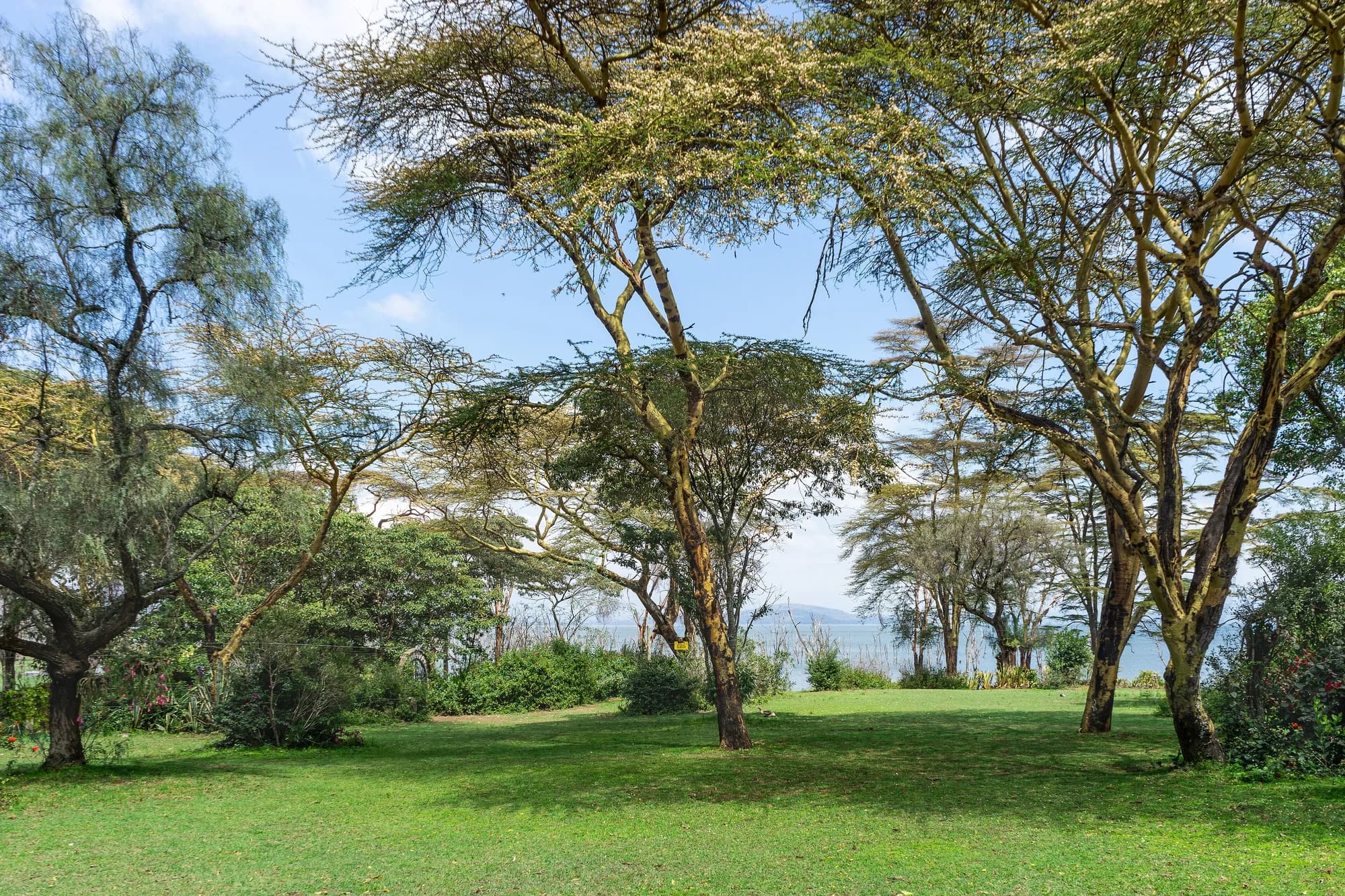
Kenya / Lake Nakuru / Safari booking — Lake Nakuru
Safari booking — Lake Nakuru
There is no permit to win here and no quota to beat. The booking decision that actually matters at Lake Nakuru is not which lodge — it is making the operator write down, before you pay, what they are promising you will see.
There is nothing to win
Park entry is a daily fee collected by Kenya Wildlife Service, not an allocated permit. No lottery, no zone draw, no jeep quota, no portal opening at midnight sixty days out. If you drove up to the Main Gate tomorrow morning with a passport and a card, you would be on the lakeshore circuit twenty minutes later.
What that leaves is a much shorter list of things that genuinely need booking, and two of them are unusual in being genuinely scarce rather than merely popular.
- A bed, inside the fence or in Nakuru city. The five private properties KWS lists inside the park are the whole of the in-park commercial stock.
- Naishi Guest House, if you want KWS's own self-catering. There is exactly one unit, sleeping eight, and it is booked through KWS reservations rather than an agent.
- A special campsite, if you are camping properly. These carry a KSh 10,000 per week reservation fee, non-refundable, which is the only thing on the entire Lake Nakuru schedule that behaves like a booking rather than a ticket.
- A vehicle and a driver-guide, if you are not driving yourself. This matters more here than the bed does, and is decided more casually.
- Nothing else. There is no activity at Lake Nakuru that sells out.
Kenya Wildlife Service — Lake Nakuru National Park
Read 28 September 2026. This is the department's own park page, and on this date it answered — which is worth recording, because kws.go.ke refuses automated requests often enough that other Kenyan parks on this site carry their figures as "read failed, carried from record". The page gives the park history to the year, the gate list, the distance from Nairobi, the accommodation list, the gate hours and the in-park rules, and it prints the same four-band conservation fee as the national schedule. It does not give a rhino population, a flamingo count or a drive time, and neither does this page.
https://kws.go.ke/park/lake-nakuru-national-park/Settle the flamingo question before you pay anybody
This is the single most useful paragraph on this park's booking page and it has nothing to do with lodges. Lake Nakuru was, for decades, the place you went to see more than a million lesser flamingos. That is no longer what the lake reliably offers, the reason is documented in peer-reviewed literature, and a great deal of the marketing has not caught up. The full evidence is set out on the wildlife page. The booking consequence is narrow and immediate: if a quote, an itinerary or a photograph is selling you flamingos at Lake Nakuru, you are being sold something the operator cannot deliver on demand.
The lake has grown by roughly 90 per cent in surface area since 2009 and the phytoplankton the birds filter-feed on has collapsed with the dilution. Flamingos are not absent — they are vastly reduced and highly variable, and no honest party can tell you in advance what a given week will hold. Anyone who does is guessing or quoting a brochure written before 2010.
The sentence to put in the email
"Please confirm in writing that no part of this itinerary depends on flamingos being present at Lake Nakuru, and that the park is included for rhino." It costs nothing to ask, it produces a written answer you can hold them to, and the quality of the reply tells you a great deal about who you are dealing with. An operator who answers it straight is worth keeping.
Byrne, Tebbs, Njoroge, Nkwabi, Chadwick, Freeman and Norris — "Productivity declines threaten East African soda lakes and the iconic Lesser Flamingo", Current Biology 34, 1786-1793 (22 April 2024)
Read 28 September 2026 from the open-access version of record. This is the paper that settles the flamingo question, and it is the reason this park's wildlife page reads the way it does. The authors combined satellite Earth observation with flamingo count data across 22 East African soda lakes from 1999 to 2022. Findings used here: lake surface areas across the 22 lakes rose by an average of 0.32 square kilometres a year; chlorophyll-a — the measure of the phytoplankton the birds eat — fell by 3.9 mg per cubic metre a year; 18 of the 22 lakes were at their least productive when their surface area was greatest; Lake Nakuru grew in surface area by 90.7 per cent between 2009 and 2022 and its mean chlorophyll-a fell from more than 400 mg per cubic metre to less than 200; the threshold the authors use for high-quality feeding water is 355 mg per cubic metre, which corresponds to an Arthrospira fusiformis density of 50 mg dry weight per litre; and at Bogoria and Nakuru the loss of high-quality feeding habitat since 2010 coincided with declining flamingo numbers. The paper describes Nakuru as "one of the most important Flamingo feeding lakes in East Africa, historically supporting over one million birds at a time". It does not give a current Nakuru count, and neither do we.
https://doi.org/10.1016/j.cub.2024.03.006Book it as a stop, not as a destination
Lake Nakuru is 156 kilometres from Nairobi on the A104 and its Main Gate is four kilometres from Nakuru city. The park is 188 square kilometres, of which the lake is about a third, leaving roughly 135 square kilometres of land with a track network you can cover in a long morning. Those three facts together produce the correct trip shape, and it is not the one most itineraries print.
How long to book here
| Length | Verdict | Who it suits |
|---|---|---|
| A day trip from Nairobi | Works, and is a genuine option no other Kenyan park on this site offers | Short trips, business visitors, anybody with one spare day |
| One night | The right answer for almost everybody | A Rift Valley or Mara circuit, where Nakuru is the rhino day |
| Two nights | Defensible if rhino is specifically why you came | Photographers, and anyone who wants both dawns |
| Three or more nights | Hard to justify | Very few people; you will run out of park |
This is unusually short advice for a national park page, and it is meant as a compliment to the park rather than a criticism. Nakuru does one thing extremely well and does not need four days to do it.
The corollary is that the booking to get right is the circuit, not the stop. Nakuru pairs naturally northwards with Bogoria and Elementaita, southwards with Naivasha, and westwards as the last comfortable night before the long drive to the Mara. Booked as the rhino night inside one of those, it is excellent value. Booked as a four-night destination, it is a pool.
The vehicle, and the guide who can find a rhino
In a park this size the vehicle matters less than at Tsavo and the guide matters more. Rhino at Lake Nakuru are genuinely reliable, but reliable is not the same as obvious: white rhino graze open ground and are usually straightforward, while black rhino are browsers in thicket and are found by people who know which thickets. That is a local skill, it is not evenly distributed, and it is what you are actually buying.
- Ask how often the guide works Lake Nakuru specifically. A driver who runs the Mara road and stops here twice a year is a different proposition from one based in Nakuru.
- Ask the seat count before the make. It sets the KWS vehicle band — KSh 600 under six seats against KSh 1,500 for six to twelve — and far more importantly it sets whether you have a window.
- Ask about the roof. An open-sided vehicle is a real advantage on the escarpment lookouts and a real disadvantage in April.
- Ask whether the day includes the southern end of the park. Makalia Falls is a commitment of time that a short circuit will quietly drop.
- Ask what happens if a track is under water. It is a live question here in a way it is not in most parks, and the answer KSh 10,500 for a KWS vehicle recovery is on the published schedule.
Self-driving is more realistic here than almost anywhere
Fenced, small, close to a city, graded tracks, a 40 km/h speed limit and a gate four kilometres from town. If you were ever going to drive yourself in a Kenyan national park, this is the one. The cost is that you lose the person who knows where the black rhino browse, which at this particular park is most of the value of a guide.
The questions that separate two quotes that look identical
- Are KWS conservation fees included, and for how many park days? At USD 90 per adult per day this is the largest legitimate gap between two comparable quotes.
- Is the bed inside the fence or in Nakuru city, and how long is the transfer to the gate in minutes?
- Private vehicle or shared, and how many seats?
- How many game drives, and does the first one leave at gate opening? The gates open at 6:00 am and that is when the park is worth being in.
- Does the itinerary depend on flamingos, in any form, at any point?
- Is this park being sold to you as the rhino stop or as the flamingo stop? The answer tells you whether the itinerary was written this decade.
Worked comparison
Two quotes for two non-resident adults, two park days. Quote A is USD 80 a head cheaper — USD 160 across the party — and excludes park fees; quote B includes them. Those fees are 2 adults x USD 90 x 2 days = USD 360, plus KSh 600 a day for an under-six-seat vehicle, so KSh 1,200. Quote A is therefore the dearer of the two by USD 200 plus KSh 1,200, and all of that difference lands at a gate rather than at the point of sale.
Kenya Wildlife Service — Conservation Fees 2025 (October 2025 schedule)
Read on 28 September 2026, from the department's own PDF rather than from the summary this site holds. The download succeeded — 130,735 bytes over HTTPS — but the file would not open: the cross-reference table is damaged and a standard text extractor refused it outright. It was repaired with Ghostscript and read from the repaired copy, and every figure below comes off that single printed page. Two things belong on the face of the page rather than in a footnote. First, the schedule bands parks rather than naming a rate park by park, and Lake Nakuru sits in the band printed "PREMIUM PARKS — Amboseli and Lake Nakuru National Parks"; the mapping from that band to this park is the one step between the document and these tables, and here the department's own park page prints the identical figures, so the step is confirmed rather than assumed. Second, the same page carries a charge naming Lake Nakuru specifically, which is set out below.
https://kws.go.ke/wp-content/uploads/2026/05/KWS-Conservation-Fee-October-2025.pdfWhat goes wrong at the booking stage
- Booking Lake Nakuru for flamingos. It is the commonest mistake made about any park on this site and it is made at the point of payment, months before anybody can correct it.
- Booking three or four nights. The park is 188 square kilometres with the lake taking a third of it. Two full days covers it comfortably.
- Booking a bed in Nakuru city to save money and then arriving at the gate at nine. The gate opens at six; the rhino are findable at six; the saving costs you the only part of the day that is scarce.
- Assuming a night drive is available because the schedule prices one. KWS prices night drives "in selected Parks and Reserves" and does not print the list. Confirm before you buy it.
- Packing a drone. USD 300 per drone per day per park, plus a Kenya Civil Aviation Authority licence, and there is no version of this park where that is a good trade.
- Pairing Nakuru with Elementaita or Bogoria and assuming one park fee covers the circuit. Different bands, different tariffs, and Elementaita is a wildlife sanctuary on the scenic band rather than a national park.