

Species · Lupulella mesomelas
Black-backed jackal
The animal everybody sees and nobody photographs — trotting down a verge, crossing a riverbed, waiting out of range of something bigger. It is worth stopping for in exactly one place on this site: the Namibian coast, where jackals work a hundred thousand fur seals and live a life that has nothing in common with the one on a Johannesburg golf course.
Also called
- Rooijakkals · Afrikaans
- Phokojwe · Setswana
- Bweha · Swahili
Checked 28 Sept 2026
- Where
- Southern Africa and the Horn, with a gap between
- Best months
- Year-round; seal pupping Nov–Dec
- Populations
- Two, over a thousand kilometres apart
- Odds
- Near-certain almost anywhere in Namibia
Two populations with a gap of well over a thousand kilometres between them: one in the Horn and East Africa, one across southern Africa from Angola to the Cape. Nothing in between, and no evidence the two halves have been in contact for a very long time.
Where it is
HabitatAlmost any open or lightly wooded country that is not rainforest — desert gravel, coastal fog belt, Karoo, savanna, farmland and the edges of towns. It is one of the few carnivores on this site whose habitat line is genuinely 'nearly everything'.
Worth travelling for
The coast is the reason to give this species a section of its own. At Cape Cross and along the Skeleton Coast, jackals feed on and around a Cape fur seal colony in daylight, in fog, on open gravel — completely different animals from the inland ones.
Also occurs
South AfricaBotswanaZimbabweKenyaTanzaniaAngolaMozambiqueEthiopiaSomaliaEritreaDjibouti
Present, but not where you would go to see one.
Where to actually go
Ranked, with the reason each — these are not interchangeable.
- 01Cape Cross Seal ReserveNamibiaJackals working the edge of the largest accessible fur seal colony on the coast, in daylight, from a boardwalk. The one place where this species is the sighting rather than the thing in the background.Daylight, at close range, with the seals
- 02Skeleton CoastNamibiaThe wilder version of the same story — colonies with no boardwalk, jackals and brown hyenas sharing them, and nobody else there.No infrastructure, no crowd
- 03DorobNamibiaThe coastal gravel plains and lichen fields between Swakopmund and the Ugab, crossed by jackals moving between the sea and the interior. Easy to drive and easy to combine.The drive between the two
Where you will not see one
- Central and West AfricaThe gap between the two populations is real and it is enormous. There is no black-backed jackal in the Congo basin, in West Africa, or anywhere across the middle of the continent.
- ForestBwindi, Kibale, Nyungwe, Gombe — none. This is an open-country animal and it needs to see.
- On a list that says you saw one in IndiaThat was a golden jackal, a different species with no saddle. The two look alike at a glance and share nothing but the word.
When to go
When to go
- J
- F
- M
- A
- M
- J
- J
- A
- S
- O
- N
- D
January: good. February: good. March: good. April: good. May: good. June: good. July: good. August: good. September: good. October: good. November: best. December: best.
Through the day
- Dawn
- Morning
- Midday
- Afternoon
- Dusk
- Night
Dawn: most active. Morning: active. Midday: usually resting. Afternoon: active. Dusk: most active. Night: most active.
Realistic odds on a three-day trip
- Near-certain
- Likely
- Lucky
- Expedition
Telling it apart
Told apart from
Side-striped jackal
Zimbabwe, Zambia and northern Botswana, where both occur
No saddle. The side-striped jackal is greyer and plainer with a pale stripe along the flank and a white tail tip; the black-backed's silver-and-black saddle has a hard, clean edge against a rufous flank and its tail tip is black.
African wolf
Kenya and Tanzania, where both occur
The animal East African guides call a golden jackal is now usually treated as the African wolf, Canis lupaster. It is plainer, sandier and saddleless. If you can see a sharp-edged black-and-silver saddle, it is not one.
Far smaller, with enormous rounded ears, a black facial mask and a bushy black-tipped tail, and it forages nose-down in a slow zigzag rather than trotting purposefully in a straight line.
Marks chosen to be usable from a moving vehicle — a black-backed jackal is rarely still and never close enough for anything subtler.
What it looks like in the field


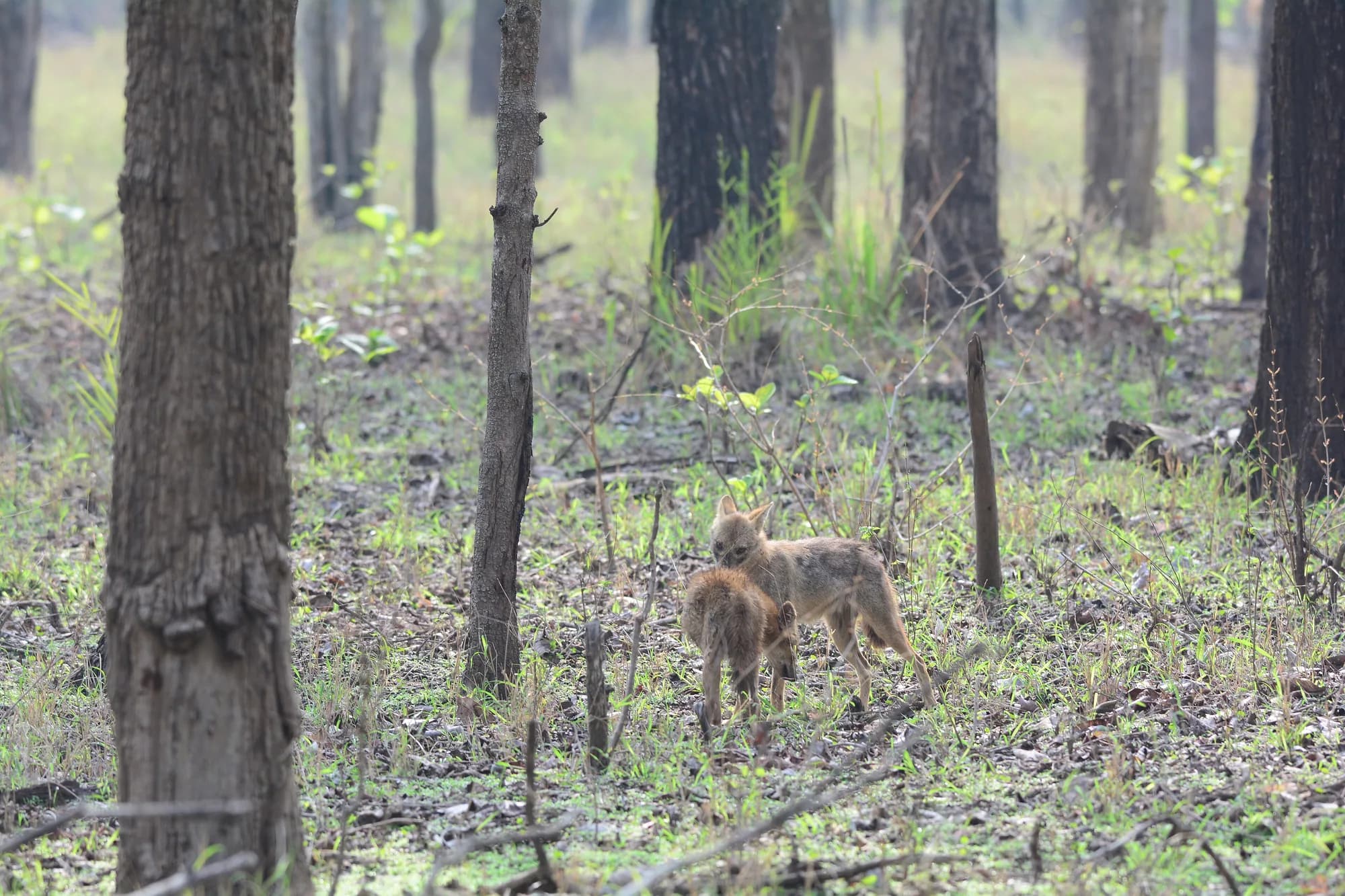
Photographs of Black-backed jackal in the wild, in Indian reserves. We publish no captive, baited or digitally composited images, and no photograph whose licence we cannot show.
Photographing it
- Lens
- 200-400mm at a seal colony, where the animals are close and busy. Inland you will be shooting from a vehicle at a moving animal and will want the longer end.
- Typical distance
- Ten to fifty metres at Cape Cross, and often less. Inland, whatever distance the jackal decides on, which is usually more than you want.
- Light
- Coastal fog gives flat, soft light that suits the saddle pattern and hides the harsh contrast that ruins midday shots. Early morning before the fog burns off is the window.
Where to stopAt a seal colony, stay on the boardwalk and do not manoeuvre for a kill shot. Jackals that get displaced from a carcass by people simply come back and take another pup, so crowding one does not prevent anything — it just adds a second disturbance to the colony.
Signs and calls
- Call
- A long rising wail that drops into a series of yaps, answered across distance at dusk and through the night. It is the defining sound of a Karoo or Kalahari camp and it carries a very long way.
- Scat
- Twisted, tapered and full of whatever is local — beetle cases and rodent fur inland, and on the Namibian coast visibly packed with seal hair.
- Tracks
- A neat four-toed canid print, smaller and narrower than a domestic dog's, usually running in a straight purposeful line along a road or a beach rather than wandering.
The saddle, and the two Africas
The field mark is unambiguous and it is the whole animal: a broad saddle of black hair shot through with silver, running from the back of the neck to the base of the tail, with a hard clean edge against rufous flanks. Nothing else in Africa wears that. The side-striped jackal is grey and plain with a white-tipped tail; the animal East African guides still call a golden jackal is sandy and saddleless, and is now usually treated as a wolf — Canis lupaster — rather than a jackal at all.
Which leaves a taxonomic oddity worth knowing. Molecular work has moved the black-backed and side-striped jackals out of Canis into Lupulella, on the finding that they branched off early and are only distantly related to the wolves, dogs and coyotes they resemble. Older books and older park signboards will say Canis mesomelas; the Red List assessment behind the status block on this page is filed under the new name. And the species itself comes in two disjunct halves — one in the Horn and East Africa, one across southern Africa — with more than a thousand kilometres of continent between them.
The Cape Cross jackal is a different animal
Inland, a black-backed jackal is the thing you drive past. It is on the verge, it is at the edge of a lion kill waiting for a gap, it is crossing the road in your headlights outside Upington, and no honest guide pretends otherwise. On the Namibian coast it is something else. There the jackals live on and around Cape fur seal colonies, feeding on afterbirth, dead pups and stranded carrion, and because nobody persecutes them and the food does not run out, they do it in daylight, in the open, a few metres from a boardwalk.
The behaviour repays watching rather than glancing at. A coastal jackal is not simply scavenging; it hunts live pups at the colony edge, works the strandline between visits, caches food in the gravel and defends what it has from other jackals with real ferocity. Brown hyenas take the same colonies over at night. Between them they are among the very few land carnivores anywhere that make their living off the sea, and at Cape Cross you can see both halves of that in one day.
Status and protection
Status and protection
- IUCN Red List
- Least Concern
- Population trend
- → Stable
Species-level assessment, filed under Lupulella mesomelas; older sources use Canis mesomelas. At 2014 this is the oldest assessment in the world set.
Assessed 2014 · IUCN Red List assessment
What to book to see one
What you would be booking
- How it is seen
- No booking required inland — you will pass one. For the coastal animals, drive the C34 salt road and the Cape Cross boardwalk, or take a Skeleton Coast trip for the colonies with no boardwalk.
- Drives to book
- None inland. For Cape Cross, half a day is enough, and early morning is both better lit and emptier.
- Zone or shift
- Cape Cross Seal Reserve for the colony and the jackals working it in daylight. Dorob for the coastal gravel plains between Swakopmund and the Ugab. The Skeleton Coast for the wilder colonies and the brown hyenas that share them.
The best jackal watching on this coast is at a seal colony in the pupping window around late November and December, when there is more carrion, more afterbirth and more unattended pups than the scavengers can use. It is also, unavoidably, the hardest thing on this site to watch — this is predation on infants at close range in broad daylight.
Cape Cross Seal ReserveOn the same trip you would also get
- Cape fur seal — the colony the coastal jackals live off
- Brown hyena — the night shift at the same colonies
Questions people ask
Where is the best place to see a black-backed jackal?
How do I tell a black-backed jackal from a side-striped jackal?
Is it the same animal as the golden jackal I saw in India?
Why are the jackals at Cape Cross out in the daytime?
Read next
The Namibian and South African coast
Cape fur seal — the colony they live off
A hundred thousand seals on one beach, audible and smellable long before you see them. Cape Cross is the largest breeding colony on the Namibian coast and the most overwhelming sensory experience on this site — and it is also where brown hyenas and black-backed jackals come to feed.
The Kalahari and the Namibian coast, and nowhere else
Brown hyena — the night shift
Shaggy, solitary, almost entirely nocturnal, and confined to southern Africa — the rarest of the world's four hyenas and the one almost nobody plans for. The Skeleton Coast population that scavenges seal colonies is the strangest carnivore story on this site.
Every reserve, and the night chorus
Golden jackal — the Asian one
The most widespread wild canid in India, seen on almost every drive and identified as almost everything else. The howling that wakes you at the lodge is this.
Cape Cross Seal Reserve