
Species · Parahyaena brunnea
Brown hyena
Shaggy, solitary, almost entirely nocturnal, and confined to southern Africa — the rarest of the world's four hyenas and the one almost nobody plans for. The Skeleton Coast population that scavenges seal colonies is the strangest carnivore story on this site.
Also called
- Strandwolf — beach wolf, for the coastal population · Afrikaans
- Phiri · Setswana
Checked 28 Sept 2026
- Where
- Botswana, Namibia, South Africa
- Best months
- Dry season; night drives only
- Habits
- Solitary forager, clan den
- Odds
- Low. Genuinely a lucky sighting
Arid southern Africa and nothing beyond it. Brown hyenas are the most range-restricted of the four hyena species, and unusually for a large carnivore a good share of the population lives on farmland rather than in parks.
Where it is
HabitatArid and semi-arid southern Africa — Kalahari sand, Karoo scrub and the Namib coast. The only hyena confined to one region, and the whole world population sits inside the three countries below plus Zimbabwe and southern Angola.
Worth travelling for
Kgalagadi is the most realistic place to see one, usually at a waterhole after dark or at first light.
The Central Kalahari and the Makgadikgadi pans hold them at low density across enormous country.
The Skeleton Coast population scavenges Cape fur seal colonies — the only hyenas anywhere that live substantially off the sea.
Also occurs
ZimbabweAngolaMozambique
Present, but not where you would go to see one.
Gone from
Most of its historic South African range outside the reserves and the Karoo
Range this species has been lost from. It is the fact a map of where it currently lives cannot show you.
Where to actually go
Ranked, with the reason each — these are not interchangeable.
- 01Kgalagadi TransfrontierSouth AfricaThe most realistic place on earth to see one. Waterholes lit at the rest camps, dry riverbeds you can scan, and a genuine resident population.Camp waterholes, before dawn
- 02Skeleton CoastNamibiaThe seal-scavenging population, which behaves unlike any other hyena anywhere. Hard to reach and unforgettable.The strangest version of this animal
- 03Central KalahariBotswanaGenuine wilderness at very low density. Camps here run research and some can take you to a den.Ask about den visits
- 04Makgadikgadi PansBotswanaOpen pan edges where a nocturnal animal is at least visible when it does appear.Open ground helps
- 05Cape Cross Seal ReserveNamibiaA seal colony the coastal hyenas work at night and at first light, and the most accessible point on that coast.First light, at the colony
Where you will not see one
- East AfricaThere are none. Kenya, Tanzania and Uganda have spotted and striped hyenas; the brown hyena does not occur north of about Angola and Zimbabwe.
- On a normal game driveDaylight sightings are close to accidental. Without a night drive or a pre-dawn start this is not an animal you are looking for, it is one you happen upon.
- In a clan, at a killBrown hyenas forage alone and rarely hunt. If you are watching several hyenas squabbling over a carcass in daylight in East Africa, those are spotted hyenas.
When to go
When to go
- J
- F
- M
- A
- M
- J
- J
- A
- S
- O
- N
- D
January: marginal. February: marginal. March: marginal. April: good. May: good. June: best. July: best. August: best. September: best. October: best. November: good. December: marginal.
Through the day
- Dawn
- Morning
- Midday
- Afternoon
- Dusk
- Night
Dawn: active. Morning: not normally seen. Midday: not normally seen. Afternoon: not normally seen. Dusk: usually resting. Night: most active.
What it looks like in the field
Photographs of Brown hyena in the wild, in Indian reserves. We publish no captive, baited or digitally composited images, and no photograph whose licence we cannot show.
Telling it from a spotted hyena
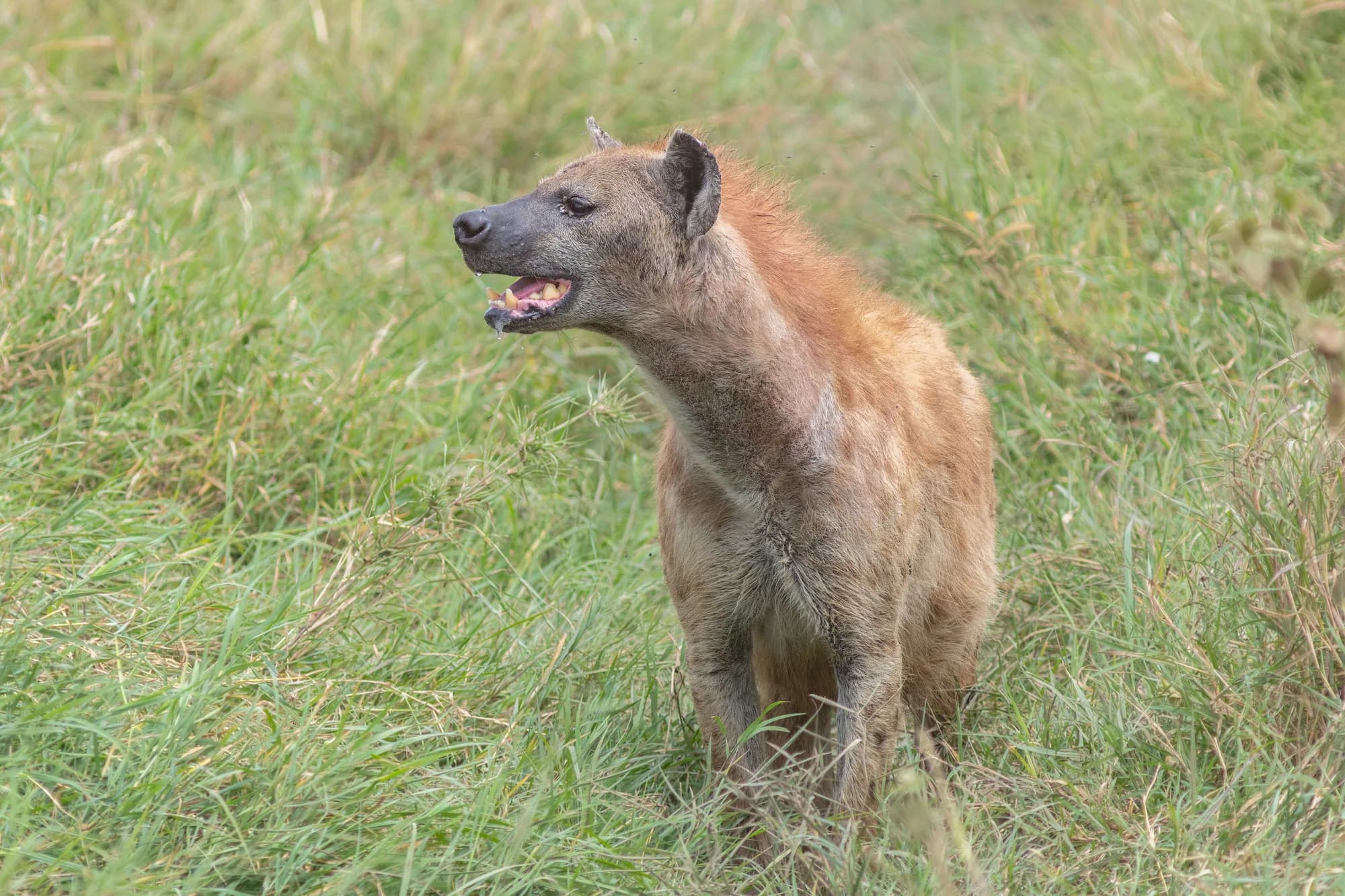
They do not look alike once you have seen both. A brown hyena is smaller, darker and shaggy, with a long coat, a conspicuous pale cape over the shoulders and boldly striped forelegs. A spotted hyena is short-coated, sandy and blotched, with rounded ears. The brown’s ears are pointed.
Behaviour separates them further. Spotted hyenas live in large matriarchal clans and kill most of what they eat. Brown hyenas forage alone, scavenge almost everything, and hunt very little — the clan exists, and it shares a den rather than a hunt.
The beach wolves
The Namibian coastal population is the reason this animal is worth a page of its own. Along the Skeleton Coast and at Cape Cross, brown hyenas live substantially off the Cape fur seal colonies — scavenging carcasses and taking pups — which makes them one of very few terrestrial carnivores anywhere that depends on the sea.
The Afrikaans name for them there is strandwolf, beach wolf. It is a better description than anything in English, and it is what guides on that coast will call them.
Status and protection
Status and protection
- IUCN Red List
- Pending
- Population trend
- · Unknown
Not yet verified against the source. These four values are written from knowledge and are awaiting a checked IUCN assessment, schedule and appendix — treat them as indicative until this line disappears.
Assessed not yet retrieved
What to book to see one
What you would be booking
- How it is seen
- A night drive, or a camp waterhole with a light. Kgalagadi's rest camps are the practical answer.
- Drives to book
- Not countable. Budget several nights in the right country and treat a sighting as a bonus rather than a plan.
- Zone or shift
- The Nossob and Auob riverbeds in Kgalagadi; the seal colonies on the Namibian coast at dawn.
Several Kalahari camps run brown hyena research and will take guests to a den under supervision. That is the one way to turn a lucky sighting into a likely one, and it is worth asking about before booking.
Kgalagadi TransfrontierOn the same trip you would also get
- Black-backed jackal — the same waterhole, far easier
- Cape fur seal — the coastal population's food supply
Questions people ask
Where can I see a brown hyena?
How do I tell a brown hyena from a spotted one?
What is a strandwolf?
Read next
Common across the savanna parks, and badly misunderstood
Spotted hyena — the commoner one
Not a scavenger that steals from lions so much as a highly successful hunter that lions steal from. A matriarchal clan of eighty animals with a rank order inherited down the female line is the most socially complex thing you will watch on a game drive.
Kgalagadi Transfrontier
Skeleton Coast