
Species · Taurotragus oryx
Common eland
A bull weighs close to a tonne and still clears a two-metre fence from standing. Eland are the biggest antelope in the world and among the shyest, which is why most people drive past a herd at four hundred metres and never look twice.
Also called
- Pofu, or mbunju · Swahili
- Eland · Afrikaans
- Impofu · isiZulu
Checked 28 Sept 2026
- Where
- Four countries here
- Best months
- Dry season, June–October
- Weight
- Bulls to about 900 kg
- Odds
- Fair — common but wary
Open grassland and light woodland from Kenya to the Cape, and notably tolerant of dry country — eland reach the Karoo and the Kalahari where most large antelope do not.
Where it is
HabitatOpen grassland, light woodland and semi-desert across eastern and southern Africa. Tolerates dry country better than most large antelope, which is why it turns up in the Karoo and the Kalahari as well as on the highveld.
Worth travelling for
Common in the interior parks and easy to see on a self-drive.
At the Etosha waterholes in the dry season, often in large herds.
Woodland herds at the pumped pans, alongside sable and roan.
Kidepo Valley's northern grasslands, in a park almost nobody reaches.
Also occurs
KenyaTanzaniaBotswanaZambiaMozambiqueMalawiAngola
Present, but not where you would go to see one.
Where to actually go
Ranked, with the reason each — these are not interchangeable.
- 01EtoshaNamibiaLarge dry-season herds at the waterholes, in a park where you can sit and wait rather than drive and hope.At a waterhole, dry season
- 02Mountain ZebraSouth AfricaHigh density in Eastern Cape hill country with almost no other vehicles.Quiet, and reliable
- 03Kidepo ValleyUgandaNorthern grassland herds in Uganda's most remote park, alongside animals found nowhere else in the country.For the park as much as the eland
- 04HwangeZimbabweWoodland herds that come to the pumped pans, with sable and roan in the same country.With the rarer antelope
- 05Golden Gate HighlandsSouth AfricaSandstone highveld where eland are one of the few large mammals, so they get the attention they rarely get elsewhere.Scenery first
Where you will not see one
- Close up, usuallyEland are the shyest of the big antelope. They run at a distance that impala and kudu tolerate comfortably, so expect a long lens rather than a close encounter.
- The forest parksBwindi, Kibale, Nyungwe and Mahale are the wrong habitat. The giant eland of Central and West Africa is a separate species and is not on this site.
When to go
When to go
- J
- F
- M
- A
- M
- J
- J
- A
- S
- O
- N
- D
January: marginal. February: marginal. March: marginal. April: good. May: good. June: best. July: best. August: best. September: best. October: best. November: good. December: marginal.
Through the day
- Dawn
- Morning
- Midday
- Afternoon
- Dusk
- Night
Dawn: most active. Morning: active. Midday: usually resting. Afternoon: active. Dusk: most active. Night: usually resting.
What it looks like in the field
Photographs of Common eland in the wild, in Indian reserves. We publish no captive, baited or digitally composited images, and no photograph whose licence we cannot show.
The clicking, and the jump
A walking eland clicks. It is audible at a surprising distance and comes from the tendons in the foreleg — larger bulls click more loudly, and the sound is thought to advertise size without a fight. If you hear a herd before you see it, that is what you are hearing.
The other thing worth knowing is the jump. An animal of nearly a tonne clears a two-metre fence from a standing start, which is why eland are difficult to keep in and why they turn up outside the reserve as often as in it. Cows jump higher than bulls.
Status and protection
Status and protection
- IUCN Red List
- Pending
- Population trend
- · Unknown
Not yet verified against the source. These four values are written from knowledge and are awaiting a checked IUCN assessment, schedule and appendix — treat them as indicative until this line disappears.
Assessed not yet retrieved
What to book to see one
What you would be booking
- How it is seen
- Any game drive in open country. They are common; the difficulty is closing the distance.
- Drives to book
- Two or three. Common enough, wary enough that one drive can miss them.
- Zone or shift
- Waterholes in the late dry season are the best chance of one standing still.
Eland are the antelope most often seen on southern African farms and game ranches, because they were the easiest large antelope to domesticate. A fenced eland is not a safari sighting and is easy to mistake for one.
EtoshaOn the same trip you would also get
- Greater kudu — the same woodland, half the weight
- Roan antelope — the same pans at Hwange
Questions people ask
What is the largest antelope in the world?
Where is the best place to see eland?
Why do eland click when they walk?
Read next
Seven parks here, in thick bush
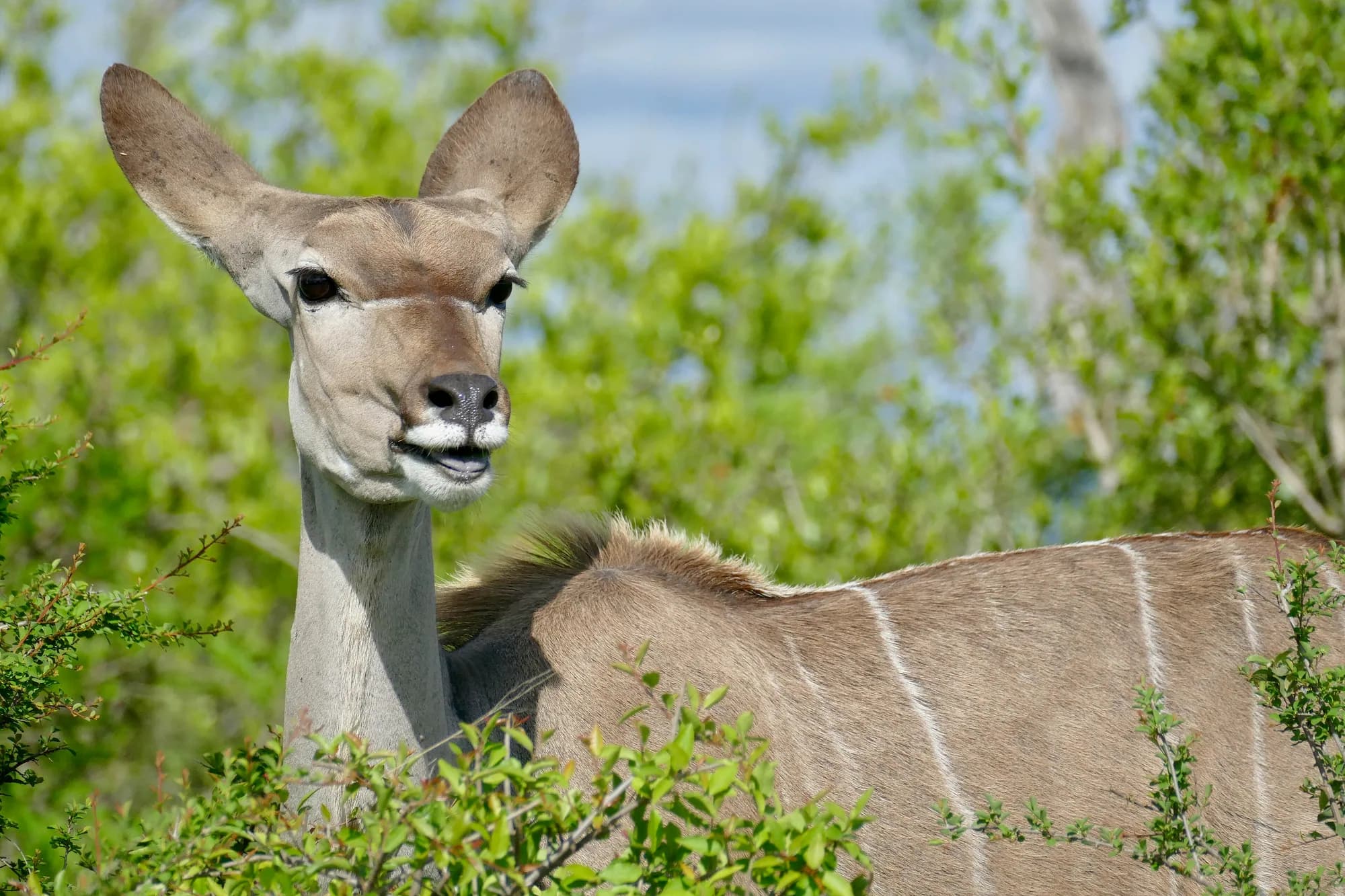
Greater kudu
A very large antelope with spiral horns over a metre long, and the animal people most often fail to see because it is standing still ten metres away. Kudu are a bush species, and their whole defence is not moving.
Three countries here, in the same woodland as sable
Roan antelope
The second-largest antelope in Africa after the eland, and the one most often mistaken for a female sable. Roan are scarce, declining across most of their range, and the reason a Kafue or Waterberg trip is worth more than its park list suggests.
Etosha