
Uganda / Kidepo Valley / Best time to visit — Kidepo Valley
Best time to visit — Kidepo Valley
Most Ugandan parks have two wet seasons and two dry ones. Kidepo has one of each, which makes the calendar simpler here than anywhere else in the country — and makes the wrong half of it harder to get out of.
One rainy season, and where UWA puts it
UWA's brochure states that the park has a semi-arid climate with just one light rainy season per year, April to September. That is a single six-month wet period and a single six-month dry one, and it is the opposite shape to the two-wet, two-dry pattern of Bwindi, Kibale and Queen Elizabeth in the west of the country.
Rainfall, by valley
| Valley | Annual rainfall | Consequence |
|---|---|---|
| Narus, in the south | About 890 mm | Remnant pools persist; the only permanent water in the park |
| Kidepo, in the north | 635 mm | Completely dry for most of the year |
Both figures are UWA's, from the Kidepo brochure. For scale: these are semi-arid numbers. Kibale, in the west, is a rainforest at around 1,700 mm. Kidepo's wetter valley receives barely half that and its drier one little more than a third, which is why a six-month rainy season here is described as light and why the dry season concentrates animals so hard.
Our record and UWA's climate note do not quite line up, and here is the honest version
This site's own park record gives best months as September to March. UWA's brochure puts the rains from April to September. Those two overlap in September, and the disagreement is probably about where a six-month rainy season tails off rather than about the facts. The defensible statement is narrower than either: the driest and most concentrated months are the ones outside UWA's April-to-September window, which is October to March, and September is a transition that could go either way in a given year. We publish both and do not reconcile them.
Uganda Wildlife Authority — Kidepo Valley National Park brochure, 2018
UWA's own two-page park brochure, linked from the download button on its Kidepo page as KVNP PARK BROCHURE and hosted on ugandawildlife.org. The file's internal creation date is 20 June 2018 and it is still the brochure UWA publishes. Downloaded (9.8 MB) and read on 14 October 2026. It is the only UWA document that explains the difference between the Narus and Kidepo valleys, names the game circuits, the campsites, the viewpoints and the trail, gives the two rainfall figures, gives the three road distances, describes the rest camp's bed stock, and names the species for which Kidepo is the only Ugandan refuge. It disagrees with UWA's own park page on the mammal count and on the distance from Kampala, and both figures are published here.
https://ugandawildlife.org/wp-content/uploads/2024/05/KVNP-2018-4.pdfWhat the dry season actually does — the mechanism, not the slogan
Dry-season game viewing is a cliche everywhere and a specific physical process here, and UWA spells the process out. During the dry months the two rivers stop flowing. The Kidepo Valley and its tributaries go completely dry. Remnant pools persist along the Narus and become the only permanent water within the park. Everything that drinks comes to them.
- Buffalo: UWA's park page gives a population of 10,000 to 15,000, and the brochure describes huge seasonal congregations in the swamps of the Narus Valley.
- Elephant: 650 to 1,000 on the park page, up from about 200 in the 1990s.
- Rothschild's giraffe: over 50, recovered from a mid-1990s bottleneck of three individuals through breeding and translocation.
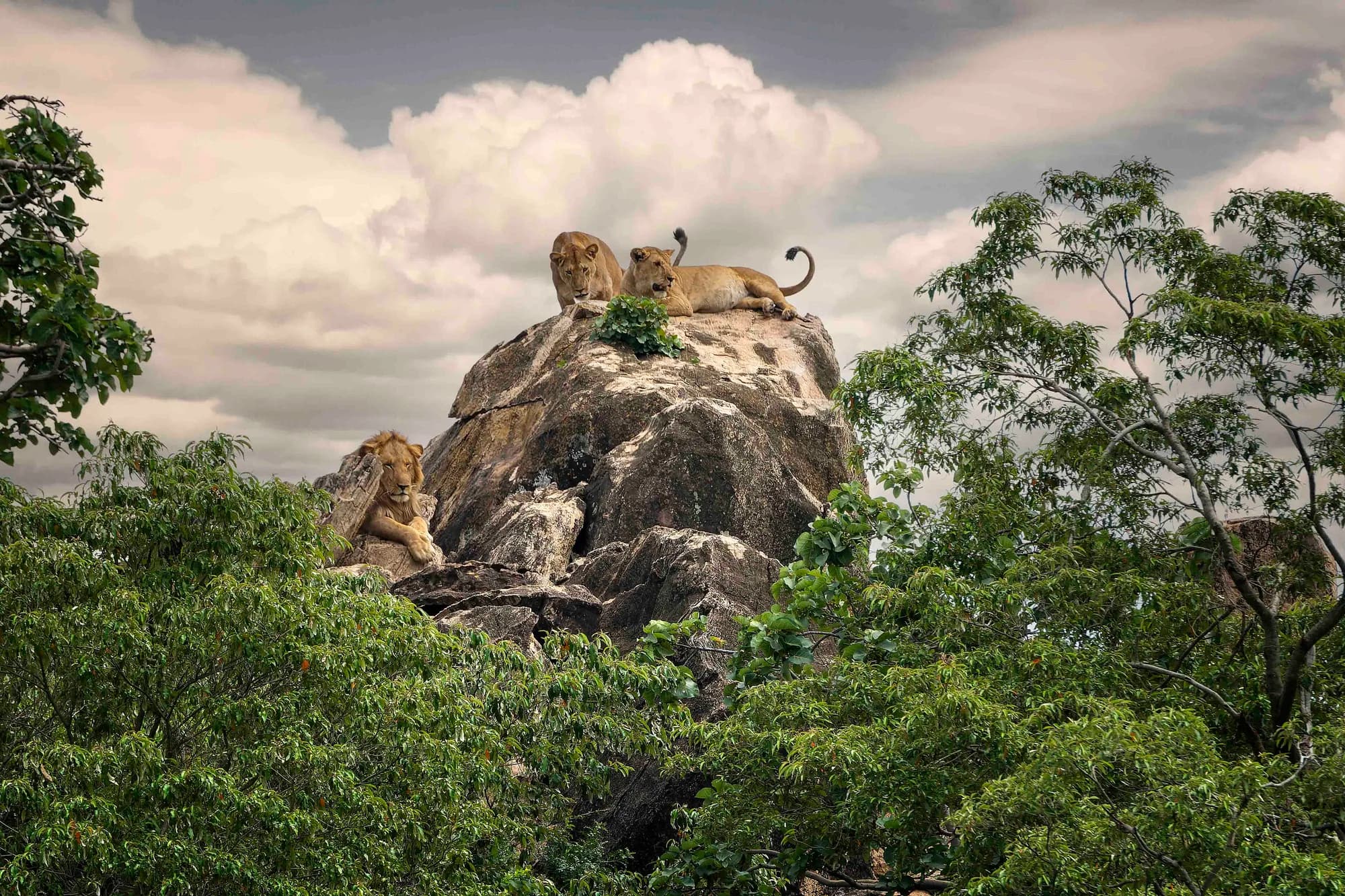
- Lion, which the park page says are often seen resting on rocky outcrops, and which the brochure says to scan the outcrops for.
- Zebra, hartebeest and many more antelope species, per the park page.
The flip side, which nobody writes down
The same mechanism that concentrates game in the dry season disperses it in the wet one. When the sand rivers run and water is everywhere, animals have no reason to come to the Narus pools, and a park of 1,442 square kilometres is a very large place to look for them in. Kidepo in May is not a slightly worse version of Kidepo in January. It is a scenically magnificent park where the thing you flew in for has spread out across an area the size of a small county. That is the honest case against the wet season, and it is stronger here than at a park with permanent rivers.
Uganda Wildlife Authority — Kidepo Valley National Park
UWA's own Kidepo park page, read 14 October 2026. The source here for the park size and altitude band, the 1962 gazettement, the distance from Kampala, the five-kilometre distance to the Kenyan border, the mammal and bird counts, the buffalo, elephant and giraffe figures, the named gates on each road route, the ten-hour drive time, and UWA's own wording on Karamoja.
https://ugandawildlife.org/national-parks/kidepo-valley-national-park/Uganda Wildlife Authority — Kidepo Valley National Park brochure, 2018
UWA's own two-page park brochure, linked from the download button on its Kidepo page as KVNP PARK BROCHURE and hosted on ugandawildlife.org. The file's internal creation date is 20 June 2018 and it is still the brochure UWA publishes. Downloaded (9.8 MB) and read on 14 October 2026. It is the only UWA document that explains the difference between the Narus and Kidepo valleys, names the game circuits, the campsites, the viewpoints and the trail, gives the two rainfall figures, gives the three road distances, describes the rest camp's bed stock, and names the species for which Kidepo is the only Ugandan refuge. It disagrees with UWA's own park page on the mammal count and on the distance from Kampala, and both figures are published here.
https://ugandawildlife.org/wp-content/uploads/2024/05/KVNP-2018-4.pdfThe road is the real seasonal variable
At most parks the season changes what you see. At Kidepo it changes whether you get there, and UWA says so in two places without ever putting the two sentences next to each other.
- A sound 4WD vehicle is required, because of various road conditions. UWA's words.
- Road conditions in the park during rainy periods can be difficult. Also UWA's words.
- The Kampala road is surfaced only as far as Kitgum on the quickest route; beyond that it is not.
- Fuel is not available in Kidepo and clean fuel is scarce in Karamoja.
- UWA's own first recommendation for reaching Kidepo is a scheduled or chartered flight, not the road.
Which is why the wet season splits into two different trips, not one
Flying in April removes most of the seasonal risk and leaves only the dispersal problem: you arrive regardless, and the game is harder to find. Driving in April stacks both — a long unsurfaced final section in the rain, in a region where you cannot refuel, to reach a park where the animals have scattered. Those are not the same holiday and they should not be priced or planned as though they were. If your dates are fixed in the April-to-September window, the question is not whether to come but whether to come by air.
Uganda Wildlife Authority — Kidepo Valley National Park brochure, 2018
UWA's own two-page park brochure, linked from the download button on its Kidepo page as KVNP PARK BROCHURE and hosted on ugandawildlife.org. The file's internal creation date is 20 June 2018 and it is still the brochure UWA publishes. Downloaded (9.8 MB) and read on 14 October 2026. It is the only UWA document that explains the difference between the Narus and Kidepo valleys, names the game circuits, the campsites, the viewpoints and the trail, gives the two rainfall figures, gives the three road distances, describes the rest camp's bed stock, and names the species for which Kidepo is the only Ugandan refuge. It disagrees with UWA's own park page on the mammal count and on the distance from Kampala, and both figures are published here.
https://ugandawildlife.org/wp-content/uploads/2024/05/KVNP-2018-4.pdfUganda Wildlife Authority — Kidepo Valley National Park
UWA's own Kidepo park page, read 14 October 2026. The source here for the park size and altitude band, the 1962 gazettement, the distance from Kampala, the five-kilometre distance to the Kenyan border, the mammal and bird counts, the buffalo, elephant and giraffe figures, the named gates on each road route, the ten-hour drive time, and UWA's own wording on Karamoja.
https://ugandawildlife.org/national-parks/kidepo-valley-national-park/Month by month
The Kidepo year, built only from what UWA publishes
| Month | UWA's rainy season? | Water in the Narus | Note |
|---|---|---|---|
| January | No | Remnant pools, the only permanent water | Deep dry season; strongest concentration |
| February | No | Remnant pools | Deep dry season |
| March | No | Remnant pools, at their lowest | Last of the dry months before the rains |
| April | Yes — rains begin | Sand rivers may fill briefly after storms | No UWA low-season discount reaches this park |
| May | Yes | Dispersal under way | Also outside the discount; see below |
| June | Yes | Dispersed | Road conditions in the park can be difficult |
| July | Yes | Dispersed | Peak season elsewhere in Uganda; not here |
| August | Yes | Dispersed | Peak season elsewhere in Uganda; not here |
| September | Yes, per UWA — our record calls it a good month | Transition | The one month the two accounts disagree about |
| October | No | Pools re-forming as the only water | Concentration beginning |
| November | No | Remnant pools | No Kidepo discount, though UWA discounts primates this month |
| December | No | Remnant pools | Dry season established |
This table is built from UWA's single stated rainy season of April to September, the brochure's description of the sand rivers and the remnant pools, and this site's own park record for September to March. UWA publishes no month-by-month rainfall table, no temperature figures and no visitor-number data for Kidepo, so nothing in the Note column is a figure we have invented to fill a cell.
July and August are the wrong months here and the right ones everywhere else
The Ugandan high season is built around the western forests, where June to September is dry and the gorilla and chimpanzee trekking is at its best. At Kidepo those months are inside UWA's single rainy season. So a classic Uganda circuit timed for Bwindi lands at Kidepo in its weakest quarter, and a circuit timed for Kidepo lands at Bwindi in the wet. There is no month that is optimal for both, and January is the closest compromise: deep dry season at Kidepo, and a drier stretch in the west than April or May. Anyone who tells you one set of dates suits the whole country has not looked at the rainfall.
Uganda Wildlife Authority — Kidepo Valley National Park brochure, 2018
UWA's own two-page park brochure, linked from the download button on its Kidepo page as KVNP PARK BROCHURE and hosted on ugandawildlife.org. The file's internal creation date is 20 June 2018 and it is still the brochure UWA publishes. Downloaded (9.8 MB) and read on 14 October 2026. It is the only UWA document that explains the difference between the Narus and Kidepo valleys, names the game circuits, the campsites, the viewpoints and the trail, gives the two rainfall figures, gives the three road distances, describes the rest camp's bed stock, and names the species for which Kidepo is the only Ugandan refuge. It disagrees with UWA's own park page on the mammal count and on the distance from Kampala, and both figures are published here.
https://ugandawildlife.org/wp-content/uploads/2024/05/KVNP-2018-4.pdfApril, May and November — the discount that does not come here
UWA introduced low-season rates in its February 2026 circular, with immediate effect, for the months of April, May and November. It is worth being precise about what they cover, because April and May are two of Kidepo's wettest months and a reader may reasonably expect a break.
The low-season rates, in full
| Activity | FNR | FR | Applies at Kidepo? |
|---|---|---|---|
| Gorilla Tracking | USD 600 | USD 500 | No — Kidepo has no gorillas |
| Chimpanzee Tracking | USD 200 | USD 150 | No — Kidepo has no chimpanzees |
Those are the only two lines in the low-season table. There is no entrance discount, no game drive discount and no walk discount in the circular, at Kidepo or anywhere else. There are also no ROA and no EAC columns on the low-season rates, so the discount as published does not reach the cheapest tiers at the parks it does cover. The rates take immediate effect and the circular states that low season permits cannot be rescheduled.
So Kidepo's wet season is full price
A foreign non-resident adult pays USD 40 a day to enter Kidepo in March, when the pools are concentrating every buffalo in the park, and USD 40 a day to enter in May, when they are not. UWA's only published seasonal pricing instrument is a primate permit discount, and this park has no primate permit. If you want the wet season to be cheaper here, it will have to be the lodge that makes it so, not the gate.
UWA — Introduction of low season gorilla and chimpanzee permit rates and revised tariff structure, 26 February 2026
The Executive Director's circular, reference TDO 93/04, signed and stamped by Dr James Musinguzi, copied to the Permanent Secretary MTWA, the Chairman of UWA's Board of Trustees and the Commissioner for Tourism and Business Development. A scanned two-page letter with no text layer: downloaded and rendered to images at 160 dpi on 14 October 2026, then read from the images. It introduces April, May and November primate rates with immediate effect, publishes a nine-line revised structure taking effect 1 January 2027, and suspends the seven-day unpaid reservation window from 1 March 2026. Not one of its lines is a Kidepo activity.
https://ugandawildlife.org/wp-content/uploads/2026/03/Tariff-changes-2026-2027.pdfUganda Wildlife Authority — Conservation Tariff 2024–2026
Downloaded and read page by page on 14 October 2026. Fifteen physical pages numbering themselves 1–24: entrance categories, vehicle and aircraft entry, guided and self game drives, walks, mountain activities, camping, research fees, fines, and a per-park fees summary. Kidepo appears in six separate places in it — the Category A entrance band, the guided game drive table, the self game drive table, the lower nature-walk band, the mountain activities table and its own summary on document page 21 — and those six places do not always agree. The tariff is printed "subject to change without prior notice". Its cover period, July 2024 to June 2026, expired on 30 June 2026 and UWA has published no successor: checked again on 14 October 2026, this is still the only tariff linked from ugandawildlife.org.
https://ugandawildlife.org/wp-content/uploads/2024/03/UWA-Conservation-Tariff-July-2024-June-2026.pdfTime of day, and the twenty-four-hour clock that rewards an early gate
Two UWA rules interact to make arrival time a money decision at Kidepo in a way it is not at a park you can reach in three hours.
- A day's entrance ticket is valid for twenty-four hours from the time of entrance, and extra time beyond twenty-four hours is charged as an extra day.
- Park gates open between 7am and 7pm.
- UWA's estimate for the quickest road route from Kampala is about ten hours.
Work it through for a party arriving by road. Enter at 18:30 after a day's drive, and your twenty-four hours expire at 18:30 the next day — one full day's fee has bought you the last half-hour of light on arrival and one complete day. Enter at 09:00 instead, having overnighted at Kitgum, and the same single fee runs to 09:00 the day after: you get a full afternoon, a full dawn and a full morning. Identical money, roughly twice the park. Across three days for two foreign non-resident adults that is the difference between USD 240 well spent and USD 240 buying a long drive and a sunset.
The practical rule
Never arrive at a Kidepo gate in the evening if you can help it. Take UWA's own advice and break the drive at Kitgum, then enter in the morning. The overnight costs you a bed and saves you most of a day's entrance for every person in the vehicle, and it is the one piece of Kidepo scheduling advice that pays for itself in cash rather than in experience.
Uganda Wildlife Authority — Conservation Tariff 2024–2026
Downloaded and read page by page on 14 October 2026. Fifteen physical pages numbering themselves 1–24: entrance categories, vehicle and aircraft entry, guided and self game drives, walks, mountain activities, camping, research fees, fines, and a per-park fees summary. Kidepo appears in six separate places in it — the Category A entrance band, the guided game drive table, the self game drive table, the lower nature-walk band, the mountain activities table and its own summary on document page 21 — and those six places do not always agree. The tariff is printed "subject to change without prior notice". Its cover period, July 2024 to June 2026, expired on 30 June 2026 and UWA has published no successor: checked again on 14 October 2026, this is still the only tariff linked from ugandawildlife.org.
https://ugandawildlife.org/wp-content/uploads/2024/03/UWA-Conservation-Tariff-July-2024-June-2026.pdfUganda Wildlife Authority — Kidepo Valley National Park
UWA's own Kidepo park page, read 14 October 2026. The source here for the park size and altitude band, the 1962 gazettement, the distance from Kampala, the five-kilometre distance to the Kenyan border, the mammal and bird counts, the buffalo, elephant and giraffe figures, the named gates on each road route, the ten-hour drive time, and UWA's own wording on Karamoja.
https://ugandawildlife.org/national-parks/kidepo-valley-national-park/