
Uganda / Kidepo Valley / Sightings log — Kidepo Valley
Sightings log — Kidepo Valley
Kibale publishes a chimpanzee sighting rate of over 90 per cent. Kidepo publishes no probability for anything. What UWA does publish is a map of where each animal stands, which is more useful than a percentage and almost nobody reads it.
No percentage exists, and here is what stands in its place
Searching for a Kidepo sighting rate is a waste of an afternoon: UWA publishes none, for lions, cheetah, elephant or anything else, in its park page, its brochure or its 114-page management plan. What it publishes instead is a layered description of where in one valley each animal is to be found, and read properly that is the better document.
Where to look, in UWA's own words
| Animal | Where UWA says to look | Which activity gets you there |
|---|---|---|
| Buffalo | In the swamps along the Narus valley floor | Narus game drive; the brochure calls the congregations huge and seasonal |
| Giraffe | On the drier slopes above the valley floor | Narus game drive, and the East Kakine walk |
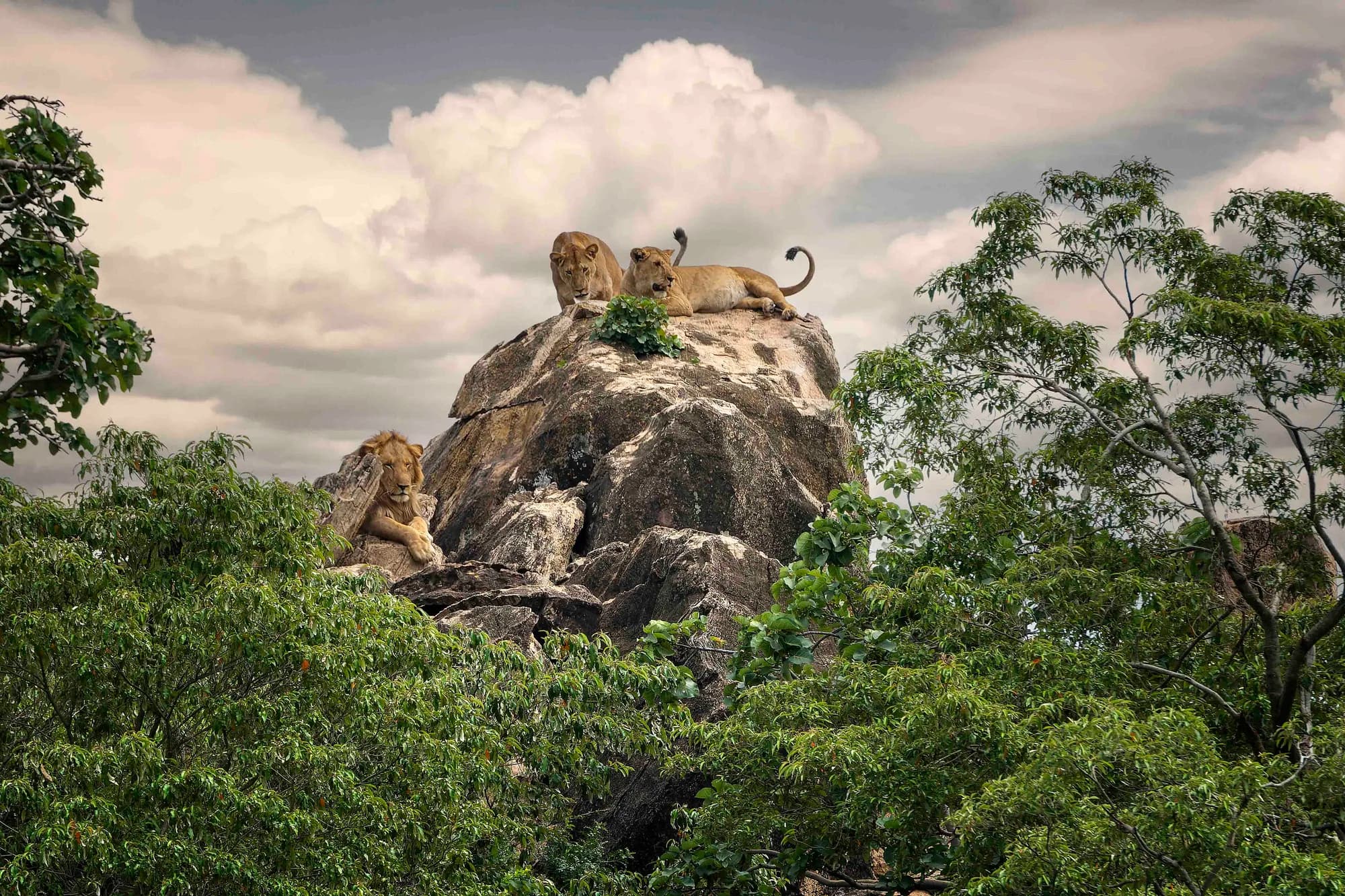
| Lion | Scan the rock outcrops. The park page adds: often seen resting on them | Narus game drive |
| Elephant | The open grasslands of East Kakine | The longer walk, as well as the drives |
| Zebra, hartebeest, reedbuck | Around Apoka Rest Camp | The short nature walk — USD 25, no vehicle needed |
| Ostrich and secretary bird | The semi-arid plains beyond the Kidepo river | The Kidepo Valley drive, 30 km from Apoka |
All from UWA's 2018 Kidepo brochure and its current park page. Notice that this is a vertical as well as a horizontal map: floor, slope and outcrop are three heights in the same view, and a party that treats a game drive as scanning a horizon will miss two of the three. Notice also that the cheapest activity on the list, the USD 25 walk from the rest camp, has three named species against it.
Why the outcrops hold lions, which is a geology answer
The management plan explains the landscape UWA keeps telling you to scan: the park's surface strata are volcanic in origin, and the rolling savanna of the valley floors is periodically broken by low hills and rocky outcrops formed by the extrusion of volcanic plugs. Those plugs are the only elevated, exposed, breezy, predator-proof surfaces in a flat valley. That is why lions are on them, why UWA says so twice in two documents, and why scanning rock rather than grass is the single most useful habit to bring to a Narus drive.
Uganda Wildlife Authority — Kidepo Valley National Park brochure, 2018
UWA's own two-page park brochure, linked from the download button on its Kidepo page as KVNP PARK BROCHURE and hosted on ugandawildlife.org. The file's internal creation date is 20 June 2018 and it is still the brochure UWA publishes. Downloaded (9.8 MB) and read on 14 October 2026. It is the only UWA document that explains the difference between the Narus and Kidepo valleys, names the game circuits, the campsites, the viewpoints and the trail, gives the two rainfall figures, gives the three road distances, describes the rest camp's bed stock, and names the species for which Kidepo is the only Ugandan refuge. It disagrees with UWA's own park page on the mammal count and on the distance from Kampala, and both figures are published here.
https://ugandawildlife.org/wp-content/uploads/2024/05/KVNP-2018-4.pdfUganda Wildlife Authority — Kidepo Valley National Park
UWA's own Kidepo park page, read 14 October 2026. The source here for the park size and altitude band, the 1962 gazettement, the distance from Kampala, the five-kilometre distance to the Kenyan border, the mammal and bird counts, the buffalo, elephant and giraffe figures, the named gates on each road route, the ten-hour drive time, and UWA's own wording on Karamoja.
https://ugandawildlife.org/national-parks/kidepo-valley-national-park/UWA — Kidepo Valley National Park General Management Plan, Ministry of Tourism Wildlife and Antiquities / UWA Planning Unit
A 114-page government management plan, hosted on ugandawildlife.org, downloaded and read on 14 October 2026. Its file name and cover say 2012–2022 and its running header on every page says 2011–2021; the PDF's internal creation date is 17 July 2013. It is by a distance the most detailed document UWA has published on this park, and almost none of it has reached a travel page. It is the source here for the four management zones, the gate names and their problems, the summit heights of Lonyili and Morungole, the location of the airstrip, the 2008 Wildlife Conservation Society and Makerere University biodiversity survey figures, the 28 mammals found in no other Ugandan national park, the species the park has lost, and the cheetah population history. Where it disagrees with UWA's 2018 brochure or its 2026 web page, all figures are published.
https://ugandawildlife.org/wp-content/uploads/2022/01/Kidepo_Valley_-National_Park_GMP.pdfThe one place UWA tells you not to expect sightings
This is the most useful sentence in the whole of UWA's Kidepo material and it is in neither the park page nor any travel article. Of the plains beyond the Kidepo river crossing, the brochure says: mammals are rare in the vast, semi-arid plains beyond the river but ostriches and secretary birds are often seen.
- That is a tourism authority, in its own promotional brochure, telling you the drive it is describing will not produce mammals.
- The same passage calls the Kidepo Valley short on big game but massive on scenery, and says its vast scale more than justifies the thirty-kilometre drive.
- The reason is on the zones page: the Kidepo Valley and its tributaries are completely dry for most of the year, while remnant pools persist along the Narus and are the only permanent water in the park.
- The animals are where the water is. UWA says both halves of that and leaves the reader to put them together.
So plan the Kidepo Valley drive as scenery, and it will not disappoint you
A party that drives to Kanangorok expecting game comes back disappointed from a genuinely spectacular day. A party that drives there for the watershed view at Lokimorigen towards the 2,975-metre Jebel Lotuke, a dry sand river to walk on, hot springs on the South Sudan border and the emptiest horizon in Uganda comes back satisfied from exactly the same day. UWA told you which one it is. The failure mode here is entirely one of expectation and it costs a whole day of a three-day trip.
Uganda Wildlife Authority — Kidepo Valley National Park brochure, 2018
UWA's own two-page park brochure, linked from the download button on its Kidepo page as KVNP PARK BROCHURE and hosted on ugandawildlife.org. The file's internal creation date is 20 June 2018 and it is still the brochure UWA publishes. Downloaded (9.8 MB) and read on 14 October 2026. It is the only UWA document that explains the difference between the Narus and Kidepo valleys, names the game circuits, the campsites, the viewpoints and the trail, gives the two rainfall figures, gives the three road distances, describes the rest camp's bed stock, and names the species for which Kidepo is the only Ugandan refuge. It disagrees with UWA's own park page on the mammal count and on the distance from Kampala, and both figures are published here.
https://ugandawildlife.org/wp-content/uploads/2024/05/KVNP-2018-4.pdfThe famous species, and honest odds on each
Kidepo is sold on cheetah, caracal and a list of animals found in no other Ugandan park. Here is what UWA's own documents say about each one's actual abundance, which is a different question from whether it is on the list.
The rarities, with UWA's own numbers against them
| Species | What UWA's management plan says | Realistic expectation |
|---|---|---|
| Cheetah | Occasionally seen in the park or surrounding area; probably no more than 5 individuals; not known if any are resident or transient. About 25 in 1971 | Do not plan around it. IUCN's 2021 figure of 17 covers Kidepo and bordering South Sudan together |
| Striped hyaena | Grouped with cheetah in the same sentence: occasionally seen, probably no more than 5 | Do not plan around it |
| Caracal | Named among the park's conservation values and the 28 Kidepo-only mammals. No population figure | Nocturnal and secretive. The night drive is the only realistic chance |
| Bat-eared fox | Named among the conservation values. No population figure | Nocturnal. Night drive |
| Aardwolf | Named among the conservation values and the 28. No population figure | Nocturnal and rarely seen anywhere in its range |
| African wild dog, Beisa oryx, roan antelope | Believed to be extinct from the park | None. They are gone |
| Black rhino | 50 in 1971, 16 counted in 1978, last seen 1983 | None |
The first two rows cite UWA's own plan citing an internal 2000 reference. Four of the seven rows are animals you will not see because they are nocturnal, and three are animals nobody will see again. This is what the twenty-eight-species claim looks like when you check it against the same authority's population data.
Which makes the night drive the only one of these that is a purchase decision
Caracal, bat-eared fox, aardwolf and striped hyaena are the four Kidepo-only mammals a visitor might plausibly see, and all four are nocturnal. The only nocturnal product UWA sells here is the guided night game drive at USD 30 a head, it requires a UWA guide, and it is restricted to tourists sleeping within the park. So the entire realistic prospect of seeing what makes Kidepo's species list distinctive depends on a bed booking made weeks earlier. That is the connection between the where-to-stay page and this one, and it is the most consequential thing on either.
UWA — Kidepo Valley National Park General Management Plan, Ministry of Tourism Wildlife and Antiquities / UWA Planning Unit
A 114-page government management plan, hosted on ugandawildlife.org, downloaded and read on 14 October 2026. Its file name and cover say 2012–2022 and its running header on every page says 2011–2021; the PDF's internal creation date is 17 July 2013. It is by a distance the most detailed document UWA has published on this park, and almost none of it has reached a travel page. It is the source here for the four management zones, the gate names and their problems, the summit heights of Lonyili and Morungole, the location of the airstrip, the 2008 Wildlife Conservation Society and Makerere University biodiversity survey figures, the 28 mammals found in no other Ugandan national park, the species the park has lost, and the cheetah population history. Where it disagrees with UWA's 2018 brochure or its 2026 web page, all figures are published.
https://ugandawildlife.org/wp-content/uploads/2022/01/Kidepo_Valley_-National_Park_GMP.pdfUganda Wildlife Authority — Conservation Tariff 2024–2026
Downloaded and read page by page on 14 October 2026. Fifteen physical pages numbering themselves 1–24: entrance categories, vehicle and aircraft entry, guided and self game drives, walks, mountain activities, camping, research fees, fines, and a per-park fees summary. Kidepo appears in six separate places in it — the Category A entrance band, the guided game drive table, the self game drive table, the lower nature-walk band, the mountain activities table and its own summary on document page 21 — and those six places do not always agree. The tariff is printed "subject to change without prior notice". Its cover period, July 2024 to June 2026, expired on 30 June 2026 and UWA has published no successor: checked again on 14 October 2026, this is still the only tariff linked from ugandawildlife.org.
https://ugandawildlife.org/wp-content/uploads/2024/03/UWA-Conservation-Tariff-July-2024-June-2026.pdfIUCN Red List of Threatened Species, version 2026-1
The Red List assessments for cheetah (assessed 17 May 2021, published 2024), caracal, striped hyaena, bat-eared fox, greater kudu (assessed 14 June 2016, published 2020) and lesser kudu, read 14 October 2026 for their Uganda range status only. Note for the next researcher: iucnredlist.org returns HTTP 403 to a plain curl and to a fetch tool alike, and the old apiv3 API is decommissioned; these pages were read through a text-rendering proxy. They are cited here only for whether Uganda is in a species range, which is the one question a Red List assessment answers authoritatively.
The morning, hour by hour
Built from UWA's gate hours, its 40 km/h speed limit, its named circuits and its own description of what is where. A Narus Valley morning from Apoka.
A Narus morning
| Time | What | What you are looking at |
|---|---|---|
| Before first light | Leave Apoka. A ranger at USD 20 for the day is already with you | Nothing yet. This is positioning |
| First light | The valley floor swamps on the Kakine circuit | Buffalo. UWA's congregations are a dry-season phenomenon and this is when they are at water |
| Soon after | Lift your eyes to the drier slopes above | Giraffe. Over fifty in the park, from a founder group of three |
| Through the morning | Work the rock outcrops specifically, not the grass | Lions, resting. This is the single highest-value habit on a Kidepo drive |
| Mid-morning | The loops north west of Apoka, or towards the seasonal Crocodile Pool | Newly created ground, per UWA. Take the ranger |
| By 10:00 or so | Back towards Apoka | Semi-arid heat and a 40 km/h limit make late mornings unproductive |
| Instead of a midday drive | The binocular viewpoint at the rest camp, or the short walk | Zebra, hartebeest and reedbuck on foot, for USD 25 |
Circuit names, the three-height structure and the walk species are all UWA's. The timing logic is ours, from the 7am to 7pm gate hours and the 40 km/h limit in the tariff's park rules, and from UWA's description of a semi-arid climate. We publish no figure for how long a drive takes because UWA publishes no distances for the Narus circuits.
The binocular viewpoints are free and almost nobody uses them
UWA installed them at three places — Apoka Rest Camp, Nagusokopire Campsite and Kakine Campsite — and Kakine's has a 360-degree panorama taking in the Napore-Nyungea range, the Morungule mountains and Mount Lomej across the border. They are the only fixed observation infrastructure in the park, they cost nothing beyond entrance, and they turn the unproductive middle of the day into something. For a party flying in without a vehicle, the viewpoint at the rest camp is the most valuable thing within walking distance.
Uganda Wildlife Authority — Kidepo Valley National Park brochure, 2018
UWA's own two-page park brochure, linked from the download button on its Kidepo page as KVNP PARK BROCHURE and hosted on ugandawildlife.org. The file's internal creation date is 20 June 2018 and it is still the brochure UWA publishes. Downloaded (9.8 MB) and read on 14 October 2026. It is the only UWA document that explains the difference between the Narus and Kidepo valleys, names the game circuits, the campsites, the viewpoints and the trail, gives the two rainfall figures, gives the three road distances, describes the rest camp's bed stock, and names the species for which Kidepo is the only Ugandan refuge. It disagrees with UWA's own park page on the mammal count and on the distance from Kampala, and both figures are published here.
https://ugandawildlife.org/wp-content/uploads/2024/05/KVNP-2018-4.pdfUganda Wildlife Authority — Conservation Tariff 2024–2026
Downloaded and read page by page on 14 October 2026. Fifteen physical pages numbering themselves 1–24: entrance categories, vehicle and aircraft entry, guided and self game drives, walks, mountain activities, camping, research fees, fines, and a per-park fees summary. Kidepo appears in six separate places in it — the Category A entrance band, the guided game drive table, the self game drive table, the lower nature-walk band, the mountain activities table and its own summary on document page 21 — and those six places do not always agree. The tariff is printed "subject to change without prior notice". Its cover period, July 2024 to June 2026, expired on 30 June 2026 and UWA has published no successor: checked again on 14 October 2026, this is still the only tariff linked from ugandawildlife.org.
https://ugandawildlife.org/wp-content/uploads/2024/03/UWA-Conservation-Tariff-July-2024-June-2026.pdfWhat surprises people
- How empty it is of people. UWA's own management plan records Kidepo visitor numbers as very low compared with Murchison, Queen Elizabeth, Kibale, Bwindi and Lake Mburo. The emptiness is the product, and it is the one thing no fee table conveys.
- How much of the park is mountains. Valley floors run 914 to 1,219 metres and the summits rise to 2,749 metres at Morungole and 2,248 at Lonyili. UWA describes grasslands extending towards rugged mountains in all points of the compass, and it is literal.
- That the birding is cheaper than the game. Birding and nature walks here are USD 25, in the tariff's lower band, for a list with 56 raptor species and over a hundred dry-country specialities.
- That there are 56 raptor species and, per the management plan, 14 raptors unique to this park in Uganda. For a certain kind of visitor that is the actual reason to come, and it is buried on page 21 of a management plan.
- That two foreign countries are in the view. Jebel Lotuke in South Sudan at 2,975 metres from the Lokimorigen watershed, and the Kenyan border five kilometres from the eastern boundary at its narrowest.
- That the Kidepo river is something you walk on rather than look at. UWA's own suggestion is to descend at the crossing and walk the dry sandy riverbed.
- How little of the famous species list is still here. Three of the twenty-eight are believed extinct from the park and the black rhino has been gone since 1983.
And the thing that surprises people in the wrong direction
Kidepo is not a big-cat park in the way Kenya's Mara or Zambia's Luangwa are, and nothing in UWA's material claims it is. There is no published lion population, no sighting rate, and no predator density figure of any kind. What there is, on UWA's own numbers, is between 10,000 and 15,000 buffalo, 650 to 1,000 elephant and over 50 Rothschild's giraffe in one valley with the only permanent water for 1,442 square kilometres. Come for the herds and the horizon. The cats are a bonus, and UWA has never promised otherwise.
UWA — Kidepo Valley National Park General Management Plan, Ministry of Tourism Wildlife and Antiquities / UWA Planning Unit
A 114-page government management plan, hosted on ugandawildlife.org, downloaded and read on 14 October 2026. Its file name and cover say 2012–2022 and its running header on every page says 2011–2021; the PDF's internal creation date is 17 July 2013. It is by a distance the most detailed document UWA has published on this park, and almost none of it has reached a travel page. It is the source here for the four management zones, the gate names and their problems, the summit heights of Lonyili and Morungole, the location of the airstrip, the 2008 Wildlife Conservation Society and Makerere University biodiversity survey figures, the 28 mammals found in no other Ugandan national park, the species the park has lost, and the cheetah population history. Where it disagrees with UWA's 2018 brochure or its 2026 web page, all figures are published.
https://ugandawildlife.org/wp-content/uploads/2022/01/Kidepo_Valley_-National_Park_GMP.pdfUganda Wildlife Authority — Kidepo Valley National Park
UWA's own Kidepo park page, read 14 October 2026. The source here for the park size and altitude band, the 1962 gazettement, the distance from Kampala, the five-kilometre distance to the Kenyan border, the mammal and bird counts, the buffalo, elephant and giraffe figures, the named gates on each road route, the ten-hour drive time, and UWA's own wording on Karamoja.
https://ugandawildlife.org/national-parks/kidepo-valley-national-park/Uganda Wildlife Authority — Kidepo Valley National Park brochure, 2018
UWA's own two-page park brochure, linked from the download button on its Kidepo page as KVNP PARK BROCHURE and hosted on ugandawildlife.org. The file's internal creation date is 20 June 2018 and it is still the brochure UWA publishes. Downloaded (9.8 MB) and read on 14 October 2026. It is the only UWA document that explains the difference between the Narus and Kidepo valleys, names the game circuits, the campsites, the viewpoints and the trail, gives the two rainfall figures, gives the three road distances, describes the rest camp's bed stock, and names the species for which Kidepo is the only Ugandan refuge. It disagrees with UWA's own park page on the mammal count and on the distance from Kampala, and both figures are published here.
https://ugandawildlife.org/wp-content/uploads/2024/05/KVNP-2018-4.pdfWhat we do not publish, and why
The named gaps, so that nothing is quietly dropped. Each of these is a question a reader will ask and each has no answer we are willing to stand behind.
- No sighting probability for any Kidepo species. UWA publishes none. Where a figure circulates, it is an operator's.
- No lion population figure. UWA gives numbers for buffalo, elephant and giraffe and none for any predator.
- No current cheetah count for the park alone. UWA's plan says probably no more than five and does not know whether they are resident; IUCN's 17 covers Kidepo and bordering South Sudan together. The two are not the same quantity and we do not merge them.
- No distances for the Narus game circuits, so no drive durations. The brochure gives 30 km to the Kidepo river and 11 km beyond it to the springs, and nothing else.
- No current bird count that two UWA documents agree on. The management plan prints 462 and 472 in different chapters and the brochure says over 475; the web page says 476.
- No verified mammal total. 86 appears in two UWA documents and traces to a November to December 2008 Wildlife Conservation Society and Makerere University survey; the web page's over 77 traces to nothing we could find. We use 86 and say why.
- No confirmation of whether greater kudu has ever been recorded here in a form IUCN accepts. See the wildlife page; the honest answer is that it has not, and that the Ugandan kudu is the lesser one.
A gap we consider more useful than a number would be
The absence of a sighting rate is not a failure of this page. Kibale can publish over 90 per cent because a chimpanzee tracking group follows a habituated community with researchers in it. Nothing at Kidepo is habituated, nothing is tracked and no group is followed — you are driving a valley and looking at it. A percentage for that would be invented whoever published it, and an invented percentage is worse than UWA's three-line map of where each animal actually stands. We have published the map.
UWA — Kidepo Valley National Park General Management Plan, Ministry of Tourism Wildlife and Antiquities / UWA Planning Unit
A 114-page government management plan, hosted on ugandawildlife.org, downloaded and read on 14 October 2026. Its file name and cover say 2012–2022 and its running header on every page says 2011–2021; the PDF's internal creation date is 17 July 2013. It is by a distance the most detailed document UWA has published on this park, and almost none of it has reached a travel page. It is the source here for the four management zones, the gate names and their problems, the summit heights of Lonyili and Morungole, the location of the airstrip, the 2008 Wildlife Conservation Society and Makerere University biodiversity survey figures, the 28 mammals found in no other Ugandan national park, the species the park has lost, and the cheetah population history. Where it disagrees with UWA's 2018 brochure or its 2026 web page, all figures are published.
https://ugandawildlife.org/wp-content/uploads/2022/01/Kidepo_Valley_-National_Park_GMP.pdfUganda Wildlife Authority — Kidepo Valley National Park brochure, 2018
UWA's own two-page park brochure, linked from the download button on its Kidepo page as KVNP PARK BROCHURE and hosted on ugandawildlife.org. The file's internal creation date is 20 June 2018 and it is still the brochure UWA publishes. Downloaded (9.8 MB) and read on 14 October 2026. It is the only UWA document that explains the difference between the Narus and Kidepo valleys, names the game circuits, the campsites, the viewpoints and the trail, gives the two rainfall figures, gives the three road distances, describes the rest camp's bed stock, and names the species for which Kidepo is the only Ugandan refuge. It disagrees with UWA's own park page on the mammal count and on the distance from Kampala, and both figures are published here.
https://ugandawildlife.org/wp-content/uploads/2024/05/KVNP-2018-4.pdfUganda Wildlife Authority — Kidepo Valley National Park
UWA's own Kidepo park page, read 14 October 2026. The source here for the park size and altitude band, the 1962 gazettement, the distance from Kampala, the five-kilometre distance to the Kenyan border, the mammal and bird counts, the buffalo, elephant and giraffe figures, the named gates on each road route, the ten-hour drive time, and UWA's own wording on Karamoja.
https://ugandawildlife.org/national-parks/kidepo-valley-national-park/