
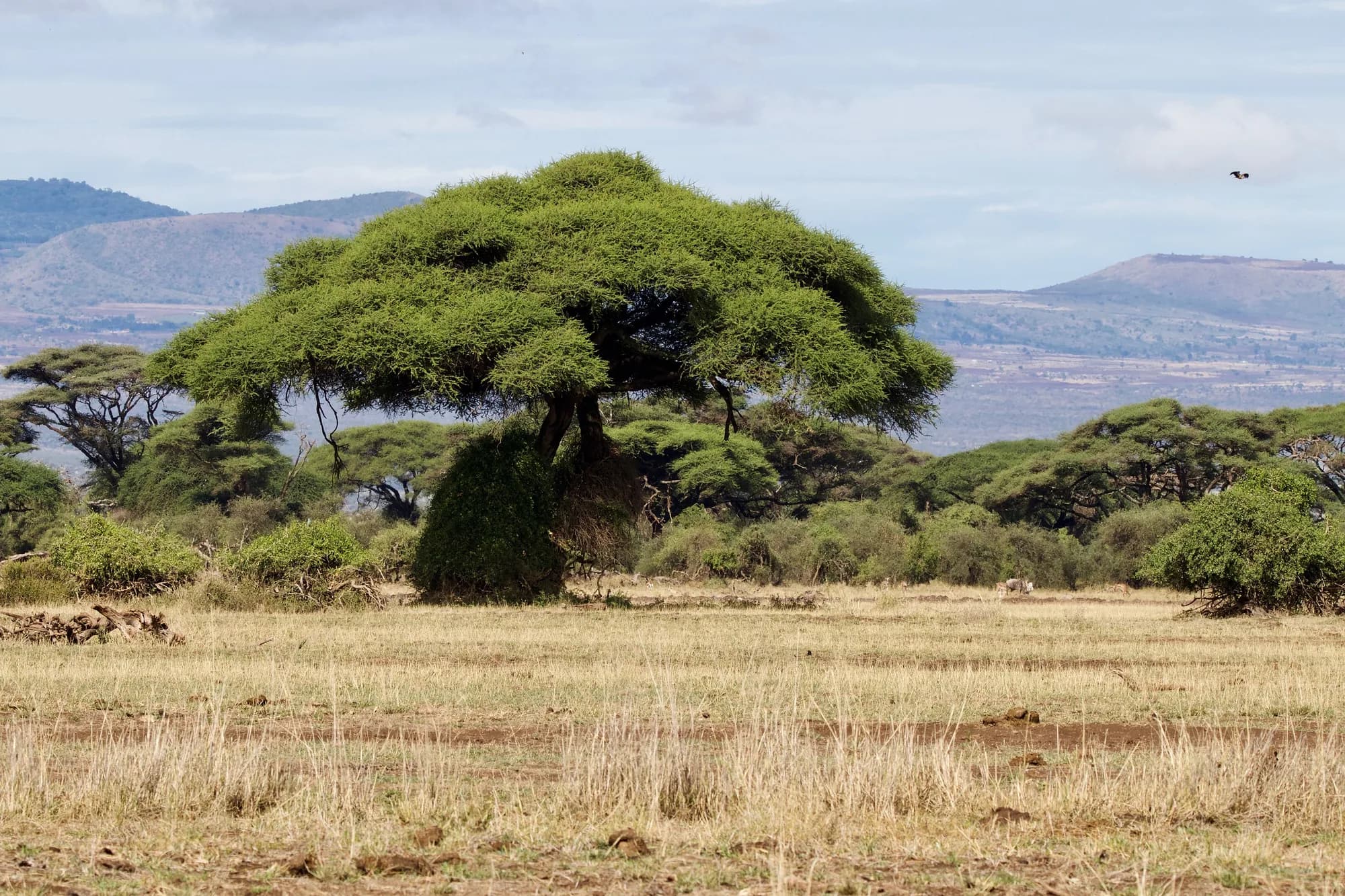
Kenya / Amboseli / Best time to visit — Amboseli
Best time to visit — Amboseli
Most people come to Amboseli for a mountain that is in another country and visible for about three hours a day. Getting the hours right matters more than getting the month right.
The mountain keeps a daily timetable
Kilimanjaro is not in the park and it is not in Kenya. It stands across the border in Tanzania, and it is the backdrop that made Amboseli famous — the elephant-beneath-a-snow-capped-mountain photograph is the single most reproduced wildlife image to come out of East Africa. What almost nobody is told before they arrive is that the mountain spends most of the day invisible.
It generates its own weather. A mass that size, rising out of hot plains, drives convection all morning: the summit is usually clear at first light, builds cloud as the ground heats, sits hidden from roughly mid-morning until late afternoon, and frequently clears again in the last hour before sunset. This is a daily cycle, not a seasonal one. It happens in August and it happens in February.
This is the most useful sentence on the page
Be out of camp before sunrise, and out again for the last ninety minutes of light. Those are the two windows. They are also the two windows in which the elephants move and the light is worth photographing, so nothing is being traded off — the timings simply coincide. A visitor who does the standard mid-morning drive and a four o'clock start will see the mountain on fewer days than the brochure implied, and will conclude they were unlucky rather than badly scheduled.
Two nights is four attempts
If the mountain is why you are coming, count windows rather than days. Two nights gives you two dawns and two evenings — four attempts. Three nights gives you six. Since a clear Kilimanjaro is weather rather than skill, adding a night is the only lever you actually have, and it is a cheaper lever than any other on the trip.
How an Amboseli day actually behaves
| Part of the day | The mountain | The wildlife |
|---|---|---|
| Before sunrise to about 08:00 | Usually clear; the best window of the day | Elephants moving towards the swamps; best light |
| 08:00 to mid-morning | Clouding over as the ground heats | Still active; dust starting to rise |
| Mid-morning to mid-afternoon | Normally hidden | Elephants standing in the swamps — unusually productive |
| Last ninety minutes of light | Often clears again | Elephants leaving the swamps; the second good window |
| After dark | Not applicable inside the park | Conservancy night drives only; the park is closed to you |
The middle row is what makes Amboseli different from most savanna parks. Elsewhere you go back to camp at eleven. Here the swamps are the sighting, and they are at their best when the mountain is not.
The year, month by month
Month by month
| Months | Conditions | Worth knowing |
|---|---|---|
| January – February | Short dry season; hot, clear, dusty | Cleanest air of the year and the best odds on the mountain |
| March – May | Long rains; green, humid, few visitors | Tracks flood, the lake bed holds water, some camps close |
| June – August | Long dry season begins; cool mornings, rising dust | Game concentrates on the swamps; peak season begins |
| September – October | Driest and dustiest | Easiest game viewing, hardest conditions for the mountain |
| November – December | Short rains; brief, patchy, green | Softer light, thinner crowds, real chance of clear mornings |
Unlike the Maasai Mara, the entry fee does not change with the season — USD 90 for a non-resident adult in every month. What changes is the dust, the state of the tracks and the camp rate.
The dry months concentrate the game, because the swamps are the only permanent water for a long way. That makes June to October the easy answer for wildlife and the reason it is peak season. But the same months put fine volcanic dust into the air, and the mountain is seen through it. January and February are dry again with far better air, and they are the months this site would choose for a first visit.
Kenya Wildlife Service — Conservation Fees, October 2025 schedule
Read on 28 September 2026 from the verified fee record this site holds against KWS's own published schedule, taken from the PDF above on 27 September 2026. On 28 September kws.go.ke refused automated requests outright — a 403 from its firewall on the park page, a TLS failure on the fee page — so the figures are carried as recorded rather than re-read live, and no operator's copy of the tariff has been substituted for the department's. One caveat belongs on the face of the page rather than in a footnote: the schedule bands parks rather than naming a rate park by park, and Amboseli sits in the band printed "PREMIUM PARKS — Amboseli and Lake Nakuru National Parks". The mapping from that band to this park is the single step between the document and these tables.
https://kws.go.ke/wp-content/uploads/2026/05/KWS-Conservation-Fee-October-2025.pdfThe rains are no longer a schedule
The long-rains and short-rains framing above is the traditional one, and the people who have measured rainfall here longest say it is coming apart. The Amboseli Trust for Elephants keeps a rainfall series running back more than half a century — it plots rain years from October to September against a fifty-seven-year annual mean — and reports that rainfall has become more erratic in distribution and in total, that the predictable pattern of long and short rains is changing, and that most of a year's rain now tends to fall in just a few days.
The consequence for a visitor is modest but real: treat a seasonal table as a probability rather than a timetable. The drought of 2022 and 2023 was followed by a year of exceptional rainfall in 2024. A March trip may find the tracks dry and an August trip may find them wet, and in Amboseli the difference between those two is the difference between a drivable western pan and a lake.
Amboseli Trust for Elephants — Annual Report 2024
Read 28 September 2026. Population, family, birth and mortality figures are the Trust's own, from the long-term monitoring section of its annual report for 2024. Because every elephant in this population has been identified individually since 1972, the numbers are stated to the animal rather than as a survey estimate — which is why they can be quoted the way they are here and cannot be quoted that way for any other elephant population on this site.
https://www.elephanttrust.org/wp-content/uploads/2025/05/amboseli-trust-for-elephants-annual-report-2024.pdfDust and flood, which are the same problem
- In the dry months the pan west of the swamps is fine grey volcanic dust. It gets into everything, and a vehicle ahead of you on the track will blind you for a minute at a time. A blower and a spare lens cloth matter more here than anywhere else on this site.
- Dust devils on the lake bed in the afternoon are a genuine feature of the place and photograph beautifully from a distance.
- In the long rains the same ground floods and the tracks across it become impassable, which shortens the usable circuit rather than closing the park.
- Changing lenses in the open in August is how sensors get ruined. Do it in the vehicle with the roof down, or do not do it.
- The park is hot, flat and open, with very little shade on the circuit. The middle of the day is unpleasant for people even while it is productive for elephants.
Green does not mean bad
The wet months are the least-sold and in some ways the most rewarding: the pan holds water and flamingo, the dust is gone, the light is soft, the camps are cheap and the park is nearly empty. What you give up is the guaranteed concentration of game on the swamps, because there is water everywhere and the animals disperse. It is a real trade rather than a consolation prize.
Choosing, if you only get one visit
- The mountain photograph is the point: January or February. Clear air, dry ground, and not quite peak season.
- Maximum elephants in one frame: August to October, when the swamps are the only water and everything is standing in them.
- Green, empty and cheap: March, or November. Accept flooded tracks in the first and patchy rain in the second.
- Travelling with children or on a tight budget: the low months, because the KWS fee does not fall but everything else does.
- Combining with the Maasai Mara for the migration: July to October, and accept Amboseli's dust as the price of the Mara's timing.
The one month we would avoid without a reason is April, when the long rains are at their heaviest, the western half of the circuit is likely to be unusable and some properties close. It is the cheapest month and it is cheap for a reason.