
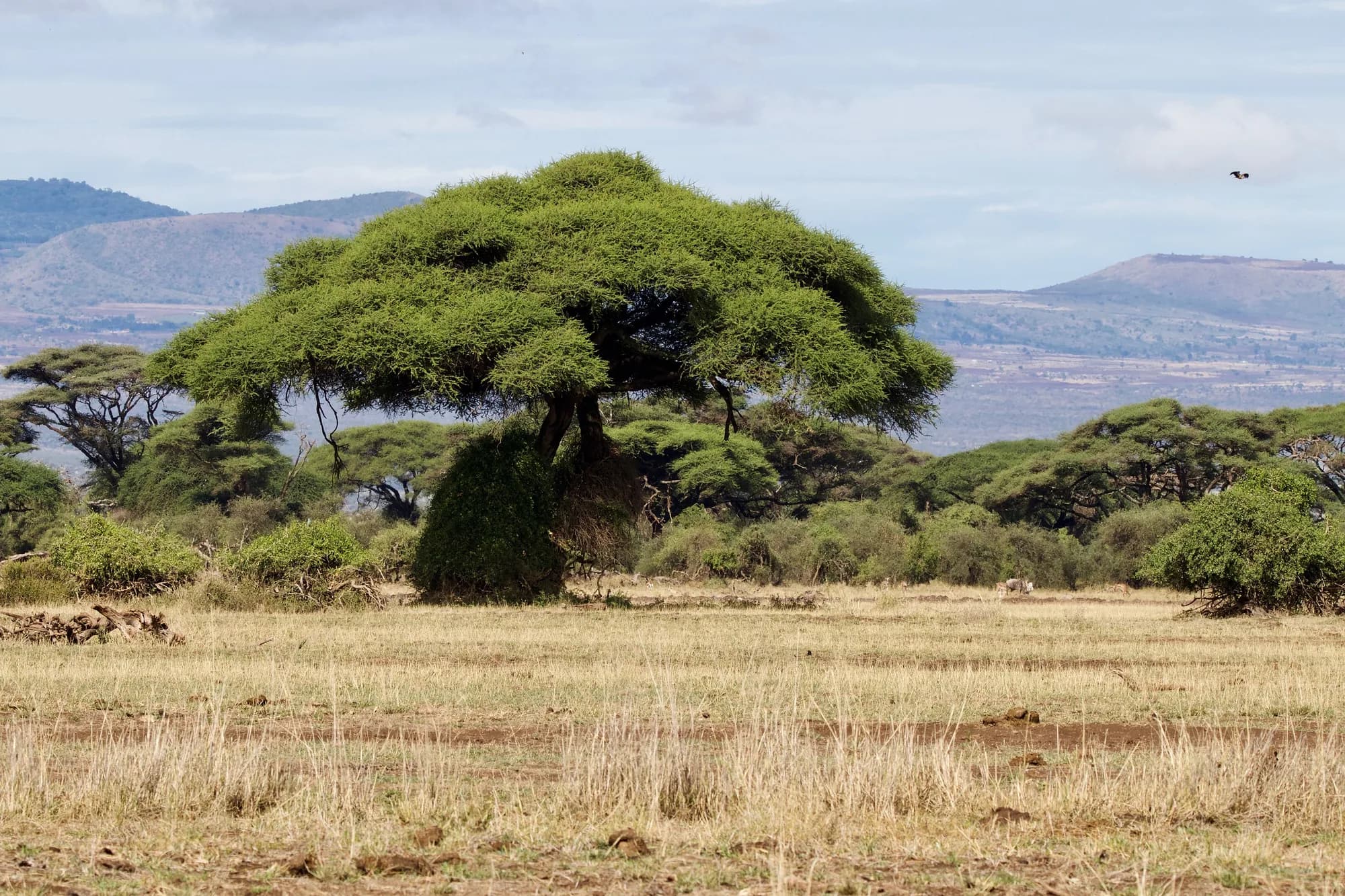
Kenya / Amboseli / How to reach — Amboseli
How to reach — Amboseli
Amboseli is a long half-day from Nairobi by road and a short hop by air, and which gate you arrive at is decided by the road you took rather than by where you are sleeping.
Where it actually is
Kajiado County, in Kenya's southern plains, hard against the Tanzanian border, with Kilimanjaro rising immediately to the south on the other side of it. Nairobi is to the north; Tsavo West is to the east, connected by the Kimana corridor; Namanga and the Tanzanian frontier are to the west.
The park itself is a core inside a much larger ecosystem — UNESCO's biosphere reserve over the same ground covers 798,298 hectares and was designated in 1991 — and almost all of the land you drive across to get here is Maasai group-ranch country rather than anything gazetted. That is worth registering on the way in: the elephants you are coming to see spend a great deal of their time on it.
UNESCO Man and the Biosphere Programme — Amboseli Biosphere Reserve
Read 28 September 2026. Designated 1991; total area 798,298 hectares. UNESCO describes the reserve as containing "natural dry mountain forest, mountains, savannah rangelands, wetlands and swamps" over "basement plains, saline plains with freshwater swamps, and the volcanic slopes of Kilimanjaro", with the Maasai as the predominant population and group ranching the dominant land use. That figure is the biosphere reserve, which is the whole ecosystem — the national park is a small core inside it, and the two are routinely confused in travel writing.
https://www.unesco.org/en/mab/amboseliBy road from Nairobi — two routes, opposite ends
There are two sensible ways south and they arrive at different corners of the park, which is the part people get wrong. The Namanga road runs down the A104 towards the border town of Namanga and enters at Meshanani in the north-west. The Mombasa road route runs south-east and turns off at Emali, entering at Iremito in the north-east. Both are tarred for most of their length and rough for the last stretch, and both take the better part of half a day with stops.
The two road routes
| Route | Turns off at | Enters at | Suits |
|---|---|---|---|
| A104 south, via Namanga | Namanga, on the Tanzanian border | Meshanani gate, north-west | The classic Nairobi arrival; camps on the western side |
| Mombasa road, via Emali | Emali | Iremito gate, north-east | Camps on the eastern side; onward runs to Tsavo |
| From Tsavo West, via Kimana | Kimana town | Kimana gate, east | The southern circuit; Chyulu and Tsavo connections |
The gate follows the road you took, not the camp you booked. Confirm with your camp which gate they expect you at before you leave Nairobi — arriving at the wrong end of even a small park still costs an hour on dust road.
The gates
Amboseli's gates and what they serve
| Gate | Position | Arrive from | Note |
|---|---|---|---|
| Meshanani | North-west | Nairobi via Namanga | The classic Nairobi arrival |
| Iremito | North-east | Nairobi via Emali, or the Mombasa road | Convenient for camps on that side |
| Kimana | East | Tsavo West and the Chyulu Hills | On the corridor towards Tsavo |
| Airstrip gate | Central | The park airstrip | For fly-in guests landing inside the park |
Fees are the same at every gate — this is a KWS park on a national schedule, so there is no cheaper entrance and no gate-specific rate.
What we could not verify
Gate opening and closing hours, and whether entry is refused after a particular time, would normally be quoted here from KWS's own park page. That page returned a 403 to us on 28 September 2026 and we will not substitute an operator's version of a department's hours. Plan to be through a gate in daylight, and confirm the hours when you buy your entry.
By air
Scheduled light aircraft serve Amboseli from Nairobi's Wilson airport, and the park has its own airstrip with a gate beside it. It is a short flight, and removing a long dusty drive from each end of a two-night stay is most of the appeal — on a three-night trip, flying can effectively buy you a whole extra day in the park.
- Flying lands you with no vehicle. A fly-in stay depends entirely on the camp's own game-drive vehicles, and is priced accordingly.
- Light-aircraft baggage limits are strict and are normally a soft bag rather than a hard case. Check the figure with the operator rather than assuming; it is not generous.
- Flights frequently route via more than one airstrip, so an advertised flying time is not the time you will be in the air.
- Amboseli combines well by air with the Maasai Mara, which removes a very long cross-country drive between the two.
Self-driving
Self-driving Amboseli is more feasible than self-driving the Maasai Mara — the park is small, the circuit is a loop, the ground is open and you can see where you are going. It is still uncommon, and the reasons are practical rather than regulatory.
- Dust in the dry months is the real hazard. A vehicle ahead of you on the western pan will blind you completely for a minute at a time.
- In the wet months the tracks across the lake bed become impassable and the usable circuit shrinks. This is where people get stuck, and there is no recovery service.
- You pay the same conservation fee plus the vehicle charge, which for an under-six-seat car is KSh 600 a day.
- A guide who knows the families is offering something specific here that no other park on this site can match. Self-driving forfeits it entirely.
- There is no night driving and no off-road driving, so the freedom self-drive usually buys does not exist inside this park.
The honest recommendation
If you are self-driving Kenya anyway, Amboseli is a reasonable park to include and you will manage the circuit without difficulty. If the choice is open, hire the driver-guide here rather than elsewhere: in a park whose whole subject is one very well-documented elephant population, the guiding is a bigger share of the value than the driving.
Onward — east to Tsavo, south to Tanzania
Eastwards the Kimana corridor runs towards the Chyulu Hills and Tsavo West, and that is the direction the KWS package rates are quietly pointing you in — a combined Tsavo West and Amboseli rate exists on the same schedule as the single-park fee. It is also the direction the elephants themselves use, which is why Kimana Sanctuary is protected as a connector rather than as a viewing area.
Southwards, Amboseli sits close to the Namanga crossing, which makes an onward run to Arusha and the northern Tanzanian parks geographically obvious even though very few itineraries do it. The obstacle is administrative rather than physical.
The East Africa Tourist Visa does not cover Tanzania
It covers Kenya, Uganda and Rwanda. Crossing at Namanga into Tanzania is a separate visa and a separate decision, and it catches travellers who assume a visa described as regional covers the whole region. Plan it before you are at the barrier.
Big Life Foundation — Big Life protects Kimana Sanctuary
Read 28 September 2026. The sanctuary is given as 5,700 acres and as a critical connector between the Tsavo and Amboseli ecosystems. The page carries no date for when that protection began, so none is stated here.
https://biglife.org/who-we-are/timeline/big-life-protects-kimana-sanctuary