
Kenya / Amboseli / Wildlife — Amboseli
Wildlife — Amboseli
Every elephant in Amboseli has a name and a file. That is not a marketing line — it is the literal output of a study that has run without a break since 1972.
The study, and why it changes what this page can say
Cynthia Moss formally established the Amboseli Elephant Research Project in 1972, and it has identified individual elephants continuously ever since. That makes this the longest-running study of any wild elephant population anywhere, and more than 3,500 elephants have been documented over its life.
The consequence for a reader is unusual. Where other parks publish an estimate with error bars, Amboseli publishes a count. The Trust knows which animals are alive, which died, when, and in most cases of what. Every figure in the next section is therefore stated to the individual animal, and no other wildlife page on this site can do that.
Amboseli Trust for Elephants — Project history
Read 28 September 2026. Cynthia Moss formally established the Amboseli Elephant Research Project in 1972, and the page states that more than 3,500 elephants have been documented over the project's life.
https://www.elephanttrust.org/index.php/about-us/project-historyThe numbers
Amboseli's elephants, from the Trust's own monitoring
| Figure | Value |
|---|---|
| Living known elephants, end of 2024 | 1,903 |
| Living known elephants, end of 2023 | 1,878 |
| Of the 2024 total | 866 males and 1,037 females |
| Individuals tracked from birth since 1972 | 4,076 |
| Known families | 65, of which 61 were seen during 2024 |
| Aged five or younger, 2024 | 20.7 per cent of the population |
| Aged over fifty, 2024 | 15 females and 5 males |
These are counts of known individuals, not survey estimates. The last row is the one to sit with: in a population of 1,903 animals, twenty were over fifty years old at the end of 2024.
Family structure is part of the reason the viewing is what it is. Sixty-five known families, sixty-one of them seen during 2024, in a park of about 392 square kilometres with permanent water in the middle. You are not hoping to find elephants here. You are choosing which group to spend the morning with.
Amboseli Trust for Elephants — Annual Report 2024
Read 28 September 2026. Population, family, birth and mortality figures are the Trust's own, from the long-term monitoring section of its annual report for 2024. Because every elephant in this population has been identified individually since 1972, the numbers are stated to the animal rather than as a survey estimate — which is why they can be quoted the way they are here and cannot be quoted that way for any other elephant population on this site.
https://www.elephanttrust.org/wp-content/uploads/2025/05/amboseli-trust-for-elephants-annual-report-2024.pdfThe drought, and what it took
The drought of 2022 and 2023 is the defining recent event in this population and it is the reason the age structure looks the way it does. It killed calves and it killed the oldest animals, which in an elephant society means losing the individuals who carry the knowledge of where water is in a bad year.
Births and known deaths, from the Trust's records
| Year | Calves born | Known deaths |
|---|---|---|
| 2022 | 76, of which 26 died before age two | 179 |
| 2023 | 88, of which 10 died before age two | 67 |
| 2024 | 32 | 14 |
In an average year fewer than 15 per cent of calves die. The 2022 figure is roughly a third.
Why 2024 had so few calves, and why 2025 should have many
Elephant gestation is twenty-two months, so a year's births reflect conditions nearly two years earlier. The Trust records that poor female condition through the 2022–23 drought carried straight into the 2024 birth figures, and that more than a hundred newly matured females were waiting to conceive as soon as conditions improved in the second half of 2023 — which points to a birth pulse in 2025. Amboseli has done this before: a dry stretch from 1976 to 1978, then a boom by 1980 in which 36 per cent of available breeding-age females gave birth, then the loss of over 30 per cent of those calves in the dry period of 1984.
Amboseli Trust for Elephants — Annual Report 2024
Read 28 September 2026. Population, family, birth and mortality figures are the Trust's own, from the long-term monitoring section of its annual report for 2024. Because every elephant in this population has been identified individually since 1972, the numbers are stated to the animal rather than as a survey estimate — which is why they can be quoted the way they are here and cannot be quoted that way for any other elephant population on this site.
https://www.elephanttrust.org/wp-content/uploads/2025/05/amboseli-trust-for-elephants-annual-report-2024.pdfBulls, musth and the tuskers
Amboseli is one of the last places on the continent where bulls carrying very heavy ivory still walk around in daylight, and that is not an accident of geography. The population has been watched, named and defended for over fifty years, and the big males have largely been allowed to grow old — which is the only way a tusker is ever produced.
- All-male groups averaged 1.6 animals across 2024, with a minimum of one and a maximum of twenty. Most often a bull is alone or with one companion.
- Musth tracks food and condition: few bulls come into musth in drought years, and the Trust observed six musth males in October 2024 and up to eight simultaneously in November once the rains had started.
- High musth numbers with few receptive females means serious competition. Several fights were recorded in 2024, one of which killed a bull in March.
- Large males with trophy-grade tusks use the cross-border country between Amboseli and Enduimet in Tanzania, and the Trust names continuing trophy-hunting risk there as a live concern. A 34-year-old bull, Esau, was collared in March 2024 partly as a deterrent.
What that means for a visitor in practice
A bull in musth is not a photographic opportunity to approach. He is a hormonally aggressive several-tonne animal with a documented record of killing another of his own kind in this park, in this decade. Give him the distance your guide asks for without negotiating it, and if you are on a conservancy walk, take the guide's instruction as an instruction.
Amboseli Trust for Elephants — Annual Report 2024
Read 28 September 2026. Population, family, birth and mortality figures are the Trust's own, from the long-term monitoring section of its annual report for 2024. Because every elephant in this population has been identified individually since 1972, the numbers are stated to the animal rather than as a survey estimate — which is why they can be quoted the way they are here and cannot be quoted that way for any other elephant population on this site.
https://www.elephanttrust.org/wp-content/uploads/2025/05/amboseli-trust-for-elephants-annual-report-2024.pdfRealistic odds on everything else
Over three or four game drives
| Animal | Odds | Where |
|---|---|---|
| African elephant | Certain | The swamps, in numbers, through the middle of the day |
| Hippopotamus | Very high | Enkongo Narok and Olokenya; often only ears and backs |
| Buffalo | Very high | Swamp margins, frequently alongside the elephants |
| Common zebra and wildebeest | Very high | The open flats east and west |
| Maasai giraffe | High | The fever tree woodland and Ol Tukai Orok |
| Spotted hyena | High | Open ground; dens on the pan edges |
| African lion | Moderate | Fewer and warier than in the Mara; worth a dawn start |
| Cheetah | Low to moderate | The open flats; better in the dry months |
| Greater and lesser flamingo | Seasonal | The lake bed and swamp edges when there is water |
| African leopard | Low | Fever tree woodland; a genuinely lucky sighting here |
Amboseli is the strongest elephant park on this site and a mid-table predator park. Anyone treating it as a Mara substitute for cats will be disappointed; anyone treating it as an elephant and landscape park will not.
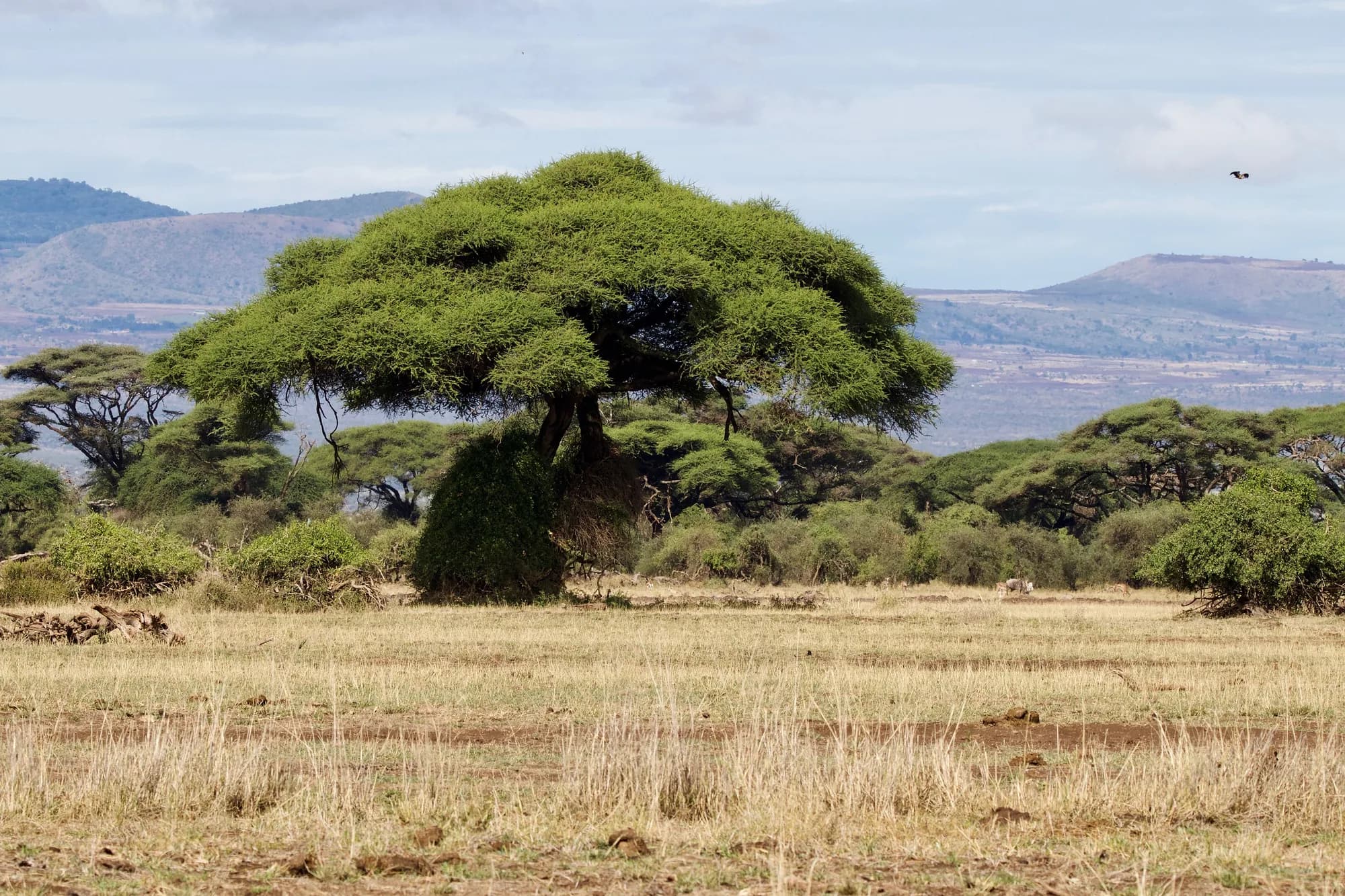
The swamps are why the game viewing works at all. In country this dry, permanent water in the middle of a small park pins the large herbivores to a compact area through the heat of the day, so the hours that are dead elsewhere are still productive here — even when the mountain has gone.
Birds, and the swamps as a wetland
Amboseli is a better birding park than its reputation, and the reason is the same one that drives everything else: permanent water in a semi-arid landscape concentrates birds the way it concentrates elephants. UNESCO's description of the biosphere reserve lists wetlands and swamps among its ecological zones alongside savanna rangeland and dry mountain forest, and it is the wetland element that a birder comes for.
- Waterbirds on Enkongo Narok and Olokenya — herons, egrets, storks, ibis, jacana and crakes in the reedbeds.
- Flamingo, both greater and lesser, on the lake bed and swamp margins when there is water. This is seasonal and can be entirely absent.
- Open-country raptors over the pan and flats, which in a treeless landscape are unusually easy to see.
- Pelican and duck on the larger open water after good rain.
- What there is very little of: forest birds and skulkers. There is almost no cover here, which is a limitation and also why the birds you do see are visible.
UNESCO Man and the Biosphere Programme — Amboseli Biosphere Reserve
Read 28 September 2026. Designated 1991; total area 798,298 hectares. UNESCO describes the reserve as containing "natural dry mountain forest, mountains, savannah rangelands, wetlands and swamps" over "basement plains, saline plains with freshwater swamps, and the volcanic slopes of Kilimanjaro", with the Maasai as the predominant population and group ranching the dominant land use. That figure is the biosphere reserve, which is the whole ecosystem — the national park is a small core inside it, and the two are routinely confused in travel writing.
https://www.unesco.org/en/mab/amboseliWhat Amboseli does not have
- Rhino. There are none in the park. Lake Nakuru, Tsavo West's sanctuary and the Laikipia conservancies are where Kenyan rhino viewing happens.
- African wild dog. Effectively absent, as across most of Kenya. Southern Tanzania, Zimbabwe and Botswana are the trips for these.
- Reliable leopard. The woodland is thin and the cats are few. If a leopard is the point, this is not the park.
- A migration. There is no seasonal movement of herds here and nothing resembling one — the spectacle is a single species in family groups against a mountain, not a plain covered in animals.
- The northern Kenyan specials. No reticulated giraffe, no gerenuk, no Beisa oryx. Samburu is that trip.
- Forest, and therefore forest wildlife. Amboseli is dust, grass, swamp and fever trees, and the list reflects it.
Stated positively: Amboseli does one thing better than anywhere else on this site, and the correct way to book it is as an elephant and landscape park attached to something else that supplies the cats. Tsavo West and the Maasai Mara are both that something else, for different reasons, and both are covered on the itineraries page.