
Species · Hippotragus equinus
Roan antelope
The second-largest antelope in Africa after the eland, and the one most often mistaken for a female sable. Roan are scarce, declining across most of their range, and the reason a Kafue or Waterberg trip is worth more than its park list suggests.
Also called
- Korongo · Swahili
- Bastergemsbok · Afrikaans
- Ndunguza · Shona
Checked 28 Sept 2026
- Where
- Namibia, South Africa, Zimbabwe
- Best months
- Dry season, June–October
- Horns
- Both sexes; shorter than sable
- Odds
- Low. A genuine find
Open woodland and tall-grass savanna in a broad band across sub-Saharan Africa, but thinly and in retreat. Roan are among the first large antelope to disappear when an area is grazed hard, and their range map is now a scatter of protected blocks rather than a band.
Where it is
HabitatOpen woodland and tall-grass savanna with water within reach — the same miombo band as sable, but roan want longer grass and lower densities of everything else. They do badly wherever grazing pressure is high, which is most of the continent now.
Worth travelling for
Kafue's Busanga sector holds one of the better remaining populations, alongside sable.
The Waterberg plateau and the Caprivi parks — Waterberg was a stronghold used to restock elsewhere.
Small managed populations in the Waterberg and Northern Cape reserves, where they are actively protected.
Ruaha and the southern circuit, where roan, sable and both kudu overlap.
Also occurs
ZimbabweBotswanaUgandaMalawiMozambiqueCameroonChad
Present, but not where you would go to see one.
Gone from
Much of West AfricaMost of South Africa outside managed reservesKenya, effectively — a remnant remains in the west
Range this species has been lost from. It is the fact a map of where it currently lives cannot show you.
Where to actually go
Ranked, with the reason each — these are not interchangeable.
- 01KafueZambiaThe Busanga sector holds roan and sable together in miombo at a scale nothing else here matches.Busanga, dry season
- 02Waterberg PlateauNamibiaA protected plateau used as a breeding stronghold for exactly this species, with sable and kudu alongside.The stronghold
- 03RuahaTanzaniaOne of very few parks where roan, sable and both kudu species overlap, with almost no vehicles.The full antelope set
- 04MarakeleSouth AfricaA small Waterberg park where roan are part of the reason to go, within reach of Johannesburg.The accessible option
- 05MokalaSouth AfricaA quiet SANParks reserve built substantially around rare antelope, holding roan and sable together.Empty, and both species
Where you will not see one
- The open plainsThe Serengeti, the Mara and the crater floor are the wrong habitat. Roan want woodland and long grass.
- The desert parksKgalagadi, the Namib and the Karoo have none — that is gemsbok country, and the Afrikaans name bastergemsbok has confused people for a century.
- In numbers, anywhereEven in the good parks roan are scarce. A herd of a dozen is a good sighting and most people in most parks will not see one at all.
When to go
When to go
- J
- F
- M
- A
- M
- J
- J
- A
- S
- O
- N
- D
January: marginal. February: marginal. March: marginal. April: good. May: good. June: best. July: best. August: best. September: best. October: best. November: good. December: marginal.
Through the day
- Dawn
- Morning
- Midday
- Afternoon
- Dusk
- Night
Dawn: most active. Morning: active. Midday: usually resting. Afternoon: active. Dusk: most active. Night: usually resting.
What it looks like in the field
Photographs of Roan antelope in the wild, in Indian reserves. We publish no captive, baited or digitally composited images, and no photograph whose licence we cannot show.
Roan, sable, or gemsbok
Roan is the one people get wrong, and almost always by calling it a female sable. The separators are the ears and the face. A roan has very long, narrow, tufted ears that droop slightly at the tip — nothing else on the savanna has them — and a bold black-and-white mask across the face. A sable cow is chestnut with short ears and a plain face.
Size cuts the other way from most people’s expectation: roan is the bigger animal, second only to eland among African antelope, while the sable looks more imposing because of the horns. Roan horns are shorter, more sharply backswept, and carried by both sexes.
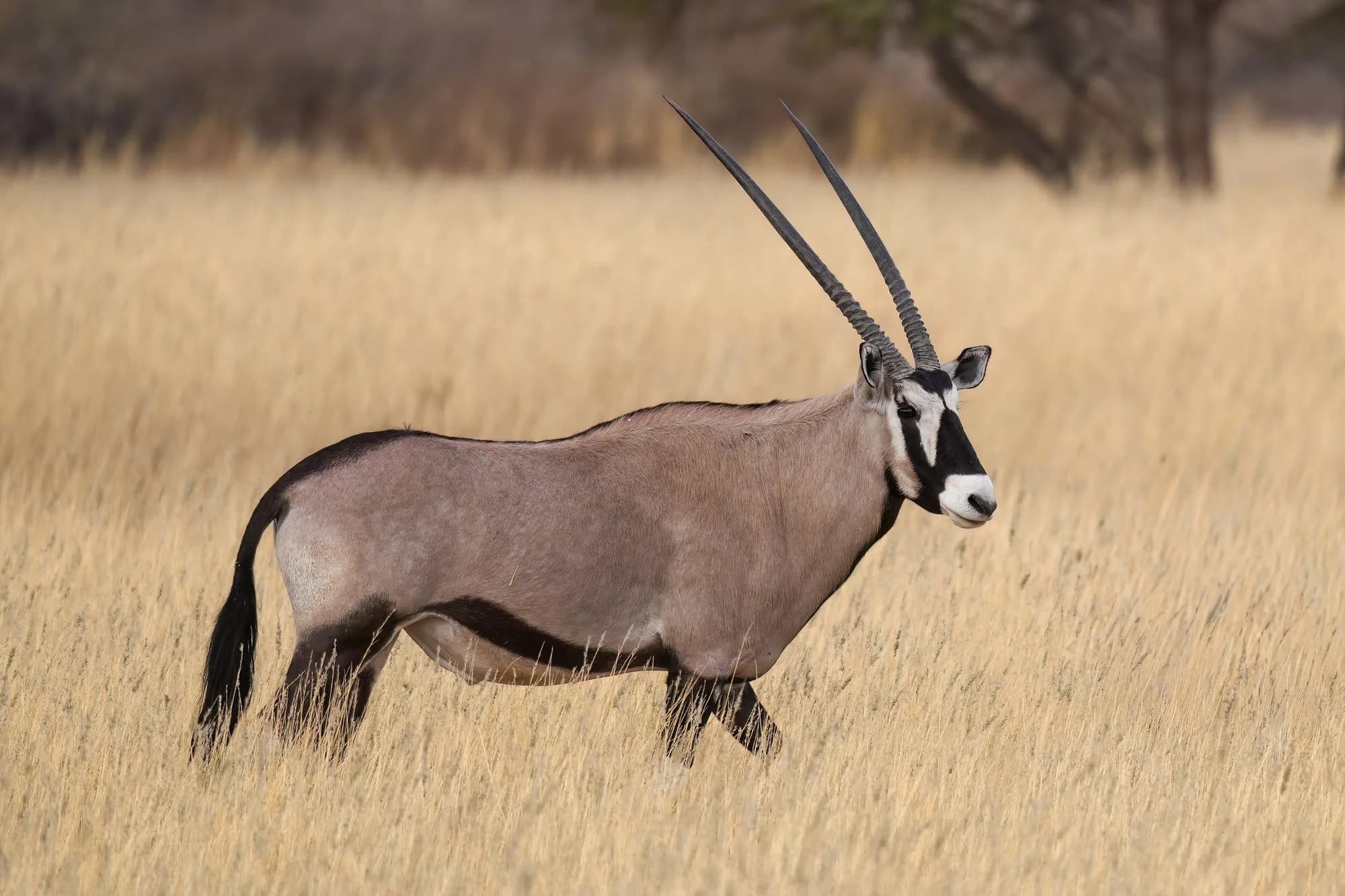
Gemsbok is a different confusion and comes from the Afrikaans name bastergemsbok, bastard gemsbok. They do not overlap much: gemsbok are desert animals with long straight horns and a heavy black flank stripe, and if you are in woodland you are not looking at one.
Status and protection
Status and protection
- IUCN Red List
- Pending
- Population trend
- · Unknown
Not yet verified against the source. These four values are written from knowledge and are awaiting a checked IUCN assessment, schedule and appendix — treat them as indicative until this line disappears.
Assessed not yet retrieved
What to book to see one
What you would be booking
- How it is seen
- Game drives in miombo and open woodland; waterholes in the late dry season.
- Drives to book
- Three or four in a park that actually holds them, and none at all in the wrong habitat.
- Zone or shift
- Busanga in Kafue, the Waterberg plateau, Marakele and Mokala, Ruaha.
Roan are highly susceptible to tick-borne disease and to competition at waterholes, which is why several southern African populations sit in intensively managed reserves rather than open parks. That is a conservation success, not a con — but it is worth knowing what you are looking at.
KafueOn the same trip you would also get
- Sable antelope — the same woodland, and the confusion
- Greater kudu — the same water at Waterberg
Questions people ask
Where is the best place to see roan antelope?
How do I tell a roan from a sable?
Are roan antelope rare?
Read next
Six countries here, in miombo woodland
Sable antelope — the confusion
A jet-black bull with swept-back horns most of a metre long, and the animal experienced guides point at before they point at a lion. It is a woodland species, which is why it is missing from the parks most people visit.
Botswana, Namibia and the Northern Cape
Gemsbok — the other confusion
The desert antelope on the red dunes, with a black-and-white face mask and rapier horns, and the animal that makes the arid parks worth the drive. It can go for long periods without drinking, which is why it is standing in country where nothing else is.
Kafue